
Let's be clear: a health and safety audit isn't just about paperwork. It’s your best tool for checking if the safety systems you've designed are actually working on the factory floor or construction site. Effective audits and compliance are your best defence for demonstrating due diligence and, more importantly, stopping incidents before they happen.
A Practical Look at Audits
An audit is simply a systematic check to verify if what you say you do in your safety procedures matches what you actually do in practice.
It’s less about catching people out and more about finding the gaps in your system before they lead to a real problem. For any manager in construction and manufacturing, this process is fundamental to managing real-world risk and meeting tough Australian regulatory standards.
The whole point is to gather objective evidence. This isn’t about feelings or opinions; it's about hard facts. Are your training records complete and up-to-date? Is machinery being maintained according to the schedule? Are the Safe Work Method Statements (SWMS) being followed on site, or are they just collecting dust in a folder?
The Goal Beyond Box-Ticking
Just running through a checklist doesn't guarantee a safe site. A truly effective audit paints a clear, honest picture of your operational health.
It helps you see exactly where your processes are strong and, crucially, where they’re weak. This is the information you need to make smart decisions, whether that means budgeting for new equipment or rolling out targeted training for a specific crew.
You can really boil the whole process down into three key phases: planning what you'll check, verifying the evidence on the ground, and then using what you find to prevent future issues.
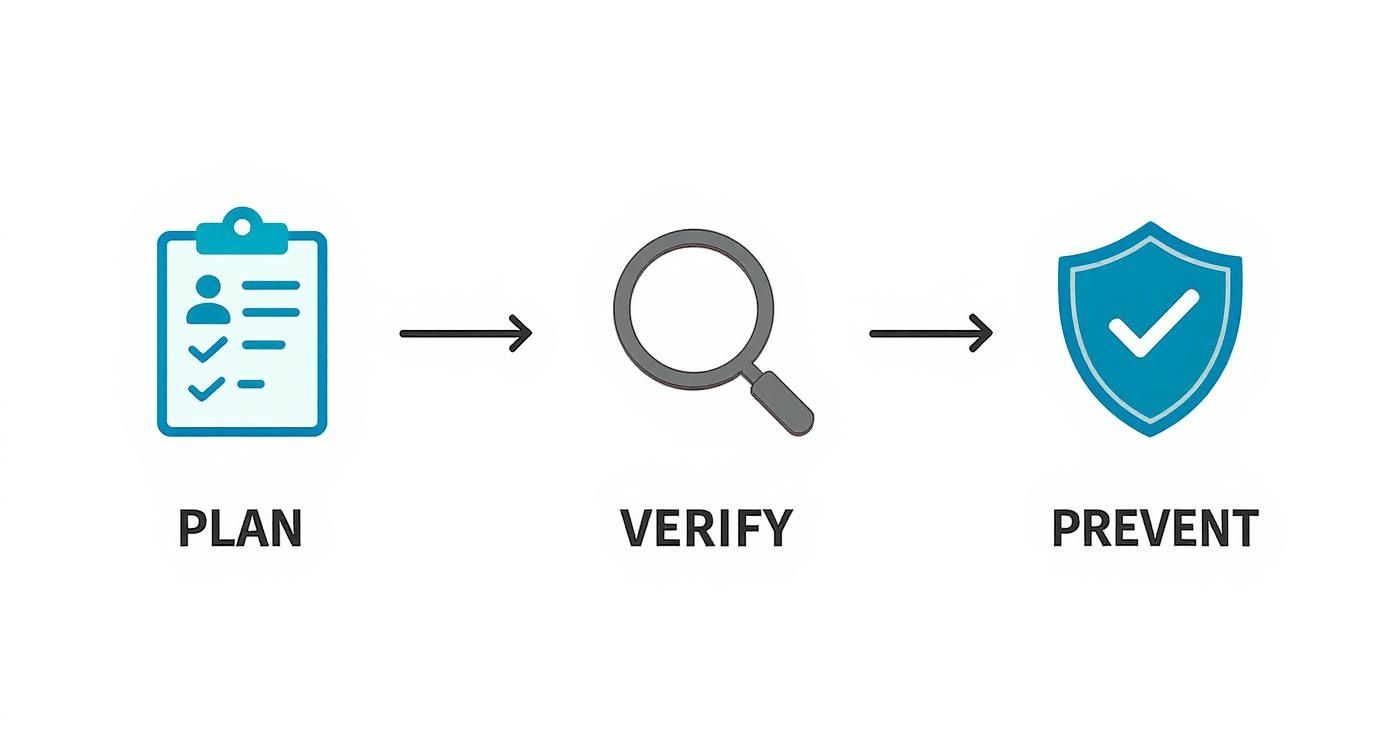
This simple flow from preparation to action is the backbone of any audit program that actually makes a difference.
Why Audits Matter in High-Risk Industries
In sectors like manufacturing and construction, the consequences of a system failure can be catastrophic. Audits give you a structured way to confirm that your safety controls are not only in place but are working as intended, day in and day out.
Take a fabrication workshop, for example. An audit of their welding procedures would check things like:
- Are the welders certified for the specific tasks they’re doing?
- Is the correct personal protective equipment (PPE) actually being worn?
- Are hot work permits being properly completed and authorised before work kicks off?
The findings from an audit like this aren't just for a report that sits on a shelf. They provide direct, actionable feedback that protects your workers and proves to regulators that you are actively managing your safety obligations. It's all about proactive verification, not just reactive problem-solving after something goes wrong.
Ultimately, consistent audits and compliance checks are how you build a reliable and predictable safety system. They give you the confidence that your workplace isn't just compliant on paper but is genuinely safe in its day-to-day operations.
Building Your Audit and Compliance Program
A solid audit and compliance program doesn't just happen by accident; it has to be built with purpose. The whole thing starts with laying a strong foundation: creating a realistic audit schedule and clearly defining the scope of what you’re actually checking. This is where you move from theory to a practical, on-the-ground plan.
This isn’t about just throwing dates on a calendar. It’s a strategic decision about what needs the most attention. Should you focus on a single high-risk machine? A specific work process like crane operations? Or an entire construction site? The right answer comes down to your operational risks.
Setting a Realistic Audit Schedule
Your audit schedule should be driven by risk, not just routine. High-risk activities in a manufacturing plant, like operating press machinery, might need a check-up every quarter. In contrast, lower-risk areas, such as an admin office, could be fine with an annual review.
A good way to start is by mapping out a yearly schedule based on a thorough risk assessment of all your operations. But remember, this schedule can't be set in stone. You need the flexibility to conduct an unscheduled audit after an incident, when a new process is introduced, or if a major piece of equipment is installed.
Don't fall into the trap of auditing everything with the same frequency. A risk-based schedule focuses your time and resources where they’ll have the most impact on safety. It makes your entire audits and compliance effort more effective.
Defining a Clear Scope for Each Audit
Once you know when you’ll audit, you need to decide exactly what you'll audit. The scope sets the boundaries, and getting it right is crucial.
A narrow scope might focus on a single procedure, like the lockout-tagout process for a specific production line. A broader scope could cover the entire WHS management system for a new construction project.
Being specific is key here. Let’s say you’re scoping an audit for a metal fabrication process. Instead of trying to look at everything, you might decide to focus only on:
- The use and maintenance of welding equipment.
- How compressed gas cylinders are stored and handled.
- The effectiveness of fume extraction systems.
This tight focus ensures the audit is deep and meaningful rather than a shallow skim across the surface. It delivers clear, usable findings you can actually use to make improvements.
Choosing the Right Audit Type
Not all audits are created equal. The type of audit you choose should align with your specific goals, whether that’s a quick spot-check or a deep dive into your entire safety system. Knowing the difference helps you pick the right tool for the job.
Here’s a quick comparison to help you decide.
Choosing the Right Audit Type for Your Needs
| Audit Type | Primary Purpose | Best Used For |
|---|---|---|
| Compliance Audit | To verify adherence to legal requirements, regulations, and standards. | Confirming you meet specific legal obligations like WHS Act requirements or industry Codes of Practice. Essential for avoiding fines. |
| Management System Audit | To assess the effectiveness of your entire safety management system (e.g., against ISO 45001). | Evaluating if your policies, procedures, and processes are working as intended. Great for continuous improvement. |
| Process Audit | To examine a specific work process or procedure in detail. | A deep dive into high-risk tasks like confined space entry or working at heights to ensure controls are effective. |
| Site/Workplace Inspection | To identify immediate hazards and unsafe conditions in a specific physical area. | Regular, on-the-ground checks of a construction site or factory floor to catch things like trip hazards or missing guardrails. |
Picking the right audit type means your efforts are always targeted and relevant. You're not just going through the motions; you're gathering the right kind of information to drive real safety improvements.
Choosing the Right Audit Criteria
Every audit needs a benchmark. You can't verify compliance if you haven't first defined what "compliant" actually looks like. This means selecting the right criteria to audit against, which is usually a mix of legal requirements and your own internal standards.
Your criteria will typically include things like:
- WHS Regulations specific to your state or territory.
- Australian Standards, such as AS/NZS 4801 for safety management systems.
- Codes of Practice relevant to your industry, like the code for managing risks of plant in the workplace.
- Your own company's policies, including Safe Work Method Statements (SWMS) and internal procedures.
Matching the right criteria to the audit's scope makes every check targeted and relevant. You're not just looking for problems; you're confirming that your operations meet the specific standards you’re held to. For a deeper look at this process, check out our guide on compliance risk management.
Internal vs External Auditors
Deciding who conducts the audit is another critical step. You can use your internal team, bring in an external expert, or even use a combination of both.
- Internal audits are great for regular, ongoing checks. Your team knows the operations and the people, which can make the process quicker and more efficient.
- External audits provide a fresh, impartial perspective. They're often essential for formal certifications or when you need specialised expertise that you don't have in-house.
Many businesses find a hybrid approach works best. Use internal teams for frequent health checks and bring in external auditors periodically for a more rigorous, independent review.
Getting this structure right is vital, especially when you consider that many local businesses are still trying to mature their compliance processes. A PwC Australia survey of 73 executives found that no Australian organisations considered themselves to be compliance leaders, compared to 7% globally. The report also noted that 56% of Australian executives saw a negative impact on growth due to compliance demands, highlighting just how much a disorganised system can hold a business back.
For businesses looking for expert assistance, exploring professional compliance solutions can provide valuable external support. By carefully planning your schedule, scope, criteria, and audit team, you create a robust program that genuinely supports a safe and compliant workplace.
Alright, with your plan locked in, it’s time to get out on the floor. This is where the real work happens: gathering the objective evidence that proves whether your safety systems are actually working as intended.
The mission is simple: collect the facts efficiently, without grinding operations to a halt.
This isn't about pointing fingers or finding someone to blame. It’s a verification process. You’re there to confirm that the procedures and controls you’ve put in place are being followed and, most importantly, that they’re effective. A well-run audit builds trust and gives you the hard data you need for a solid, fact-based report.
Gathering Objective Evidence
Objective evidence is the bedrock of any credible audit. It's the verifiable proof you collect to see if your processes stack up against the audit criteria. It boils down to three main methods.
Reviewing Documents and Records
This is always the starting point. You’re looking for the paper trail that proves safety procedures are being followed. Think Safe Work Method Statements (SWMS), training records, equipment maintenance logs, and even reports from past audits. If you’re auditing a specific piece of machinery, for instance, you’ll want to see its maintenance log to confirm it’s been serviced on schedule.Observing Work in Progress
There's no substitute for seeing things with your own eyes. Get out into the work area and watch how tasks are really being done. If you're auditing a work-at-heights procedure, you need to see if workers are correctly using fall protection, if exclusion zones are properly established, and if equipment checks are happening before use. Direct observation is where you’ll often find the gap between what the procedure says and what actually happens.Conducting Interviews
Talking to the people on the tools provides context you can’t get anywhere else. These aren’t interrogations; they’re just straightforward conversations. Ask open-ended questions like, "Can you walk me through the pre-start check on this forklift?" or "What's the process if you spot a hazard during your shift?" Their answers quickly tell you if they genuinely understand the procedures and are able to follow them.
Communicating Clearly with the Team
Your whole approach matters. You want to avoid a "gotcha" atmosphere where everyone feels like you're just hunting for faults. Kick things off with a brief opening meeting to lay out the audit's scope and purpose. Let the team know what you’ll be looking at and who you’ll need to speak with.
Be transparent throughout the audit. If you spot something that doesn’t quite line up, ask about it directly and professionally. This open dialogue not only gets you better information but also makes the team feel like they’re part of the solution, not the problem.
A good auditor is more detective than judge. Your job is to gather the facts and understand the 'why' behind them, not to hand out blame on the spot. This keeps everyone focused on improving the system itself.
Using Digital Tools for On-the-Spot Capture
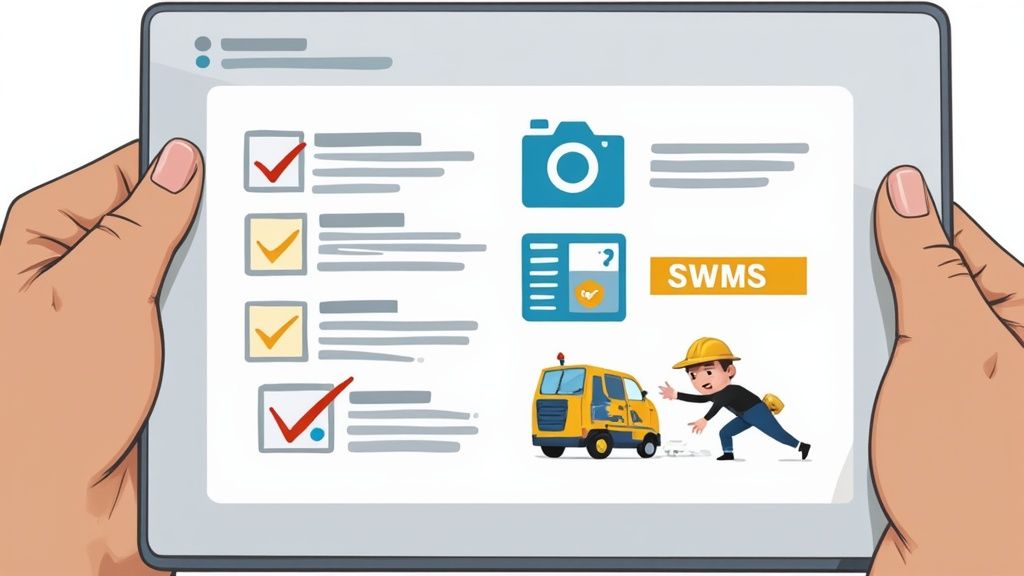
Forget juggling a clipboard, a camera, and a notepad. These days, a simple digital tool on a tablet or phone makes collecting evidence infinitely faster and more organised. With the right audit software, you can capture everything you need, right there on-site.
Picture this: you're auditing scaffolding on a construction site and notice an incomplete handrail. You can immediately:
- Snap a photo of the non-conformance.
- Attach it directly to the relevant item on your digital checklist.
- Add a quick note detailing the exact location and issue.
This approach ensures your evidence is clear, time-stamped, and tied directly to the audit criteria. It completely eliminates the risk of losing notes or misremembering details when it's time to write your report. This kind of practical data collection aligns perfectly with the principles outlined in official Australian auditing standards.
Using a pre-loaded checklist is a game-changer for thoroughness. For specialised areas, a specific list like a USP 800 compliance checklist is essential. Digital platforms let you upload your own custom checklists, guiding you through the audit so you don’t miss a single critical point. It’s all about making every audit consistent and comprehensive.
Turning Audit Findings into Corrective Actions
An audit is just a data collection exercise until you actually do something with the findings. This is the most critical part of the entire audits and compliance process: turning information into tangible improvements on the ground. A well-written audit report kicks this off, but it’s worthless if it’s too dense for management to skim or too vague for your team to act on.
The goal here is to produce a clear, practical document that focuses squarely on the problems, not the people. From there, you can build out and track corrective actions that genuinely fix the underlying issues, making sure the same problems don't just keep popping up in the next audit cycle.
Writing a Report That Gets Read
Your audit report needs to be direct. Forget the corporate jargon; write it for the operations manager who has five minutes between meetings to get the gist. Always start with a simple executive summary covering the key takeaways: what was audited, the main findings, and the absolute priority actions.
This isn't just about ticking boxes, either. We're seeing more and more audits uncover significant issues. Recent data shows a continued upward trend in moderate and significant findings across Australian agencies. One official audit matters report noted that 35% of audits found notable compliance issues, a jump from 28% the previous year. That trend alone makes clear, actionable reporting more vital than ever.
To make your findings truly actionable, stick to the objective evidence. Don't write, "The workshop was messy." Be specific: "Three emergency exits in the fabrication workshop were partially blocked by pallets of raw materials, preventing clear access." That gives the team a concrete problem to solve.
Classifying Audit Findings
Not all findings are created equal. Classifying them helps everyone grasp the level of risk and, most importantly, prioritise what gets fixed first.
A simple system works best:
- Non-Conformance (NC): This is a clear-cut failure to meet a requirement. It could be a breach of WHS legislation, an Australian Standard, or your own company procedure. A non-conformance demands immediate attention and a formal corrective action plan.
- Observation: Think of this as an area for improvement. It’s not a direct breach yet, but it’s a situation that could easily lead to a non-conformance if left alone. For example, noticing that SWMS are being followed, but they're stored in a spot that's a hassle for workers to access.
This simple classification cuts through the noise. It helps management quickly see where the serious risks are and channel resources where they're needed most.
Developing Corrective Actions
Just pointing out a problem isn’t enough; you need a solid plan to fix it. This is where you create Corrective and Preventive Actions (CAPAs). A good CAPA plan is specific, measurable, and assigned to a real person, not just a department.
The core of an effective CAPA is moving beyond the immediate fix. Finding an unguarded machine and putting a guard back on is a correction. Figuring out why the guard was removed in the first place and putting a system in place to stop it from happening again; that’s a corrective action.
For every finding, especially the non-conformances, your plan should detail:
- The Immediate Correction: What will you do right now to contain the risk? (e.g., "Take the faulty grinder out of service immediately.")
- The Root Cause Analysis: Why did this happen? Was it a training gap, a maintenance failure, or a flaw in the procedure itself?
- The Corrective Action: What's the long-term fix to address the root cause and prevent it from happening again? (e.g., "Update the pre-start checklist to include a guard check and retrain all workshop staff on the new procedure.")
Assigning and Tracking Actions
An action plan without clear accountability is just a wish list. Every single corrective action needs to be assigned to a specific person. This creates ownership and makes it obvious who is responsible for seeing the task through to completion.
Set realistic deadlines, too. A critical safety fix might need to be sorted within 24 hours, while a procedural update could take a couple of weeks. The deadline has to reflect the level of risk involved.
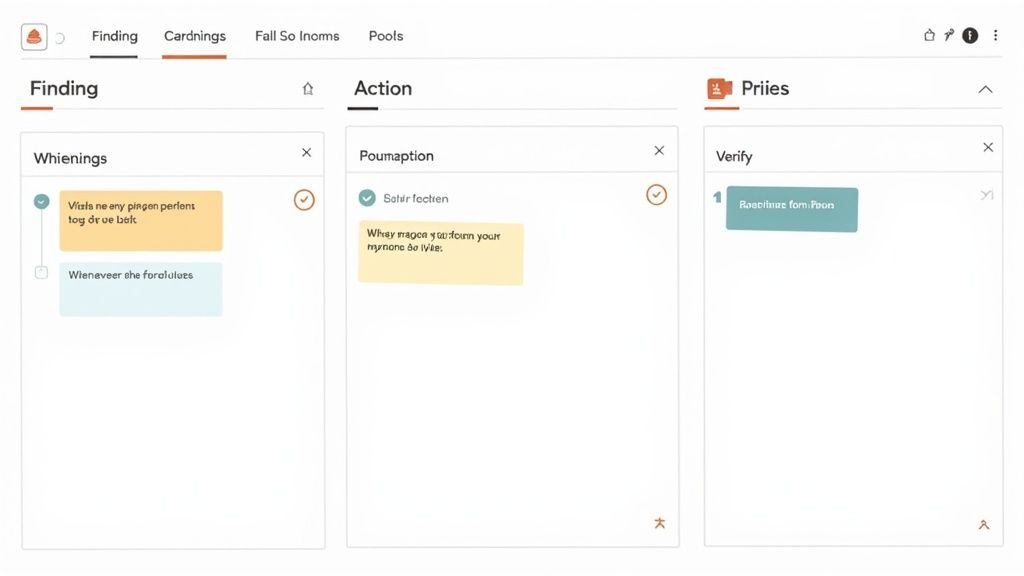
This is where digital systems like Safety Space really prove their worth. Instead of wrestling with a spreadsheet that's outdated the second you save it, a digital platform automates the entire workflow. It can assign tasks, send reminders to the responsible person as deadlines loom, and flag anything overdue for management. This ensures nothing gets missed and every finding from your audits and compliance checks is properly closed out.
Using Audit Data for Continuous Improvement
Finishing an audit and closing out corrective actions can feel like crossing the finish line, but in reality, you’re only halfway there. The real, lasting value of your audits and compliance program emerges when you step back and look at the data you've gathered over time. This is the crucial shift from fixing one-off problems to making intelligent, system-wide improvements.
A single audit gives you a snapshot of what’s happening right now. But analysing data from multiple audits? That’s where you uncover the patterns, the recurring headaches, and the genuine weak spots in your safety management system. It’s about making your information work for you, not just collecting numbers for the sake of it.
Identifying Trends and Recurring Problems
After you’ve run a few audits, you’ll start building a pool of data. This is your goldmine. Start digging for the common threads. Are the same non-conformances popping up at different sites or on different shifts? Maybe it's a nagging issue with incomplete pre-start checks on mobile plant, or you’re constantly finding gaps in the SWMS for a particular high-risk task.
This kind of trend analysis is incredibly powerful. Let’s say a construction firm notices that subcontractor paperwork is consistently incomplete across multiple projects. That’s not just a series of isolated admin errors. It’s a massive red flag signalling that their entire subcontractor onboarding and verification process is broken and needs a rethink.
In a similar vein, a manufacturing company might see recurring findings related to manual handling. That data provides the hard evidence they need to justify investing in new lifting equipment. The conversation shifts from a vague "nice to have" to a solid business case backed by safety data.
Key Performance Indicators You Should Track
To make any sense of your audit data, you have to track the right metrics. These Key Performance Indicators (KPIs) give you a clear, objective view of how your program is actually performing.
There's no need to overcomplicate it. Start with a few practical KPIs that tell a story:
- Number of Non-Conformances per Audit: Is this number trending up or down? A decreasing trend is a fantastic sign that your improvements are taking root.
- Corrective Action Closure Rate: What percentage of actions are being closed on time? A low rate points to serious issues with accountability or resources.
- Average Time to Close Actions: How long does it take, on average, to get a problem fixed? If it’s taking months to address a serious non-conformance, you’re sitting on a major risk.
- Scheduled vs Completed Audits: Are you actually doing the audits you planned to do? A low completion rate could mean you need to dedicate more resources or that the program isn't being taken seriously.
These numbers create a dashboard view of your program's health. They instantly show you what’s working and what needs more attention. For a more detailed approach, our guide to safety audit software explains how digital tools can automate KPI tracking and reporting, saving you from spreadsheet hell.
Tracking these metrics isn't about creating more charts for a meeting. It's about having the facts at your fingertips to prove what’s working, justify spending on improvements, and hold everyone accountable for safety outcomes.
Using Data to Inform Business Decisions
Your audit data should be a direct line into your business strategy. When you can walk into a management meeting and show a clear trend of recurring near misses tied to ageing equipment, the conversation about capital expenditure changes completely. You’re no longer just asking for money; you’re presenting a data-backed solution to a documented risk.
This approach is only becoming more critical as regulators sharpen their focus on thorough reporting and risk management. The pressure to get this right is significant. For example, in a recent financial year, the Australian Securities and Investments Commission (ASIC) reviewed 254 company financial reports, leading to 18 entities having to make material changes to their disclosures. You can get more insights into ASIC's focus on audit quality in this report on their findings.
By systematically collecting and analysing your audit findings, you build a powerful feedback loop. You stop fighting the same fires over and over again and start making lasting improvements that strengthen your entire safety system. This continuous improvement cycle is the ultimate goal of any effective audits and compliance program.
Common Questions About Audits and Compliance
Even with the best plan, you're always going to run into practical questions when you're managing audits and compliance on the ground. Here are some of the most common ones, along with some straight answers based on real-world experience.
How Often Should We Conduct Health and Safety Audits?
Honestly, there's no magic number. It all comes down to risk.
High-risk activities demand more frequent attention. Think about processes like working at heights on a construction site or operating heavy press machinery in a factory; you'd probably want to audit those quarterly.
On the flip side, lower-risk areas like an administrative office or a warehouse storing non-hazardous goods might only need a thorough check once a year. A good place to start is mapping out a yearly schedule based on a proper risk assessment of your entire operation.
But remember, your schedule isn't set in stone. You have to be ready to conduct an unscheduled audit whenever things change. A significant incident, a new work process, or a major piece of equipment coming online are all triggers for an immediate audit to keep your safety program responsive.
What Is the Difference Between an Audit and an Inspection?
This is a big one. People throw these terms around interchangeably, but they are fundamentally different tools for different jobs. Getting this right is key.
An inspection is your quick, on-the-spot check. It’s about looking at something right now to see if it’s okay. The daily pre-start check on a forklift or a weekly walk-around to spot trip hazards? Those are inspections. They’re designed to find immediate, obvious problems.
An audit, however, is a much deeper dive. It's a systematic review of your entire safety management system. It doesn't just ask what is wrong, it digs into why it's wrong.
Here’s a practical example:
- An inspection finds a safety guard is missing from a machine.
- An audit investigates why it was missing. It looks at your maintenance logs, pulls training records, and talks to the operators and their supervisors to figure out if the system itself (the procedures, the training) is failing.
How Do We Get Our Team to Support Audits?
You can have the best audit plan in the world, but if your team isn't on board, you’ll hit a wall of resistance and get poor information. Gaining their trust is everything.
The secret is to frame audits as a tool for improvement, not a witch hunt. Be upfront and totally transparent about the purpose and scope before you even start. Let everyone know what you're looking at and why.
When you're conducting the audit, keep the focus on the process, not the person. If you find an issue, bring the team into the conversation about how to fix it. They're the ones on the tools every day; they almost always have the most practical and effective solutions.
Then, when a fix is in place and it's working, broadcast that success. Show them that their input led to a real, positive change. This is how you build trust and prove that audits and compliance checks are genuinely there to make their workplace safer.
What Are the Biggest Mistakes to Avoid in Audits?
A few classic blunders can completely derail an audit program. The absolute biggest one is treating audits as a box-ticking, paper-shuffling exercise. This usually involves grabbing a generic, off-the-shelf checklist that has nothing to do with the specific risks on your site.
Another major failure is not following up on corrective actions. An audit finding that just sits in a report is a massive waste of time and, more importantly, leaves a known risk unmanaged. You have to track every single action item to completion.
And finally, a huge red flag is letting someone audit their own work. The person responsible for a process can't be the one to assess it; you'll never get an honest, impartial view of what's really happening.
Ready to move beyond spreadsheets and build a more effective safety management system? Safety Space provides a single, easy-to-use platform to manage your audits, track corrective actions, and get real-time visibility into your compliance. Book a free demo today and see how you can simplify your entire health and safety program.
Ready to Transform Your Safety Management?
Discover how Safety Space can help you build a safer, more compliant workplace with our comprehensive safety management platform.
Book a Free DemoRelated Topics
Safety Space Features
Explore all the AI-powered features that make Safety Space the complete workplace safety solution.
Articles & Resources
Explore our complete collection of workplace safety articles, tools, and resources.