
A proper root cause analysis (RCA) format is more than just another piece of paperwork. It’s a structured investigation tool that forces you to dig past what happened and find out why it happened. Unlike a basic incident report, its whole purpose is to get to the heart of system issues so you can stop the same problems from happening over and over again.
Why Your Incident Reports Keep Failing
Let’s be honest. There’s nothing more frustrating than filling out an incident report for the same recurring issue. You document the event, list the immediate actions taken, file it away, and then a few weeks later, you’re dealing with a nearly identical situation.
This painful cycle happens because most standard reports are designed to capture a snapshot of an event, not to take apart the reasons it happened in the first place.
A basic incident report asks, "what happened?" A root cause analysis format forces you to keep asking "why?" until you can't ask it anymore. This shift is the critical difference between a temporary patch and a permanent fix. Without a structured format to guide your investigation, it's far too easy to stop at the most obvious symptom and call it a day. For a practical guide on what to include, you can check out our article on the essential elements of a work incident report.
From Documenting to Investigating
The biggest problem with many incident reporting processes is they become a box-ticking exercise. A worker gets a minor hand injury, and the report dutifully records the date, time, and first aid given. The "corrective action" often ends up being something vague like "reminded worker to be more careful."
This approach completely misses the point.
Why was their hand in that position to begin with? Was the machine guard poorly designed? Was the pressure to hit production targets so intense that they skipped a safety step? A good RCA format acts as your investigation roadmap, pushing you to uncover these system flaws instead of just closing out the paperwork.
Simply documenting incidents without a deep dive into their origins is like fixing a leaky pipe with tape. It might hold for a little while, but you haven't stopped the corrosion that caused the leak in the first place.
This isn't just an anecdotal problem. Research into adverse events shows that even when a root cause analysis is attempted, a staggering 72% of recommendations are not properly formulated. They often lean on weak administrative fixes instead of tackling the faulty processes that are the real source of the problem.
Incident Report vs RCA Format: A Quick Comparison
To make this crystal clear, let's break down the fundamental differences between a standard incident report and a true RCA format. Think of it this way: one is a record of an event; the other is a roadmap to prevention.
| Element | Standard Incident Report | Root Cause Analysis Format |
|---|---|---|
| Primary Goal | Document what happened for compliance and record-keeping. | Investigate why it happened to prevent recurrence. |
| Focus | The immediate event, people involved, and surface-level details. | Systemic processes, contributing factors, and underlying systems. |
| Typical Outcome | A filed report with a simple, often weak, corrective action. | A detailed action plan with specific, measurable, and assigned tasks. |
| Depth of Inquiry | Stops at the immediate cause (e.g., "worker slipped"). | Digs deeper using tools like '5 Whys' to find latent causes. |
| Long-Term Impact | Minimal. The same or similar incidents are likely to happen again. | Significant. Reduces the likelihood of recurrence by fixing the core issue. |
Understanding this distinction is the first step. While a standard report is a necessary part of compliance, it’s the RCA format that delivers real, long-term safety improvements.
Building a Root Cause Analysis Format That Actually Works
Let's be honest, moving from a basic incident report to a proper root cause analysis format is a big leap. It's about creating a document that genuinely guides an investigation, forcing you to look past the immediate mess and find the system cracks that allowed it to happen in the first place.
A blank page is where good intentions go to die. A well-designed format, on the other hand, is a roadmap.
The point isn't to generate more paperwork for the sake of it. The goal is to build a practical tool that stops critical steps from being skipped, from grabbing the initial details right through to checking if your so-called "fixes" actually fixed anything.
So, let's break down what a rock-solid RCA format looks like.
This is the basic flow: an incident happens, it gets reported, and then the real work begins with a proper RCA. It’s a deliberate shift from just noting down what happened to digging deep to prevent it from happening again.
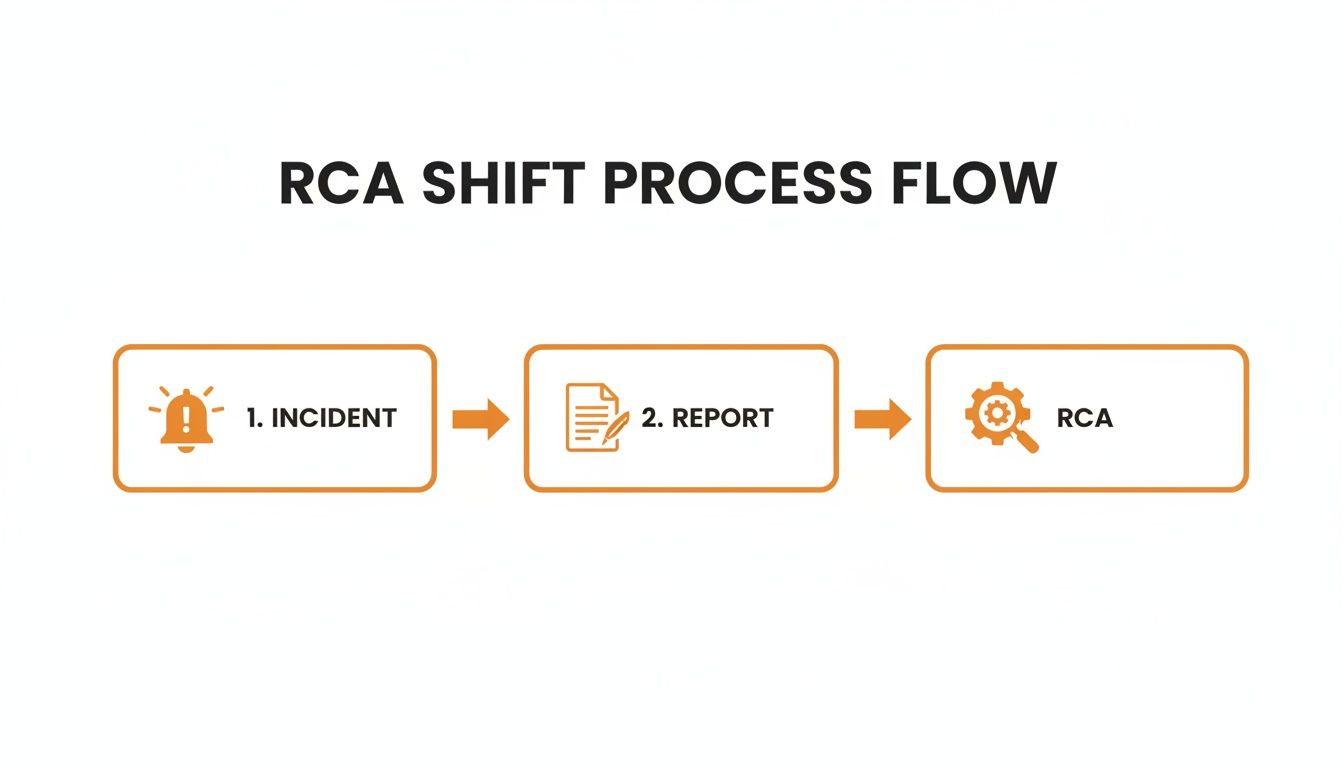
This simple diagram shows how a structured format moves your organization from simply documenting an event to conducting a real investigation aimed at prevention.
Section 1: Immediate Actions Taken
First things first. The very top of your form needs to capture what was done to get the situation under control immediately after the incident. This isn't about long-term solutions; it’s about containment and making the area safe right now.
Think of this as the emergency response log. What did the team on the ground do in the first 5-10 minutes? This context is critical for understanding how things played out and whether your immediate safety protocols held up.
Your format should prompt for answers to questions like:
- What specific steps were taken to make the scene safe? (e.g., machine locked out, area cordoned off)
- Who was notified straight away? (e.g., supervisor, first aid officer)
- What was done to care for any injured people?
Section 2: Detailed Incident Description
Next, you need a crystal-clear, factual account of what happened. This section has to be completely objective, no blame, no assumptions, no opinions. You're trying to paint a picture with pure facts.
Guide the investigator to stick to the "who, what, where, and when." It's tempting to ask "why" here, but that's a trap. The "why" comes later in the analysis. Knowing how to write business reports that get results is a massive help here, as it teaches you to keep information clean and actionable.
Make sure you capture these key details:
- Date and Time: Be as precise as possible.
- Location: Not just the site, but the specific area, bay, or machine.
- Personnel Involved: Names and roles of everyone directly involved, including witnesses.
- Sequence of Events: A simple, step-by-step timeline of what happened before, during, and immediately after the event.
Section 3: Structured Analysis and Causal Factors
This is the engine room of your RCA format. Here's where the real digging begins. The objective is to push past the obvious, surface-level problem and identify all the contributing factors that had to line up perfectly for the incident to occur.
One of the most powerful and straightforward tools for this section is the '5 Whys' technique. Start with the problem statement from the incident description and just keep asking "Why?" until you hit a wall, which is usually a broken process or system failure.
For instance, if the incident was "A worker slipped on a patch of oil," the analysis might go like this:
- Why was there oil on the floor? Because Machine X was leaking.
- Why was Machine X leaking? Because a hydraulic seal failed.
- Why did the seal fail? It was past its service life and hadn't been replaced.
- Why wasn't it replaced? It wasn't listed on the preventive maintenance schedule.
- Why wasn't it on the schedule? The maintenance checklist for Machine X was never updated after it was installed.
Boom. The root cause isn't the oil spill; it's the fact that your maintenance documentation process is broken.
By forcing the investigator to dig deeper with a structured method like the '5 Whys', your format stops them from settling for the first, most convenient answer. It ensures they find the true systemic weakness that needs fixing.
Section 4: The Root Cause Statement
Once you've mapped out the causal factors, you need to boil them down into a single, concise root cause statement. This is the one fundamental reason that, if you fix it, will prevent this type of incident from ever happening again.
A strong root cause statement always points to a system or process your organization can control. It should never be a person’s name or a vague, unhelpful concept like "carelessness."
- Weak Statement: "John forgot to check the machine."
- Strong Statement: "The pre-start checklist process for operators does not include a check for hydraulic leaks, leading to undetected equipment faults."
See the difference? One points a finger; the other points to a broken system that can be fixed.
Section 5: Corrective Action Plan
Finding the root cause is a great feeling, but it's only half the battle. Your RCA format is useless if it doesn't drive meaningful action. This is where so many companies fall down.
In fact, one study on RCAs found that while 75.0% of professionals cited a lack of time as a major barrier, the real kicker was that only 18.6% saw their recommendations fully implemented. More than half were only partially actioned. That's a massive gap between finding the problem and actually solving it.
Your corrective action plan must be concrete and assign clear accountability. A simple table is the best way to do this. Include these columns:
- Corrective Action: A specific, measurable task to be completed.
- Person Responsible: The name of the individual who owns it.
- Due Date: A realistic but firm deadline.
- Status: A field to track progress (e.g., Not Started, In Progress, Complete).
This structure transforms a vague idea into an actionable work order, making it infinitely more likely that real, lasting change will happen.
Real World Examples: A Filled-Out RCA Format In Action
Theory is one thing, but seeing a root cause analysis format in action is where it all starts to click. To show you how the different parts of the template come together, we’ll walk through two detailed scenarios. These aren't squeaky-clean, generic examples; they reflect the kind of messy, real-world problems that crop up on busy sites every day.
First, we'll dive into a near-miss in a manufacturing plant involving a machine guard. Then, we’ll jump over to a construction site to analyse a fall from a dodgy temporary platform.
Each example will show you the logical flow from the initial incident to pinpointing the real root cause, and finally, to creating a solid corrective action plan that actually prevents it from happening again.
These examples will help you see how a structured format doesn't just document an event, it guides the investigation to find and fix the underlying system failures.
Manufacturing Near-Miss: The Removed Guard
Picture this: a busy fabrication workshop, machines humming. An operator, trying to clear a jam on a metal press, has a heart-stopping moment when the machine cycles unexpectedly. The fixed guard? It was removed earlier in the shift and is sitting on the floor. This is a classic near-miss that was centimetres away from being a serious injury.
Here’s how our RCA format would break this down.
Immediate Actions Taken
- The machine was immediately shut down using the e-stop.
- The area supervisor was notified straight away.
- The machine was properly isolated and locked out by the authorized maintenance fitter.
- The operator involved was taken aside to give a clear-headed statement, away from the machine.
Detailed Incident Description
- Date and Time: 24/07/2024 at 10:15 AM.
- Location: Fabrication Workshop, Bay 3, Press #4.
- Personnel Involved: Operator (Jane Smith), Supervisor (Mark Jones), Maintenance Fitter (David Chen).
- Sequence of Events: Press #4 jammed at roughly 10:10 AM. Jane Smith tried to clear the material jam by hand. While her hand was near the point of operation, the press cycled unexpectedly. Fortunately, her hand wasn't in the direct path of the die, and she was not injured. The fixed side guard was observed sitting on the floor next to the machine.
This section is purely factual. It states what happened without any assumptions or blame. The fact that the guard was on the floor is recorded as an observation, not an accusation. We dig into the "why" next.
Structured Analysis (Using the 5 Whys)
- Problem: The press cycled while an operator was trying to clear a jam, and the guard was off.
- Why 1? (Why was the guard removed?) To get better access to clear a recurring jam.
- Why 2? (Why was the jam recurring?) The feed alignment guide was slightly bent, causing material to constantly catch.
- Why 3? (Why was the alignment guide bent?) A small forklift knock a week prior wasn’t reported because it seemed minor.
- Why 4? (Why wasn't the damage reported?) The process for reporting minor equipment damage is confusing, and operators feel it creates too much paperwork for something that "isn't a big deal."
- Why 5? (Why is the process so unclear?) There's no formal, simple system for operators to flag small equipment bumps or near-misses; the focus is only on injury-related incidents.
Root Cause Statement
The organization lacks a clear and simple process for reporting minor equipment damage and near-misses. This failure in the reporting system means that small faults go unfixed, which in turn leads operators to develop unsafe workarounds to deal with the consequences.
Corrective Action Plan
| Corrective Action | Person Responsible | Due Date |
|---|---|---|
| Repair the bent alignment guide on Press #4. | David Chen | 25/07/2024 |
| Develop and implement a simple 'Fix-It' tag system for reporting minor equipment damage. | Mark Jones | 15/08/2024 |
| Conduct a toolbox talk with all workshop teams to introduce the new tag system and explain its importance. | Mark Jones | 20/08/2024 |
| Verify the new system is being used and is effective. | Sarah King (H&S Manager) | 20/09/2024 |
Construction Fall From Height
Now, let's switch gears to a construction site. A plastering subcontractor falls about 1.5 metres from a temporary work platform, spraining their ankle. On inspection, it’s clear the platform was a Frankenstein's monster, assembled with mismatched components.
Immediate Actions Taken
- Work in the immediate area was stopped.
- First aid was given by the site's designated First Aid Officer.
- The injured worker was taken to a local medical clinic for a proper assessment.
- The Site Supervisor secured the area to preserve the scene, preventing anything from being moved.
Detailed Incident Description
- Date and Time: 02/08/2024 at 2:30 PM.
- Location: Level 2, West Wing, Apartment Block A.
- Personnel Involved: Injured Worker (Tom Wilson, Plasterer Subcontractor), Site Supervisor (Bill Peters).
- Sequence of Events: Tom Wilson was on a mobile scaffold platform plastering a ceiling. As he shifted his weight, one of the platform decks dislodged, causing him to fall to the concrete floor. A quick check showed the platform deck was from a completely different scaffold system and wasn't secured properly. Seeing how others document events like this can be a huge help; you can check out a range of incident reports samples to get ideas on writing clear and concise descriptions.
Structured Analysis (Using the 5 Whys)
- Problem: A worker fell when a scaffold platform deck failed.
- Why 1? (Why did the deck fail?) It was the wrong size and not compatible with the frame it was sitting on.
- Why 2? (Why was an incompatible deck used?) The correct deck for that scaffold bay was missing from the storage container.
- Why 3? (Why was it missing?) Components from different scaffold systems are all chucked in together without being organized or inspected when they're returned.
- Why 4? (Why aren't they organized?) There is no single person responsible for managing and inspecting returned scaffold gear.
- Why 5? (Why isn't someone responsible?) The site induction and subcontractor agreements don't specify who is responsible for scaffold component management; it's just assumed "everyone" is, which means no one is.
Root Cause Statement
The site has a failed process for managing hired equipment, specifically scaffold components. The lack of a clear system for storage, inspection, and accountability means incompatible and damaged parts get mixed together, creating a high risk of incorrect assembly.
Corrective Action Plan
| Corrective Action | Person Responsible | Due Date |
|---|---|---|
| Quarantine all scaffold components on site for a full inspection. | Bill Peters | 05/08/2024 |
| Create a designated, signed laydown area for scaffolding, with separate bays for different systems. | Bill Peters | 12/08/2024 |
| Update the subcontractor agreement to assign responsibility for daily scaffold checks and returns. | Jessica Lee (Project Manager) | 19/08/2024 |
| Conduct a site-wide meeting to communicate the new scaffold management process to everyone. | Bill Peters | 22/08/2024 |
Common Mistakes to Avoid When Using Your RCA Format
Having a well-structured root cause analysis format is a great starting point, but it’s no silver bullet. Even the best template can fall flat if your team doesn't use it right. The biggest hurdle is often just human nature, we all have that instinct to find a quick, simple answer so we can tick the box and move on.
But the real point of an RCA isn't to close out a report; it's to keep digging until you find a broken process, not just a person who made a mistake. There are a few common traps that can completely undermine an investigation, turning what should be a powerful prevention tool into just another piece of paperwork that changes absolutely nothing.
Stopping the Analysis Too Soon
This is easily the most common mistake I see. The investigation stops at the very first or second "why." When an RCA concludes that an incident was caused by "equipment failure" or "worker inattention," you haven't actually found the root cause. You've only identified a symptom.
Think about it: a conveyor belt motor burns out. The easy answer is "motor failure." But why did it fail? Was it well past its service life? Was it missing its regular lubrication? Was the belt constantly overloaded, putting the motor under strain?
A good RCA format forces you to keep pulling on that thread until you find the real systemic issue, like a preventive maintenance schedule that no one follows or an equipment purchasing process that prioritizes cost over quality.
If your investigation ends with a simple, obvious answer, you probably haven't dug deep enough. The true root cause is almost always a flawed system or process, not just a single event or action.
The Human Error Blame Game
Another critical failure is letting an investigation dead-end at "human error." While a person may have taken the action that directly led to an incident, blaming them completely ignores the conditions that made their mistake possible, or even likely.
Let's say a worker skips a lockout-tagout step. The question isn't just that they skipped it, but why.
- Was the lockout point buried behind a panel that takes ten minutes to remove?
- Was production pressure so intense that taking shortcuts had become the unofficial standard operating procedure?
- Was the training they received on the procedure rushed, unclear, or done years ago?
Blaming the individual does nothing to fix the underlying system failures that set them up for that mistake. A truly effective investigation looks at the work environment, the tools provided, and the processes in place. If you just blame the person, you're pretty much guaranteeing the same incident will happen again with the next person who steps into that role.
Creating Weak Corrective Actions
Finding the true root cause is a pointless exercise if the solutions you come up with are weak and ineffective. And the most common weak action of all? "Retrain staff."
While training can be part of a solution, it rarely solves a systemic problem on its own. If a process is poorly designed, you can retrain people until you're blue in the face, and they will still struggle.
Strong corrective actions create tangible changes to the work environment or process. They're things you can physically see and verify.
| Weak Action (Avoid) | Strong Action (Implement) |
|---|---|
| Remind operators to be more careful. | Install a physical barrier or hard guard. |
| Retrain staff on the safe work procedure. | Redesign the workflow to eliminate the hazardous step. |
| Tell supervisors to monitor staff more closely. | Implement a pre-start checklist that must be completed. |
National reviews of RCA implementation in Australia show this is a widespread issue. One ACT Health system-wide review found that improper application occurred in 15% of cases, with investigators often choosing weaker solutions like memos and reminders over more robust process redesigns. This is a major reason why problems keep recurring.
By consciously sidestepping these common pitfalls, your root cause analysis format becomes more than just a document. It transforms into a genuine driver of change, helping you build more reliable and safer systems for everyone.
How to Integrate Your RCA Format Across Sites and Software
A standardized root cause analysis format is a powerful tool, but only if it’s actually used consistently. Rolling out a new document across different sites, teams, and contractors can feel like a mammoth task, especially when everyone’s used to doing things their own way.
The trick is to make your new format the path of least resistance.
The goal isn't just to email a template and hope for the best. It’s about getting everyone on the same page, from the project manager in the office to the site supervisor on the ground. A unified approach stops incidents from being investigated differently from one site to the next, which is absolutely critical for spotting those wider, company-wide trends before they become major problems.
Standardizing Across Teams and Locations
Getting buy-in starts with clear communication. You need to explain why the new format is being introduced, focusing on how it makes investigations simpler and more effective, not just more paperwork. Honestly, a short toolbox talk or a quick training session will do far more good than a company-wide email that gets ignored.
To make the rollout as smooth as possible, think about these practical steps:
- Create a Central Hub: Don't let old versions of your template live on people's desktops. Store the master document in a shared, accessible location like a company intranet or a shared drive. This ensures everyone is working from the single source of truth.
- Appoint Site Champions: Find a key person at each location, maybe a respected supervisor or a leading hand, to be the go-to for any questions. Having a local expert makes a world of difference.
- Provide a Worked Example: Give them a filled-out example of the RCA, just like the ones we covered earlier. Seeing a real-world scenario makes the whole process much less intimidating.
Moving from Paper to H&S Software
While a paper or spreadsheet-based system is a decent start, the real gains come when you integrate your root cause analysis format into health and safety software. This is where you turn a static document into a dynamic, trackable part of your entire safety system. The right software doesn't just store information; it helps you actively manage it.
This is the modern setup: multiple sites and even remote offices all feeding data into a central software system, creating a single, reliable picture of all incident investigations.
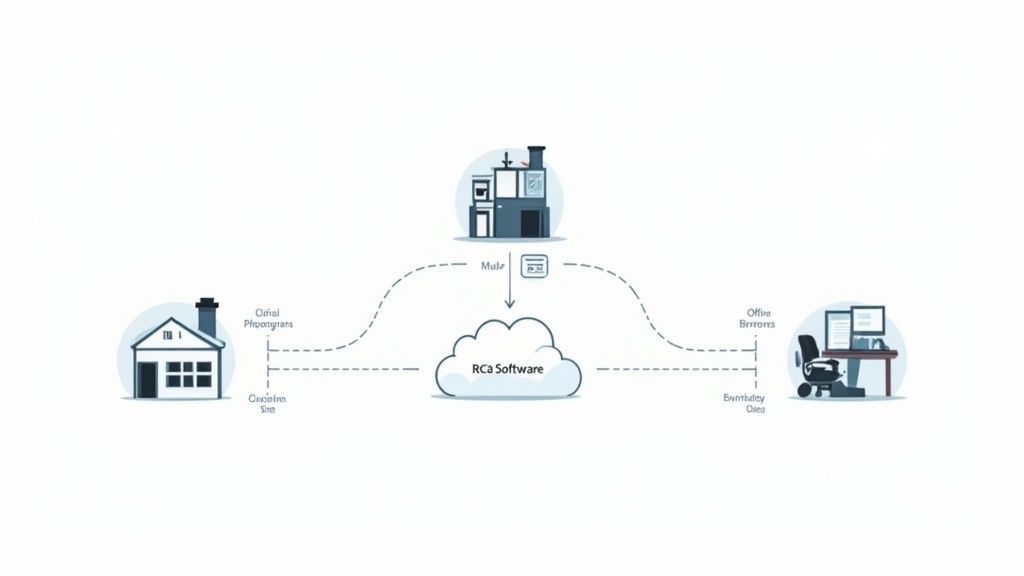
Centralization is the key takeaway here. When all your data is in one place, you can finally stop just reacting to individual incidents and start proactively identifying, and fixing, the systemic risks across the entire business.
Key Benefits of a Digital RCA Format
Going digital offers immediate, practical advantages over juggling spreadsheets and paper forms. The biggest one? Proper oversight and accountability.
When your RCA format lives inside a software platform, corrective actions stop being items on a forgotten to-do list. They become trackable tasks with automated reminders and clear ownership, making it almost impossible for things to fall through the cracks.
A digital system also hands you powerful data analysis on a silver platter. You can instantly see which sites have the most near-misses, what type of incidents are trending, and how quickly corrective actions are being closed out. This kind of insight is invaluable for making genuinely informed decisions. For those ready to make the jump, exploring a dedicated incident management software solution is the logical next step to formalize the whole process.
To ensure your RCA format supports robust service delivery, it's also useful to see how it fits within broader operational frameworks like IT Service Management (ITSM), which also relies heavily on structured problem analysis. This integration helps align safety investigations with overall business processes, making sure everyone is working from the same playbook.
Your Top Root Cause Analysis Questions, Answered
Got questions? You're not the only one. When teams start using a proper root cause analysis format, a few practical queries always pop up. Here are some straight answers to the most common ones we hear from people on the ground.
How Long Should a Root Cause Analysis Take?
Look, there's no magic number here. A simple incident, like a minor bit of equipment playing up, might only take a few hours to dig into properly. But for a more tangled event with multiple things going wrong, you could be looking at several days of careful work.
The real goal isn't speed; it's getting it right. Rushing an investigation is the fastest way to stop at a symptom instead of the actual root cause. If you do that, you're just signing yourself up to deal with the exact same headache in a few weeks or months.
Who Should Be in the Room for an RCA?
Getting the right people involved is non-negotiable. An effective investigation team absolutely must include:
- The people who know the job inside and out. This means the operators or tradies who do the work day-in, day-out.
- Their direct supervisor or team leader. They have the immediate context on work pressures and the environment.
- A safety professional or a trained investigator. Their job is to guide the process and keep the analysis on track.
You simply have to have that firsthand knowledge to figure out what really happened and why. Leaving out the people who actually do the work is a surefire way to miss the crucial details and land on the wrong conclusions.
What’s the Difference Between a Causal Factor and a Root Cause?
This one trips a lot of people up, but it's a critical distinction.
Think of it this way: causal factors are all the dominoes that had to fall for the incident to happen. The root cause is the fundamental system or process failure that set the dominoes up in the first place.
For instance, a wet floor (a causal factor) and someone wearing worn-out boots (another causal factor) might lead to a slip. But the real root cause could be the complete lack of a regular inspection process for spotting and cleaning up spills.
You’ll probably find several causal factors in any investigation. Treat them as clues. They all point you towards that single, deeper root cause that, if you fix it, will stop the whole chain of events from ever starting again.
Can We Just Use a Simple 5 Whys Template?
The '5 Whys' technique is a brilliant tool for the analysis phase of your investigation, but it's not a complete root cause analysis format by itself. A truly solid format needs a bit more structure to be effective.
A proper template also needs dedicated sections for describing the initial incident, outlining the immediate actions taken to make the scene safe, a formal corrective action plan (with names and deadlines), and a final sign-off step to confirm your fixes actually worked.
The '5 Whys' is the engine, but the format is the whole car.
Ready to stop chasing the same recurring issues? Safety Space provides a simple, all-in-one platform to manage your incident investigations, track corrective actions, and spot trends before they become problems. Get a demo and see how you can move from frustrating paperwork to real prevention.
Ready to Transform Your Safety Management?
Discover how Safety Space can help you implement the strategies discussed in this article.
Explore Safety Space FeaturesRelated Topics
Safety Space Features
Explore all the AI-powered features that make Safety Space the complete workplace safety solution.
Articles & Resources
Explore our complete collection of workplace safety articles, tools, and resources.