
Forget the posters on the wall and the dusty rule books in the office. A workplace’s real approach to safety is much simpler: it’s the way things actually get done around here. It’s the collection of shared habits, beliefs, and unspoken rules that guide what your team does when nobody is watching.
What Defines Your Workplace Safety Habits
Think of it like a professional sports team. The players don't need to consult the rulebook for every single play. They know how to work together, anticipate moves, and support each other because they've practiced the right actions until they became second nature. A worksite with strong safety habits operates the same way.
This kind of environment doesn't just happen by accident. It's the direct result of consistent actions, clear communication from leaders, and what is rewarded or corrected day in and day out. You see it in how the team responds when things go wrong and, more importantly, what they do to stop it from happening again.
The Real-World Difference
In a busy manufacturing plant, does a worker feel comfortable hitting the emergency stop button if they spot a potential issue, even if it halts production for ten minutes? Or do they hesitate, worried about getting blamed for the downtime?
On a construction site, if a new contractor points out a frayed cable, does the supervisor thank them and get it replaced immediately? Or do they tell them to "just work around it" to keep the project on schedule?
The answers to these questions reveal everything about a company's true priorities. These everyday interactions are far more powerful than any official policy. They establish the real ground rules, shaping the collective habits that either protect your team or put them at risk.
A worksite’s character is defined not by its safety manual, but by the routine actions of its people, especially when facing pressure to cut corners. It’s the sum of all the small decisions made every single day.
To get a clearer picture, let's look at the practical differences between a workplace with strong safety habits and one where they're lacking.
Signs of Good vs. Poor Workplace Habits
| Indicator | What It Looks Like With Good Habits | What It Looks Like With Poor Habits |
|---|---|---|
| Communication | Risks and near misses are discussed openly to find solutions, not to assign blame. | People hide mistakes. The focus is on finding who was at fault. |
| Leadership Actions | Managers follow the same rules they set for their crews. Their actions prove safety is a priority. | Leaders bend the rules for themselves or to meet deadlines, sending a mixed message. |
| Peer Influence | Workers look out for each other, like reminding a colleague to wear their PPE. | A "mind your own business" attitude prevails. Safety is seen as an individual problem. |
| Problem Solving | When an incident occurs, the first question is "What happened?" to understand the system failure. | The first question is "Who did this?", which creates a climate of fear and cover-ups. |
As you can see, the contrast is stark. These aren't just minor differences in style; they represent a fundamental gap in how safety is valued and practiced on the ground, which ultimately determines your outcomes.
How Strong Safety Habits Affect Your Bottom Line
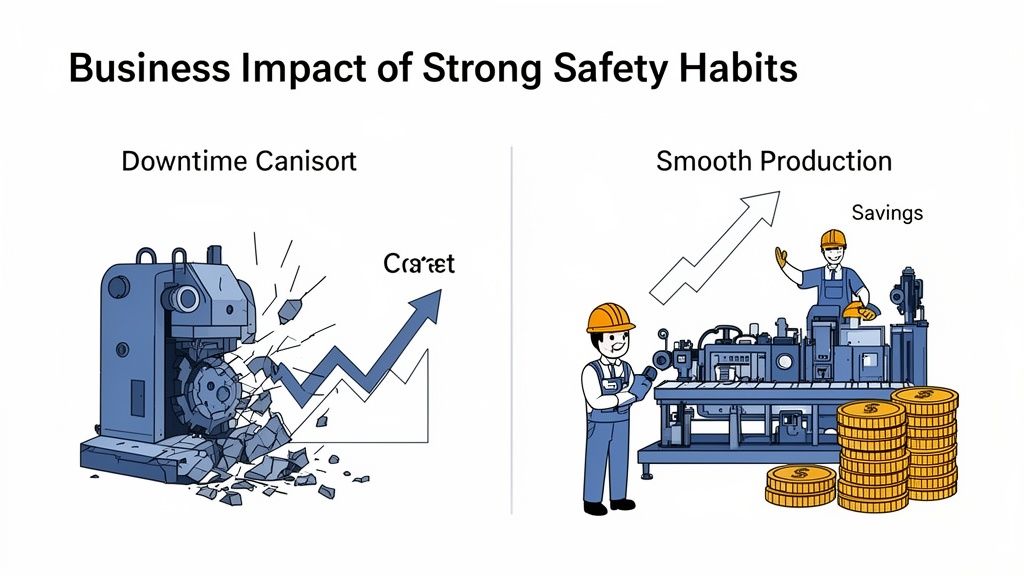
Let's move beyond the theory. The way people act on site every single day has a direct, measurable impact on your business's performance. This isn't a 'soft' topic; it's a critical operational driver that shows up in project budgets, insurance premiums, and your company's reputation.
Managers who get this and focus on building consistent, positive safety habits see tangible returns. It’s that simple.
When proactive actions become the norm, costly incidents and regulatory fines are far less likely to happen. This creates a more predictable work environment, cuts down on unplanned project downtime, and keeps your schedules on track. Strong workplace habits translate directly into financial stability and operational efficiency.
The Real Cost of Inconsistent Habits
In Australia, the consequences of poor workplace practices are starkly clear. Over the ten years leading up to 2023, Australian workplaces recorded more than 1,850 traumatic injury fatalities and over 1,140,000 serious workers’ compensation claims. These aren’t just statistics; they’re the ultimate measure of whether a workplace's approach to safety is working or not.
For any health and safety manager in construction or manufacturing, this is the real bottom line. Safe Work Australia's national strategy, aiming for a 30% reduction in fatalities by 2033, makes it clear that proactive management is now a national expectation. This means daily hazard reporting and quick management responses are no longer optional, especially in high-risk industries. You can find more insights on the official data portal.
When incidents happen, they carry significant costs that go far beyond the initial medical bills.
- Direct Costs: These are the obvious ones: workers' compensation payments, medical expenses, and legal fees.
- Indirect Costs: These are the hidden killers for a project's budget. Think lost productivity during an investigation, the cost of training a replacement worker, and damage to expensive equipment.
- Reputational Damage: A poor safety record makes it harder to win new contracts and attract skilled people, hitting your long-term growth.
Understanding this full financial picture is crucial. It’s about knowing why is health and safety important in the workplace from both a human and a business perspective.
From Cost Centre to Profit Driver
A manufacturing firm in Victoria offers a perfect real-world example. The company was struggling with frequent minor injuries and two major lost-time incidents every year. The result? Soaring insurance premiums and unpredictable production stoppages that were killing their margins.
Management decided to shift their focus from just reacting to incidents to actively building better daily habits.
They introduced a simple digital system for reporting hazards and near misses. Then, they trained supervisors to respond positively to every single report and started recognising teams who were the most proactive.
The results were stunning. Within 18 months, their lost-time injury frequency rate dropped by 70%. Their workers' compensation premiums fell by over $150,000 annually, and the reduction in downtime added an estimated $250,000 to their yearly profit.
This case shows a crucial shift in thinking. Proactive safety measures are not an expense to be minimised; they are an investment in operational excellence that pays for itself.
By focusing on the small, consistent actions that prevent incidents, the company turned a major liability into a real competitive advantage. It’s proof that good safety isn't just about compliance, it's about building a smarter, more resilient business.
The Actions That Truly Define Your Workplace
The idea of how people approach safety can feel a bit vague and corporate. But it gets very real when you look at the small, consistent actions that happen every single day on site. These are the moments that show whether your workplace is genuinely safe or just looks good on paper.
These actions are the building blocks of good safety habits. They reveal what your team actually values, especially when the pressure is on and deadlines are tight. By watching a few key behaviors, you can get a surprisingly accurate read on what’s really happening on the ground.
How Openly Do People Report Problems?
This is probably the most telling sign of all: are people willing to put their hand up and report near misses and hazards? When they do, it's a massive indicator of trust. It means they believe their concerns will be taken seriously, not brushed aside or blamed for causing delays.
A site with a high number of near-miss reports isn't necessarily more dangerous. In fact, it's often the opposite. It shows you have a team that's actively looking for trouble before it can hurt someone. The data backs this up, showing a clear link between more near-miss reports and fewer actual incidents.
But this openness is fragile. If a worker points out a small oil spill and gets ignored or criticised for slowing things down, you can bet they won't report the next one. The goal is to make reporting a normal, helpful part of the job, not a reason to get in trouble.
The Quality of Your Pre-Start Talks
Pre-start or toolbox talks are a daily ritual on most sites, but their quality varies wildly. A truly effective talk isn't just a supervisor droning on while reading from a checklist.
It’s a real conversation where the crew actively participates. People should feel comfortable asking questions or pointing out risks specific to that day's work. For instance, a roofer might flag that the wind has picked up, something that wasn't covered in the original risk assessment.
An engaged pre-start meeting is a conversation, not a lecture. It’s where the team collectively plans to stay safe, adapting the work plan to the reality of the site that day.
If these talks are rushed, robotic, or just seen as a box-ticking exercise, they are a complete waste of time. The best ones are brief, relevant, and encourage genuine input from the people actually doing the work.
How Supervisors React When Things Go Wrong
A supervisor's reaction to a safety issue is a moment of truth. It sends a powerful message to the entire crew about what the company really prioritises.
Imagine a worker on a construction site points out a frayed power cable on a grinder.
- A poor response: The supervisor sighs and says, "We're behind schedule, just be careful with it and get on with the job." This tells the worker that the deadline is more important than their safety.
- A good response: The supervisor immediately says, "Good catch, thanks for pointing that out. Let's tag it out of service right now and get a new one." This shows that speaking up is valued and that problems get fixed, no questions asked.
The second response builds trust and encourages everyone to stay switched on. The first creates an environment where people start to ignore risks. Research shows that employees who feel their concerns are heard are more than five times more likely to feel safe at work.
Following The Rules When The Pressure Is On
Here’s the final acid test: what happens when a deadline is looming? Do your safe work procedures hold firm, or are they the first thing to be thrown out the window to save a bit of time?
Think about a manufacturing team needing to clear a jammed conveyor. The correct procedure is a full lockout-tagout, which takes about 15 minutes. When the pressure is on to get the line moving, it can be tempting to take a shortcut, like trying to poke the jam free while the machine is still live.
A team with strong habits will always follow the lockout procedure, no matter how much pressure they're under. They get that those 15 minutes are a non-negotiable investment in preventing a life-changing injury. That commitment to doing things right, even when it’s inconvenient, is the hallmark of a workplace where safety is truly embedded in everything they do.
How to Measure What’s Happening on Your Site
You can't fix what you can't see. If you want to improve how things get done on your worksite, you first need a clear, honest picture of what’s happening right now, without relying on guesswork or gut feelings. This means we have to move beyond just counting injuries after they happen and start measuring the actions that prevent them in the first place.
This is all about using two types of information: lagging and leading indicators. Think of it like driving a car. Lagging indicators are like looking in the rearview mirror; they tell you where you've been. Leading indicators are like looking through the windscreen; they show you what's coming up ahead.
Looking Backwards with Lagging Indicators
Lagging indicators are the traditional safety metrics that most of us are familiar with. They measure past failures, the stuff that's already gone wrong.
These metrics typically include:
- Injury Rates: Tracking how many incidents resulted in lost time or medical treatment.
- Workers' Compensation Claims: The number and cost of claims being filed.
- Property Damage: The cost to repair or replace equipment and materials damaged in incidents.
These numbers are important. They show the real-world consequences of past actions and give you a clear baseline to work from. The problem is, they don't help you prevent the next incident. You can use tools like an accident frequency rate calculator to keep an eye on these numbers and track performance over time, but they’ll always be telling you a story that has already ended.
Looking Forwards with Leading Indicators
Leading indicators are where the real proactive work happens. They track the positive actions and conditions that stop incidents before they even have a chance to occur. They give you a real-time view of how engaged your teams are with safety, day in and day out.
Some simple but incredibly powerful leading indicators include:
- Near-Miss Reports: How often are potential incidents being reported before anyone gets hurt?
- Safety Observations: Are people documenting both safe and at-risk actions during routine site walks?
- Corrective Actions Closed: How quickly are we fixing the hazards we identify?
This is all about creating a system where the small, everyday actions add up to a much stronger safety net on site.
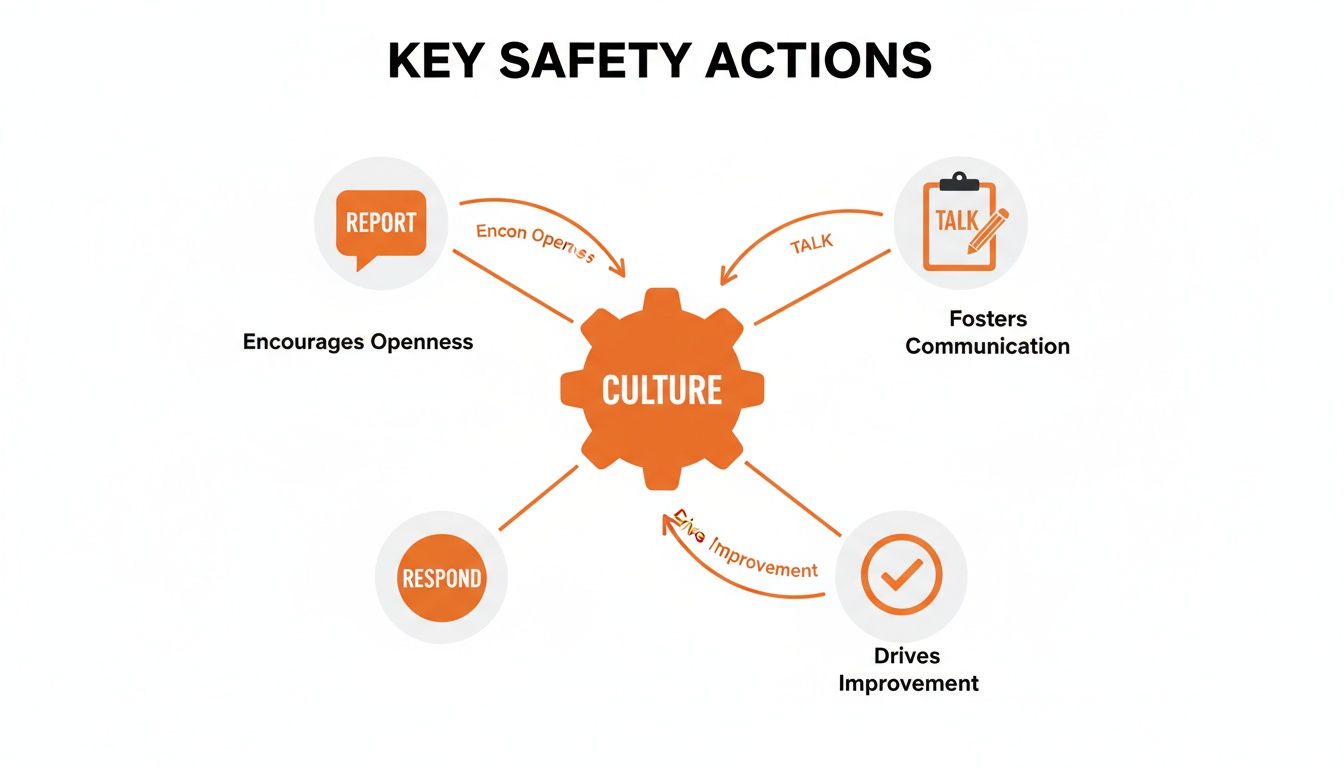
As you can see, the core idea is simple: the daily habits of reporting issues, talking about them, and responding quickly are what drive genuine, lasting improvement.
Turning Measurement into a Daily Tool
The old way of measuring safety involved stacks of paper checklists and spreadsheets that someone updated once a month, if you were lucky. It was a chore. Modern digital platforms, however, turn this whole process into a live, daily operational tool. Managers can see in real-time which teams are actively reporting hazards and which ones might need a bit more support.
Dashboards can instantly show you trends, like a spike in reports about faulty equipment on a particular site. This allows you to step in and act before it leads to a major breakdown or, worse, an injury. This makes measurement less about ticking compliance boxes and more about smart, proactive management. And a solid grasp of potential hazards is the cornerstone of any effective risk security management plan.
Measuring what's happening isn't about catching people doing something wrong; it's about finding opportunities to do things right, more often. It shifts the entire focus from blame to prevention.
This proactive approach is fast becoming a national expectation. The Australian Work Health and Safety Strategy 2023–2033 now directly links positive workplace habits with measurable business outcomes. It sets clear targets, including at least a 30% reduction in worker fatalities and a 15% reduction in permanent impairment frequency.
For operational leaders, this is a clear signal. Investing in systems that track and improve daily safety actions isn't just a good idea, it's directly tied to meeting these national benchmarks, protecting your workers, and reducing the significant financial drag of injuries.
Knowing you need to improve your team's safety habits is one thing. Actually doing it is another beast entirely. The good news is that you don't need some massive, complicated program to see real change. Lasting improvement comes from a few simple, consistent actions that quietly nudge your team towards making the right thing the easiest thing to do.
Let's walk through a straightforward, five-step roadmap that any manager in construction or manufacturing can start using today to build better, stronger safety habits.
1. Make Reporting Fast and Painless
Let's be honest: if reporting a hazard takes longer than sending a text, your people just won't do it. Paper forms, clunky email chains, or having to track down a supervisor are all roadblocks. The real goal here is to remove every bit of friction from the process.
Imagine a worker can just pull out their phone, snap a photo of a hazard, add a quick note, and hit 'send', all in under 60 seconds, without even leaving their work area. That’s the standard. This simple shift dramatically increases not just the quantity of reports you get, but the quality of the information, giving you a live, real-time view of risks on site.
Here's what that looks like in practice. A clean, simple digital form that anyone can use without needing a training manual.
An interface this clean makes it dead simple for anyone to flag an issue on the spot.
2. Guarantee a Visible Follow-up
This is the step where most safety initiatives fall apart. When a worker takes the time to report an issue, they need to see that something happens because of it. If their reports vanish into a black hole, they'll stop bothering, and any trust you've built will evaporate overnight.
Quick, visible follow-up is everything. When a hazard is reported, the right supervisor should be notified instantly. Once it's fixed, the person who reported it needs to get a notification closing the loop. This simple act of acknowledgement is powerful; it proves that management is listening and, more importantly, taking action.
What it looks like: A worker reports a loose guard rail using an app on their phone. The site supervisor gets an immediate alert, assigns a team member to fix it, and marks the task as complete, all within the hour. The original reporter gets a notification saying, "Thanks, this has been fixed." That simple exchange builds a powerful feedback loop founded on trust.
3. Train Supervisors to Have Constructive Conversations
Your supervisors are the most influential people on the ground, hands down. But they're often promoted for their technical skills, not their ability to communicate. Just telling them to "talk more about safety" is a recipe for failure. You need to give them the right tools and training for the job.
This isn't about lecturing people on the rules. Effective workplace safety training teaches supervisors how to have brief, constructive conversations that encourage their teams to think proactively. Continuous education is a non-negotiable part of creating strong worksite habits. For teams in high-risk electrical environments, for example, developing robust arc flash safety training programs is an essential piece of this puzzle.
4. Recognise Proactive Actions, Not Just Good Luck
Most organisations only recognise the absence of incidents. That’s a bit like rewarding someone for not crashing their car on the way to work. It doesn't reinforce the right behaviours.
Instead, shift your focus. Start publicly recognising the proactive things you want to see more of. Did a team report a high number of near misses this week? Thank them in the pre-start meeting. Did someone stop a job to double-check a procedure? Acknowledge their professionalism. This sends a clear message to everyone: you value thoughtful, careful work far more than just speed.
5. Use Data to Guide Your Efforts
Once you have a steady stream of data flowing in from reports and observations, you can finally stop guessing where your problems are. A good digital system will give you simple dashboards that instantly highlight trends. You might discover that one specific site has a recurring issue with faulty equipment, or that a particular team consistently skips their pre-start checks.
This data allows you to focus your limited time and resources where they’ll have the biggest impact. It’s an evidence-based approach that moves your safety management from a reactive, paper-pushing chore into a smart, proactive business function. For Australian companies, where headline fatality rates are already relatively low, this kind of insight is crucial for driving continuous improvement when traditional compliance methods just aren't moving the needle anymore.
Common Questions About Building Workplace Safety Habits
Even with the best plan, changing how things get done on-site always brings up a few tough questions. I've heard the same concerns from managers in construction and manufacturing time and time again. Here are some straight answers to the most common ones.
How Do I Get My Team to Report Near Misses?
The secret? Make reporting ridiculously simple and kill any fear of blame. If your crew has to fill out paperwork or walk back to an office, you've already lost. They need to be able to report an issue on their phone in under 60 seconds, right from where they're standing.
But a tool is only half the battle. What happens next is what really matters.
Management has to act on that report, visibly and quickly. Then, in the next team meeting, publicly thank the person who raised the flag. When people see that their report leads to a real fix and they get recognised for it, reporting just becomes part of the daily routine.
If you use reports to point fingers, or if they just vanish into a black hole, the whole system collapses. Trust is everything, and you build it one response at a time.
Is This Stuff Just for Big Companies?
Not at all. Honestly, it’s often easier and faster to build great safety habits in a smaller team where everyone talks directly. The principles are exactly the same, whether you have five people on the books or five hundred.
The owner or the lead supervisor sets the tone. If they’re the ones consistently checking gear, talking about risks before a job, and are willing to hit pause to fix a problem, the crew will follow their lead. It's that simple.
And digital tools aren't just for the big players anymore. A simple monthly subscription can ditch the messy paperwork and give a small contractor the same professional oversight as a massive corporation. Good habits protect your people and your business, no matter the size.
My Supervisors Are Great Technicians but Not People Managers
This is one of the most common hurdles in the industry. The trick isn't to turn them into psychologists overnight. It's about giving them simple, practical tools that make leading on safety a straightforward part of their job, not another chore.
Give them things they can actually use:
- A weekly checklist: A short list of safety actions or conversation starters for their team talks. It gives them structure.
- Automated reminders: Let a digital system flag overdue inspections or follow-ups. They shouldn’t have to keep a running list in their head.
- Simple scripts: Train them with easy phrases like, "Good catch, let's get that sorted now," instead of asking them to adopt corporate jargon.
The goal is to weave safety leadership into their existing workflow. Make it easy for them to get it right, and they will.
How Long Does It Take to See Real Changes?
You can see some positive signs, like a jump in hazard reporting, within just a few weeks. That happens when you bring in a simple system and leadership is visibly backing it. People are quick to use new tools when they see they actually work.
But seeing a real drop in your incident rates? That takes longer. You're typically looking at around 6 to 12 months for new, positive actions to become second nature for the whole team.
The single most important ingredient is consistency. Small, daily actions from leaders and supervisors, backed by a system that makes doing the right thing the easy thing, create unstoppable momentum. This isn’t a project with an end date; it’s a permanent shift in how you operate.
Ready to build a workplace where safety is a habit, not a hassle? Safety Space gives you the tools to make reporting simple, track actions in real-time, and get the data you need to protect your people and your projects. See how easy it is to build a stronger safety system by booking a free demo and consultation at https://safetyspace.co.
Ready to Transform Your Safety Management?
Discover how Safety Space can help you implement the strategies discussed in this article.
Explore Safety Space FeaturesRelated Topics
Safety Space Features
Explore all the AI-powered features that make Safety Space the complete workplace safety solution.
Articles & Resources
Explore our complete collection of workplace safety articles, tools, and resources.