
A workplace safety policy is your company’s formal commitment to health and safety on site. It's the document that lays out the rules and procedures to prevent injuries. But it has to be more than just a piece of paper; it needs to be a practical, living guide that informs daily operations and protects your team from real dangers.
Why Your Current Safety Policy Might Be Failing You
Let's be blunt. A workplace safety policy isn't a box-ticking exercise for compliance that you can just file away. Its purpose is to prevent incidents in high-risk environments like construction sites and manufacturing plants. If your policy is a generic template you downloaded from the internet, it’s almost certainly failing to protect your workers and your business.
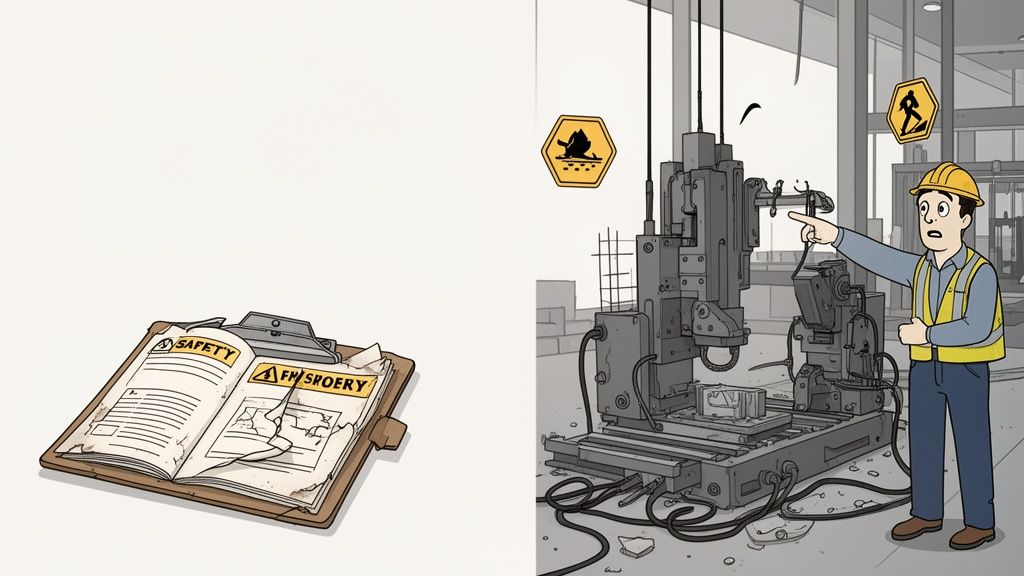
A static, outdated document just can't keep up with a worksite. New machinery, changing project phases, and different subcontractors all introduce new risks. A generic policy can't possibly cover these specifics. This is the gap between policy and practice, and it’s where incidents happen.
The Real-World Consequences
When a policy isn't specific to your operations, it becomes irrelevant to the very people who need it most.
Think about a fabrication workshop that brings in a new plasma cutter but doesn't update its safety procedures. The existing policy on "hot works" is far too general. Before you know it, an operator suffers severe burns because the PPE guidelines weren't specific enough for that machine.
This isn't just a hypothetical scenario. The real costs of a weak policy are tangible and severe:
- Serious Incidents: Preventable injuries, or worse, because of unclear instructions.
- Hefty Fines: Significant financial penalties from regulators for non-compliance.
- Operational Downtime: Site shutdowns for investigations, costing you time and money.
- Legal Liability: Increased exposure to workers' compensation claims and other legal action.
The statistics highlight just how urgent this is. In a recent year, Australia recorded 188 work-related fatalities, a national fatality rate of 1.3 deaths per 100,000 workers. The transport, construction, and agriculture sectors accounted for a massive 72% of these deaths, showing exactly where strong, specific policies are most needed.
To get a clearer picture of where the biggest risks lie, here’s a breakdown of the most common causes of incidents in these high-risk industries.
Common Causes of Incidents in High-Risk Industries
| Incident Type | Percentage of Fatalities (National) | Primary Industries Affected |
|---|---|---|
| Vehicle Collisions | 44% | Transport, Postal & Warehousing, Agriculture, Construction |
| Being Hit by Moving Objects | 14% | Construction, Transport, Manufacturing, Agriculture |
| Falls from Height | 10% | Construction, Agriculture |
| Being Trapped by Moving Machinery | 8% | Agriculture, Manufacturing, Construction |
This data shows exactly where your policy needs to be strongest. It's not about covering every possibility, but about focusing intensely on the most probable and severe risks your team faces every day.
From Vague Rules to Tangible Risks
A policy fails when it’s filled with abstract statements instead of clear, actionable instructions. For example, a rule like "Maintain a tidy worksite" is practically useless.
Compare that to: "All walkways must be kept clear of materials and debris, with designated lay-down areas for all deliveries." One is a suggestion; the other is a clear, auditable instruction.
A policy's value is measured by its relevance on the workshop floor or construction site, not by how well it reads in the main office. If your team can't apply it to their specific tasks, it's not working.
Understanding the potential legal fallout is also critical. When an incident occurs, questions about employer liability are inevitable. Seeing how employees might explore if they Can I sue my employer if I got injured while working for them can shine a harsh light on any gaps in your safety measures. This isn’t about scare tactics; it’s about recognizing the serious responsibility a workplace safety policy carries and building one that genuinely protects everyone involved.
Laying the Foundation for an Effective Policy
Before you think about writing your workplace safety policy, you need to get the groundwork right. A policy built on assumptions or a generic template is about as useful as a screen door on a submarine. It just won't hold up when things get real.
The first, and most critical, step is to get out on the floor or the site. You need to see with your own eyes what your team is up against every day. This isn’t a task for the office; it’s about boots-on-the-ground observation and analysis.
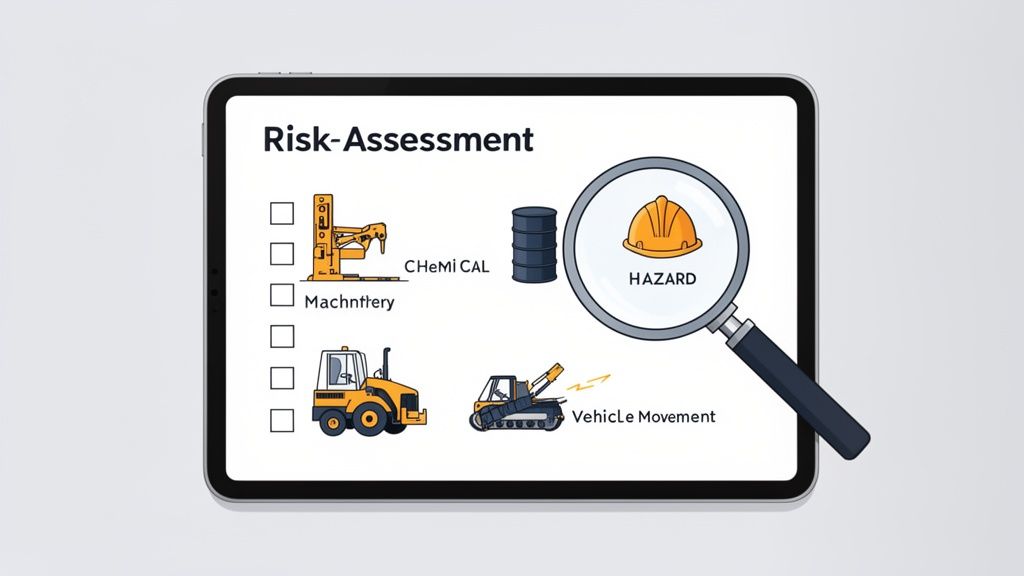
It all starts with a thorough risk assessment tailored to your specific environment, whether it's a buzzing manufacturing plant or a dynamic construction site. You simply can't write a rule to control a hazard you haven't identified. A truly effective policy is a direct response to the risks you uncover.
Starting With a Practical Risk Assessment
Your risk assessment needs to be practical and detailed. This is the intelligence-gathering phase that will inform every single clause of your policy. Ditch the generic checklists and focus on what’s actually happening in your operational areas.
Get out there and look for:
- Machinery and Equipment: Where are the pinch points, moving parts, and energy sources? Are the guards in place and doing their job? Are lockout/tagout procedures crystal clear and, more importantly, are they being used every time?
- Chemical Handling: What hazardous substances are actually on site? Check the storage, make sure Safety Data Sheets (SDS) are readily available, and verify that the team has the right PPE and knows the spill response procedures.
- Vehicle and Pedestrian Interaction: Map out the traffic flow for forklifts, trucks, and people. Are there blind corners, confusing signage, or spots where paths cross dangerously? I’ve seen too many near misses in these areas.
- Subcontractor Activities: It’s easy to just focus on your own crew, but that's a mistake. What are your subcontractors doing? Are their safety methods compatible with yours, especially for high-risk jobs like crane lifts or live electrical work?
This initial walk-through gives you a clear, evidence-based snapshot of your workplace hazards. Without it, your policy is just guesswork.
Understanding Your Legal Obligations
Once you have a handle on your physical risks, you need to line them up with your legal duties. Here in Australia, everything comes back to the Work Health and Safety (WHS) Act. Trying to write a policy without a solid grasp of these obligations is a fast track to non-compliance and hefty fines.
The WHS Act isn't about memorizing legal jargon; it’s about your primary duty of care. This means you must do what is reasonably practicable to ensure the health and safety of your workers. Your policy is the primary way you demonstrate how you’re meeting that duty. It has to show that you've identified hazards, assessed the risks, and put controls in place.
A compliant policy isn't just about ticking a box to avoid fines. It's about building a genuine system that actively manages risk, the absolute core of the WHS Act. Your policy document is the proof.
The cost of getting this wrong, both financially and in human terms, is massive. Take Western Australia, for example. Recent WorkSafe WA data showed 12,550 serious compensation claims in a single year, with an eye-watering average cost of $27,558 per claim. This rate is one of the highest in the country, blowing past the national average. These numbers aren’t abstract stats; they represent real people, real injuries, and serious business disruption.
Gathering the Right Information
With your risk assessment done and your legal framework understood, it's time to gather the specific information that will become the building blocks of your policy. This is where you convert all those observations into concrete points. The goal is to have clear, factual data ready to go before you write a single sentence.
For a solid foundation, make sure you have:
- A List of Key Risks: Prioritize the hazards you found, from the most severe down to the least.
- Applicable Legal Standards: Note the specific WHS codes of practice that apply to your industry, like those for machinery guarding or working at heights.
- Current Control Measures: Document what you’re already doing to manage these risks. This is great for spotting gaps where your new policy needs to be stronger.
- Defined Roles: Start thinking about who is responsible for what. Who’s in charge of forklift training? Who signs off on hot work permits? Clarity here is crucial.
Having this information organised makes drafting the policy itself far more straightforward and effective. It's a vital piece of building a robust safety management system. To see how this fits into the bigger picture, check out our guide on the 9 Key Elements of a Health and Safety Management System. By putting in this groundwork now, you ensure your workplace safety policy is built for your reality, not someone else's.
Drafting the Core Components of Your Safety Policy
Once you’ve done the groundwork, it’s time to actually start writing the policy. This is where you turn your risk assessments and legal obligations into a clear, functional document that people will actually use. The aim here isn’t a literary masterpiece. It’s a practical tool that guides everyday actions on site.
Think of it less like writing a legal contract and more like creating an operating manual for a safe workplace. It needs to be direct, easy to understand, and laser-focused on the real-world tasks your team performs. Vague statements are the enemy; clarity is everything.
Starting with a Clear Policy Statement
The policy statement is your opening pitch. It’s a short, sharp declaration of your company’s commitment to safety, and it needs to be signed by the most senior person in the organisation, like the Director or CEO. This shows everyone that accountability starts right at the very top.
This isn't the place for corporate jargon. Keep it simple and direct.
Your policy statement should clearly state that safety is a primary responsibility and that the company will provide the necessary resources, training, and equipment to maintain a safe working environment. It sets the tone for everything that follows.
For example, you could include a commitment to complying with all relevant WHS legislation and a promise to consult with workers on safety matters. This simple opening establishes intent and authority from the get-go.
Defining Roles and Responsibilities
This is arguably the most critical part of your entire workplace safety policy. Policies fail when nobody knows who is responsible for what. That ambiguity leads to inaction, which is exactly how incidents happen. You need to spell out, in plain English, the specific safety duties for every single level of your organisation.
Use direct, action-oriented language. Don't just say, "management will ensure safety." Get specific.
Example Responsibilities Breakdown:
- Directors/Senior Management: "You are responsible for providing adequate funding for safety equipment, training, and resources. You must also lead safety reviews and visibly demonstrate commitment to this policy."
- Supervisors/Foremen: "You are responsible for conducting daily pre-start talks, ensuring your team completes risk assessments like SWMS, and stopping any job that appears unsafe. You must also investigate and report all incidents immediately."
- Workers: "You are responsible for following all safety procedures, using the correct PPE for your task, and reporting any hazards or near misses to your supervisor without delay. You must complete the pre-start checklist for your machinery every morning."
- Subcontractors: "You are responsible for complying with our site safety policy, providing evidence of your workers' competencies, and participating in our site induction process before starting any work."
This approach leaves no room for doubt about who needs to do what. It transforms the policy from a passive document into an active guide for individual accountability.
Outlining Specific Safety Procedures
While your policy isn't the place for every single step-by-step procedure, it must outline the key processes that govern safety on your site. This section is what connects your high-level commitment to the practical, on-the-ground activities that keep people safe.
Think about the most critical safety interactions your team has daily. Those are the procedures that need to be clearly defined in the policy itself.
Here are the key procedures to include:
- Hazard Identification and Risk Control: Explain how your team finds hazards (e.g., through site inspections, pre-start checks) and the process they must follow to control them. This is the perfect place to mention your commitment to using the hierarchy of controls. To get a better handle on this framework, you can learn more about applying the hierarchy of control measures in our detailed guide.
- Incident Reporting and Investigation: Detail the exact steps a worker must take after an incident or a near miss. Who do they report it to? What form do they use? The policy should state that all incidents, no matter how small, will be investigated to find the root cause.
- Emergency Response: What happens if there's a fire, a medical emergency, or a chemical spill? Your policy needs to outline the emergency plan, including evacuation routes, assembly points, and the specific roles of fire wardens and first aid officers.
- Training and Competency: State clearly that all workers will get a site induction and task-specific training before they start work. The policy should also require that records of all training are kept and maintained.
- Chemical and Substance Management: When drafting the core components of your safety policy for laboratory environments, it is essential to include detailed Fume Hood Safety protocols. This ensures specific risks are managed correctly.
By clearly mapping out these core procedures, you provide a consistent framework for handling critical safety situations across your entire operation.
Using a platform like Safety Space can make this whole process much easier. You can start with pre-built templates for these core sections and then customise them with your specific site details. Better yet, digital forms for incident reports or pre-start checklists can be linked directly from your policy, turning it into a truly integrated and usable system instead of just another static document sitting in a folder.
Putting Your Workplace Safety Policy Into Action
You’ve drafted the perfect workplace safety policy. It’s comprehensive, compliant, and ticks all the boxes. But let's be honest, it’s completely useless if it just sits in a folder on the server.
The real work starts now. This is where you move from document to action, turning those written commitments into the daily reality for your team on the construction site or factory floor.
Without a solid rollout plan, even the best policy will fail. People slip back into old habits, instructions get missed, and your carefully crafted document gathers digital dust. The goal is to make safety a visible, accessible, and practical part of everyone's job.
This diagram breaks down the core elements you’ve built, the statement, roles, and procedures, which now need to be brought to life.
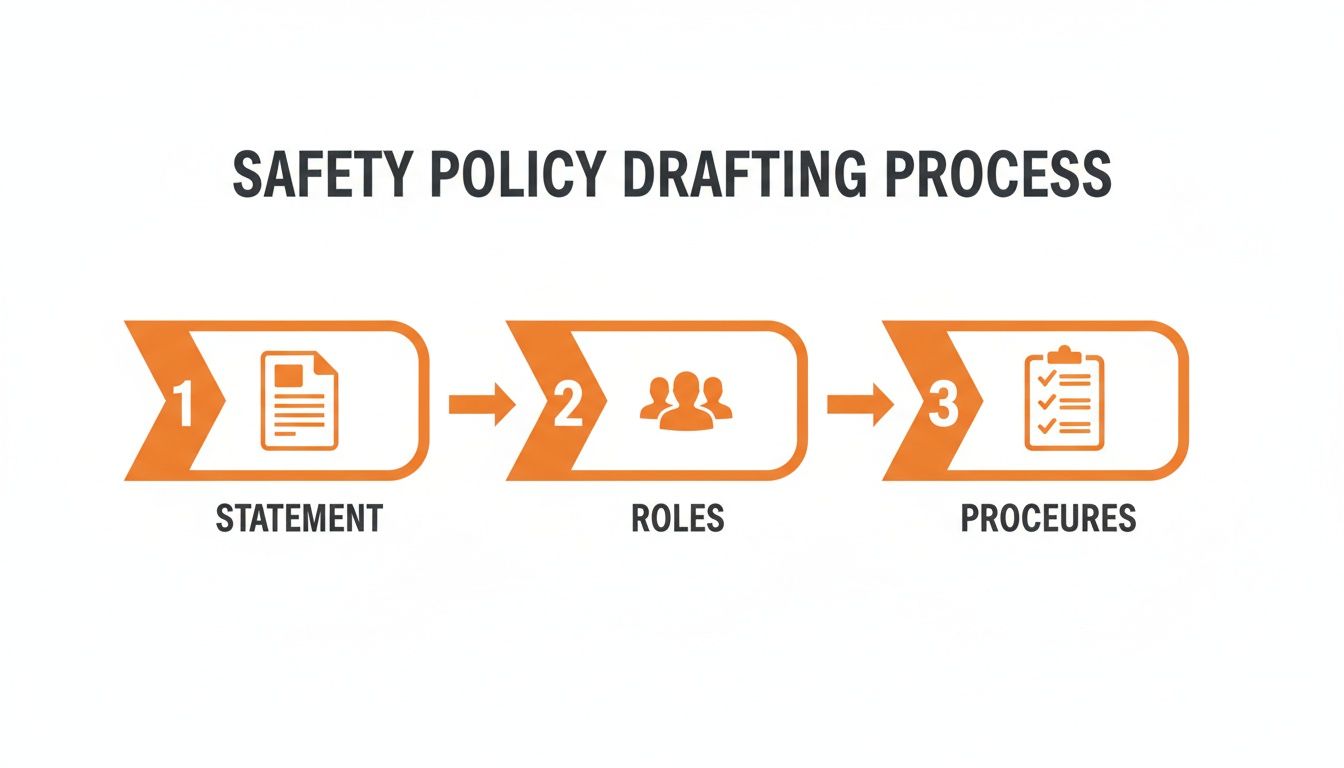
Now, it's time to put those foundations into practice.
Communicating The New Policy (So People Actually Listen)
How you introduce the new policy matters just as much as what's in it. A quick email with a PDF attachment is a surefire way to guarantee nobody reads it. You need a communication strategy that actively engages your team and explains not just what is changing, but why.
Start from the top. The message has to come from leadership. Get your supervisors and managers to lead toolbox talks or team meetings dedicated to walking through the new policy. This shows their commitment and opens the floor for immediate questions.
In these sessions, focus on the practical stuff:
- What’s new? Pinpoint specific changes, like a different incident reporting form or new PPE requirements for a particular task.
- Why did it change? Give them the reason. For example, "We've updated the lockout/tagout procedure after that near-miss last month to add a second verification step."
- Where can I find it? Make sure everyone knows where the full policy lives, whether it’s on a company intranet, an app like Safety Space, or posted in common areas.
Accessibility is everything. A policy locked away in an office is no good to anyone. It must be available where the work actually happens.
Tailoring Training For The Real World
A one-size-fits-all training session is a waste of time. The safety info a forklift operator needs is worlds away from what an office administrator requires. Your training has to be role-specific to have any impact.
Break down your training plan by job function and risk level.
- High-Risk Roles (e.g., Welders, Crane Operators): These teams need intensive, hands-on training covering the exact procedures and hazards detailed in the policy for their work. Think practical demonstrations and competency checks, not just a PowerPoint presentation.
- Supervisors and Managers: Their training needs to focus on their responsibilities: enforcement, incident investigation, and how to lead safety conversations. They are your front-line safety leaders, so equip them accordingly.
- General Staff and Office Workers: This group needs training on the bigger picture, like emergency procedures, how to report a hazard, and general workplace safety rules.
Getting supervisors to deliver the training for their own teams is a game-changer. When the person managing daily work also leads the safety instruction, it sends a clear message: safety and operations are one and the same. For more ideas, check out our guide on effective workplace safety training.
A policy is only as strong as the team's understanding of it. Investing time in targeted training isn't a compliance task; it's a direct investment in preventing incidents.
Implementation Checklist From Paper to Practice
To make sure nothing slips through the cracks, a simple checklist can help you manage the rollout. Here’s a practical guide to take your policy from a document to a living, breathing part of your worksite.
| Action Step | Key Responsibility | Digital Tool to Use (e.g., Safety Space) |
|---|---|---|
| Finalise & Distribute Policy | H&S Manager | Upload the final policy to a central document hub. |
| Leadership Briefing | CEO / General Manager | Schedule a meeting with all supervisors to review the policy and their role in its implementation. |
| Schedule Toolbox Talks | Site Supervisors | Use a digital calendar to schedule team-specific rollout sessions. |
| Deliver Role-Specific Training | Team Leaders / Trainers | Assign digital training modules based on job roles. |
| Collect Acknowledgements | H&S Coordinator | Send out digital sign-off requests and track completion in real-time. |
| Update Site Signage | Site Manager | Post key policy points (like new PPE rules) in high-traffic areas. |
| Integrate into Inductions | HR / H&S Team | Update the new-hire and contractor induction process to include the new policy. |
This checklist ensures every critical step is assigned and tracked, creating clear accountability across the entire team.
Using Digital Tools For A Smoother Rollout
This is where things can get messy, especially with large teams or multiple sites. Tracking who has read the policy, completed their training, or is certified for a specific task can become an administrative nightmare of paper and spreadsheets.
This is exactly where a tool like Safety Space cuts through the chaos.
Instead of chasing paper signatures, you can manage the entire rollout digitally. Here’s how it works:
- Digital Distribution: Upload your new policy directly to the platform. An alert goes out to every relevant team member, telling them to review it.
- Trackable Acknowledgements: The system prompts each person to digitally sign that they’ve read and understood the policy. This creates an instant, unshakeable audit trail. You can see at a glance who’s done it and who needs a nudge.
- Assigned Training Modules: Assign specific training modules to different roles or individuals right through the platform. Completion is tracked automatically, giving you an always-current record of your team’s competencies.
By using a digital system, you ditch the administrative headache and create a clear line of accountability. It ensures everyone, including new hires and subcontractors, gets and acknowledges the policy as part of their induction, turning your implementation plan into a live, manageable, and verifiable system.
Keeping Your Safety Policy Alive: Monitoring and Review
A workplace safety policy isn't a "set and forget" document. Your worksite is a living thing, constantly changing with new people, new gear, and new processes. If your policy doesn’t evolve with it, it quickly becomes irrelevant wallpaper, useless in a real emergency.
Policy reviews aren't just about ticking a compliance box. They're a practical health check to make sure your safety rules still match the real-world risks your team faces every day. This ongoing process is what bridges the gap between the rules on paper and the reality on the workshop floor. Without it, you’re just hoping for the best with an outdated playbook.
Setting a Practical Review Cycle
Don't wait for an incident to force your hand. The best way to keep a policy relevant is to build a regular review cycle right into your business calendar.
For most businesses in manufacturing or construction, a full annual review is a solid minimum. Lock it in. Treat it like you would a tax deadline or a major project milestone.
But a date on the calendar is only half the story. Certain events have to trigger an immediate review, no matter when your annual check-up is scheduled. Think of these as your early warning system.
Key triggers for an instant policy review include:
- A serious incident or a near-miss: This is the most obvious one. Once everyone is safe, the very next question should be, "How did our policy fail to prevent this?"
- Changes in legislation: Work Health and Safety (WHS) laws and codes of practice get updated. A quick review keeps you compliant and, more importantly, keeps your team safe under the latest standards.
- New equipment or processes: That new CNC machine, a different chemical supplier, or a new construction method all bring fresh risks your old policy simply won't see coming.
- Feedback from your crew: If your team is telling you a procedure is clunky, impractical, or just plain unsafe, listen. They are your eyes and ears on the ground, and their feedback is gold.
This mix of scheduled and trigger-based reviews creates a robust system that stops your policy from ever gathering dust.
Get on the Floor: Gathering Feedback and Analysing Data
How do you know if your policy is actually working? You have to measure it. This means getting away from the desk and digging into what’s happening on-site. Honestly, talking to your team is one of the most powerful review tools you have.
Supervisors, health and safety reps, and the workers on the tools, they live and breathe this stuff every day. They know what’s working and what’s a time-wasting bottleneck.
An open conversation about a frustrating safety procedure is far more valuable than a dozen ticked boxes on a compliance audit. Try asking your team directly: "Which safety rule is the hardest to follow, and why?" The answer will often point you straight to a weakness in your policy.
Beyond conversations, your own data tells a clear story. Get into the habit of regularly analysing your incident reports, hazard logs, and site inspection records. Are you seeing the same types of near misses popping up over and over again? That’s not a coincidence; it’s a red flag that a specific part of your policy is failing.
For instance, if you spot a pattern of minor hand injuries in one section of your factory, it could mean your policy's PPE requirements or the machinery guarding procedures for that zone need a serious rethink.
Using Real-Time Monitoring to Stay Ahead of the Game
Here’s where traditional, reactive policy reviews fall short. Waiting for incident reports to pile up means you’re always playing catch-up. By the time a trend becomes obvious from looking back at old data, multiple incidents may have already happened.
This is exactly the problem modern tools were built to solve.
Platforms like Safety Space make a fundamental difference here. Instead of trying to manually collate paper reports and spreadsheets once a month, all your safety data flows into one digital system, in real time.
With Safety Space, you can use dashboards to spot trouble as it’s brewing.
- See if one particular subcontractor is consistently failing site inspections.
- Notice if pre-start checklists for a certain type of vehicle are frequently being skipped.
- Identify a specific site that has a much higher rate of hazard reports than others.
This kind of immediate visibility allows you to be proactive, not reactive. You can see a problem taking shape and update your workplace safety policy to shut it down before it leads to an accident.
If the dashboard flags recurring issues with a subcontractor’s paperwork, for example, you can immediately strengthen your policy's contractor management section with stricter verification rules. This transforms your policy from a document that looks backward into a live, proactive risk management tool.
Got questions? You’re not the only one. Even with the best intentions, putting a safety policy into practice brings up some common hurdles. Here are some quick, no-nonsense answers to the questions we hear most from managers in construction and manufacturing.
How Often Should I Review My Safety Policy?
At an absolute minimum, you need to give your workplace safety policy a thorough review once a year. Think of it as an annual health check to make sure it’s still relevant and effective for your current operations.
But don't just lock it in and forget about it. Certain events should trigger an immediate review. If you bring in new machinery, if WHS legislation changes, or if your crew on the ground tells you a specific procedure just isn't working, it’s time to open the document.
And most critically: any significant incident or near-miss demands an instant look at what went wrong and how the policy can be tightened to stop it from ever happening again.
What’s the Difference Between a Safety Policy and a Safety Procedure?
This one trips a lot of people up, but the difference is actually quite simple.
Your workplace safety policy is the 'what' and the 'why'. It’s your high-level commitment, stating your company’s dedication to safety, outlining everyone’s responsibilities, and setting the overarching rules of the game.
A procedure, on the other hand, is the 'how'. It gives the specific, step-by-step instructions for a single task. For instance, your policy will state that all equipment must be isolated before maintenance. The procedure will detail the exact lockout/tagout steps for that specific machine. The policy is the framework; the procedures are the boots-on-the-ground actions.
How Do I Get Subcontractors to Actually Follow Our Safety Policy?
Getting subbie buy-in isn’t just a nice-to-have; it's a non-negotiable part of site safety. Their actions directly impact your team, so they have to play by the same rules. This process has to start long before they even step foot on your site.
First, make your workplace safety policy a mandatory, referenced part of their contract. This isn't just paperwork, it creates a clear legal and commercial obligation right from the get-go.
Next, before they begin any work, every single one of their team members must go through your site-specific safety induction. This is where you communicate your expectations and point out hazards unique to your site. Don't just assume they’ll "read the manual." Look them in the eye and explain what matters.
The real secret to ongoing compliance is weaving it into your daily site rhythm. Supervisors should be checking that subcontractors are following procedures during their regular site walks, with the same diligence they’d use for their own crew.
The best way to keep this all under control is to use a system that manages their compliance documents and tracks their inductions. It creates a bulletproof record of accountability and proves that everyone on your site, employee or contractor, is working to the same safety standard. That consistency is what really prevents incidents.
Simplify compliance and protect your team with a single, easy-to-use platform. Safety Space replaces outdated paperwork with real-time monitoring and digital forms, giving you a clear view of your entire safety system. Book a free demo and H&S consultation to see how it works.
Ready to Transform Your Safety Management?
Discover how Safety Space can help you implement the strategies discussed in this article.
Explore Safety Space FeaturesRelated Topics
Safety Space Features
Explore all the AI-powered features that make Safety Space the complete workplace safety solution.
Articles & Resources
Explore our complete collection of workplace safety articles, tools, and resources.