
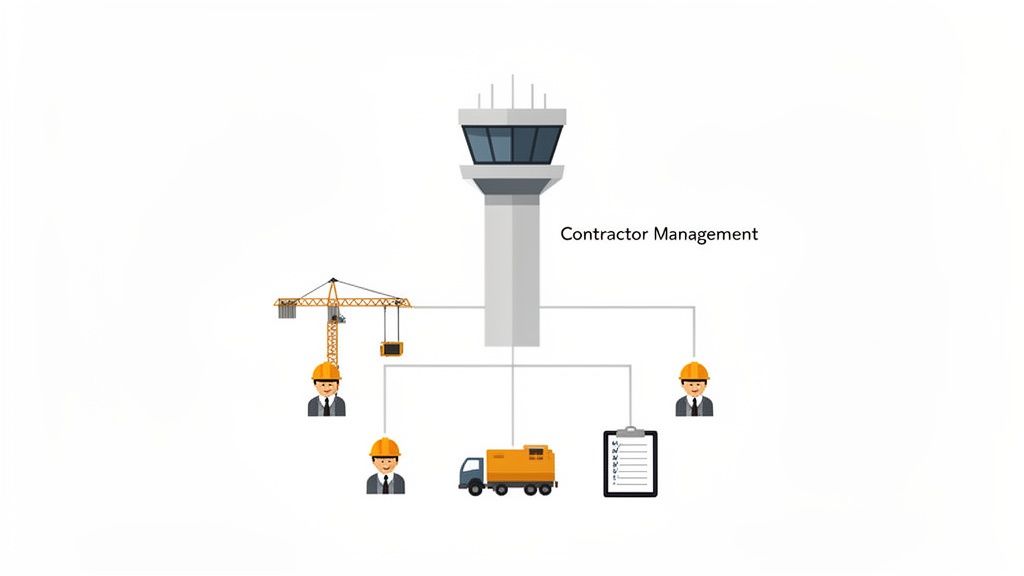
Bringing contractors onto a project is a bit like running a busy airport. Without a solid system, things can get chaotic fast. That’s where contractor management services come in.
It’s the entire framework for handling your external workforce, from the moment you vet them to the final sign-off. Think of it as a complete playbook that ensures every contractor works safely, meets all your legal and project requirements, and integrates smoothly with your operations.
When everything lives in email threads, real life looks like this: a welding package is ready to go but liability cover expired yesterday, or a crew gets a second generic induction because the last one never hit the central record. One pipeline for credentials, inductions, and permits stops those stalls.
A single gate before work starts
Treat the handover like an airport gate: check tickets, match people to the job they are cleared for, and only then issue access. That is the operational meaning of a controlled site—proof on file before boots cross the line.
What Are Contractor Management Services?
Imagine you're in an airport control tower. Your job is to coordinate every single plane, making sure they all take off and land safely without causing any disruption. That's exactly what contractor management does for your business. It’s the structured process that organises how you engage, monitor, and sign off on all work done by non-employees.
This isn't just about filing paperwork or ticking boxes. It’s a core business function that brings order to the complex dance of managing an external workforce.
Why a Structured Process Is Essential
Without a clear system, critical details slip through the cracks. Things like insurance renewals, licence verifications, and site-specific training get missed, opening you up to massive business risks. A structured process is your defence against this chaos.
And the need for these systems is only growing. More businesses than ever rely on contractors to get the job done. As of August 2023, there were 1.1 million independent contractors in Australia, which is 7.6% of the entire employed population. The construction sector alone accounted for 280,600 of them. You can dive deeper into these Australian workforce statistics if you're interested.
Key Activities in Contractor Management
A solid contractor management system is built on a few core activities. Each step flows logically into the next, creating a workflow that’s both repeatable and predictable.
Here’s what that typically looks like:
- Prequalification: This is your first line of defence. Before a contractor even gets a look-in, you vet their work history, qualifications, insurance coverage, and safety records. It’s about making sure they meet your non-negotiable standards from day one.
- Site Induction: Before any boots hit the ground, contractors need a thorough briefing on your site-specific rules, hazards, and emergency procedures. This isn’t a nice-to-have; it’s essential for ensuring they understand the unique environment they’re walking into.
- Performance Tracking: Once the work starts, you need to monitor it. This means regular check-ins, site inspections, and progress reports to confirm everything is aligning with the agreed-upon standards and timelines.
- Offboarding: When the project is wrapped up, there's a formal sign-off process. This involves finalising all paperwork, conducting a performance review, and officially closing out the contract so there are no loose ends.
By organising these activities into a single process, you move from a reactive approach to a proactive one. You are no longer just reacting to problems as they appear; you are actively managing the entire contractor relationship from beginning to end.
Understanding Your Core Responsibilities When Managing Contractors
When you bring contractors onto your site, especially in high-risk industries like construction or manufacturing, your job goes way beyond just paying their invoices. Under Australian Work Health and Safety (WHS) laws, you have a direct legal duty to ensure their safety, just as you do for your own employees. This isn't just about best practice; it's a fundamental legal obligation.
This responsibility lands squarely on the Person Conducting a Business or Undertaking (PCBU), which is the legal term for your business. As a PCBU, you hold the primary duty of care for absolutely everyone on your worksite, from contractors and their teams to any visitors passing through. You can't delegate this duty. It’s yours, and you can't outsource it.
Put simply: if a contractor is working for you, on your site, their safety is your responsibility.
Your Practical WHS Checklist for Contractors
Knowing the law is one thing, but turning those duties into daily actions is what actually keeps people safe and your business compliant. Your core responsibilities can be broken down into a practical checklist. This isn't about creating mountains of paperwork; it's about having a solid system for every single contractor you bring on board.
Here are the non-negotiables every manager needs to have covered:
- Verify Qualifications and Licences: Before any work kicks off, you have to confirm the contractor holds all the necessary licences and qualifications for the job. Think high-risk work licences, trade tickets, and any specific certifications for operating equipment.
- Confirm Insurances: A critical part of the puzzle is checking their insurance. You need to understand the different contractor insurance requirements and see current Certificates of Currency for, at a minimum, their Public Liability and Workers' Compensation insurance.
- Review Their Safety Plans: For any high-risk construction work, contractors must provide a Safe Work Method Statement (SWMS). It’s your job to review it carefully to make sure they’ve properly identified the hazards and planned out how to control them for that specific task.
From Paperwork to On-Site Action
Once you’ve got the paperwork sorted, your focus shifts to the physical worksite. This is where documented plans need to become real-world actions.
The first step is a site-specific induction. Every contractor needs to be briefed on your site’s unique hazards, emergency procedures, communication channels, and reporting rules before they even think about starting. This makes sure they aren’t walking in blind. For more detail on structuring these vital documents, check out our guide on creating effective WHS policies and procedures.
It’s easy to let these things slip, even for massive organisations. A 2021 audit of Services Australia, which had 4,269 contractors on its books, found major gaps in its management systems. The report pointed to big inconsistencies in mandatory training and security, proving that without a robust process, compliance can easily fall apart. You can read the full findings from the Services Australia performance audit on anao.gov.au.
Your final, and maybe most important, responsibility is active monitoring. The job isn’t done after the induction. You must actively supervise contractors to make sure they're sticking to the agreed-upon safety procedures and their own SWMS.
This means getting out on site, doing regular walks, observing how they work, and correcting unsafe practices on the spot. This ongoing oversight is what truly fulfills your duty of care. It closes the loop between planning and doing, ensuring safety stays front and centre for the entire project.
The Four Stages of an Effective Contractor Workflow
A solid contractor management process isn’t a one-off task; it’s a living workflow with clear stages. When you think about it this way, things stop falling through the cracks. It gives you a reliable structure to follow for every contractor, every single time. This approach breaks down a massive job into four manageable parts, each with its own specific goal.
Each stage builds on the last, creating a logical path from initial checks right through to project completion. This isn't about creating more red tape. It's about front-loading the important checks and maintaining oversight throughout the job, which is what prevents those much bigger, costlier problems down the track.
The process boils down to three core actions: verifying credentials, conducting proper inductions, and actively monitoring work on site.
This really highlights that managing contractors is a continuous loop of verification and supervision, not just a box-ticking exercise at the start of a project.
Stage 1: Prequalification
The first stage is prequalification. Think of this as your gatekeeping step, which happens before a contractor is even allowed to bid for work on your site. The goal here is simple: filter out any companies that don’t meet your non-negotiable standards right from the get-go.
It’s just like reviewing a candidate’s resume before deciding to interview them. You’re confirming they have the basic requirements to even be considered. This saves everyone a heap of time and immediately cuts down your risk.
During prequalification, you need to collect and verify:
- Company Information: ABN, contact details, and business registration.
- Licences and Qualifications: Relevant trade licences, high-risk work licences, and any other required certifications for their specific trade.
- Insurance Documents: Current Certificates of Currency for Public Liability, Professional Indemnity, and Workers' Compensation insurance.
- Safety Performance History: A look into their past safety record, including any incidents or notices from regulators.
Prequalification is your first and best chance to set clear expectations. It sends a message that you take compliance seriously and will only partner with contractors who feel the same way.
Stage 2: Onboarding
Once a contractor is prequalified and wins the job, the next stage is onboarding. This is critical, and it all has to happen before they set foot on your site to start work. The focus here is getting them up to speed with your specific work environment.
This is far more than a welcome chat. It’s a vital information transfer where you arm the contractor with the site-specific knowledge they need to work safely and efficiently alongside your own people. With Australia's major public infrastructure pipeline hitting a massive $242 billion and 41% of that work involving subcontractors, the complexity is enormous. This heavy reliance on contractors creates cascading compliance duties and makes a structured onboarding workflow absolutely essential. You can read more about this in the 2023 Infrastructure Market Capacity report.
Key onboarding tasks include:
- Site-Specific Induction: A detailed briefing on your site's layout, emergency procedures, first aid locations, unique hazards, and reporting processes.
- Permit to Work Issuing: Formal authorisation for specific high-risk jobs, like hot work, confined space entry, or working at heights.
- SWMS Review: A final check and formal acceptance of their Safe Work Method Statement for the exact tasks they’ll be performing on your site.
Stage 3: Monitoring
With the contractor now on-site and working, the workflow shifts into the monitoring stage. This isn’t a one-and-done check; it’s an ongoing process that lasts for the entire project. The goal is to actively verify that the plans and procedures agreed upon during onboarding are actually being followed.
This is where you move from paperwork to boots-on-the-ground observation. Trust is great, but verification is mandatory. Active monitoring ensures safety standards don't slip over time and that the work is being done as promised.
Monitoring activities involve:
- Regular Site Inspections: Scheduled and unscheduled walk-throughs to observe work practices and spot any new or uncontrolled hazards.
- Document Verification: Spot-checking that safety paperwork, like pre-start checks or equipment maintenance logs, is being completed and is readily available.
- Performance Check-ins: Regular meetings to talk about progress, tackle any issues, and confirm that work is staying on schedule and within scope.
Stage 4: Offboarding
The final stage is offboarding. This kicks off once the contractor finishes their work and is ready to leave the site for good. The whole point is to formally close out the contract and make sure every last loose end is tied up.
A proper offboarding process prevents future headaches and gives you invaluable data for your next project. It confirms that all contractual obligations have been met and gives you a chance to record honest feedback on the contractor's performance.
Essential offboarding steps are:
- Final Paperwork Submission: Making sure all required documents, like final reports or compliance certificates, have been received.
- Performance Review: A formal evaluation of the contractor’s work against your key metrics: safety, quality, and timeliness. This data is gold when deciding whether to hire them again.
- Final Sign-off: Officially closing the job in your system, processing the final payment, and revoking site access. This creates a clean, definitive end to the engagement.
The table below summarises how these four stages fit together to create a complete contractor management lifecycle.
Contractor Management Workflow Stages
| Stage | Key Actions | Primary Goal |
|---|---|---|
| Prequalification | Verify licences, insurance, and safety history before engagement. | Filter out non-compliant contractors and set minimum standards. |
| Onboarding | Conduct site-specific inductions and review Safe Work Method Statements (SWMS). | Prepare contractors for the specific hazards and rules of your site. |
| Monitoring | Perform regular site inspections and verify ongoing compliance. | Ensure agreed-upon safety procedures are being followed in practice. |
| Offboarding | Conduct performance reviews, collect final documents, and process final payments. | Formally close the contract and capture performance data for future use. |
Following this workflow ensures a consistent, structured approach that not only protects your business but also builds stronger, safer relationships with your contracting partners.
Choosing Software That Actually Solves Your Problems
Picking the right software for your contractor management services isn't about ticking off the longest feature list. It's about finding a tool that fixes the real, everyday problems you face on a busy manufacturing floor or construction site. Forget the fancy jargon, what matters is whether it makes your job easier and your site safer.
A system that looks great in a demo but is clumsy to use on the ground is worse than useless. The goal is to find software that fits into your existing workflow, not one that forces you to change everything just to suit its limitations. When looking for tools that truly solve problems, a great starting point is a comprehensive guide to contractor management software that outlines what to look for in the Australian market.
The right software stops being a burden and becomes a practical tool that genuinely supports your daily operations.
Focus on Core Functions First
Before getting distracted by flashy add-ons, you need to make sure the software nails the fundamentals. These are the non-negotiable features that form the backbone of any good system. Without them, everything else is just window dressing.
A solid platform must have:
- A Central Document Database: This is your single source of truth. It needs to store, organise, and give you instant access to every contractor’s licences, insurance certificates, SWMS, and qualifications. No more digging through emails or shared drives.
- Automated Expiry Alerts: Manually tracking renewal dates for hundreds of documents is a recipe for disaster. The system must automatically notify you (and the contractor) weeks before a licence or insurance policy expires, giving everyone plenty of time to get updated copies.
- Digital Onboarding Modules: Your site induction shouldn't rely on paper sign-in sheets and a rushed chat. A digital module lets contractors complete inductions online before they even arrive, covering site-specific rules and hazard awareness, with a digital record to prove it.
The real value of good software is its ability to automate the repetitive, low-value tasks that consume your time. This frees you up to focus on what actually matters, like being present on-site and managing real risks.
It Must Work Where the Work Happens
Your site supervisor isn't sitting behind a desk all day, so their management tools shouldn't be either. Any software that’s chained to a desktop is fundamentally broken for industrial environments. The reality of your work demands a mobile-first design.
Site managers and supervisors need to conduct inspections, verify documents, and log observations directly from the factory floor or construction site. A clunky mobile interface or a website that requires constant pinching and zooming just won't cut it. A dedicated, easy-to-use mobile app is essential for practical, on-the-ground use.
This means a supervisor can pull out their phone, scan a contractor's QR code, and instantly see if their qualifications are current and their induction is complete. That’s a real solution to a real problem.
Make Sure the System Adapts to You
Your company has established processes for a reason. The last thing you need is a rigid software system that forces you to abandon what already works. The best platforms offer customisable workflows that can be configured to match your specific steps for prequalification, onboarding, and monitoring.
For example, if your prequalification process involves a review by both the safety and operations departments, the software should allow you to build that two-step approval into the digital workflow. If it can't, you'll end up creating manual workarounds that defeat the entire purpose of buying the software in the first place. For a deeper dive into how software can support your entire workflow, explore our specific guide to contractor management software.
Ultimately, the software should serve your process, not the other way around. Look for flexibility and the ability to tailor the system to your real-world needs, ensuring it solves your problems without creating new ones.
How to Put a New Contractor Management System in Place
Bringing a new contractor management system online can feel like a massive undertaking, but if you break it down into a sensible plan, it's far more manageable. The goal isn't to flip a switch and change everything overnight. A successful rollout is gradual, thoughtful, and built around getting your people to actually use the new tools.
It all starts with a clear plan that accounts for the realities of your worksite. You need a roadmap that gets you from the initial decision to a fully adopted system that makes everyone's job easier, not harder.
Start with a Clear Business Case
Before you even think about software, you need to get your leadership team on board. This means moving beyond a vague desire to "get organised" and building a solid business case. You have to frame the change in terms of tangible outcomes that leaders actually care about.
Your business case should spell out exactly what problems the new system will solve. For instance:
- Slash the Admin Workload: Tally up the hours your team currently burns manually chasing expired insurance certs or filing safety paperwork. A new system automates this, freeing up your key people for higher-value work on site.
- Speed Up Contractor Onboarding: Show how long it currently takes to get a new contractor inducted and cleared to start. A digital system can shrink this time dramatically, getting critical projects moving faster.
- Get Instant Compliance Visibility: Explain that with your current manual process, proving compliance during an audit is a nightmare. A centralised system gives you an instant, clear, and defensible record of every contractor's qualifications and safety documents.
When you focus on efficiency gains and risk reduction, you’re not just asking for a new toy. You're presenting a direct solution to existing business pains, which makes it a much easier "yes" for leadership.
Assemble Your Team and Plan the Rollout
You don't need a huge committee for this. Just pull together a small, focused implementation team with people who will actually use the system every day. This should absolutely include a site supervisor, an administrator, and someone from your health and safety team.
With your crew in place, map out a phased rollout. Trying to switch on the system across all your sites at once is a recipe for disaster.
- Start with a Pilot Project: Pick one project or a single, contained worksite for the initial launch. This lets you test the system in a real-world setting, iron out any wrinkles, and fix things on a small scale first.
- Get Real Feedback: Actively ask the pilot group what's working, what's confusing, and what could be better. Use this direct input to refine your processes before you go any further.
- Expand Gradually: Once the pilot is running smoothly, you can start rolling the system out to other sites or projects one by one. This controlled expansion means each team gets the support they need to succeed.
Manage the Data and Train Your People
A new system is only as good as the information you put into it and the people who use it. The next critical step is getting your data migration right. This means pulling all your existing contractor info from scattered spreadsheets, email folders, and filing cabinets and getting it into the new system cleanly and accurately. Good, organised data is the foundation of a system you can actually rely on.
Finally, nail the training. Don't just email out a user manual and hope for the best. Run practical, hands-on training sessions for both your internal staff and your contractors. Show them exactly how to complete key tasks, like uploading documents or running through a digital induction.
Clear communication and proper training are what will turn your new software into an indispensable part of how you get work done safely and efficiently. You can learn more about how a well-structured contractor management system can support this entire implementation journey.
Ready to Get a Handle on Your Contractors? This is How Safety Space Helps
Trying to manage contractors can feel like a constant battle against chaos. You're juggling scattered spreadsheets, chasing down missing paperwork, and hoping nothing critical falls through the cracks. It's a time-suck, and it's risky.
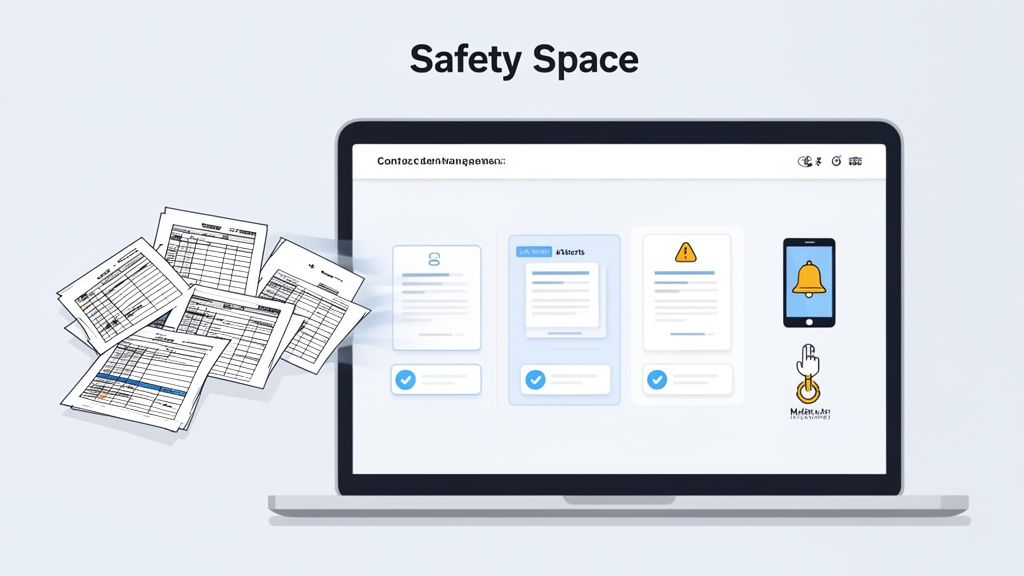
Safety Space was built by people who've lived that frustration. We designed it to replace all those manual, disconnected processes with one straightforward platform for all your contractor management.
Think of it as your central command centre. Instead of digging through emails to check if a contractor's insurance is still valid, you get an automatic heads-up before it expires. Instead of a pile of SWMS on your desk, every document is organised, easy to find, and ready for review in one spot.
A Practical Solution That Actually Works on Site
Safety Space is designed to solve the real-world problems that get in the way of managing risk properly. This isn't just another piece of software you have to force into your workflow; it’s a tool built for the realities of construction and industrial work.
Here’s what that looks like in practice:
- One Place for Everything: All contractor documents, qualifications, and inductions are managed from a single, clear dashboard.
- Smarter Verification: Our system uses AI-powered tools to help check documents, slashing the admin burden on your team.
- Info When You Need It: Supervisors on the ground can pull up any contractor's vital information right on their phone or tablet. No more running back to the site office.
We built Safety Space to give you your time back. By automating all the repetitive, low-value tasks, you can get out of the office and focus on what truly matters: being on-site and making sure work is being done correctly and safely.
Ready to see how a dedicated system can fix your contractor management headaches for good? Book a free, no-obligation demo and see the platform in action. We'll also throw in a complimentary H&S consultation to map out how Safety Space can fit your exact operational needs.
Got Questions About Contractor Management? We’ve Got Answers.
Even with the best systems in place, managing contractors throws up tricky questions. You’re not alone. Here are some of the most common queries we hear from managers on the ground, along with some straight-up answers.
What's the Real Difference Between an Employee and a Contractor?
This is a big one in Australia, and getting it wrong can be costly. While the line can feel a bit blurry, the legal distinction is actually quite clear and it all comes down to control and independence.
An employee works in your business, following your direction. A contractor, on the other hand, runs their own business and provides services to yours.
Think of it like this: you tell an employee how, where, and when to do their job. With a contractor, you’re paying them to achieve a specific result. They typically use their own tools, set their own hours to hit the deadline, and are free to work for other clients simultaneously. This distinction is critical because it completely changes your obligations for things like tax, superannuation, and leave entitlements.
What Paperwork Do I Absolutely Need Before a Contractor Steps on Site?
Sorting out the paperwork from day one saves a world of pain later. Before any contractor starts work, there's a non-negotiable set of documents you need to see. This isn't just red tape; it's about verifying their legitimacy and ensuring they're compliant.
Here’s a quick checklist of the must-haves:
- Business Details: Their registered business name and Australian Business Number (ABN) are essential.
- Insurance Certificates: You must get a current Certificate of Currency for their Public Liability insurance and Workers' Compensation.
- Relevant Licences: This includes any trade-specific licences (like for electrical or plumbing work) or high-risk work licences needed for the job.
- Safety Qualifications: Proof of any required safety training, like a White Card for construction work.
Don't treat this as a box-ticking exercise. Gathering these documents is a fundamental part of your due diligence. It’s how you confirm you’re bringing a legitimate, insured, and professional business onto your site.
If a Contractor Has an Accident, Who's Responsible?
This question keeps a lot of managers up at night, but the answer is simple: responsibility is shared.
Under Australia’s Work Health and Safety (WHS) laws, your business, as the Person Conducting a Business or Undertaking (PCBU), has a primary duty of care for every single person on your worksite.
And yes, that duty of care absolutely extends to your contractors and their workers. You can’t just outsource safety. While the contracting company also has a duty to look after its own people, you are legally on the hook for providing a safe working environment.
This means you’re responsible for identifying hazards on your site, putting risk controls in place, and making sure everyone, contractors included, knows and follows your safety procedures. If an accident happens, regulators will look at what both your company and the contractor did (or didn't do) to meet their legal duties. It's a team sport, and everyone has a role to play in keeping the site safe.
Tired of chasing paperwork and want a clear, simple way to nail your contractor compliance? Safety Space brings it all together on a single platform. Book a free demo today and see how you can get your contractor management organised and get your time back.
Ready to Transform Your Safety Management?
Discover how Safety Space can help you implement the strategies discussed in this article.
Explore Safety Space FeaturesRelated Topics
Safety Space Features
Explore all the AI-powered features that make Safety Space the complete workplace safety solution.
Articles & Resources
Explore our complete collection of workplace safety articles, tools, and resources.