
A contractor arrives at the gate with a White Card, a licence saved as a phone image, and an induction record buried in an email thread. The supervisor can't confirm whether the documents are current, whether the worker is approved for this site, or whether a required competency is missing. Entry is delayed, or worse, granted on incomplete evidence.
A contractor safety passport system addresses that control failure by connecting worker identity, training, competency evidence and site permissions in one managed record. It doesn't remove the PCBU's duties under Australian WHS law. It gives the PCBU a more reliable way to apply them before work begins and whenever a contractor returns.
Table of Contents
- Defining the Contractor Safety Passport System
- Meeting Australian WHS Compliance Requirements
- Core Features of Digital Workforce Management
- Navigating White Card and Data Governance Rules
- Rolling Out the System Across Multiple Sites
- Evaluating Platforms for Contractor Oversight
Defining the Contractor Safety Passport System
A contractor safety passport system is a dynamic compliance control, not merely a digital ID card. It links a verified worker profile to training records, licences, competencies, site inductions and access decisions. The system should answer a practical question at the gate: is this identified person currently authorised and competent to perform the approved work at this site?
Paper records usually answer a different question. They show that someone completed a form or attended an induction at some point. They don't necessarily show whether the induction has expired, whether the worker's role has changed, or whether a site manager has approved access for the current project.
Practical rule: Treat the passport as the decision point for access, not as a filing cabinet with a QR code.
A workable model has four connected controls:
- Identity verification: The worker's identity is matched to a profile and access credential.
- Training evidence: General and site-specific induction records are logged with completion dates and status.
- Competency evidence: Licences, qualifications and role-specific approvals are attached to the worker's record.
- Access permissions: The gate or site administrator grants access only when required controls pass.
The Australian model has developed in this direction over time. Bouygues Construction Australia describes an online contractor workflow where businesses create profiles, workers upload licences and competencies, complete online inductions and receive access ID cards linked to their profiles. The University of Sydney's contractor system also brings together onboarding, induction, permit-to-work approvals, corrective action tracking and pre-qualification in one contractor management process. These examples show why the passport concept is broader than a card.
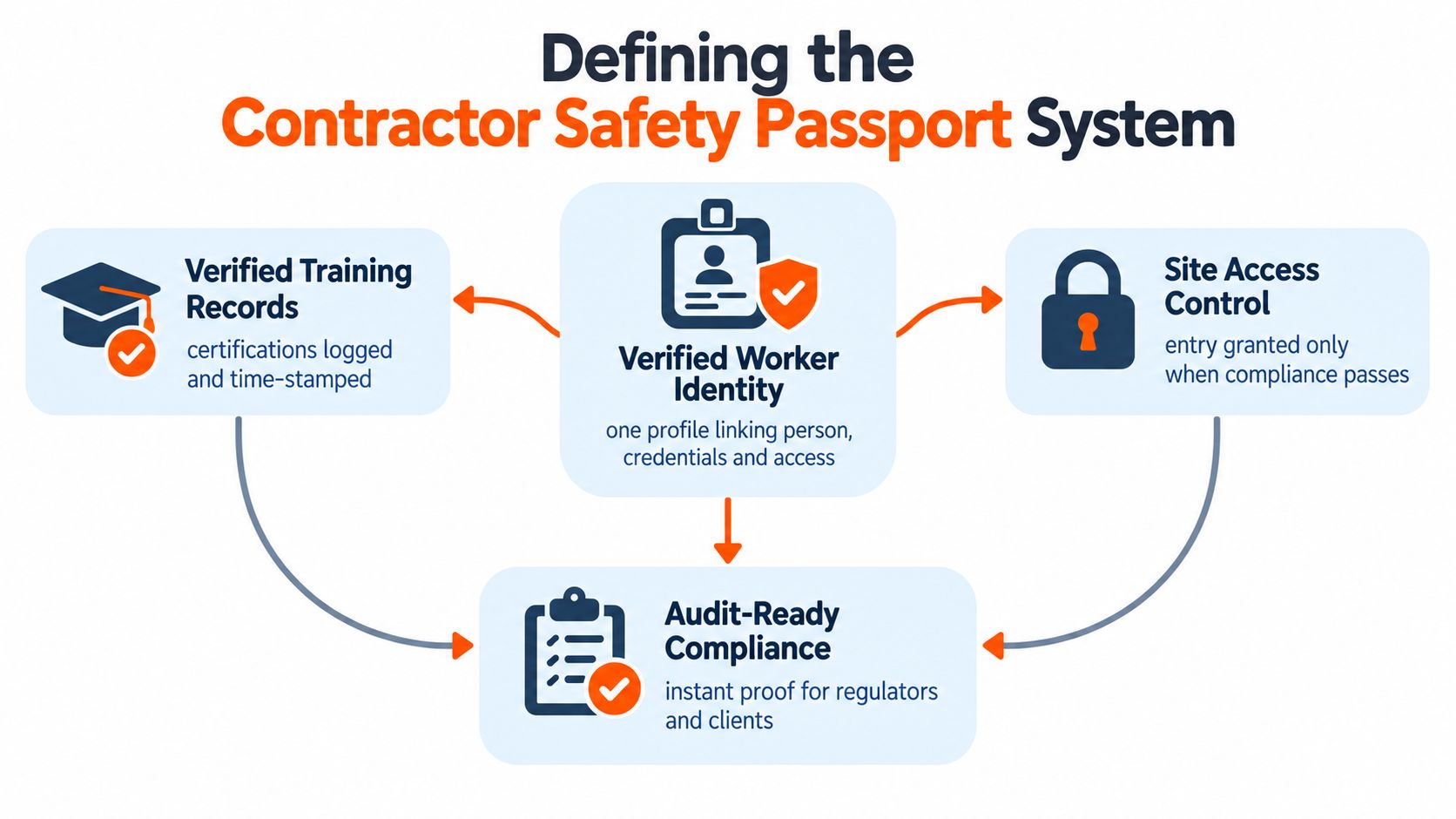
The operational benefit comes from connecting the records. If an induction expires, the system should flag the worker before the next visit. If a licence is missing, the contractor coordinator should see the exception before mobilisation. If a worker changes from low-risk maintenance to high-risk electrical work, the approval should reflect the new role rather than rely on a generic contractor status.
For a broader explanation of the surrounding process, see this guide to what contractor management involves. The passport is one control within that system, and it works only when procurement, supervisors, site administrators and contractors maintain the underlying data.
Meeting Australian WHS Compliance Requirements
A passport doesn't create a separate legal duty. It helps a PCBU perform existing duties with evidence that can be checked consistently. Under Australian WHS arrangements, the PCBU remains responsible for managing risks to workers and other people affected by the work. Contractor access must therefore connect to the actual hazards, controls and work scope, not just to an administrative approval.
Construction induction is the clearest example. Safe Work Australia states that a worker mustn't carry out construction work without successfully completing general construction induction training. A worker whose training is older than two years and who hasn't carried out construction work during that period must also be retrained, as set out in the construction induction guidance.
Comcare's guidance adds a formal application requirement for the White Card. A worker becomes eligible to apply after successfully completing approved training, and the application must be lodged within 60 days of the training certification date. The application also requires certified proof of identity totalling 100 points. That makes the White Card a regulated identity and competency checkpoint, particularly relevant in Australian Capital Territory and Commonwealth construction environments, rather than a basic attendance record. These requirements are set out in Comcare's construction induction card guidance.
What the gate should verify
A passport system should enforce the sequence, not merely store documents:
- Confirm the worker's identity and employing business.
- Check the White Card or other legally required construction induction evidence.
- Confirm the role-specific licence and competency requirements.
- Complete the site's own induction and any task controls.
- Check that the worker is approved for the relevant work area and project.
The White Card remains a separate legal gate. Safe Work Australia's construction duties guidance confirms that workers must hold a construction induction card before starting construction work, while the PCBU retains the primary duty to manage risks. A passport sits alongside those obligations. It can't replace them.
Insurance and risk allocation also deserve attention. A useful companion resource is this brokers checklist for builders, which helps project leaders consider how compliance arrangements interact with broader construction risk and insurance decisions.
The practical consequence is straightforward. If the system allows an unqualified worker through because a scanned document looks complete, the organisation has a control failure even if the database shows a green status. Configure the passport to block unresolved exceptions, record who approved overrides, and retain the evidence needed to demonstrate how the PCBU controlled access.
Core Features of Digital Workforce Management
A contractor may arrive with valid documents and still lack approval for the work area, task, or site conditions. Digital workforce management should therefore connect company approval, worker evidence, induction status, and access decisions in one controlled record. The passport becomes a compliance control point, not just a digital ID card.
Bouygues Construction Australia's workflow is instructive for one reason: the access ID card is generated only after licence and induction records are attached to the worker profile. The credential at the gate is therefore tied to evidence that can be reviewed, rather than existing as an isolated card number.
The record structure
A contractor safety passport system should connect at least these records. For a fuller explanation of how records link across projects, see this guide to workforce management systems.
- Business profile: Legal entity details, insurance evidence, pre-qualification status, and approved service categories.
- Worker profile: Identity, employer, role, work scope, training history, and current access status.
- Document register: Licences, tickets, certificates, issue dates, expiry dates, and supporting evidence.
- Induction workflow: Online modules, assessments, site rules, and completion confirmation.
- Approval record: The person who reviewed the evidence, the decision made, and any access conditions.
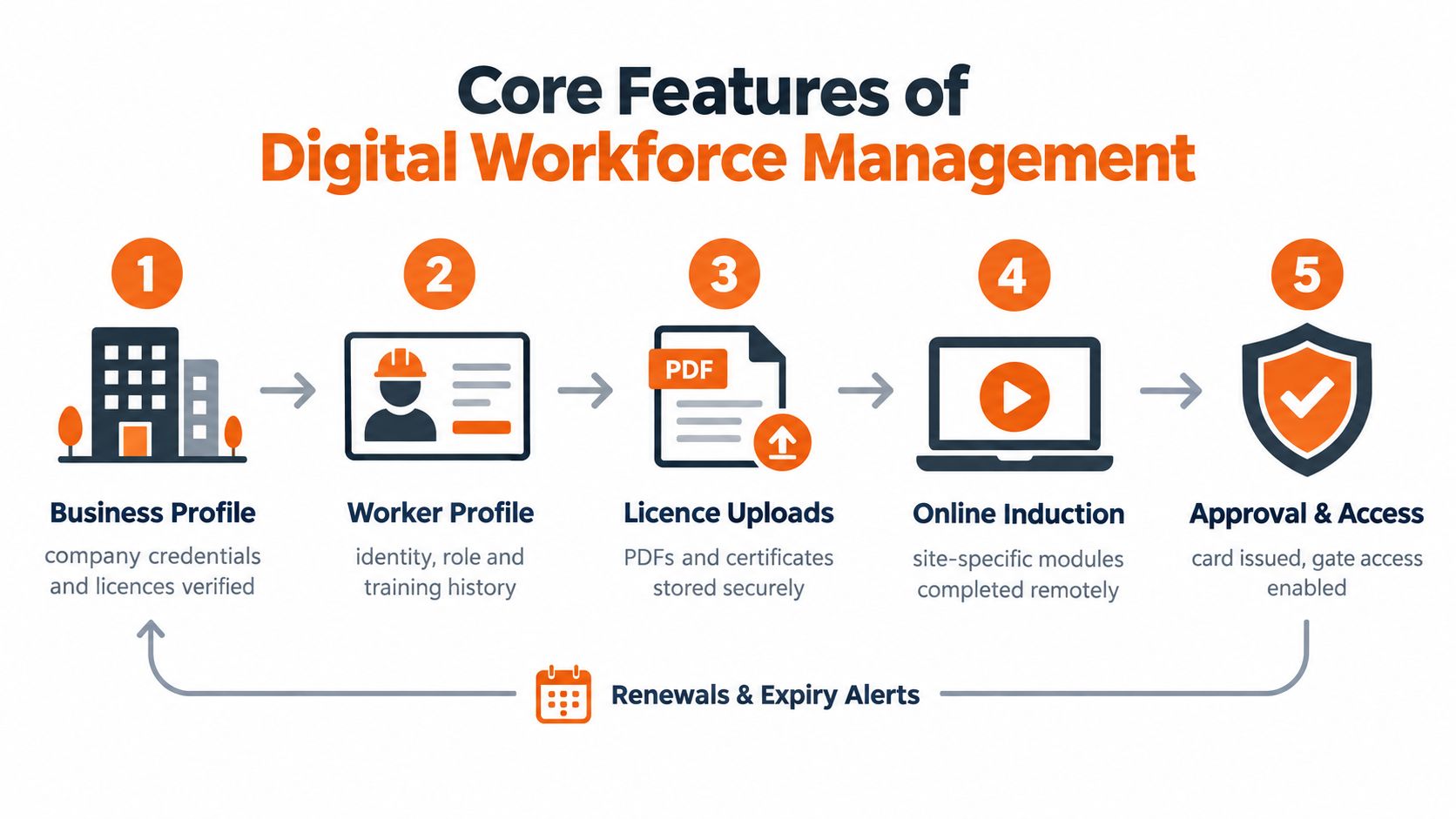
Site-specific induction must remain separate from general competency evidence. A worker can hold the correct trade licence and still need instruction on a particular plant's traffic routes, emergency arrangements, hazardous substances, reporting process, or permit controls. The Department of Health and Aged Care provides an example through its mandatory contractor WHS induction module, which covers WHS obligations, hazard identification, risk management, and incident reporting. Completion is confirmed by email using the contractor ID or business name, as described in its WHS induction module.
That completion record should feed into the passport. Supervisors should not search an inbox or rely on a downloaded certificate to determine whether site requirements are met. The system should display the module, completion status, worker identity, applicable site, and any approval condition.
The operational trade-off is data ownership. Digital storage reduces duplication only when assigned people review documents, manage expiry decisions, and update contractor status. Without those controls, the platform produces unreliable records faster.
Navigating White Card and Data Governance Rules
A QR code confirms that a passport record exists. It does not establish that the underlying evidence is legally sufficient. A site manager who relies on a policy number, expiry date or training status still needs to know who issued the document, whether it is current and whether it matches the work being performed.
The White Card boundary set out earlier still applies. A digital passport can record the card, check its status and support gate decisions, but it cannot substitute for the card's legal function under Safe Work Australia's construction WHS duties.
Source evidence versus summary data
Treat summary data as an access-control aid, not as the complete compliance record. The register should state:
- Credential ownership: Whether the worker, contractor business or principal controls the original evidence.
- Verification responsibility: Which role checks authenticity, relevance and currency.
- Retention rules: How long the organisation keeps each record and the reason for retention.
- Access permissions: Which administrators, supervisors and gate staff may view personal information.
- Override controls: Who may approve an exception, for what reason and for how long.
Retention and verification rules are easier to enforce when training records sit in one register. See this guide to training record management for a workable structure.
SubPass describes a model in which workers share a compliance passport through a QR code, while site managers view summaries such as policy numbers and expiry dates. That supports rapid screening, but a summary may not satisfy legal due diligence. Depending on the site, the principal may still need the underlying policy, licence, clearance or role-based verification.
A valid access credential proves an access decision was made. It does not prove that every document behind the decision was properly verified.
Privacy controls need an assigned owner and a defined process. Collect only information required for the WHS and access purpose, restrict administrator access and provide a way to correct outdated records. Update the passport promptly when a contractor leaves a business, changes roles or loses a licence. An active profile that no longer reflects the worker's status creates false assurance at the gate.
Manufacturing and industrial sites may also require security passes, clearances or area restrictions. Keep those controls distinct where necessary, then connect their current status to the access decision. The passport should show whether the worker is ready for the defined work and area, while preserving the separate evidence and approvals that support that decision.
Rolling Out the System Across Multiple Sites
A multi-site rollout needs shared rules with controlled local variation. Give every location the same contractor identity, evidence structure and approval logic, then let each site add requirements tied to its hazards, plant, work scope and access arrangements. This avoids two operational failures: applying unsuitable rules everywhere, or forcing contractors to repeat the same process without a clear compliance reason.
Start with the decisions the passport must support. Define contractor categories, the evidence each role requires and the person authorised to approve it. Set separate validity rules for inductions, licences, clearances and site permissions. One expiry period will not suit every control.
Pilot the model at a site with enough contractor activity to expose weaknesses, while keeping its approval paths manageable. Test expired training, missing documents, changed roles and urgent mobilisation before extending the process. Include procurement, WHS, operations and supervisors in the test, because each may own a different decision. Once the workflow works, copy the common profile and document structure to other sites, then add local inductions and permissions.
Australian requirements show why configuration matters. A South Australian council contractor induction remains valid for two years, while a Western Australian public-school contractor WHS induction is valid for 12 months and must be completed on arrival at the site. The South Australian council contractor induction information shows that a passport is time-limited, not permanent approval. Site owners must confirm their own duties and conditions rather than copy either example.
Make the contractor journey explicit: pre-qualification, document submission, general and site-specific induction, role approval, attendance confirmation, then access. The University of Sydney's contractor process illustrates how onboarding can connect with induction, permit-to-work approvals, corrective actions and pre-qualification.
Site access is only one control point. During the job, supervisors need to check that the approved scope matches the planned work, corrective actions are closed or managed, and any permit-to-work approval exists before work starts. A passport that reflects those live decisions supports operational control. A static record at the gate does not.
Evaluating Platforms for Contractor Oversight
Choose a platform by testing the decisions it can enforce, not by counting features on a product sheet. The essential question is whether the system helps the organisation prevent unauthorised access, identify exceptions early and produce reliable evidence after an incident or audit.
Legacy spreadsheets often separate the contractor list, licence register, induction records and site access log. Paper forms add another layer of duplication. That arrangement can work for a small, stable workforce, but it becomes fragile when contractors move between sites, subcontractors change, or supervisors need current information during a shift.
Test the workflow with real exceptions
Ask each platform provider to demonstrate these scenarios using your own operating rules:
- An expired induction: Does the system block access, notify the right owner and show the reason?
- A changed work scope: Can a worker move from general maintenance to a higher-risk task only after the required approval?
- A missing SWMS: Can the site prevent work from starting until the document is reviewed?
- A licence update: Can the contractor upload new evidence while preserving the verification history?
- A multi-site worker: Can one identity record hold different site inductions and permissions without creating duplicates?
- An urgent arrival: Can an authorised person apply a controlled, time-bound exception with a clear audit trail?
The platform should support contractor pre-qualification, licence and insurance verification, SWMS checks, induction, corrective action tracking and permit-to-work approvals where those controls form part of your process. It should also show who approved each record and when, rather than presenting a status that no one can explain.
Review the vendor management guide from MR2 Solutions when comparing vendor governance practices with your contractor oversight model. The same principle applies to safety software: define ownership, approval gates and escalation paths before you configure screens.
Safety Space is one option for organisations seeking a customisable WHS management platform with contractor pre-qualification, induction and tracking, including verification of licences, insurance and SWMS before work starts. Assess it against your actual site workflow, data governance requirements and access controls rather than assuming any platform will fit without configuration.
The right system doesn't replace supervisor judgement. It makes the required evidence visible before that judgement becomes an urgent gate decision.
Start by auditing one site's current contractor journey from sourcing to demobilisation. Record every document check, approval, induction, expiry alert and access decision. Then compare that workflow with platform demonstrations and require each vendor to show how the system handles failed checks, not just successful onboarding.
Safety Space brings contractor pre-qualification, induction, document verification and multi-site oversight into a configurable WHS management platform. Review your current gate controls and see how Safety Space could support clearer approvals, live compliance records and accountable contractor access.
Ready to Transform Your Safety Management?
Discover how Safety Space can help you implement the strategies discussed in this article.
Explore Safety Space FeaturesRelated Topics
Safety Space Features
Explore all the AI-powered features that make Safety Space the complete workplace safety solution.
Articles & Resources
Explore our complete collection of workplace safety articles, tools, and resources.