
Think of contractor management as the official rulebook for every external worker who sets foot on your site. It’s a formal system for handling the entire journey of a contractor, from initial background checks and vetting right through to the final project sign-off.
This isn't just about shuffling paperwork. It's about making sure every contractor is qualified, insured, and understands your site-specific rules before they start work.
What a Contractor Management System Really Does
At its heart, a proper system for managing contractors creates a consistent, repeatable process for every external worker who comes through your gates. In high-risk industries like construction and manufacturing, you simply can't afford to wing it. This structured approach gets you away from relying on messy spreadsheets, paper forms, and someone's memory, all of which are breeding grounds for error and create serious legal exposure.
Instead, you establish a single, reliable way to check credentials, deliver essential training, and control who gets access to the site. The main goal? To ensure that only qualified and prepared people are allowed to do the work. It’s a foundational step in dialling down project risks and stopping incidents before they happen.
Creating a Controlled and Compliant Worksite
A well-organised approach to contractor management tackles some of the biggest operational headaches head-on. Without a formal process, it’s frighteningly easy for unqualified workers to get on-site, for insurance certificates to expire without anyone noticing, or for important induction info to be completely missed.
A formal system acts as a gatekeeper. It makes sure that all the compliance checks are ticked off before a contractor can even be issued a permit to work. It gives you a clean, auditable record of who is on-site, what they're cleared to do, and confirms they have the right tickets for the job.
This isn't about creating more red tape. It’s about building a predictable and safe operational framework that protects your projects, your people, and your business. A solid system delivers:
- Verifiable proof of competency: A clear, documented trail showing that every contractor meets your company's minimum standards for skills, licences, and insurance.
- Consistent onboarding: A standard process for site inductions ensures every contractor hears the same critical information about your worksite's hazards and procedures. No more 'he said, she said'.
- Improved operational control: A single, central view of all contractor activity helps you manage project timelines and resources more effectively.
Ultimately, effective contractors management services give you the structure needed to oversee a complex, temporary workforce while keeping a firm grip on your legal and operational responsibilities. To dig a bit deeper into the fundamentals, you can get a more detailed explanation of what contractor management is and why it's so crucial for modern worksites.
The Five Key Stages of Contractor Management
Managing contractors effectively isn't a single tick-box exercise. It's a lifecycle, a structured process that starts long before they set foot on your site and finishes well after they've packed up. Think of it as a repeatable framework that ensures every external worker and company is vetted, prepared, and monitored from start to finish.
The whole process boils down to a simple, logical flow: you vet them, you train them, and you track them.
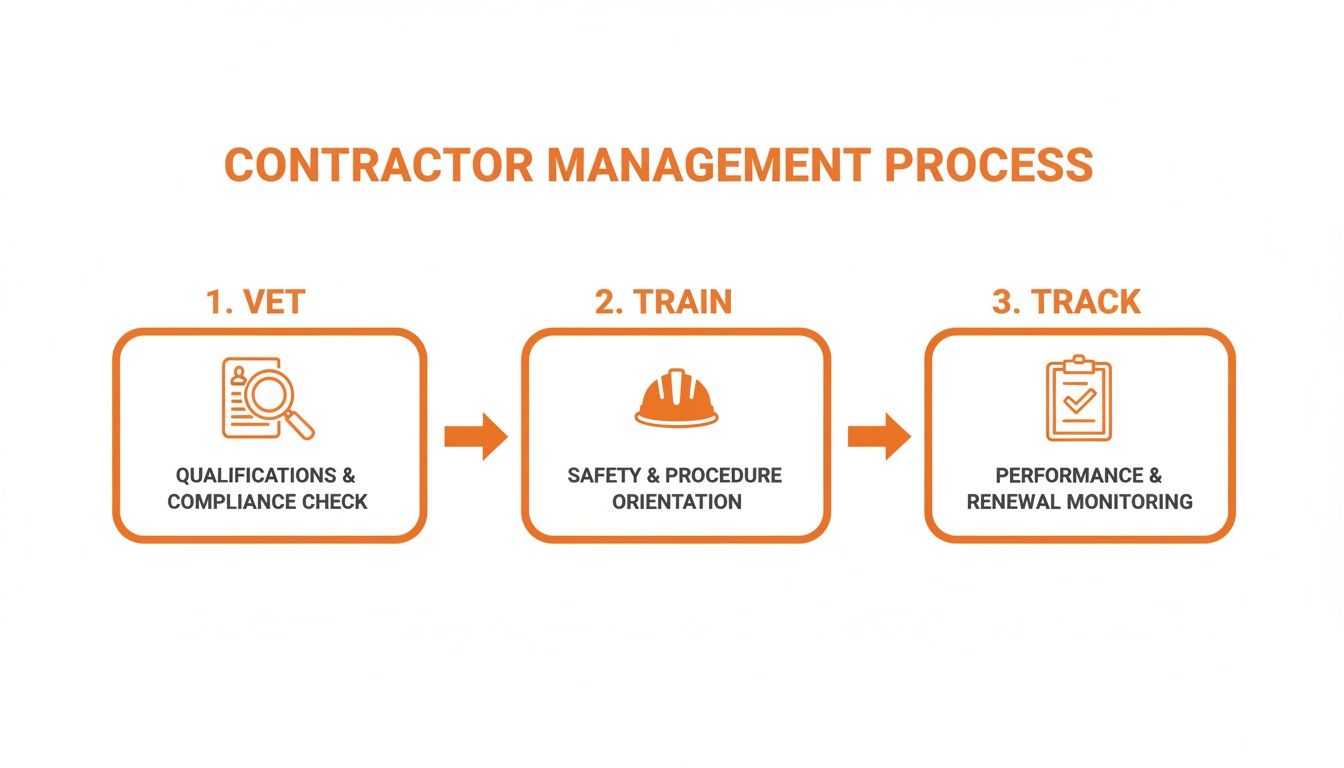
This simple flow is powerful. It shows that a rock-solid system is built on a foundation of verification, followed by clear communication of your rules, and capped off with active oversight. Each stage builds on the last, creating a controlled and predictable work environment.
To get this right, you need to understand the distinct stages involved. We've broken down the entire lifecycle into five core stages, detailing what needs to happen at each point to keep your operations safe and compliant.
| Stage | Primary Goal | Key Activities |
|---|---|---|
| 1. Prequalification | Check a contractor company meets your minimum standards before engagement. | Checking insurances, validating licences and certifications, reviewing past performance. |
| 2. Induction & Training | Ensure every individual worker understands your site-specific rules and hazards. | Site-specific online or in-person training, hazard awareness, emergency procedure briefing. |
| 3. Work Authorisation | Formally approve and control high-risk activities before they begin. | Issuing and managing Permits to Work (e.g., hot work, confined space). |
| 4. On-site Monitoring | Actively confirm contractors are following the rules while on site. | Supervisor checks, spot audits, verifying permit conditions are being met. |
| 5. Post-Work Evaluation | Assess performance to inform future decisions and drive continuous improvement. | Performance reviews, incident analysis, updating approved vendor lists. |
By following these five stages, you create a closed-loop system that not only manages current risk but also learns from past performance to make smarter, safer decisions in the future. Now, let's look at what each of these stages looks like in practice.
Stage 1: Prequalification
Before a contractor company even gets a look-in for a job, they need to be pre-qualified. This is your first line of defence, the initial vetting stage where you confirm they meet your minimum standards for things like insurance, licences, and safety history.
Think of it as a background check for a business. It’s all about due diligence to weed out unqualified or high-risk companies before they become your problem.
During this phase, you’ll be busy collecting and checking key documents:
- Checking Insurances: Do they have current and adequate Public Liability and Workers' Compensation insurance? You need to see the certificates.
- Licence and Certification Validation: Are their trade licences, high-risk work licences, and other critical certifications valid for the work they'll be doing?
- Reviewing Past Performance: What does their track record look like? Checking references helps you gauge their reliability and competence.
A robust pre-qualification process is non-negotiable. It stops potential issues from ever getting through your gate.
Stage 2: Induction and Training
Once a contractor company is pre-qualified, the focus shifts to the individuals they send to your site. Every single worker must complete a site-specific induction before they can start. This isn’t a generic "be safe" chat; it's detailed training on your worksite’s unique hazards, rules, and emergency procedures.
The goal here is simple: nobody picks up a tool without understanding the specific risks they'll face at your location. A welder at a chemical plant needs to know about your flammable material zones, not just the general rules for hot work.
A standard induction process guarantees that every contractor, regardless of their trade or employer, receives the same critical safety information. It removes guesswork and establishes a baseline of site knowledge for everyone.
This is where you set crystal-clear expectations from day one, covering everything from signing in and first aid locations to emergency evacuation plans and site-specific hazards.
Stage 3: Work Authorisation
With inductions complete, it’s time to authorise the actual work. For anything high-risk, this is managed through a Permit to Work system. This is a formal, documented process that acts as a final checkpoint, making sure a hazardous job has been properly planned and assessed before it kicks off.
This is a critical control point for tasks where things could go very wrong, very quickly.
Common permit types include:
- Hot Work Permits: For any task involving open flames, sparks, or high heat, like welding or grinding.
- Confined Space Entry Permits: For work inside tanks, pits, vessels, or any enclosed area with limited access.
- Working at Heights Permits: For jobs on scaffolding, rooftops, or elevated work platforms where fall protection is critical.
The permit confirms that all precautions are in place, the right gear is being used, and everyone involved knows the plan.
Stage 4: On-site Monitoring
Just because the work has started doesn't mean your job is done. On-site monitoring involves actively checking that contractors are sticking to the rules and the conditions of their work permits. This isn't about micromanaging; it's about visible leadership and making sure the plan on paper is being followed in practice.
This can range from daily checks by a supervisor to more formal, scheduled audits of a contractor's work area. It creates a real-time feedback loop, letting you catch and correct unsafe practices on the spot. An active presence on the ground is what keeps a project on track and maintains a controlled work environment.
Stage 5: Post-Work Evaluation
The final stage kicks in after the tools are down and the job is finished. A post-work evaluation is your chance to assess the contractor’s overall performance. Did they meet the brief? Did they follow your safety rules? Were there any incidents or near misses along the way?
This feedback is gold. It provides hard data to inform your future procurement decisions. A contractor with a stellar safety and performance record might be fast-tracked for the next project. On the other hand, one with a poor showing might be flagged for review or even removed from your approved list.
This stage closes the loop, making sure your contractor management system is always learning and improving.
Why Proper Contractor Management Isn't a 'Nice-to-Have'
Thinking of contractor management as just another admin task is a gamble you can't afford to take. For any operations manager or business owner, a messy, disorganised approach is a direct threat to your legal standing, site productivity, and ultimately, your bottom line. This isn't about ticking boxes; it's about maintaining control.
When you don't have a solid system in place, you’re basically leaving the front gate wide open to risk. An unqualified worker wandering into a high-risk area, a company with expired insurance doing a job on your site, or a crew getting an inconsistent safety briefing are not small slip-ups. They are massive liabilities just waiting to blow up.
And the consequences are very real. We're talking about heavy fines and project delays that gut your profitability, not to mention the lasting stain on your company's reputation. A single incident involving a contractor can trigger a full-blown regulatory investigation, grinding work to a halt and putting your entire operation under a microscope.
The Growing Reliance on Subcontractors
The days of juggling a small, familiar group of external workers are long gone. Today's worksites, especially in construction, are tangled networks of subcontractors. This explosion in numbers multiplies the points of contact and layers of responsibility for project leaders, making robust contractors management services an absolute necessity.
Across Australia’s construction and high-risk sectors, the scale of contractor networks has ballooned. The major public infrastructure pipeline is sitting at around AUD 242 billion, with an estimated 41% of this work being delivered by subcontractors. That means nearly half of all on-site activity is performed by contractors, creating more handovers and shared duties than ever before. With the wider construction industry pulling in an estimated AUD 521.2 billion in revenue, no one can afford a costly shutdown caused by poor subcontractor oversight. You can get more data on the infrastructure pipeline from Infrastructure Australia's market capacity report.
Relying this heavily on external teams without a formal system means you're flying blind, losing visibility and control over a massive chunk of the work being done under your banner.
From Reactive Firefighting to Proactive Control
A proper management system flips your whole approach from reactive to proactive. Instead of running around putting out fires after they’ve started, you stop them from ever igniting. It’s the difference between mopping up a huge spill and making sure the container never tips over in the first place.
Here’s a real-world example:
- Without a system: A worker with a dodgy, fraudulent ticket for operating heavy machinery rocks up to site. He signs a paper form, gets a generic safety talk, and is sent off to work. The problem isn't caught until something goes wrong or a random audit happens to flag it.
- With a system: That same worker’s details are entered into a digital platform long before they set foot on site. The system immediately flags the invalid ticket and blocks them from being approved. They’re stopped before they can even get their hard hat on.
This proactive gatekeeping is where the real value lies. It transforms critical checks from a manual, error-prone headache into an automated, reliable safeguard.
A well-structured contractor management process is your business's immune system. It identifies and neutralises threats like non-compliance or lack of qualification before they can cause systemic damage to your project's health.
This shift has a direct and immediate impact on your finances. Every unqualified worker blocked, every expired insurance policy caught, and every permit correctly issued is a potential incident, fine, or delay you’ve successfully sidestepped.
Protecting Your Business Bottom Line
At the end of the day, the argument for organised contractor management comes down to money. It's about protecting your profitability and keeping the business running smoothly. Putting resources into a structured process isn't an expense; it's an investment in risk mitigation that pays for itself over and over.
Here’s how it connects directly to your financial health:
- Reduced Legal Exposure: Having a documented, consistent management process is your best defence. It demonstrates due diligence and shields you from fines and legal battles.
- Improved Project Timelines: When you ensure only qualified and prepared contractors are on site, you slash the risk of errors and incidents that lead to expensive delays.
- Stronger Reputation: Being known as a well-organised and safe principal contractor makes you a magnet for both top-tier clients and high-quality subcontractors.
Ignoring these fundamentals is a direct threat to your operational stability. In a complex, high-risk world, a strong framework for managing contractors is one of the most practical and effective shields you can have for your business.
How to Choose the Right Contractor Management Software
Picking the right contractor management software isn't just a tech decision. It’s a critical choice that will shape how you handle risk, stay compliant, and manage your day-to-day operations. When you’re ready to move on from a chaotic mix of spreadsheets and paper forms, you need a tool that actually fits the way you work. The whole point is to find a platform that solves more problems than it creates.
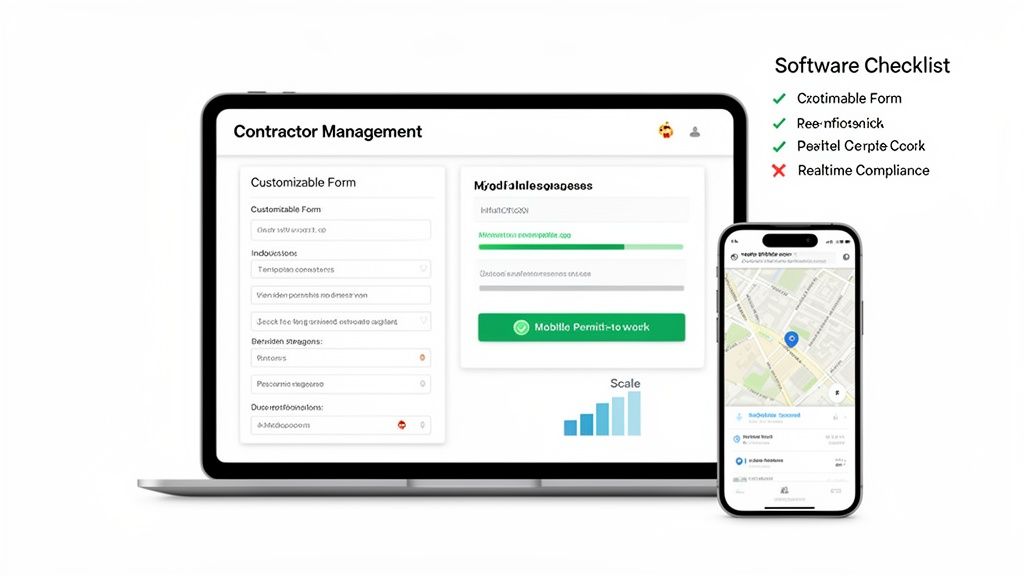
This is more than just buying software; you’re investing in a system that will sit at the very heart of your worksite. The best choice will feel like a natural part of your team, making life easier for everyone, from the H&S manager in the office to the supervisor on the ground.
Core Features You Cannot Overlook
When you start looking at different platforms, it’s easy to get sidetracked by flashy features you’ll probably never touch. My advice? Zero in on the core functions that deliver real, practical value. These are the absolute non-negotiables a solid system for contractors management services must have.
Customisable Pre-qualification: Your business has its own unique standards for contractors. A generic, one-size-fits-all pre-qualification form just won't cut it. Look for a system that lets you build and tweak your own vetting questionnaires to get the exact information you need, whether that’s specific insurance details, trade licences, or proof of past project experience.
Automated Induction Tracking: Manually chasing contractors to complete their site inductions is a massive time sink and a huge headache. The right software should handle this for you, from sending out training invites to tracking who has completed it and automatically flagging anyone who is out of date.
Mobile-Friendly Permit to Work: High-risk work doesn’t happen behind a desk. Your supervisors and contractors need to be able to manage permits right there in the work area. A functional mobile app is a must-have for issuing, approving, and signing off on permits in real-time, directly from a phone or tablet.
Real-Time Compliance Dashboards: You need a single, clear view of where all your contractors stand, right now. A good dashboard will show you at a glance who is approved to be on site, whose qualifications are about to expire, and which companies have actions they still need to complete.
Usability and Scalability
Let’s be honest: even the most powerful system is completely useless if your team and your contractors find it too complicated. The platform you choose has to be straightforward for everyone involved. If a contractor can't easily upload their documents or a supervisor can't figure out how to issue a permit, they'll just find a workaround, and you’ll be right back where you started.
The real test of any software is its adoption rate. If the platform is intuitive and makes life easier for contractors and your own staff, they will use it. If it's clunky and confusing, it will quickly become expensive, unused shelf-ware.
Beyond ease of use, you need to think about the future. Your business is going to grow, and your software needs to be able to grow with it. Ask potential vendors how their system handles more users, more projects, or more sites. A scalable solution will support your expansion without forcing you into a costly and painful overhaul down the track. To see what's out there, you can review this helpful guide to contractor management systems.
Checklist for Contractor Management Software
To help you compare your options, here’s a quick checklist of what to look for. Think of this as your starting point for asking the right questions and making sure you cover all the important bases.
| Feature Category | What to Look For | Why It Matters |
|---|---|---|
| Onboarding & Vetting | Fully customisable pre-qualification forms and workflows. | Ensures all contractors meet your specific safety, insurance, and quality standards before they set foot on site. |
| Training & Inductions | Automated induction delivery, tracking, and renewal reminders. | Saves countless admin hours and guarantees everyone on site has completed the required, up-to-date training. |
| On-Site Operations | Mobile-first design for permits, SWMS, and inspections. | Lets workers manage safety tasks in the field, not back in the office, improving accuracy and real-time oversight. |
| Compliance & Reporting | Real-time dashboards with visual alerts for expiring documents. | Gives you an instant, high-level view of your compliance status, so you can address risks before they become problems. |
| Integration | Open API or pre-built integrations with your existing systems (e.g., HR, finance). | Prevents data silos and double-handling, creating a single source of truth for all contractor-related information. |
| User Experience | Intuitive interface for both your team and external contractors. | High adoption is key to ROI. If the system is difficult to use, people simply won't use it, defeating the purpose. |
| Support & Partnership | Australian-based support, clear onboarding process, and ongoing training resources. | A good provider acts as a partner, helping you configure the system and get the most value out of your investment. |
Ultimately, the goal is to find a system that not only ticks these boxes but also feels like the right fit for your company’s culture and operational flow.
Integration and Support
Finally, remember that no software works in isolation. Your contractor management platform will need to talk to the other systems you rely on, like your accounting software for invoicing or HR systems for keeping records. Smooth integration stops you from having to enter the same data in multiple places and ensures all your business information stays consistent and accurate.
Just as important is the support you’ll get from the provider. Look for a partner who offers solid onboarding help, ongoing technical support, and is genuinely willing to help you set up the system to match your specific workflows. The right provider will feel like an extension of your own team, dedicated to helping you succeed. Choosing correctly from the start is crucial, so take your time to properly evaluate the full capabilities of different contractor management software solutions before you commit.
Getting Rid of Daily Headaches with a Central Platform
Trying to manage contractors with a jumble of spreadsheets, emails, and paper forms is like trying to conduct an orchestra with hand signals from another room. It's chaotic, things get missed, and it's incredibly frustrating for everyone involved. A proper contractors management services platform sorts out these daily headaches by giving you one central place to manage everything.
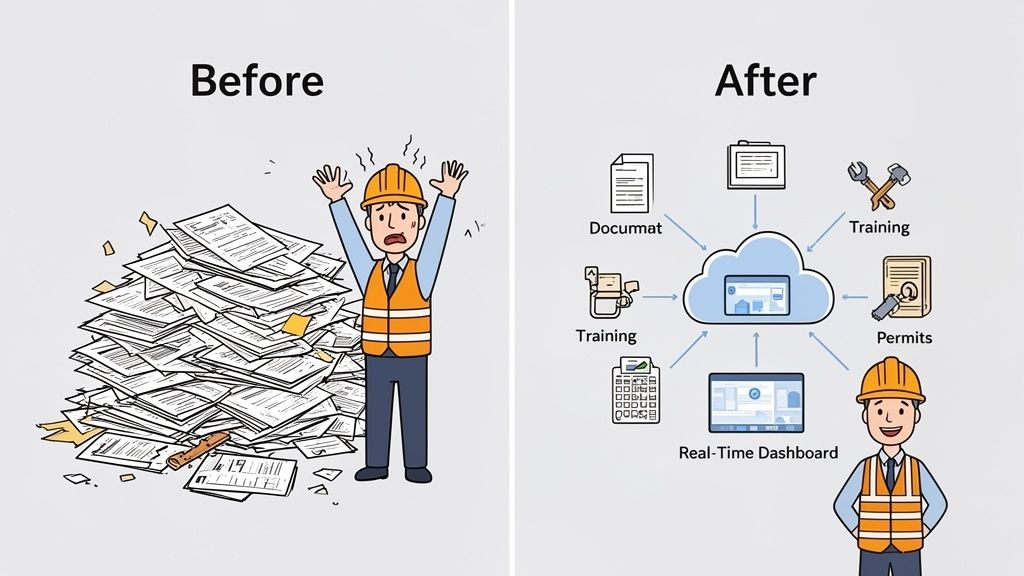
Let's break down some of the most common pain points and see how a single platform offers a real, practical solution.
Problem One: Lost Paperwork and Expired Documents
It’s the classic nightmare scenario. A folder stuffed with contractor insurance certificates is sitting in a cabinet, but nobody realised three of them expired last week. Or worse, a critical safe work method statement (SWMS) has vanished just before a high-risk job is meant to kick off.
This last-minute administrative scramble isn't just inefficient; it's a massive compliance risk waiting to happen. A central platform puts a stop to this completely.
A digital system becomes your single source of truth. Every single document, from licences to insurance policies, gets uploaded once and stored securely. More importantly, the system actively tracks expiry dates and sends out automated alerts, giving you weeks of notice before something needs renewing.
It flips document management from a manual, thankless chore into an automated safety net.
Problem Two: Inconsistent and Untracked Inductions
When site inductions are done in person, they're rarely the same twice. An induction on Tuesday with one supervisor might cover completely different ground to one on Thursday with another. This leads to dangerous gaps in knowledge.
Even worse is trying to manually track who has completed what. It’s messy and unreliable. A central platform fixes this by standardising and automating the whole process.
- Standardised Content: You create one official online induction. Every single contractor gets the exact same critical information about your site's specific rules and hazards. No more variations.
- Automated Tracking: The platform logs who has completed the induction and when. Supervisors can see in real-time if a worker is cleared to be on-site, just by checking their profile on a phone or tablet.
This consistency creates a solid, reliable baseline of site awareness for everyone, every single time.
Problem Three: Zero On-the-Ground Visibility for Supervisors
For a site supervisor, not knowing who is compliant and safe to work is a huge source of stress. Without a live system, they’re forced to rely on radio calls back to the office or just cross their fingers and hope the paperwork is in order.
A central platform gives them instant visibility right where they need it: out on the ground. Real-time dashboards, accessible on any mobile device, show them exactly who is on site and what their current compliance status is.
A green tick next to a contractor’s name means all their documents are valid and inductions are complete. A red flag instantly shows there's an issue that needs sorting out before they can start work. This immediate access to information allows supervisors to make fast, informed decisions.
This real-time view is becoming non-negotiable as the Australian construction market grows. With a heavy reliance on subcontractors, who already account for 41% of infrastructure construction, the risk of misaligned safety procedures skyrockets when you're using paper. An integrated platform that standardises processes is essential to manage these complex project structures effectively. You can read more about the growth and risks in the Australian construction sector.
Frequently Asked Questions About Contractor Management
Getting into a structured system for managing contractors always brings up a few questions. Whether you're finally ditching the spreadsheet chaos or weighing up a new software platform, it’s completely normal to wonder how it all works in the real world. Let's get straight into some of the most common questions we hear from operations managers and business owners.
We'll clear up the critical differences between contractors and employees, what to expect when you set up a digital system, and whether these tools are a good fit for smaller businesses.
What Is the Main Difference Between Managing Contractors and Employees?
This is a big one. The most costly mistake a business can make is treating contractors like employees. While both might be working on your site, the legal and operational lines are incredibly distinct. Getting it wrong can land you in hot water, with serious risks like sham contracting claims.
The core difference is the nature of the relationship. An employee is part of your organisation. You direct their work, give them their tools, and set their schedule. A contractor, on the other hand, is a separate business you hire for a specific service. You manage the outcome of their work, not the process.
Think of it this way: You hire an employee to be a permanent chef in your kitchen. You tell them their shifts, their tasks, and how you want things done. You hire a contractor to fix your broken oven. You just tell them the oven is broken; you don't stand over their shoulder telling them which wrench to use. That's their expertise.
This isn't just semantics; it has huge practical implications:
- Control and Direction: With employees, you have a high degree of control over the how, when, and where. With contractors, your control is limited to what’s outlined in your contract.
- Tools and Equipment: You’re responsible for giving employees the tools they need to do their job. Contractors are expected to bring their own.
- Financial and Legal Obligations: For employees, you handle superannuation, workers' compensation, and payroll tax. Contractors are responsible for their own tax, insurance, and super.
A dedicated contractor management system is built around these fundamental differences. Its job is to verify their business-level compliance (think insurance certificates and trade licences), not manage them like a member of your internal team.
How Long Does It Take to Set Up a Digital Contractor Management System?
This is always a top-of-mind question, and for good reason. No one has time for a project that drags on for months and throws operations into chaos. The good news is that modern, cloud-based platforms are built for a much faster rollout than the clunky enterprise software of the past. The exact timeline, though, really depends on a few things.
A realistic timeframe to get a system humming along is anywhere from a few weeks to a couple of months. It’s not an overnight flip of a switch, but it definitely shouldn’t be a six-month ordeal.
What really drives the setup speed?
- The Complexity of Your Needs: A single-site business with a straightforward pre-qualification checklist will get up and running much faster than a multi-site organisation with complex, role-specific induction courses.
- Data Migration: If you’re sitting on years of contractor data in spreadsheets or an old system, getting it moved across will add to the timeline. The cleaner and more organised your current data, the smoother this part will be.
- Your Internal Resources: Having a dedicated person or a small team on your side to champion the project makes a world of difference. They can make decisions without delay and keep things moving forward.
A typical implementation follows a pretty clear path:
- Discovery and Configuration (1-2 weeks): The provider sits down with you to understand your current process, then configures the platform to match your specific pre-qualification forms, induction content, and workflows.
- Data Loading and Testing (1-3 weeks): Your existing contractor data gets imported, and your team has a chance to test the system to make sure it all works as expected.
- Training and Go-Live (1 week): Your internal team and maybe a small pilot group of trusted contractors get trained on the new system before you roll it out to everyone.
The secret is partnering with a provider who offers solid support and has a clear onboarding plan. That partnership is what turns a potentially painful process into a smooth one.
Are These Systems Only for Large Companies?
There’s this stubborn myth that proper contractors management services are only for huge corporations with thousands of contractors and bottomless budgets. Honestly, that couldn’t be further from the truth today. Modern, subscription-based platforms have made these powerful tools accessible and affordable for small and medium-sized businesses (SMEs).
Think about it: a small manufacturing business with 20 regular contractors faces the same fundamental risks as a massive construction firm with 200. An unqualified worker or an expired insurance policy can cause just as much chaos and liability, no matter the size of your company. The consequences don’t scale down.
Modern systems are built to be flexible:
- Scalable Pricing: Most providers offer tiered pricing based on how many contractors you manage, so you’re only paying for what you actually use. This makes it a no-brainer for SMEs.
- Reduced Admin Burden: For a small business where staff wear multiple hats, the time saved by automating document chasing and inductions is arguably even more valuable.
- Improved Professionalism: Using a proper system shows your contractors and clients that you take compliance seriously. In a competitive market, that can be a real advantage.
At the end of the day, the decision to use a contractor management system should be based on your level of risk, not the size of your payroll. If you depend on external workers to get the job done, especially in high-risk industries like construction or manufacturing, a dedicated system is one of the smartest, most practical investments you can make to protect your business.
Ready to stop chasing paperwork and gain real control over your contractor compliance? The team at Safety Space can show you how a fully customisable platform can solve your daily headaches and protect your business. Book a free demo today and get a clear plan for your worksite.
Ready to Transform Your Safety Management?
Discover how Safety Space can help you implement the strategies discussed in this article.
Explore Safety Space FeaturesRelated Topics
Safety Space Features
Explore all the AI-powered features that make Safety Space the complete workplace safety solution.
Articles & Resources
Explore our complete collection of workplace safety articles, tools, and resources.