
When something goes wrong on site, a clear, actionable incident report is your most critical tool. It's not just paperwork; it’s a structured way to capture exactly what happened, whether it’s an injury, a near miss, or property damage. Using a solid template means you won't miss the key details needed for investigation and follow-up.
A Practical Guide to Incident Reports
This guide is for people on the ground in sectors like construction and manufacturing. We're cutting through the jargon to give you a collection of straightforward incident report samples you can actually use. The idea is to provide a reliable reference you can adapt for your own needs, making sure you capture what matters without getting bogged down in complexity.
You’ll find clear examples for the most common situations you're likely to face, including:
- Employee injuries
- Property and equipment damage
- Near misses
- Environmental spills
Each sample is designed to help you document the facts accurately and objectively. In the following sections, we’ll break down each type of report, with notes explaining what to include and, more importantly, why it’s needed.
Before we get into the specific templates, here's a quick reference table to help you find what you need.
Quick Reference to Report Samples
This table summarises the different report samples covered in this guide, outlining what they're best used for and the key information you'll need to focus on for each.
| Report Type | Primary Use Case | Key Sections to Focus On |
|---|---|---|
| Workplace Injury | Documenting any injury or illness to an employee, contractor, or visitor. | Immediate actions taken, Description of injury, Witness statements |
| Near Miss | Capturing events that could have caused harm but didn't. | Detailed event description, Potential severity, Preventative suggestions |
| Property/Equipment Damage | Recording damage to company assets, vehicles, or facilities. | Description of damage, Estimated cost, Impact on operations |
| Environmental Spill | Documenting the release of hazardous substances into the environment. | Substance details, Containment actions, Regulatory notifications |
Having a quick lookup like this makes it easier to grab the right starting point when an incident happens, saving valuable time.
The chart below gives you a sense of just how common certain incidents are, which really drives home where you need to be prepared.
As the data shows, slips and falls make up a huge portion of reported incidents. This stat alone shows why having a solid injury report template is non-negotiable for any workplace.
Workplace Injury Report Sample
When an injury happens at work, documenting it properly is non-negotiable. The goal isn't to point fingers or assign blame; it's about creating a clear, factual, and organised record of what happened. A solid template is your best friend here, making sure no critical details get missed, which is essential for any follow-up actions and, more importantly, for learning from the incident.
This kind of documentation is how you spot patterns and prevent future issues. It's a universal need, but how it's handled can vary. Take South Africa, for example. By bringing in better digital systems, they managed to lift incident reporting compliance to nearly 85%. With around 50,000 workplace injuries recorded each year across their varied industries, you can see how important structured reporting is for improving safety. If you're interested in looking into these kinds of regional safety trends, you can find more data on africanlii.org.
Let’s break down an annotated sample of a workplace injury report, specifically for a construction or manufacturing environment.
Key Fields in an Injury Report
A strong report is built on specific, objective information. This is where you need to avoid guesswork and stick to what can actually be confirmed.
- Employee Details: You'll need the full name, job title, and department of the person who was injured. This immediately clarifies who was involved.
- Incident Time and Location: Get this down to the minute. The exact date, time, and specific location (e.g., 'Assembly Line 3, near the conveyor belt') are important for providing context.
- Description of Events: Walk through what happened, step-by-step. Keep it chronological and use neutral, factual language. Something like, "The worker was lifting a box when they reported a sharp pain in their lower back" is perfect.
- Nature of Injury: Describe the injury itself and the part of the body affected. Be specific but stay out of the doctor's office. You're not making a medical diagnosis. Examples: 'Laceration to the left hand,' or 'Sprained right ankle.'
Here’s a look at how these fields come together in a standard report.

As you can see, clear and concise entries make all the difference, creating a record that anyone can pick up and understand instantly.
Actions and Witness Details
What happens right after the incident is just as important as the event itself.
- Immediate Actions Taken: What did you do the moment the injury occurred? Make a note of it. This could be anything from 'First aid was administered on-site by a certified first aider' to 'The employee was transported to the nearest medical clinic.'
- Witness Statements: If anyone saw what happened, get their details. You'll want their names and contact information, and ask them to provide their own brief, factual account of what they observed.
Using a standardised workplace injury report sample just makes good sense. It drives consistency and makes sure you get the full picture, every single time.
Near Miss Report Sample
A near miss is one of those classic "that was a close one" moments. An unplanned event that could have caused an injury or damage, but thankfully didn't. Reporting these is one of the most practical, proactive steps you can take to prevent a real incident down the track. It's all about spotting a problem before it actually hurts someone.
Of course, these reports are only useful if people actually submit them. The process needs to be simple, quick, and completely non-punitive. Your goal is to gather information and learn, not to point fingers for something that didn't even happen. Keeping the form straightforward encourages everyone, from the new hire to the seasoned veteran, to flag potential hazards. For terminology and culture, see our near miss reporting guide.
Key Sections of a Near Miss Form
A good near miss report doesn't need to be long. It just has to capture the essential information so you can follow up properly.
- Description of the Event: Just the facts. A clear, objective account of what happened. For example, "A worker walking through the west storage bay nearly tripped over a loose power cable left across the walkway."
- Potential Outcome: This part is important because it clarifies the severity of what could have gone wrong. For instance, "The potential outcome was a serious fall, which could have resulted in a broken wrist or head injury."
- Contributing Factors: What conditions or actions led to the close call? This could be something like "poor housekeeping" or "equipment not stored correctly after use."
Turning Information into Action
The most important part of any near miss report is the corrective actions section. This is where you turn a close call into a real improvement by outlining practical steps to stop it from happening again. Vague suggestions are a waste of time; you need specific, assignable actions.
An effective corrective action is always clear and measurable. Instead of just writing "Clean up the area," a much better action is: "Implement a daily 5-minute tidy-up at the end of each shift for the west storage bay, with the shift supervisor responsible for sign-off."
This single step transforms a near miss report from a piece of paper filed away into a practical tool for problem-solving. It gets to the root cause, making the workplace safer for everyone.
Property Damage Report Sample
When machinery, buildings, or other company assets get damaged, you need a clear record of what happened. A property damage report is that factual account, and it's vital for organising repairs, dealing with insurance claims, and most importantly, figuring out how to stop it from happening again.
Unlike a personal injury report, this one is all about the assets. It’s a tool for documenting the financial hit and operational disruption an incident has caused.
This broader view of incident reporting is catching on worldwide. The African Union, for example, is pushing to improve how incidents are documented across the continent, covering everything from industrial accidents to natural disasters. These events have led to over 5,000 deaths and property damages topping $2 billion USD, which really highlights the need for solid, structured reporting. You can read more about these regional risk reduction strategies on au.int.

What to Include in the Report
A truly useful report gets down to specifics. The key is to stay objective and stick to what you know for sure. No guesswork.
- Asset Identification: Be precise. Don't just say "forklift." Instead, write "Hyster H50FT Forklift, Asset #72B." Make sure to note its exact location when the incident happened.
- Description of Damage: Get detailed. Vague terms like "broken" aren't helpful. Use descriptive language like "dented left-side panel and a cracked hydraulic hose."
- Estimated Costs: Put a number on it. Provide a preliminary estimate for repairs or a full replacement. You should also note any potential downtime or operational delays this damage will cause.
Documenting the Incident and Follow Up
A good report doesn't just describe the damage; it explains the context and lays out the next steps. This is where you connect the dots between the asset and the event that caused the damage.
The goal here is to paint a complete picture. Include a timeline of events that led to the damage. You'll also want to attach supporting evidence like photos of the damage from different angles, maintenance logs for the equipment involved, or even simple diagrams of the area.
Finally, your report must outline the immediate actions taken to get the situation under control, like cordoning off the area or shutting down the machinery. It should also suggest practical, preventative steps for the future. This is what turns a simple piece of paperwork into a useful tool for managing property-related incidents.
Customising Your Incident Report Templates
Using a standard incident report sample is a great starting point, but making it fit your specific worksite is what makes it effective. A generic form downloaded from the internet probably won't capture the details you really need.
A report for a construction site will naturally need different fields than one for a factory floor. The goal is to create a document that isn't just a box-ticking exercise for compliance, but a genuinely useful tool for your business. This means adding or removing fields to match how you actually operate. In manufacturing, for example, you might add a field for a specific machine identifier or production line number.
Make Your Reports Clear and Logical
The language you use matters. A lot. Keep it simple and direct so any employee can fill it out without getting confused or needing to ask for help. It's best to avoid technical jargon or overly complicated questions that could lead to vague or unhelpful answers.
A logical flow is also important. Your report should guide the person filling it out from one step to the next, starting with the basic "who, what, where, when" and moving cleanly into the event description and actions taken. Organising the form this way makes it far easier to complete, whether it’s on a piece of paper or a tablet.
A well-customised report captures the right information the first time. This cuts down on the back-and-forth of follow-up questions and helps you get a clearer picture of what actually happened, faster.
When deciding what to add, it helps to think about the essential, non-negotiable fields versus the nice-to-haves that are specific to your operations.
Core vs. Custom Report Fields
| Field Type | Example Fields | Reason for Inclusion |
|---|---|---|
| Core Fields (Essential) | Date/Time of Incident, Location, Names of Involved Parties, Detailed Incident Description, Witness Information, Immediate Actions Taken. | These are the universal building blocks of any incident investigation. Without them, you lack the fundamental context to understand what happened. |
| Custom Fields (Optional) | Equipment ID Number, Scaffolding Tag Number, Chemical Batch ID, Project Name/Number, Weather Conditions, Vehicle Registration. | These fields provide industry-specific context that is crucial for a thorough investigation in your particular environment. |
Ultimately, a good template balances the core requirements with the specific details that make the report a useful tool for preventing future incidents.
Key Customisations to Consider
Think about what information is most valuable for your specific incident investigations. What details do you always find yourself asking for after the fact?
Here are a few practical ideas to get you started:
- Industry-Specific Fields: Add sections that are directly relevant to your work. Think "Scaffolding Tag Number" for construction, "Chemical Batch ID" for manufacturing, or "Vehicle Rego" for a transport company.
- Digital Integration: Make sure your template works well on mobile devices. Consider how you can use a digital incident management system to make reporting easier and more immediate for your team in the field.
- Visual Aids: Leave a dedicated space for diagrams or sketches of the incident area. A simple hand-drawn map can often explain a complex situation far better than a paragraph of text.
Common Mistakes to Avoid When Writing Reports
Writing a useful incident report means avoiding a few common traps that can make the whole document confusing or unhelpful. Even with the best templates, a few simple errors in how you fill them out can derail the entire process. A clear, factual report is your best tool for getting to the bottom of what really happened.
One of the biggest mistakes is the use of subjective or emotional language. Words like "carelessly" or "dangerously" inject opinion where you need facts. The report should state what happened, not your personal judgement of how it happened. Stick to objective descriptions that anyone can understand, no matter their involvement.
Another frequent error is including personal opinions or trying to assign blame. A report's job is to document the facts, not to point fingers. Pinning the blame on an individual can stop an investigation and prevent you from ever finding the true root cause of the incident.
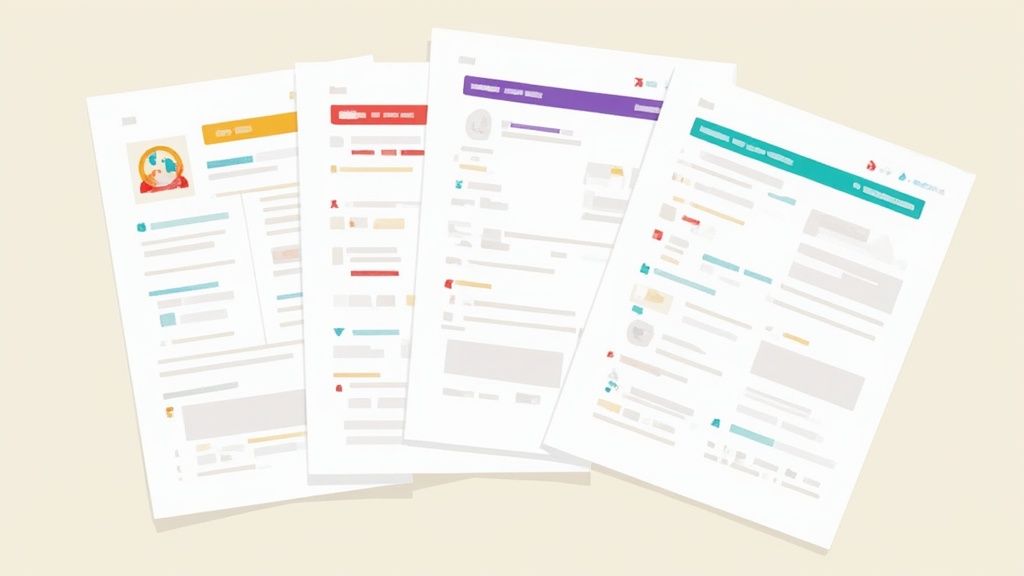
Unclear Language and Incomplete Details
Vague descriptions are a major problem. A report that just says "the machine broke" isn't nearly as helpful as one that says "the hydraulic hose on the press machine (ID #P-7) split, leaking fluid onto the floor." Specificity is everything.
In the same way, incomplete information can make a report almost useless. Missing witness statements, forgetting the exact time and date, or leaving out the immediate actions taken are all common omissions. Every empty field on your form is a missed opportunity to learn and prevent it from happening again.
What Not to Do: "John was being clumsy and dropped the box on his foot."
What to Do Instead: "John Smith was lifting a 15kg box from the bottom shelf. As he stood up, he lost his grip, and the box fell, landing on his right foot."
See the difference? This simple change removes blame and emotion, focusing purely on the sequence of events.
How to Sharpen Your Reporting
The best way to sidestep these mistakes is to create a clear process and stick to it. Following a structured approach makes sure every report is consistent and complete. These small adjustments are important parts of a much larger plan. You can learn more about building effective frameworks in our guide to safety systems management.
Here’s a quick checklist to run through before you finalise any report:
- Is the language objective? Hunt down and remove any words that suggest opinion or emotion.
- Are all fields complete? Do a quick scan for missing dates, names, or key descriptions.
- Is it factual? Make sure every statement is based on what was observed, not what you assume happened.
- Is blame avoided? The report needs to focus on the 'what' and 'how', not the 'who'.
By avoiding these common errors, your incident reports will become far more accurate and more valuable for preventing future problems.
Your Incident Report Questions Answered
Even with the best templates in hand, questions always pop up when it comes to incident reporting. Filling out forms isn't anyone's favourite job, but getting it right is important.
Getting clear, practical answers helps everyone follow the correct procedure and improves the quality of the information you collect. Here are some of the most common questions we hear from teams on the ground.
What’s the Most Important Information to Include?
While every detail has its place, the absolute non-negotiables are the who, what, when, and where of the incident. It sounds simple, but you’d be surprised how often the basics get missed in the heat of the moment.
Specifically, you need the exact date and time, the precise location on site, the names of everyone involved (and any witnesses), and a clear, step-by-step description of what happened. This factual foundation is the bedrock of any investigation. Without these core details, trying to analyse what went wrong or put effective controls in place is just guesswork.
How Soon Does a Report Need to Be Done?
As soon as possible. Ideally, a report should be completed within the same shift or, at the very latest, within 24 hours.
The longer you wait, the foggier memories become. Details get blurred, and the accuracy of the report suffers. Immediate reporting keeps the information fresh and allows your team to respond quickly, whether that’s fixing a hazard or getting support for an affected worker. It’s all about preventing it from happening again.
Who Is Actually Responsible for Filling It Out?
Typically, the employee directly involved in the incident should fill out the report, provided they're able to. If they're injured or shaken up, their direct supervisor or manager should step in to complete it with them or on their behalf.
Sometimes, a witness or the first person on the scene might kick off the report. The key isn't who starts it, but that your company has a clear policy so everyone knows their role. This cuts out confusion and makes sure nothing falls through the cracks.
At Safety Space, we provide a fully customisable platform that replaces outdated paper and spreadsheets, giving you a straightforward way to manage all your health and safety documentation. Our system helps you spot issues before they escalate, making compliance and safety management simpler for everyone on your team. Learn more at https://safetyspace.co.
Ready to Transform Your Safety Management?
Discover how Safety Space can help you build a safer, more compliant workplace with our comprehensive safety management platform.
Book a Free DemoRelated Topics
Safety Space Features
Explore all the AI-powered features that make Safety Space the complete workplace safety solution.
Articles & Resources
Explore our complete collection of workplace safety articles, tools, and resources.