
A Non Conformance Report (NCR) is a formal document that flags when something has gone wrong on a project. Think of it as a detailed receipt for a mistake, used in construction and manufacturing to record when a product, process, or service fails to meet the agreed-upon requirements. It's a practical tool for problem-solving, not just another piece of administrative paperwork.
What a Non Conformance Report Is and Why It Matters
At its heart, an NCR is all about control and communication. When a steel beam is fabricated to the wrong length or a batch of concrete doesn't meet its specified strength, an NCR is raised to formally document the issue. This isn’t about pointing fingers; it’s about creating a clear, factual record of the deviation.
That record becomes the starting point for a structured response. It makes sure that everyone involved, from the site foreman to the quality manager and even the client, understands the problem in exactly the same way. Without this formal paper trail, issues can get forgotten, miscommunicated, or ignored, leading to much bigger headaches down the line.
More Than Just Paperwork
The real value of an NCR is in the process it kicks off. It's a catalyst for action that helps shield your business from financial hits, project delays, and reputational damage. When handled correctly, the non conformance report becomes a cornerstone of your quality management system.
Here’s why it's so critical:
- It Prevents Problems from Escalating: By formally identifying and containing a non-conforming product or material, you stop it from being used in the project. This simple step prevents a small mistake from snowballing into a major structural or functional failure.
- It Drives Problem Solving: A good NCR forces the team to investigate why the error happened in the first place. This root cause analysis is key to preventing the same issue from popping up again on future projects.
- It Creates Accountability: The report clearly documents the issue, the investigation, and the agreed-upon solution. This creates a transparent record that holds all parties, including subcontractors and suppliers, accountable for their part in fixing it.
- It Protects Your Business: If a dispute arises, a well-documented NCR provides a factual, time-stamped record of the issue and the steps taken to resolve it. This is invaluable for managing contracts and client relationships.
A well-managed NCR process is the difference between learning from a mistake and being destined to repeat it. It shifts the focus from fixing a single defect to improving the entire process.
The Role in Audits and Compliance
Finally, a systematic approach to handling non-conformances is essential for staying compliant with industry standards like ISO 9001. Auditors will look for evidence that you have a solid process to identify, document, and correct deviations from the plan.
A complete history of your non conformance reports demonstrates a genuine commitment to quality control and continuous improvement. Effective handling of these documents is a core part of your overall system for audits and compliance, proving that your quality checks are more than just for show.
Breaking Down the Core Components of an NCR
A non conformance report is only as good as the information it contains. A vague or incomplete report just creates confusion, making it impossible to get to the bottom of the issue and fix it for good. To be an actionable tool, an NCR needs to capture specific details in a clear, organised way.
Think of it like a mechanic's job card for a car. You wouldn't just write "car broken". You’d note the make, model, the specific noise it’s making, what happened right before it stopped working, and the parts you’ve already checked. Each field on an NCR serves a distinct purpose, guiding you from simply identifying a problem to ensuring it never happens again.
Here’s a quick look at how a well-structured NCR form lays this all out.
A digital format like this ensures key information is captured systematically. Nothing gets missed, and the report is easy to track from start to finish.
Detailed Description of the Non Conformance
This is your starting point, and you could argue it's the most important section. The goal here is to describe the problem with objective facts, not opinions or blame. A well-written description allows anyone, even someone totally unfamiliar with the project, to understand exactly what went wrong.
Instead of writing, "The subcontractor installed the wrong windows," get specific:
"Windows installed on Level 2, west elevation, are model number W-102. Project specification 4.7B and drawing A-201 require model number W-205, which has a different thermal rating. Ten units have been installed as of 15 May."
This description is factual and precise. It references the exact requirements that were missed and focuses on the 'what' and 'where', not the 'who'.
Immediate Action Taken
This field documents what you did right away to contain the problem. The whole point of immediate action is to stop the issue from getting worse. It’s all about damage control. This isn’t the long-term fix; it’s the rapid response to prevent a non-conforming product or service from moving any further down the line.
Good examples include things like:
- Segregation: Moving a faulty batch of materials to a clearly marked quarantine area to stop it from being used by mistake.
- Halting Work: Issuing a stop-work order on a specific task until the deviation can be properly assessed.
- Tagging: Slapping a red tag or a clear label on non-conforming equipment or components.
Documenting these steps proves you took control of the situation promptly, which is critical for both internal quality management and any external audits.
Root Cause Analysis
Once the immediate fire is out, the next step is to figure out why the non-conformance happened in the first place. This is your root cause analysis (RCA). If you only fix the symptom without understanding the cause, you’re pretty much guaranteeing the problem will pop up again. A surface-level analysis might blame 'human error', but a proper RCA always digs deeper.
Was the wrong material used because the drawing was outdated? Did a machine fall out of calibration? Was the supplier given the wrong spec sheet? Answering these kinds of questions gets you to the real heart of the issue.
The purpose of root cause analysis is to find a process or system failure, not to point fingers. A problem is rarely the fault of a single person; it’s usually a breakdown in a process that allowed the error to occur.
Proposed Corrective and Preventive Actions
This is where you lay out your plan to fix the problem for good. It’s really important to separate corrective and preventive actions, as they tackle two different things.
A Proposed Corrective Action fixes the immediate problem. It answers the question, "What are we going to do about this specific non-conformance?" Using our window example, this might be: "Remove the ten incorrect W-102 windows and replace them with the specified W-205 models."
A Proposed Preventive Action stops the problem from ever happening again. It answers, "What will we change in our process to prevent a recurrence?" This action targets the root cause you identified. For example: "Update the material receiving checklist to require a two-person verification of model numbers against the latest approved drawings before materials are moved to the installation area."
Documenting both shows you're committed not just to fixing mistakes, but to actually improving your entire operational system. This proactive approach is exactly what regulators and clients want to see.
The growing complexity of compliance in Australia makes this kind of structured documentation more important than ever. For example, ASIC received 7,561 misconduct reports in just six months, leading to 11,060 compliance issues. Many of these would trigger an NCR as part of the resolution. With regulators like the ACCC dishing out fines of over AUD 500 million in a year, a solid NCR process is a key line of defence. You can discover more insights about these compliance trends from ASIC.
The Step-by-Step NCR Management Workflow
A non-conformance report isn't just a piece of paper; it's the starting gun for a dynamic process. To actually fix anything, an NCR has to move through a clear, logical workflow from the moment someone spots an issue to its final resolution. This structured path is your best defence against things falling through the cracks.
Think of it like an assembly line for problem-solving. Each station has a specific job to do before the issue can move on. If you skip a step or jumble the order, you’ll get a poor outcome, just like in manufacturing. A consistent workflow makes the whole process repeatable, predictable, and a lot more effective.
The process usually breaks down into six key stages. Let's walk through them with a real-world example from a construction site. Imagine a foreman discovers that a new batch of precast concrete panels just failed its initial strength test. Here’s what happens next.
1. Identification and Documentation
The first move is always to spot the problem and get it down on paper. This is where the non-conformance report is born. The person who finds the issue, be it a site foreman, a quality inspector, or a machine operator, is responsible for raising the alarm.
In our example, the site foreman who gets the bad news about the concrete test results would immediately kick off the NCR. He'd fill out the first few sections, describing the deviation in plain English: "Batch #74B of precast concrete panels, delivered on 22 May, failed the 7-day strength test, achieving 25 MPa against the required 32 MPa."
This simple act transforms an informal observation into a formal, trackable issue in the quality management system. The process is a lot like creating a formal record for other on-site issues, which you can see in our guide to incident reporting samples.
2. Segregation of Non-Conforming Product
Once you’ve documented the problem, you need to contain it. That means physically separating the faulty items to stop them from being used by accident. This step is critical. It prevents a small, localised problem from spiralling into a much bigger, more expensive failure down the line.
The responsibility here falls to whoever is in charge of the area, like the foreman or a warehouse manager. For our dodgy concrete panels, the foreman would have the entire batch moved to a designated quarantine area straight away. He'd slap big tags on them reading: "DO NOT USE - ON HOLD PENDING NCR-123." This simple physical action guarantees no one on the crew grabs a substandard panel by mistake.
3. Initial Review and Disposition
With the problem contained, the NCR lands on the desk of someone with the authority to make a call, usually a Quality Manager or Project Manager. Their job is to quickly assess how serious the non-conformance is and decide on an initial course of action, known as the disposition.
The disposition usually falls into one of a few categories:
- Reject: The product is a write-off. Scrap it or send it back to the supplier.
- Rework: The product can be fixed to meet the original specs.
- Repair: The product can be patched up, but it won't perfectly meet the original specs (this nearly always needs client approval).
- Use-As-Is: The defect is so minor it doesn't affect form, fit, or function. This also typically requires a concession from the client.
In our concrete panel saga, the Quality Manager reviews the test data and concludes the panels are unusable. The disposition is clear: "Reject: Return to supplier."
This is the basic flow, from describing the problem to taking decisive action.
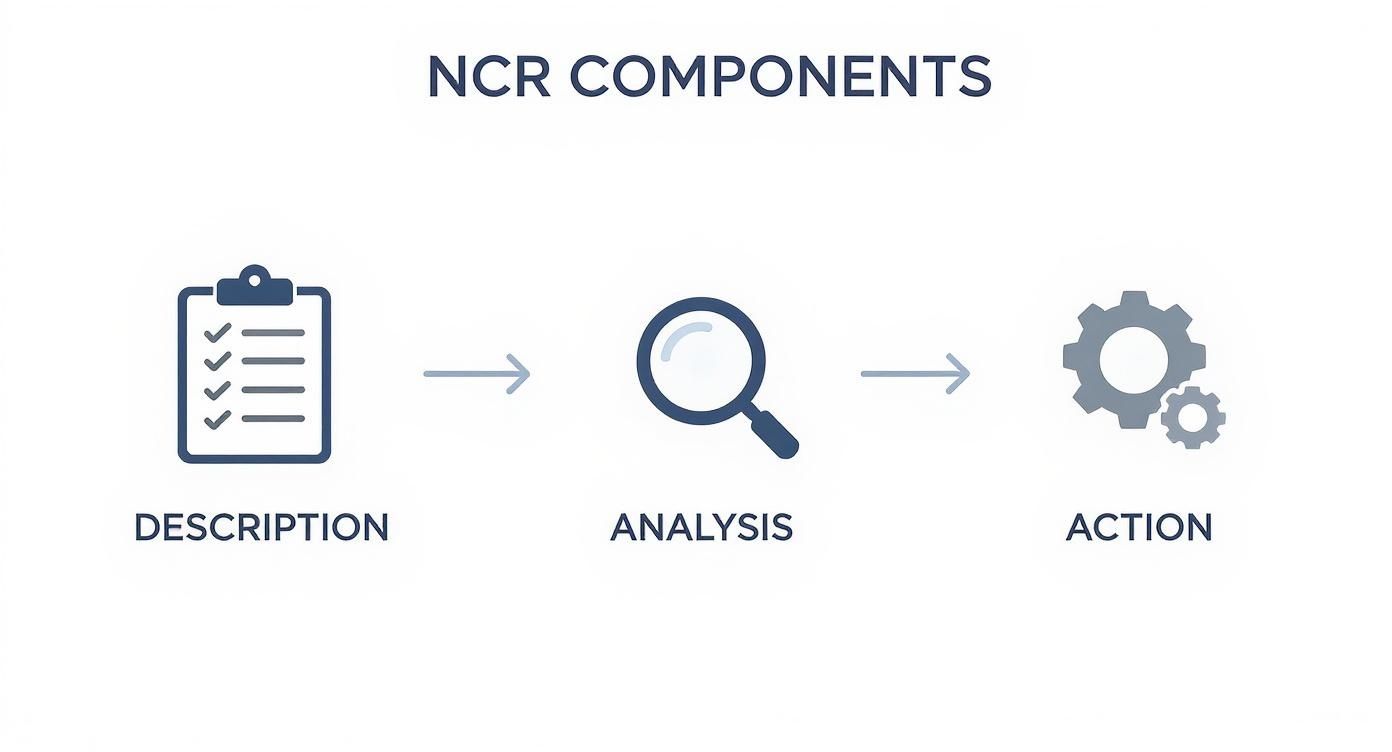
As you can see, a non-conformance report is all about the process: description, analysis, and then action. It's not just a static form.
4. Root Cause Analysis
After figuring out what to do with the faulty product, the focus shifts to why it happened in the first place. The Quality Manager usually leads this investigation, working with the relevant teams to dig deep for the root cause. This isn't about blaming individuals; it's about finding cracks in the system.
The investigation into the weak concrete might reveal that the supplier used an incorrect aggregate mix because of a typo in their internal documentation. The root cause isn't just "bad concrete," but a "failure in the supplier's material control process."
The goal of root cause analysis is to find a single, fixable source. If you can trace the problem back to a broken process and fix that process, you can be confident the issue won't happen again.
5. Implementing Actions
Once you know the root cause, the team can map out corrective and preventive actions. The corrective action tackles the immediate problem, while the preventive action makes sure it can't happen again.
- Corrective Action: "Issue a formal non-conformance report to the supplier and arrange collection of Batch #74B. Secure a replacement batch from an approved secondary supplier to avoid project delays."
- Preventive Action: "Require the primary supplier to update their batching procedure to include a mandatory two-person sign-off on the mix design before production can start."
6. Verification and Closure
The final step is to circle back and confirm that all the actions were completed and, most importantly, that they actually worked. The Quality Manager is responsible for this last check. They would confirm the new panels arrived and passed their strength tests with flying colours. They would also ask for and review the supplier's updated procedure to ensure the preventive fix was properly implemented.
Once all actions are verified, the Quality Manager formally signs off on the non-conformance report, and it's officially closed. This completes the workflow, leaving a perfect audit trail of the problem and its permanent resolution. Managing the dependencies between these steps is key, and you can find helpful ideas in this article on 5 Ways To Manage Workflow Dependencies Across Teams.
Common NCR Pitfalls and How to Avoid Them
Even with a solid workflow in place, an NCR process can quickly lose its teeth if you’re not careful. It’s easy to fall into a few common traps that turn what should be a powerful problem-solving tool into a frustrating box-ticking exercise that nobody takes seriously. The real goal is to sidestep the issues that stop your NCRs from actually making things better.
Most of these problems aren't complicated; they're just bad habits that creep in when teams are under pressure. By spotting them early, you can keep your quality management system sharp, focused, and genuinely useful.
The Blame Game
One of the fastest ways to kill your NCR process is to let it become a witch hunt. As soon as employees see a non-conformance report as a way to get someone in trouble, they’ll stop reporting issues. It’s human nature. This creates an environment of hiding mistakes instead of fixing them.
- The Pitfall: The report zeroes in on who made the mistake, with language like, "The operator failed to follow the procedure."
- How to Avoid It: Shift the focus from the person to the process. Frame the description around the 'what' and 'how' of what happened. A much better description would be, "The component was assembled using procedure 2.1, which resulted in a deviation from the specification." This encourages everyone to look at the system objectively, not point fingers.
Superficial Root Cause Analysis
Another classic failure is conducting a shallow root cause analysis that just scratches the surface. Blaming "human error" is the perfect example of this. It’s an easy out, a dead end that stops you from finding the real, underlying process failure that allowed the error to happen in the first place.
A root cause analysis that stops at "human error" is an incomplete investigation. It's a missed opportunity to fix the system that set the person up for failure in the first place.
Think about it: if a part was machined to the wrong dimension, a superficial analysis might just conclude "operator mistake." A proper investigation, however, might uncover that the operator was working from an outdated drawing. Suddenly, the root cause isn't the operator's skill, it's a breakdown in document control.
Letting Reports Get Lost
A non-conformance report that gets filed and forgotten is completely useless. This happens all the time in systems that still rely on paper forms or messy spreadsheets. Without a clear owner and a tracking system, NCRs fall into a black hole, and the corrective actions never see the light of day.
To really nail this, it’s crucial to understand the importance of document version control, which makes sure the right information is always accessible and properly tracked. It’s what prevents critical fixes from being lost and stops outdated info from causing the same problems over and over again.
No Follow-Up on Actions
Just writing down a brilliant corrective action plan doesn’t actually fix anything. The final, and arguably most critical, step is verifying that the actions were implemented and, more importantly, that they worked. Failing to follow up is a massive problem that pretty much guarantees the same non-conformance will pop up again.
Here’s how you make sure the follow-up actually happens:
- Assign Clear Responsibility: Every single corrective and preventive action needs to have a specific person's name next to it, along with a firm due date. No ambiguity.
- Schedule a Verification Check: The NCR should not be closed until someone (usually a quality manager) has physically checked that the changes have been made.
- Measure Effectiveness: Wait a while, then review the data. Has the problem come back? If it has, the fix wasn't effective, and you might need to reopen the NCR.
The pressure to get these processes right is mounting for Australian organisations facing a slew of new regulations. A recent survey showed that none of the 73 Australian executives polled felt their organisations were compliance leaders, and over 56% reported negative business impacts from these challenges. This makes a rock-solid non-conformance report system absolutely essential for managing risk. You can read more about these compliance challenges in Australia.
Using Digital Tools for Better NCR Management
If you're still relying on paper forms and clunky spreadsheets for your non-conformance reports, you’re making things harder than they need to be. Let's be honest, those old methods usually create more problems than they solve. Paperwork gets lost, spreadsheets turn into a mess of conflicting versions, and trying to track a corrective action across different sites feels like an impossible task.
This lack of a central system means you have zero real visibility. A site manager in one location has no idea that another team is battling the exact same issue with a supplier. That disconnect leads to wasted time, repeated mistakes, and a quality management system that only really exists on paper.
Digital tools completely change this dynamic. They connect the entire process from start to finish, creating a single source of truth that makes managing non-conformance reports simpler and far more effective.
Centralised Control and Real-Time Visibility
The biggest win from a digital system is having everything in one place. Instead of reports sitting in filing cabinets or buried in endless email chains, every NCR is logged into a central dashboard. This gives you an instant, real-time overview of all open non-conformances across the entire organisation.
This is what a centralised dashboard often looks like, offering a clear view of quality management tasks.

With this kind of visibility, managers can spot bottlenecks, track progress on corrective actions, and see which issues are overdue at a single glance.
A platform like Safety Space is built to solve these exact problems. It provides a simple way to create, assign, and track every non-conformance report from the moment it's identified right through to closure. This organised approach is the foundation of a robust quality system and is a core part of effective incident management software.
Automated Workflows and Accountability
Digital systems use automated workflows to push the NCR along its lifecycle. When a report is raised, it’s automatically routed to the right person for review and disposition. When a corrective action is assigned, the system sends reminders and notifications until it's marked as complete.
This automation does two crucial things:
- It removes human error: Nothing gets forgotten or falls through the cracks because the system handles all the follow-ups.
- It builds accountability: Every action has a clear owner and a due date. The dashboard makes it obvious who is responsible for the next step, leaving no room for confusion.
The move to digital isn't just about getting rid of paper. It's about building a system where the correct process is the easiest path to follow.
This is especially relevant as NCRs are increasingly used for issues beyond physical products. In Australia, for instance, a 25% year-over-year increase in data breaches has led to a rise in NCRs for cybersecurity compliance. These formal reports are essential for documenting non-conforming system controls in sectors like health and finance. You can read the full research about these data breach trends in Australia.
From Data Collection to Actionable Insights
One of the most powerful benefits of a digital NCR system is its ability to turn raw data into genuinely useful information. Every report you log contributes to a growing database of quality issues. Over time, you can analyse this data to spot trends that would be completely invisible with a manual system.
For example, you might discover that:
- 70% of material defects are linked to a single supplier.
- A specific machine is responsible for a recurring dimensional error.
- A certain process consistently fails during the colder months.
This kind of trend analysis allows you to shift from being reactive to proactive. Instead of just fixing individual problems as they pop up, you can identify and address the systemic weaknesses causing them in the first place. With a tool like Safety Space, generating these reports is simple, giving you the insights needed to make smart, data-driven decisions that prevent future non-conformances before they even happen.
Got Questions About Non Conformance Reports? We’ve Got Answers.
Even with a solid process mapped out, questions always crop up when you start using non conformance reports on a real project. Let's tackle some of the most common ones head-on, so you can handle these situations with confidence and keep your quality management system running smoothly.
Who Is Actually Responsible for Raising an NCR?
Short answer: anyone.
Technically, anyone who spots a deviation from a requirement can, and should, raise a non conformance report. This isn’t a job just for the quality manager. In a healthy quality system, the machine operator, the site foreman, or the project engineer are all encouraged to flag an issue when they see one.
Think about it, the person who discovers the problem is the best one to capture the initial, on-the-ground details. The real key is making the process painless. If raising an NCR involves a mountain of paperwork, people will simply avoid it. A simple digital form, on the other hand, encourages everyone to report issues right away, which is exactly what you need for a proactive system.
Corrective vs. Preventive Action: What's the Difference?
This is a classic point of confusion, but getting it right is fundamental to actually solving problems instead of just patching them up.
Imagine you have a leak in your roof.
Corrective Action is putting a bucket under the drip and patching the hole. You’ve fixed the immediate, existing problem. In a project context, this is reworking a faulty part or scrapping a bad batch. It solves the symptom.
Preventive Action is figuring out why the roof leaked in the first place. Maybe the flashing has failed, so you decide to replace it with a better design across the entire roof to stop it from ever happening again. This solves the root cause.
A non conformance report isn’t really doing its job until both actions are properly considered. Just fixing the symptom without digging into the root cause is a surefire way to see the same problem pop up again down the track.
How Long Should a Non Conformance Report Stay Open?
There's no magic number here. The timeline depends entirely on how complex the issue is. A minor paperwork error might be closed out in a day. A major problem that requires a full supplier investigation and new material testing could stay open for weeks.
The goal is not speed, but thoroughness. An NCR should remain open until all corrective and preventive actions have been fully implemented and, crucially, verified as effective.
Closing a report just to clear it off a dashboard is a massive mistake. The job isn't done until you have hard proof that the fix actually worked and the problem hasn't come back. That verification step is non-negotiable.
Can an NCR Be Used for a Service, Not Just a Product?
Absolutely. A non-conformance is simply a failure to meet a specified requirement. That requirement could relate to a physical product or a service-based process. The NCR is just as powerful for documenting slip-ups in services.
For example, an NCR would be perfect if:
- A cleaning crew fails to follow the correct sanitisation procedure in a medical facility.
- A logistics partner delivers a temperature-sensitive shipment outside the agreed-upon thermal range.
- A software support team misses the response time guaranteed in their service level agreement (SLA).
In every case, the process is identical. You document the deviation, contain the immediate fallout, investigate why it happened, and put actions in place to prevent it from happening again.
Managing all this effectively demands a system that's clear, consistent, and easy for your entire team to use. Safety Space replaces messy spreadsheets and lost paperwork with a single, clear platform to track every non conformance report from start to finish. You can ensure accountability, automate follow-ups, and get the data you need to spot trends and fix problems for good.
Find out how to improve your quality management by booking a free demo.
Ready to Transform Your Safety Management?
Discover how Safety Space can help you build a safer, more compliant workplace with our comprehensive safety management platform.
Book a Free DemoRelated Topics
Incident Report Samples
An NCR documents a process or product failure; an incident report documents a workplace event. See real samples of both to understand the difference.
WHS Act Compliance
When an NCR uncovers a regulatory breach you may have notification obligations. Read which non-conformities require WHS reporting.
Risk Management Matrix
Use a 5×5 risk matrix to grade each NCR — minor, major, or critical — and decide which require formal corrective action.
Near-Miss Reporting
Near-misses are leading indicators that often surface before NCRs. See how to capture them and feed them into the corrective-action loop.