
An Occupational Health and Safety (OHS) management system is the backbone of a safe workplace. It’s the structured framework your business uses to manage health and safety risks, but don't think of it as just a folder of documents gathering dust.
Think of it as your company's playbook for keeping people safe, a systematic way to find and fix hazards before they cause harm.
What is an OHS Management System, Really?
Let’s cut through the jargon. At its heart, an OHS management system is simply how your business organises everything to do with workplace health and safety. It’s what connects your policies and goals with the practical actions you take on the ground every day, from the factory floor to the construction site.
This isn't about creating more paperwork for the sake of it. It’s about building a living, breathing process that prevents incidents.
Imagine it’s like the preventative maintenance schedule for a critical piece of machinery. You don't wait for it to break down and halt production; you service it regularly to keep it running smoothly and safely. An OHS management system applies that same logic to your most valuable asset: your people.
To put it plainly, an OHS management system organises your safety efforts into a few core functions.
OHS Management System Core Functions at a Glance
| Core Function | What It Means in Practice |
|---|---|
| Hazard Identification | Systematically finding things that could cause harm to your team. |
| Risk Assessment | Figuring out how likely that harm is and how severe it could be. |
| Control Measures | Putting practical steps in place to eliminate or reduce the risk. |
| Monitoring and Review | Checking that your controls are working and looking for ways to improve. |
Having a clear, structured system for these functions is fundamental to meeting your legal duties under Australian Work Health and Safety (WHS) laws.
From Reactive to Proactive
A formal system proves you're being proactive about managing risks, which is exactly what the law requires. Without one, most businesses fall into a reactive cycle, only dealing with safety after an incident has already happened.
A well-organised OHS management system fundamentally shifts your approach. It gives you a clear method for spotting trouble ahead of time and taking steps to avoid it, moving you from reacting to incidents to proactively preventing them.
Connecting to Standards Like ISO 45001
Many businesses align their systems with recognised standards like ISO 45001. This global standard provides a blueprint for what a good OHS management system looks like.
Now, certification isn't a legal requirement for most Australian businesses. However, following its framework is a proven way to build a solid, effective, and compliant system. It’s a great way to make sure you have all the key components in place for consistent safety performance.
This systematic approach is directly linked to real-world results. Australia has seen a major improvement in workplace safety over the past decade, largely because businesses are adopting these structured systems. Data from Safe Work Australia shows the work-related injury rate has dropped substantially, proving that a structured approach to identifying and controlling hazards really works.
You can dive into the specifics in the latest Australian workplace safety statistics.
The Four Parts of a Working OHS System
Every effective OHS management system, whether it’s for a sprawling manufacturing plant or a dynamic construction site, runs on a simple, powerful engine: the Plan-Do-Check-Act (PDCA) cycle. It’s not a one-off task but a continuous loop that keeps driving safety improvements forward.
Think of it like building something. You wouldn't just start welding without a blueprint, right? You plan the design, build the structure, inspect the work for quality, and then make adjustments based on what you find. The PDCA cycle applies that same practical, hands-on logic to workplace safety.
This process flow shows how identifying risks, implementing controls, and monitoring performance are all connected in a non-stop cycle.
The key takeaway here is that safety management is an active process, not a static set of rules gathering dust on a shelf. Each step directly informs the next. Let's break down each phase with some real-world examples.
Plan: Identifying Hazards and Setting Goals
The "Plan" phase is where all good safety management kicks off. It’s about looking ahead to spot potential trouble before it happens and deciding what a "safe workplace" actually looks like for your specific operations. This stage is more than just guesswork; it's about systematic, proactive thinking.
For a manufacturing business, this could mean conducting a risk assessment on a new piece of machinery. You’d identify potential hazards like moving parts, noise levels, or ergonomic strains. Your goal might be to ensure no worker is exposed to noise above the legal limit. Simple.
In construction, the plan might involve a detailed site assessment before you even break ground. You'd be looking for risks like overhead power lines, unstable ground, or public access points. The goal? To establish clear exclusion zones and solid safe work method statements (SWMS) for high-risk activities.
Key activities in the Plan phase include:
- Hazard Identification: Systematically walking through the workplace to find things that could cause harm.
- Risk Assessment: Evaluating how likely those hazards are to cause an incident and how severe the fallout could be.
- Setting Objectives: Defining clear, measurable safety goals, such as "reduce manual handling injuries by 15% this year."
Do: Putting the Plan into Action
Once you have a plan, the "Do" phase is all about execution. This is where you put the controls and procedures you’ve decided on into practice. It’s the most visible part of your OHS management system, involving practical changes and direct communication with your team on the ground.
For the manufacturing example, "Do" means actually installing the physical guards on that new machine. It also includes providing workers with specific training on how to operate it safely and supplying the correct personal protective equipment (PPE), like ear protection.
Back on the construction site, this phase involves putting up fencing for those exclusion zones you planned. It also means conducting daily pre-start meetings to run through the SWMS and make sure every worker, including subcontractors, understands the day's specific risks and controls.
A plan that stays on paper is useless. The "Do" phase is what turns good intentions into tangible safety measures on the workshop floor or construction site, making the theoretical practical.
Check: Monitoring How Things Are Going
So, how do you know if your plan is actually working? That’s what the "Check" phase is for. This stage is all about monitoring and measuring your safety performance to see if you're hitting your goals and if your controls are truly effective.
This isn't about waiting for an accident to happen. It’s about proactively looking for evidence that your system is functioning as intended.
Monitoring activities can include:
- Workplace Inspections: Regularly walking the site to check that controls are in place and being used correctly.
- Incident Reporting: Tracking not just injuries, but also near misses and minor incidents to spot developing trends before they become major problems.
- Consultation: Actually talking to your workers to get their feedback on whether safety procedures are practical and effective.
Research highlights the importance of focusing on the right things here. One study found that high-quality leading indicators for OHS systems are heavily centred on risk control systems (25%) and communication (14%). But it also noted that many systems lack good indicators for worker competence and involvement, a clear sign that we need to get better at including workers in the process. You can dig into the full research on health and safety leading indicators for more detail.
Act: Making Adjustments for Improvement
The final phase, "Act," closes the loop. Based on what you learned in the "Check" phase, you take action to make improvements. This is what makes the PDCA cycle a genuine tool for continuous improvement, not just a one-time setup.
If your site inspections reveal that workers are consistently removing a machine guard because it slows them down, the "Act" phase isn’t about blaming them. It’s about figuring out why. Maybe you need to redesign the guard to be more user-friendly or change the work process itself.
If incident reports show a spike in near misses related to forklift traffic in the warehouse, the "Act" phase could involve reviewing traffic management plans, installing mirrors at blind corners, or implementing a new pedestrian-only walkway. This is the phase that ensures your OHS management system evolves and gets smarter over time.
Building Your OHS Management System Step by Step
Putting together an effective OHS management system isn’t a theoretical exercise; it’s a sequence of practical, real-world actions. This roadmap breaks the process down into manageable steps, designed specifically for busy manufacturing and construction environments where you need straightforward solutions that work with the people and resources you actually have.
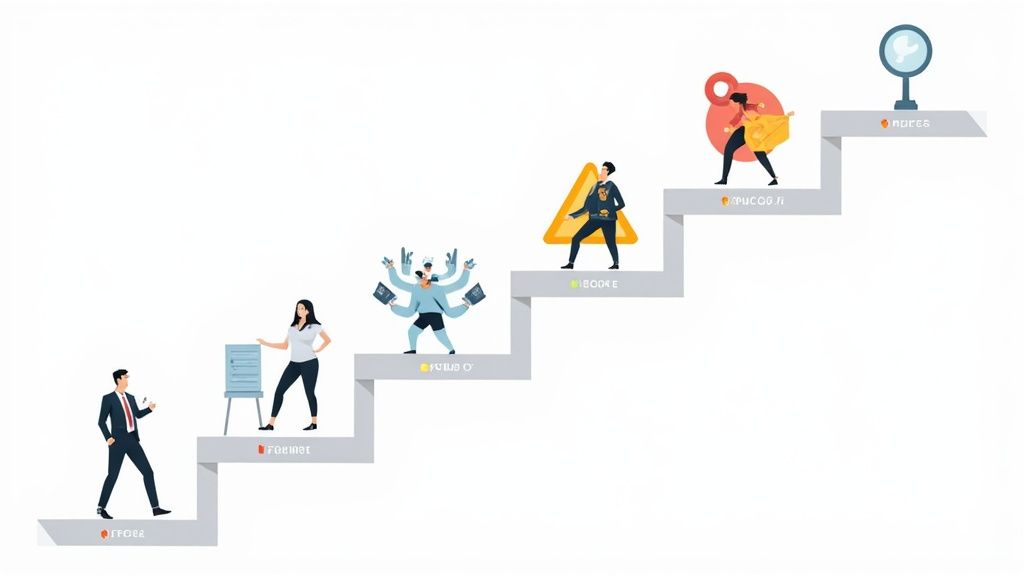
The aim here is to build something that gets used every single day, not a shiny binder that gathers dust on a shelf. Let's walk through how to make that happen.
Step 1: Secure Genuine Leadership Commitment
This is the absolute foundation. Seriously, without genuine buy-in from the top, any safety system will fail to launch. This goes way beyond just signing a policy document; it means leaders are actively involved, asking questions, and putting real resources behind safety.
Management has to allocate a realistic budget. They need to assign clear responsibilities and make safety a regular agenda item in operational meetings. When leaders show they’re invested, it signals to the entire workforce that safety is a core part of the business, not just a compliance headache.
Leadership sets the tone for the entire organisation. When managers are visibly involved in safety walks, incident reviews, and celebrating safety wins, it sends a powerful message that this is not just another initiative; it’s how business is done.
Step 2: Define Clear Roles and Responsibilities
Everyone in your organisation, from the apprentice to the CEO, needs to know exactly what their role is in keeping the workplace safe. If responsibilities are vague, critical tasks will inevitably be missed. You need to get it down on paper, clearly, who is accountable for what.
A simple organisational chart or a clear list will do the trick.
- Managers and Supervisors: They're on the hook for implementing safety procedures in their areas, running daily checks, and making sure their teams have the right training and gear.
- Workers: Their job is to follow the rules, use equipment properly, and, crucially, report hazards or incidents the moment they see them.
- Safety Coordinator/Officer (if you have one): This person coordinates the whole system, tracks performance, and acts as the in-house expert.
By clearly defining these roles, you create solid lines of communication and accountability. Everyone knows what their part is, which is what makes the system actually function.
Step 3: Conduct a Practical Risk Assessment
Your risk assessment has to reflect the reality of your day-to-day operations. Forget box-ticking. This is about systematically identifying what could actually hurt someone on your site and figuring out the smartest way to stop it from happening.
Start by walking the floor. Go through every part of your factory or site and talk to the people doing the work, they know the real risks better than anyone. Document every potential hazard you find, from an unguarded machine in the workshop to a simple trip hazard on a busy construction site.
Once you’ve listed the hazards, you need to assess the risk. How likely is an incident, and how bad would it be? This is how you prioritise, allowing you to focus your time and money on the biggest dangers first. This entire process becomes the engine of your OHS management system, informing every procedure you create.
Step 4: Develop Key Documents and Procedures
Now that you know your risks, you can develop the practical documents that will guide safe work. These are the tools your team will actually use every day. The key is to keep them simple and clear. Nobody reads a 50-page manual.
Here are the essentials:
- A clear OHS Policy: A short, sharp statement from leadership showing your commitment to safety.
- Safe Work Procedures (SWPs): Simple, step-by-step instructions for high-risk tasks. Think of a procedure for operating a press brake or for working at heights.
- Safe Work Method Statements (SWMS): A must-have for high-risk construction work. These documents detail the specific hazards of a job and the exact controls you'll use to manage them.
- Emergency Procedures: Clear, easy-to-follow plans for what to do during a fire, medical emergency, or chemical spill.
Step 5: Roll Out Practical Training
Your shiny new procedures are useless if your team doesn't understand them. Training needs to be practical, hands-on, and directly relevant to the tasks your workers are doing. A generic PowerPoint presentation just won't cut it.
For a manufacturing team, this might mean a live demonstration of the correct lockout-tagout procedure on the machine they actually use. On a construction project, it means a site-specific induction that points out the unique hazards of that job. And make sure to keep records of who was trained on what, and when they’re due for a refresher.
Step 6: Set Up Monitoring and Review Processes
An OHS management system isn't a "set and forget" project. You need simple ways to check that it’s actually working and to spot opportunities for improvement. This means setting up regular monitoring activities.
Start with the basics:
- Weekly Site Inspections: A supervisor walks the site with a simple checklist to spot new hazards or check that rules are being followed.
- Incident and Near-Miss Reporting: A no-fuss process for workers to report issues without fear of blame. The easier it is, the more you'll learn.
- Toolbox Talks: Short, sharp meetings to discuss a safety topic that’s relevant to the work happening that day.
These activities give you the feedback loop you need to see what’s working and what’s not. Many businesses find that specialised software makes this whole process much easier to manage. If you're heading down that path, our guide on choosing health and safety management software is a great place to start. It helps you pull everything from inspections to incident reports into one organised place.
Finally, schedule a formal management review at least once a year. This is the big-picture meeting where leadership looks at the system’s performance, discusses incident trends, and sets new safety goals for the year ahead. This closes the loop and drives that all-important continuous improvement.
Key Processes Your System Must Include
An OHS management system isn't just a binder on a shelf. Its real value comes alive in the day-to-day processes that keep it running. These are the practical, non-negotiable actions that turn your safety policy into a reality on the factory floor or construction site.
A good system is all about documented, understood, and actively used processes that prevent harm. Let's break down the absolute essentials, especially for high-risk industries where there's no room for error.
Systematic Hazard Identification and Control
This is the engine room of your entire OHS system. It’s the continuous cycle of looking for what could go wrong, figuring out how bad it could be, and then putting smart controls in place to stop it. This isn't a once-a-year task; it’s a constant state of vigilance.
On a busy manufacturing floor, for example, this means more than just an annual walkthrough. It's about daily pre-start machinery checks, weekly inspections of chemical storage, and actually listening when a worker says a safety guard is clumsy and getting in the way.
The goal is simple: find and fix problems before they cause an incident. A structured approach is the only way to do this reliably.
- Routine Inspections: Give your supervisors simple checklists to run through their work areas regularly.
- Worker Consultation: Make it incredibly easy for your team to report hazards. They are your eyes and ears on the ground and will spot the subtle risks managers often miss.
- Job Safety Analyses (JSAs): Before kicking off any non-routine or high-risk task, break it down step-by-step. This helps you pinpoint potential hazards and establish the right controls from the get-go.
Once you find a hazard, you need a proven method for controlling that risk. We’ve got a detailed breakdown of the best methods in our guide to the hierarchy of control measures, which will help you prioritise the most effective solutions over weak, administrative ones.
Incident Reporting and Investigation
Look, no system is perfect. When an incident or even a near-miss happens, how you react is what truly matters. An effective OHS management system has a clear, blame-free process for reporting and investigating these events. The goal isn't to punish someone; it's to understand the root cause so you can make sure it never, ever happens again.
Your reporting process needs to be simple enough for any worker to use without hesitation. It just needs to capture what happened, where, and when. As soon as a report comes in, a systematic investigation should kick off to uncover the hidden factors that led to the event.
A strong incident investigation process treats every near-miss as a free lesson. It gives you critical insight into your system's weaknesses before a serious injury occurs, allowing you to make targeted, effective improvements.
A proper investigation digs deeper than just blaming "worker error." It asks why the error happened. Was the procedure confusing? Was the training inadequate? Was there pressure to rush the job? Answering these questions leads to meaningful corrective actions that fix the system, not just the symptom. A crucial part of this is having clear guidelines; learn how to create effective Standard Operating Procedures (SOPs) that eliminate confusion.
Emergency Preparedness and Response
When an emergency hits, there’s no time to go looking for a manual. Your team needs to know exactly what to do, right now. Your OHS system must include clear, simple, and well-practised emergency response plans.
This covers everything from a fire or chemical spill to a serious medical event.
Key elements of being prepared include:
- Clear Procedures: Documented, step-by-step plans for different emergency scenarios.
- Accessible Equipment: Making sure fire extinguishers, first aid kits, and spill kits are always stocked, visible, and regularly checked.
- Regular Drills: Drills are the only way to know if your plan actually works. They build muscle memory, so people react correctly and instinctively when the pressure is on.
Remember to make these plans specific to your site. A construction site’s evacuation plan will look completely different from a manufacturing plant’s response to a chemical spill.
Contractor and Subcontractor Management
On most construction and manufacturing sites, subcontractors are a daily reality. Your OHS management system is responsible for everyone on your site, not just your direct employees. This means you need a rock-solid process for managing contractor safety.
This process begins long before they ever step foot on your site. It starts with a pre-qualification step where you check their safety record, insurance, and licences. Once they're approved, they must go through a site-specific induction covering your rules, hazards, and emergency procedures.
This is absolutely vital in high-risk sectors. Recent data shows that 80% of traumatic fatalities and 61% of serious claims were concentrated in just six industries, including transport, manufacturing, and construction. With vehicle incidents causing 42% of deaths and falls from height causing 13%, a tailored OHS system with robust contractor oversight is essential. You must actively monitor their work to ensure they continue to meet your safety standards throughout the project.
How to Tell If Your Safety System Is Working
So, you’ve put a safety system in place. How do you actually know if it's making a difference? Just counting injuries after the fact is like looking in the rearview mirror, it only tells you about crashes you've already had. A genuinely effective system gives you clues that it's working before an incident happens.
These clues are what we call leading indicators. They measure the proactive safety activities your team is doing every day, not just the negative outcomes. They show you people are engaged and your processes are alive and well. Shifting your focus to these measures is the secret to knowing if your system is truly protecting your people.
Moving Beyond Injury Rates
Relying solely on metrics like Lost Time Injury Frequency Rates (LTIFR) can be dangerously misleading. A low LTIFR might mean you’re doing great, or it could just mean you’ve been lucky. Luck eventually runs out.
To get a true picture of your system’s health, you need to track the actions that prevent incidents from happening in the first place. This means measuring things like how many safety observations your crew reports each month or how fast you’re closing out identified hazards. These numbers give you real-time data on how things are really going.
Practical Leading Indicators to Track
The right indicators will depend on your specific operations, but here are a few powerful examples that work well in manufacturing and construction.
- Hazard Reporting: How many new hazards are your workers pointing out? A steady flow of reports is a fantastic sign. It shows your team is switched on and feels safe enough to speak up.
- Corrective Action Closure Rate: When someone reports a problem, how quickly is it fixed? A fast closure rate, say, 95% of actions closed within 7 days, proves your system has teeth and isn't just a paper-shuffling exercise.
- Inspection Completion: Are your supervisors actually doing their weekly site walk-arounds on time? Hitting 100% completion shows that your routine checks and balances are firmly in place.
- Training Completion Rates: This one’s simple but crucial. Tracking the percentage of your team that has completed required training gives you a clear snapshot of your site’s overall competency.
Think of these indicators as the dashboard of your safety system. They are the gauges and warning lights that let you know if the engine is running smoothly, rather than waiting for it to break down completely.
Using Data to Make Smart Decisions
Collecting this data is one thing; using it is another. All these numbers are useless unless you act on them. Schedule regular, quick-fire reviews of these metrics with your leadership team and supervisors. Look for trends.
For example, if you see hazard reporting suddenly drop off in one department, it’s a red flag. Go and talk to that team. Is a new supervisor quietly discouraging reports? Has a process changed that makes it harder for them to log issues? This data gives you a starting point to ask the right questions and fix small problems before they become big ones.
This approach helps you make targeted, intelligent improvements. It also sends a powerful message to everyone on site that you’re serious about managing safety proactively, not just reacting to failures. To add a more formal structure to this process, looking into audits and compliance can provide a clear framework for your review cycles.
Your OHS Management System Questions Answered
Even with a solid plan, a few questions always pop up when you're getting an OHS management system off the ground. Let's tackle some of the most common ones we hear from business owners and managers in manufacturing and construction.
Do I Really Need ISO 45001 Certification?
Straight answer? No, getting formally certified for ISO 45001 isn't a legal requirement in Australia. Your actual legal duty is to manage workplace health and safety risks, full stop. The thing is, building a system that follows the principles of ISO 45001 is an incredibly effective way to meet that duty.
Certification usually comes into play for commercial reasons. You might find you need it to tender for large government projects or to get on the books with a major construction firm where it’s a non-negotiable.
But plenty of businesses get all the safety benefits by simply using the standard as a blueprint. They build a compliant, practical system that fits their own operations, without sinking time and money into the formal audit process.
What's the Difference Between a Safety Plan and an OHS Management System?
This is a great question because the two terms get mixed up all the time. The easiest way to think about it is this: your OHS management system is the entire workshop, and a safety plan is just one specific tool you pull out for a particular job.
An OHS management system is the overarching framework for your whole business. It’s the engine running in the background, covering your company-wide policies, how you assess risk, your training programs, and your incident reporting procedures. A safety plan is a specific output of that system.
A perfect example is a Site-Specific Safety Plan (SSSP) in construction. It's a document that details the unique hazards and controls for a single project. It’s temporary and project-focused, created using the procedures already defined within your broader OHS management system. The system runs the business; the plan manages the project.
How Do I Manage OHS with Subcontractors on My Site?
This is critical: your OHS management system is responsible for every single person on your worksite, and that absolutely includes subcontractors. You can’t handball your safety duty. This means a rock-solid contractor management process isn't a nice-to-have; it's essential.
Your process needs to cover a few key steps:
- Prequalification: Before they set foot on site, you need to be checking their safety history, licences, and insurance certificates. This is your first filter to make sure you're partnering with competent operators.
- Site-Specific Induction: Once they’re approved, every one of their workers must go through your site induction. This is where you lay down your rules, explain emergency procedures, and point out the specific hazards they’re about to face.
- Monitoring: You have to actively monitor their work to make sure they're sticking to the safety standards you’ve set. As the principal contractor, the buck stops with you.
Our Business Is in Western Australia – Are There Specific Rules?
Yes, absolutely. While most of Australia has moved to harmonised Work Health and Safety (WHS) laws, Western Australia still operates under its own specific legislation: the Work Health and Safety Act 2020.
The core principles of managing risk are pretty similar nationwide, but there are definite differences in WA's regulations, codes of practice, and what the regulator expects to see. Your OHS management system must be specifically built to comply with this local legal framework.
It’s a huge mistake to assume a system built for an eastern states business will be fully compliant in WA. Always use WorkSafe WA as your go-to source for legal requirements and ensure your procedures and paperwork align with their specific rules.
Trying to manage all these moving parts with paper forms and spreadsheets is a never-ending battle. Safety Space replaces the clutter with a single, easy-to-use platform. It helps you handle everything from contractor compliance and incident reports to site inspections, all in one place. See how you can build a stronger, simpler OHS management system by booking a free demo.
Ready to Transform Your Safety Management?
Discover how Safety Space can help you build a safer, more compliant workplace with our comprehensive safety management platform.
Book a Free DemoRelated Topics
Safety Space Features
Explore all the AI-powered features that make Safety Space the complete workplace safety solution.
Articles & Resources
Explore our complete collection of workplace safety articles, tools, and resources.