
The crane is set up, the dogger is on the radio, and the supervisor is holding a signed document while the load waits on the hook. Then someone asks whether the access route is still clear, whether the load mass includes the spreader, and who will keep pedestrians out of the landing area. If the answers aren't in the safe work method statement for lifting, the lift isn't ready.
Table of Contents
- What a Lifting SWMS Actually Is Under Australian Law
- High-Risk Construction Work Categories a Lift Can Trigger
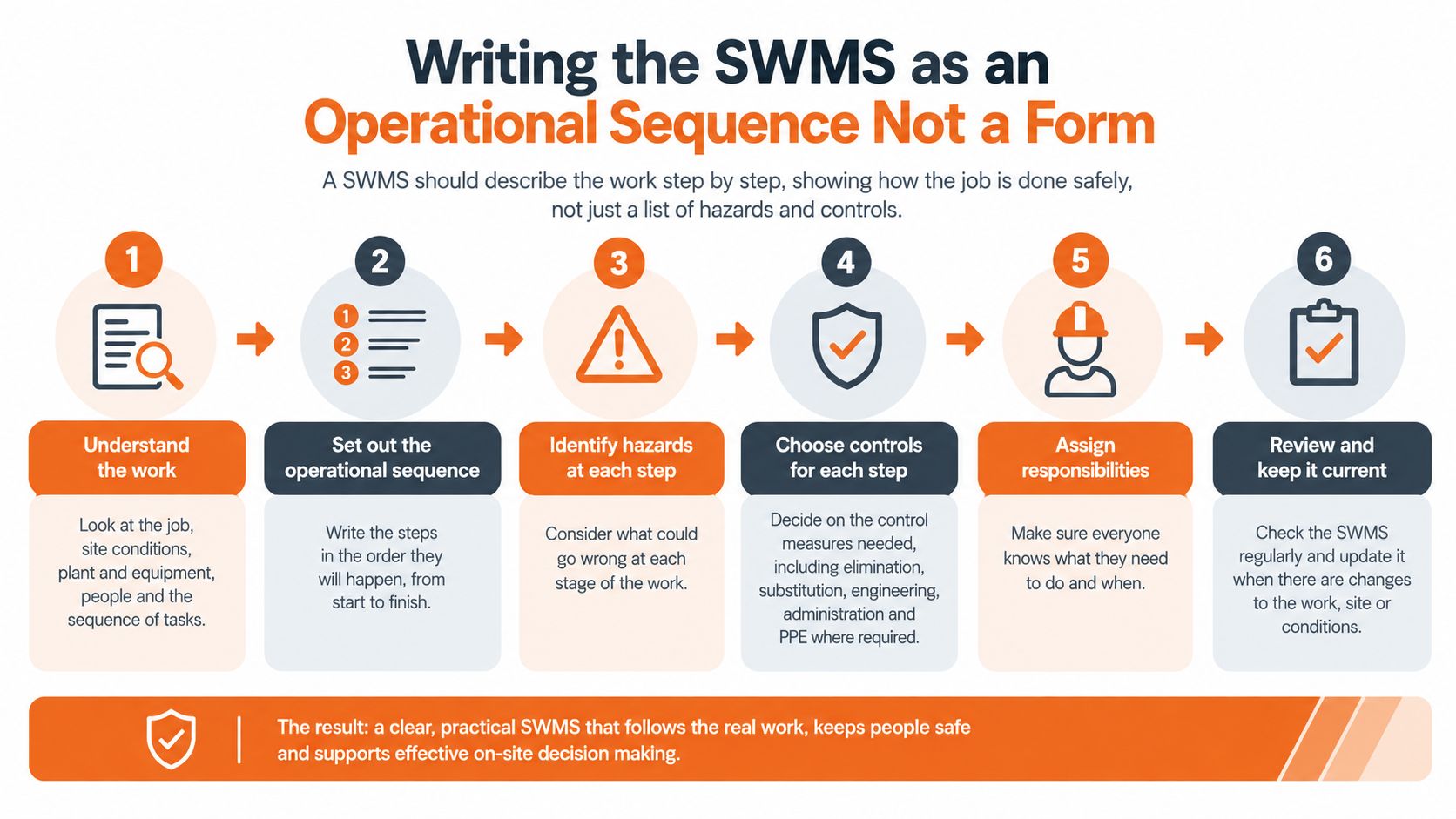
- Writing the SWMS as an Operational Sequence Not a Form
- The Rigging and Manual Handling Interface Most SWMS Miss
- Reusable SWMS Template and a Worked Mobile-Crane Example
- Roles, Consultation, Sign-On and Evidence of Implementation
- Pre-Lift Checklist, Stop-Work Triggers and Jurisdictional Notes
What a Lifting SWMS Actually Is Under Australian Law
A Safe Work Method Statement, or SWMS, is a legally significant control document for high-risk construction work in Australia. It isn't a generic lifting checklist, a risk assessment copied from another job, or a signature sheet kept in a project folder. It must describe the high-risk construction work, the hazards arising from it, and the controls used to eliminate or minimise those hazards.
For lifting work, that means the document needs to match the actual task. It should identify the load, lifting plant, accessories, route, landing area, exclusion zones, communication method, weather limits and people responsible for each control. A statement such as “lift safely using appropriate equipment” gives the crew no usable method.
A PCBU must prepare the SWMS, or ensure one has been prepared, before the high-risk construction work starts. The PCBU must make it available, provide it to the principal contractor where applicable, ensure the work follows it and review it when controls are ineffective or circumstances change. Safe Work Australia also confirms that one SWMS can cover multiple high-risk activities, which matters when a lift involves mobile plant, traffic, structural work and height exposure at the same time. The practical meaning of a safe work method statement is simple: it tells people how the work will happen, in order, with controls that can be checked.
Practical rule: A signed SWMS that doesn't match the lift on the ground is not evidence of control. It is evidence that someone completed paperwork.
New Zealand uses a different document framework. The Health and Safety at Work Act 2015 places comparable duties on PCBUs to manage risks, and WorkSafe NZ commonly expects site-specific safety plans and task controls rather than an Australian statutory SWMS. A business operating in both countries should still use the Australian SWMS structure as a minimum where Australian high-risk construction work is involved.
In the United States, OSHA's 29 CFR 1926 Subpart N covers cranes and rigging, but there is no SWMS-style statutory document with the same Australian function. US employers can borrow the sequence, hold points and stop-work logic as good practice, while meeting the applicable OSHA requirements.
The legal trigger in Australia is whether the task is high-risk construction work. If it is, the SWMS must exist before work starts. For a lift, the useful test is whether workers can understand it, verify it and follow it while conditions change.
High-Risk Construction Work Categories a Lift Can Trigger
A lift rarely sits inside one risk category. A telehandler placing roof trusses may involve powered mobile plant, work where a person could fall more than 2 metres and structural components. A mobile crane placing a plant room over a live driveway may involve powered mobile plant, work near a traffic corridor, structural components and work at height. A vehicle-loading crane delivering materials across a footpath may involve mobile plant and traffic interface risks before the load leaves the tray.
Safe Work Australia identifies 18 categories of high-risk construction work requiring a SWMS, including work involving powered mobile plant, work where a person could fall more than 2 metres, work near roads or other traffic corridors, work involving structural components and diving work. The full Safe Work Australia list of high-risk construction work requiring a SWMS should be checked when the lift touches another construction activity.
Scan the lift by exposure
Use the planned movement, not the equipment name, to identify the categories.
- Powered mobile plant: This applies when a crane, forklift, telehandler or other mobile plant moves or suspends the load. The SWMS should address interaction with pedestrians, trucks and other plant.
- Falls above 2 metres: A worker may be exposed while connecting rigging, receiving the load, working from a roof or placing structural components.
- Traffic corridors: A crane or hiab operating beside a road, driveway, footpath or other traffic route needs separation and movement controls.
- Structural components: Roof trusses, precast elements, steelwork and other components can create both lifting and structural stability risks.
- Existing services and lines: The lift may pass near energised electrical services, gas lines, refrigerant lines or other services. The method needs verified clearances and controls before mobilisation.
- Temporary load-bearing support: Structural alterations or repairs may need temporary support to prevent collapse. The lifting method must state how the structure remains stable before, during and after placement.
One SWMS can cover several categories. That avoids separate documents that contradict each other, but only if the sequence joins the controls together. The minimum for a mobile-crane roof lift may be powered mobile plant, work at height, structural components and traffic exposure, depending on the site.
Writing the SWMS as an Operational Sequence Not a Form
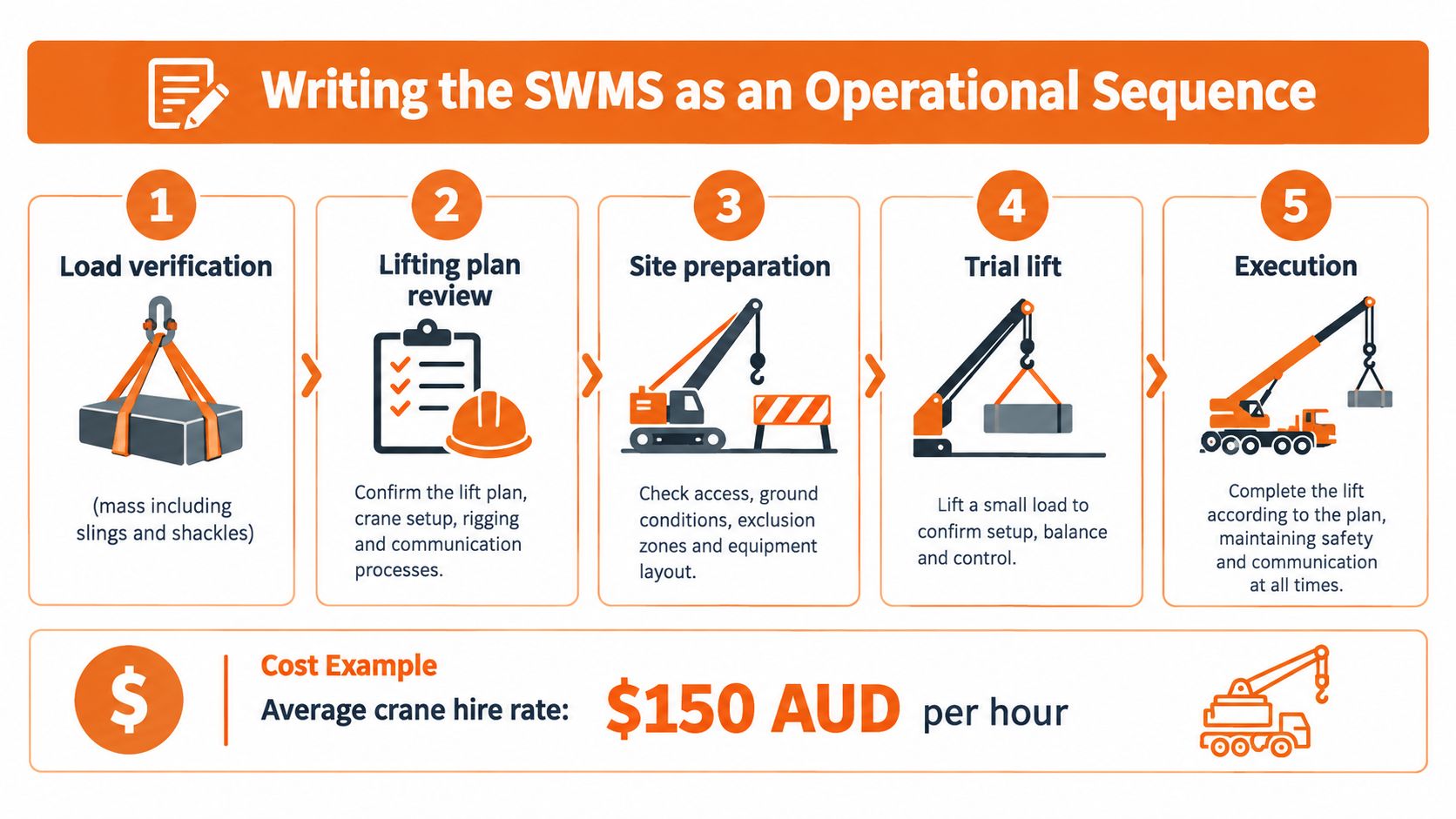
The strongest lifting SWMS reads like a procedure a supervisor can walk, not a table of hazards detached from the work. Each step should state what happens, what can go wrong, what control must be in place, who owns it and where the lift pauses for verification.
Start with the load and the crane
Begin by verifying the load mass. Include slings, shackles, spreader beams and other lifting accessories. Compare the marked mass with the best available actual information, identify the centre of gravity and confirm the approved lifting points.
Then confirm the crane type and configuration. Check the load chart at the planned radius, boom arrangement, counterweight and outrigger configuration. The crane's maximum rated capacity isn't available at every radius or setup. The standing must also support the maximum ground-bearing pressure, with suitable mats or other controls where required.
Record the setup conditions:
- Standing and outriggers: Confirm the ground is stable, level where required and capable of supporting the planned setup.
- Overhead services: Identify electrical or other overhead services and establish controls before the crane arrives.
- Travel path: Inspect the full movement envelope, including slew, swing, drift, snagging and access constraints.
- Landing point: Confirm the receiving structure, landing surface, access route and the space workers need to secure the load.
- Weather limits: State the wind and weather limits from the equipment and lift requirements, not a vague instruction to monitor conditions.
The difference between a JSA and a SWMS matters here. A lifting SWMS must explain the operational method and controls for high-risk construction work, not merely list hazards.
Build the pre-start around hold points
Before the hook moves, confirm competent and appropriately licensed personnel, inspected and certified lifting gear, crane setup to the manufacturer's requirements and exclusion zones around the lifting area, landing area and full travel path. Nominate the operator, dogger or rigger, signalperson and supervisor. Agree the radio or hand-signal method, including what happens when communication is lost.
The trial lift is a real control, not a ceremonial pause. Raise the load a controlled distance, check balance, sling seating, ground response, crane stability and communication, then hold for confirmation. The supervisor should be able to stop the operation at named points:
- Load verification: The mass, centre of gravity, lifting points and accessories match the approved information.
- Setup confirmation: The crane, ground, outriggers, services and exclusion zones match the method.
- Trial lift: The load remains balanced, stable and clear of obstructions.
- Landing control: The receiving area is clear and workers are positioned outside pinch and drop zones.
The lift stops for wind or weather beyond equipment limits, loss of communication, anyone entering the exclusion zone, unstable ground, altered load information or any deviation from the approved configuration. Damaged gear, unexpected movement or a changed radius also requires the method to pause and be reassessed.
The Rigging and Manual Handling Interface Most SWMS Miss
Many lifting documents stop when the load leaves the ground. That is where a different exposure often begins. Workers connect and remove rigging, manage tag lines, guide the load into position, release tension and make final adjustments by hand.
A crane removes some carrying, but it doesn't remove manual handling. A worker can still be exposed to awkward posture, sudden movement, pinch points and high force over a short distance. The boundary between the suspended-load task and the manual adjustment task needs its own controls.
Write the final metre into the method
The SWMS should identify who attaches and removes the slings, who controls the tag line and where each person stands. It should state whether a tag line is suitable for the load and conditions. A tag line can help control rotation, but it can also expose a worker to stored force or pull the worker towards the load if the movement isn't understood.
The load must remain stable before anyone approaches. After landing, the method should state how it is restrained, when tension can be released, how workers keep hands out of pinch points and what aid or team method is used for final positioning. “Position manually” isn't a control. It hides another task inside the lift.
The document should distinguish these stages:
- Suspended-load lift: Workers stay out of the drop zone and line of fire while the crane controls the load.
- Landing and securing: The receiving area is controlled, the load is stable and workers use nominated contact points or tools.
- Manual adjustment: The crane is isolated from unintended movement, the load is restrained and the method controls posture, force and pinch exposure.
- Rigging removal: Workers release gear only when the load is stable and no stored energy can cause movement.
This matters across residential construction, manufacturing and waste operations. Australian workers' compensation data recorded 50,600 serious claims from body stressing, or 34.5% of all serious claims, while musculoskeletal and connective-tissue diseases accounted for 22,500 serious claims, or 15.3%. Those figures are reported in guidance on preventing back injuries in healthcare, and the principle applies beyond healthcare. A planned mechanical lift can still finish with an uncontrolled manual task.
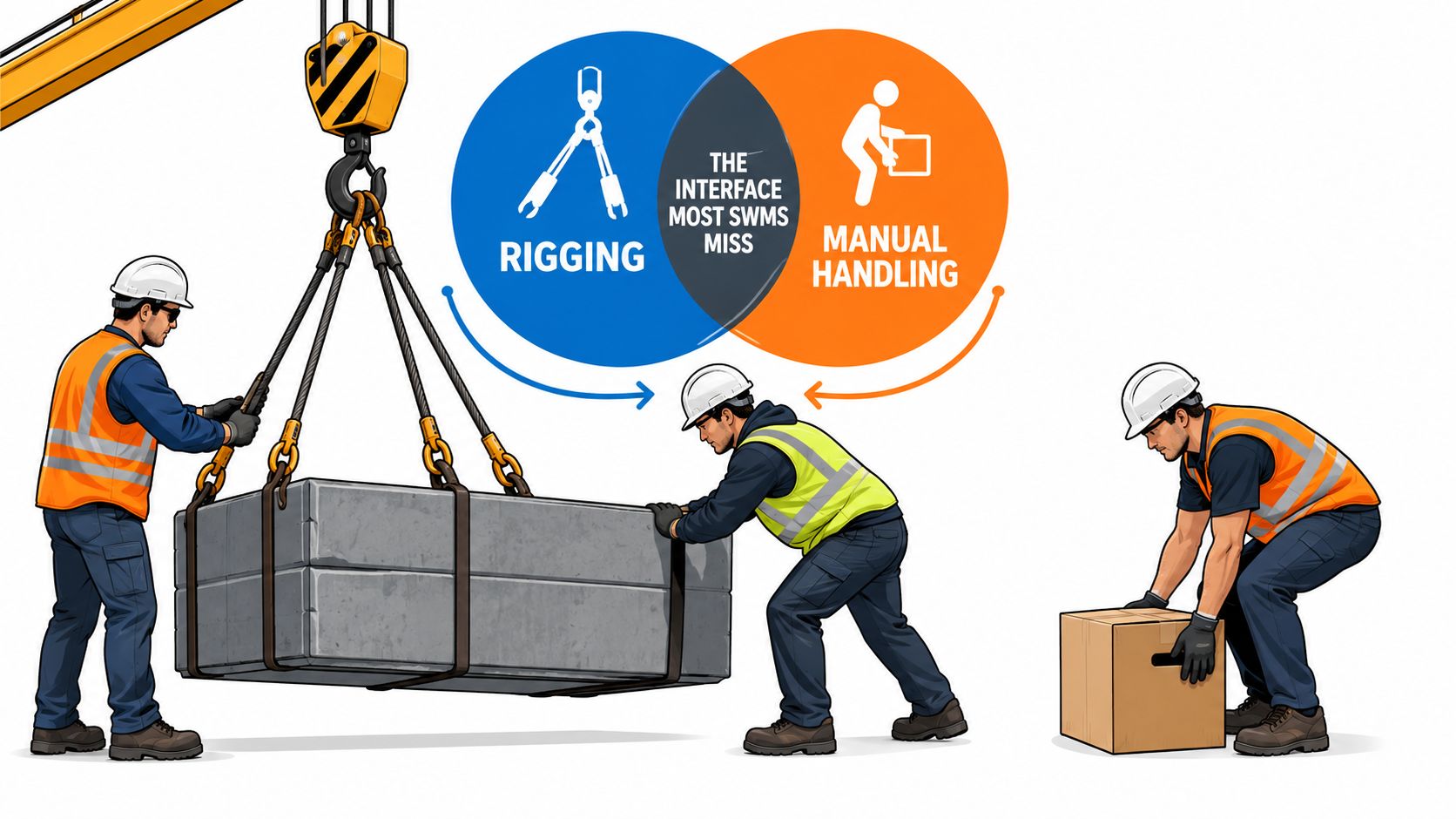
A useful control block names the worker responsible for checking the attachment, identifies the safe standing position, specifies when tag lines are prohibited or unsuitable, and defines the action if the load lands out of position. It also covers the return path for slings and accessories. Workers shouldn't improvise the final movement because the main lift was formally planned.
Reusable SWMS Template and a Worked Mobile-Crane Example
A reusable template should provide a consistent frame without forcing every lift into the same wording. The writer still needs to replace generic controls with the actual load, plant, site and sequence.
| Section | What to capture | Why it matters |
|---|---|---|
| Job description | Location, task, load and work boundaries | Sets the scope and prevents unrelated controls from diluting the method |
| High-risk categories | Mobile plant, height, traffic, structural work, services and support risks | Establishes why the SWMS applies |
| Lift specifics | Load mass, accessories, crane, radius, configuration, ground, access and weather limits | Tests whether the planned equipment can perform the lift |
| Operational sequence | Setup, rigging, exclusion zones, trial lift, movement, landing and demobilisation | Gives the supervisor a method to follow |
| Hazards and controls | Specific exposure and control for each step | Links controls to the point where risk appears |
| Hold points | Verification before setup, trial lift, movement and landing | Prevents the lift from progressing on assumptions |
| Stop-work triggers | Weather, communication, people, ground, gear, load or configuration changes | Defines when the method no longer applies |
| Roles and consultation | PCBU, supervisor, operator, dogger, rigger, signalperson and ground crew | Assigns ownership rather than relying on collective awareness |
| Sign-on and review | Worker understanding, pre-start, field checks and change review | Provides evidence that the SWMS is live |
Worked example for a rooftop unit
The task is a mobile crane lifting a packaged rooftop unit onto a commercial building. The SWMS identifies powered mobile plant, work at height, structural components if the unit affects the roof structure, and work near traffic if the crane stands beside a road or driveway.
Before mobilisation, the supervisor confirms the unit's mass, including all lifting accessories, its centre of gravity and approved lifting points. The crane supplier's configuration is checked against the planned radius, ground-bearing requirements and available space. The landing area is checked for structural capacity, access and edge protection.
The crew then establishes a physical exclusion zone around the crane, the lift path and the roof landing area. The operator and dogger confirm the radio protocol. The dogger checks the gear, connects the unit and directs the trial lift. The lift stops if the unit tilts unexpectedly, the gear shifts, the crane standing responds adversely or communication fails.
After the trial lift, the unit travels through the cleared path without workers beneath it. The receiving crew remains outside the line of fire until the load is stable and restrained. Only then do they release tension and complete the final connection or positioning task under the manual-handling controls already written into the SWMS.
The same scaffold can support a forklift or telehandler task, but the controls must change. Replace crane load-chart and outrigger checks with plant capacity at the required reach, attachment suitability, visibility, travel surface and stability. The high-risk categories may remain similar, but the movement path, blind spots, exclusion arrangements and landing method must be rewritten. A guide to heavy machinery used for tree removal is also useful when comparing how different mobile plant changes the planning problem, although each worksite still needs its own task-specific method.
Roles, Consultation, Sign-On and Evidence of Implementation
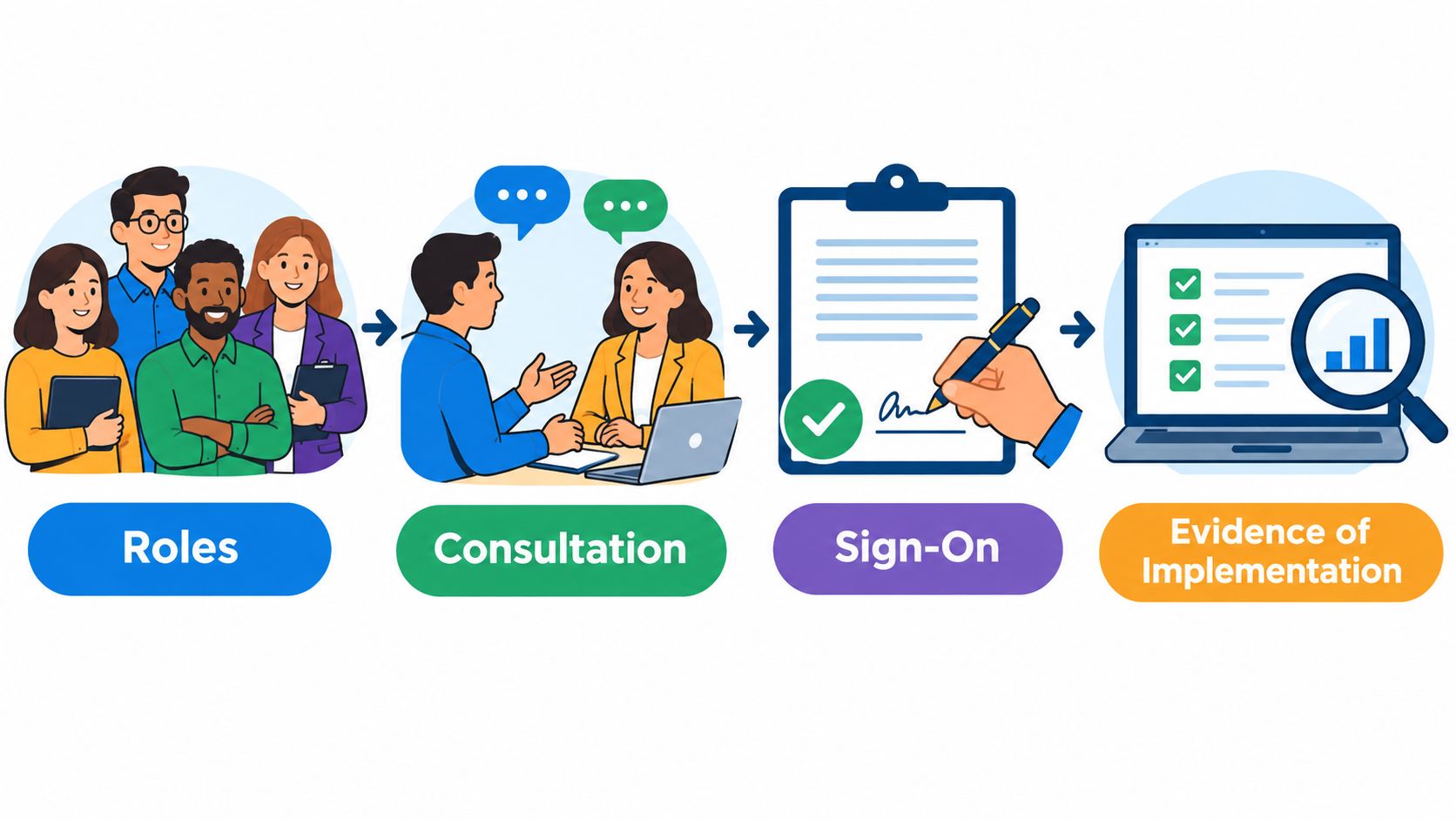
The PCBU owns the duty to prepare the SWMS or ensure it has been prepared. The principal contractor receives it, checks that it suits the project and coordinates it with other work. Neither role is discharged by filing a document that the crew can't use.
The supervisor owns execution against the method. The crane operator controls the plant within the approved configuration. The dogger or rigger owns the attachment, load control and signals within their competency. The signalperson maintains the agreed communication link. The slinger checks the connection and gear. Ground workers stay outside the exclusion zone unless their task and position are specifically controlled.
Consultation must change the document
Workers need to be consulted while the SWMS is developed, understand the controls and sign on before work starts. Consultation should test practical questions: Can the crew reach the lifting points without exposure? Does the exclusion zone cut across a normal access route? Can the operator see the landing area? Who has authority to stop the lift?
A signature proves attendance, not understanding. The supervisor should ask workers to explain the trial-lift hold point, the communication failure rule and the location of the exclusion boundary. If those answers aren't clear, the briefing hasn't done its job.
Evidence is behaviour that matches the method, not a stack of signatures.
Queensland evidence shows why this distinction matters. Between 1 July 2016 and 30 June 2017, mobile plant or transport killed 12 workers and caused 2,087 serious injuries across Queensland industries, based on workers' compensation data. The same project found that almost 10% of workplaces that had prepared a SWMS were not, or were only partially, carrying out the work in accordance with it. These figures are reported in the WorkSafe Queensland onsite traffic management project.
Evidence of implementation includes a pre-start verification, field inspection of the crane standing and exclusion zones, a gear inspection record, worker sign-on, photographs where appropriate, corrective actions and a re-brief after any change or near miss. Safety Space can hold the SWMS, worker sign-on, pre-start verification, corrective actions and field inspections in one system, with offline access for field workers.
Pre-Lift Checklist, Stop-Work Triggers and Jurisdictional Notes
A morning-of-lift check should be short enough to use and specific enough to expose a failed assumption. The WHS compliance checklist can support broader verification, but the lift still needs its own field check.
Pre-lift checklist
- Load and rigging: Confirm mass, centre of gravity, lifting points, accessories, working-load limits, inspection status and edge protection.
- Crane and chart: Confirm crane type, configuration, radius, load chart, counterweights, outriggers and setup requirements.
- Ground and weather: Verify ground stability, bearing controls, overhead services and weather within equipment limits.
- Exclusion zones and access: Control the lifting area, landing area and complete movement path. Keep traffic and pedestrians separated.
- People and licences: Confirm competent operator, dogger, rigger, signalperson, supervisor and receiving crew.
- Communication: Test the radio or agreed signals. Confirm who can stop the lift.
- Trial lift and hold points: Complete the controlled trial lift and pause for balance, stability, gear and communication checks.
Stop the lift when
- Weather changes: Wind or weather exceeds the equipment or approved method limits.
- Communication fails: The operator, dogger or signalperson can't maintain clear contact.
- The zone is breached: Any unauthorised person enters the exclusion zone.
- Ground moves: The standing becomes unstable or the crane setup changes.
- The load or radius changes: Mass, centre of gravity, lifting points, route or radius differs from the approved information.
- Gear fails inspection: Lifting gear is damaged, incompatible or otherwise unsafe.
- The method changes: The crew deviates from the approved configuration, sequence or landing arrangement.
In Australia, a SWMS is required by law for the identified categories of high-risk construction work. In New Zealand, PCBUs work under the Health and Safety at Work Act 2015 and generally use site-specific safety plans and task controls. In the United States, employers can use the same operational structure as best practice while meeting OSHA 29 CFR 1926 Subpart N requirements for cranes and rigging.
The final compliance test is practical. The document is available before work starts, workers understand it, the supervisor verifies the controls in the field, and the method is reviewed when conditions change. If any of those four checks fail, the lift needs a pause before the hook moves.
Safety Space provides SWMS and JSAs with worker sign-on, pre-starts, inspections, corrective actions and offline access for field teams. Visit Safety Space to see how those controls can be kept together by site or project while lifting work is planned and verified.
Ready to Transform Your Safety Management?
Discover how Safety Space can help you implement the strategies discussed in this article.
Explore Safety Space FeaturesRelated Topics
Safety Space Features
Explore all the AI-powered features that make Safety Space the complete workplace safety solution.
Articles & Resources
Explore our complete collection of workplace safety articles, tools, and resources.