
A compliant manufacturing document system isn't a folder of generic templates. It must connect WHS policies and procedures with risk assessments, SWMS or JSAs, permits, training evidence, inspections, incident investigations and corrective actions, then put the right version in front of the person doing the work.
That matters in Australian manufacturing. Safe Work Australia recorded 13,800 serious workers' compensation claims in manufacturing in 2023, representing 10.0% of all serious claims nationally. The sector recorded a frequency rate of 16.7 serious claims per million hours worked, with a median direct cost of $15,800 per claim. These figures make written hazard controls and usable operational records foundational, not administrative decoration. (Safe Work Australia's manufacturing report)
A PCBU also has formal recordkeeping duties. Under the Work Health and Safety Regulations 2011, a risk assessment must generally be kept until at least 28 days after the work is completed, or for at least 2 years after a notifiable incident where relevant. The assessment must remain readily accessible to workers involved in the task and available for inspection. (Safe Work Australia's national WHS data guidance)
The ten resources below separate two decisions that businesses often confuse. First, which safety documents for a manufacturing company must be controlled? Second, which tools help create, store, distribute and review those documents? Templates can fill a content gap. Digital platforms can manage ownership, version control, evidence and follow-through. Neither removes the need to account for state and territory differences, assign document owners, or review records after process changes, incidents, maintenance failures and contractor onboarding.
Table of Contents
- 1. Safety Space
- 2. SafetyDocs by SafetyCulture
- 3. BlueSafe Online
- 4. Occupational Safety Solutions
- 5. Solum Safety Consulting Templates and Packs
- 6. Risky Digital AU WHS Templates
- 7. Ideagen Plant Assessor Australia
- 8. EcoOnline Australia Chemical and SDS Management
- 9. SWMS Generator AU
- 10. Safe Work Australia Free WHS Templates and Guidance
- Top 10 Safety Document Solutions Comparison
- Turn Templates Into Controlled WHS Evidence
1. Safety Space
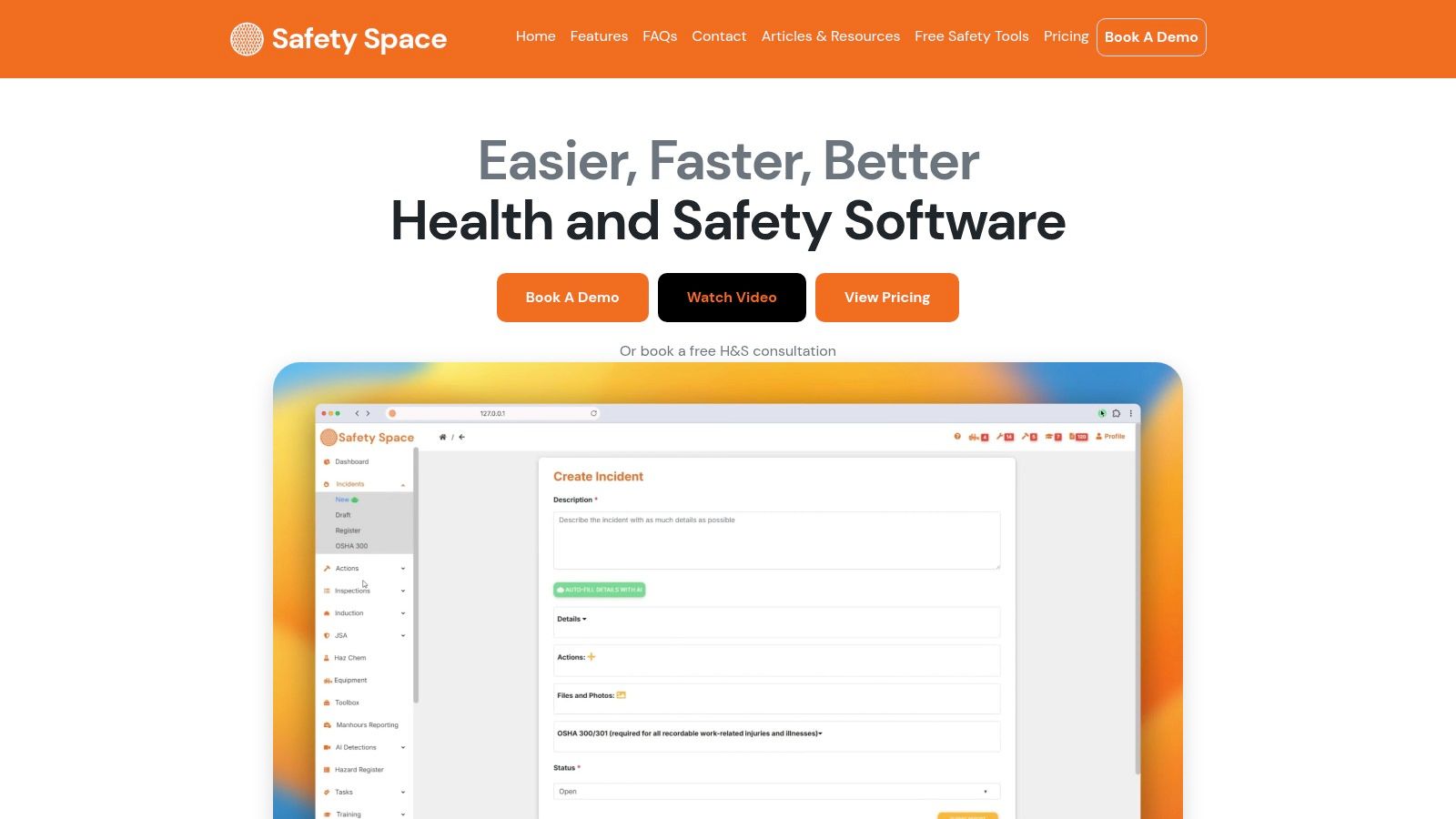
Safety Space is the strongest fit when the problem isn't one missing SWMS. It's the absence of a controlled system connecting documents, forms, actions, accountability and site oversight. The platform is positioned as a customisable health and safety management system for replacing paper, spreadsheets and disconnected legacy tools across manufacturing, construction and industrial operations.
Where it fits in a manufacturing operation
A manufacturing team can use one environment to create, distribute and track safe working procedures, risk assessments, inspections, incident records, corrective actions and training evidence. Its hazardous chemicals register also supports accessible records for chemicals used, handled or stored on site. That matters because chemical registers and accessible SDS need to sit alongside operating procedures, emergency arrangements and exposure controls, not in a separate folder nobody checks.
Real-time dashboards can give H&S, operations and plant managers visibility across sites and projects. Multi-site and subcontractor functions are particularly relevant where contractors maintain machinery, enter production areas or work under site-specific controls. Integrations can reduce duplicate data entry, although the quality of the result will depend on how the business maps its existing systems and assigns data ownership.
The platform also advertises AI-assisted form completion and drafting for procedures and risk assessments. That can reduce administrative effort, but generated content still needs review by someone who understands the machine, task, chemical, work environment and applicable jurisdiction.
Practical rule: Use automation to prepare a document. Keep approval, field verification and review with a competent person who owns the risk.
Strengths and limitations
The main strengths are multi-site visibility, custom forms, subcontractor oversight, dashboards, integrations, onboarding and ongoing support. Flexible monthly, cancel-any-time plans and annual contracts are available, with custom pricing rather than public list prices. A free demo and H&S consultation can help a procurement team test the workflow before committing.
The trade-off is that quote-based pricing slows direct comparison. Third-party review volume is also limited, although Safety Space is listed at 4.6 out of 5 on Capterra from 8 reviews. (Capterra listing) Treat that as a prompt for a live demonstration or controlled pilot, not as proof that the system will fit every plant.
2. SafetyDocs by SafetyCulture
SafetyDocs by SafetyCulture is a document library rather than a complete manufacturing safety management workflow. It suits a business that needs editable Australian WHS templates quickly, especially SWMS, SOPs, policies, registers, safety management plans and broader system documents.
The dedicated Manufacturing Industry Package is useful because it gives teams a starting point closer to production, plant and warehousing work than a generic construction template. Documents are available in editable Word and PDF formats, can be downloaded immediately and can be branded for the organisation.
The practical use case
This resource works well when an H&S manager has identified a missing document and needs a credible base version for internal review. It can help establish consistent headings, responsibilities, control descriptions and record fields across a document set. It can also reduce the time spent drafting routine policies and procedures from a blank page.
It doesn't, by itself, prove that workers have read the current version, that controls were checked on the floor, or that corrective actions were closed. A Word file stored on a shared drive still needs an owner, approval status, review date, distribution method and withdrawal process for obsolete copies.
For that reason, use SafetyDocs as a content source, then place approved documents into a controlled document management workflow. A document management system for safety teams is more suitable when the business needs controlled access, acknowledgements, version history and evidence across sites.
Use it for: fast document acquisition and customisation.
Don't use it as: the entire evidence trail for a multi-site WHS system.
Pricing varies by document and package, so the total cost depends on how much of the system you need. The broad catalogue is a strength for template buyers, but the ongoing workflow remains the responsibility of the business unless another platform manages it.
3. BlueSafe Online
BlueSafe Online takes a more structured approach than a single-template store. It offers Australian-written WHS management systems with policies, procedures, forms and registers, alongside a cloud portal for controlled documents and electronic forms. The materials are presented as aligned with AS/NZS ISO 45001 principles, which may suit SMEs building a formal management system without developing every document internally.
Why the portal matters
The key distinction is ongoing maintenance. The subscription portal includes version control and updates intended to reflect Australian legislative changes. That is more useful than buying a static pack and assuming it will remain suitable as duties, processes and plant change.
Sector packs include mechanical, automotive and industrial categories that can support manufacturing and manufacturing support services. They may still need site-specific work for machine guarding, isolation, hazardous chemicals, confined spaces, emergency response, maintenance access, production changes and contractor interfaces. A system can be well structured and still fail if it describes a different plant from the one operating at your site.
The free master template and eForms can help a small business assess the format before selecting a broader system. That makes BlueSafe a reasonable option for organisations that want a guided framework rather than a collection of disconnected Word files.
Where it can fall short
Complete system packs cost more upfront than individual templates. That can be sensible for a business with weak governance, but wasteful for a mature H&S team that only needs a few targeted documents. Review the pack against your hazard register before buying. Pay particular attention to whether it covers contractor control, chemical management, plant inspection, maintenance records and multi-site approval arrangements.
BlueSafe also provides a useful reference point for the manufacturing crossover between document content and practical implementation. Its manufacturing WHS resources recognise that controls need regular review rather than one-time completion.
4. Occupational Safety Solutions
Occupational Safety Solutions provides Australian WHS templates for policies, procedures, SWMS and registers. It suits manufacturers that already have a management system but need to fill defined gaps, such as a task procedure, risk document or core governance policy.
The materials reference Safe Work Australia frameworks, model laws and Codes of Practice. That local orientation is useful, particularly for businesses that don't want to adapt overseas material or terminology before it reaches internal review.
Best use in an existing system
Buyers should approach this resource as a curated replacement or addition to an existing document library. Start with a gap analysis. Compare the available documents with your hazard register, legal register, plant list, chemical inventory, training matrix and contractor requirements. That prevents the common mistake of buying an attractive pack that doesn't match the actual work.
The site leans towards construction and service trades in places. A manufacturing business may need to edit terminology, responsibilities and control steps for production lines, scheduled maintenance, shift handover, machine isolation, product changeovers and interactions between operators and contractors.
The templates are editable, which helps with that customisation. The risk is that a manager changes the document without recording what changed, why it changed and who approved it. That weakens version control and makes it difficult to demonstrate that the current procedure was the one communicated to workers.
Procurement considerations
Pricing is shown per item or pack and varies across the catalogue. This model can work for targeted purchases, but a full manufacturing system may require several separate transactions and an external method for distribution, review and evidence.
Keep the original template separate from the approved site version. Assign one document owner. Record the applicable state or territory. Then test the final procedure with the supervisor and workers who perform the task. A template is a starting point, not a control verification record.
5. Solum Safety Consulting Templates and Packs
Solum Safety Consulting offers a broad catalogue in two useful formats, interactive digital forms and editable Word documents. It also provides larger bundles covering forms, project WHS material, toolbox talks and leadership content, with branding options and an AI assistant called Solly to help complete forms.
That combination suits an organisation that needs both office-level governance and practical records used by supervisors. A Word policy may need formal approval, while a pre-start check, toolbox talk or inspection form needs to be completed repeatedly by people working under production pressure.
Matching the format to the task
Digital forms can improve consistency where teams repeatedly capture the same information. Editable Word documents remain useful for policies, management plans and procedures that require detailed review and controlled approval. Offering both avoids forcing every document into one format.
The full catalogue may be more than a smaller manufacturer needs. A business with one site and a narrow risk profile should avoid buying a complete system because the bundle is convenient. Select documents against actual work activities and legal duties, then identify what must be integrated with existing maintenance, training or contractor systems.
The AI helper can assist with completion, but it shouldn't be allowed to decide whether a control is adequate. A manufacturing risk assessment still needs input from people who understand the equipment, energy sources, chemical exposure, production sequence and foreseeable abnormal conditions.
A form becomes evidence only after the right person completes it accurately, the business acts on the result and someone checks that the control worked.
Implementation approach
Branding can help workers recognise the company's approved documents, but visual consistency won't compensate for poor distribution. Add document numbers, owners, approval dates, review triggers and superseded-version controls to every operational document. Then use toolbox talks and supervisor observations to confirm that the content reflects how work is performed.
Pricing isn't public for every full-system bundle, so obtain a quote if you need the complete catalogue. Ask specifically about user access, support, data export and how digital forms connect to corrective action management.
6. Risky Digital AU WHS Templates
Risky Digital is a useful option for manufacturing and warehousing teams that want templates written in practical shop-floor language. Its documents emphasise hazard identification, risk analysis, the hierarchy of control and legislative references connected to the Model WHS Act and Regulations.
The manufacturing focus matters. A generic risk template often produces vague controls such as “wear PPE” or “follow procedure”. A more useful document prompts the team to examine the task, identify the hazard, select controls in the right order and describe how those controls will be implemented.
What to examine before approval
Templates include pre-populated risk analysis and legislative references. That saves drafting time, but it creates a review obligation. Check every reference against the jurisdiction where the work occurs, the equipment in use and the actual method of work. Risky Digital includes an advisory note for Victorian operations, so Victorian businesses should not assume that a Model WHS document transfers without adaptation.
For multi-site organisations, use the templates as a common language rather than a final answer. Standardise hazard categories, control terminology and approval fields. Then allow each site to add local plant, layout, emergency contacts and contractor arrangements without changing the corporate baseline unnecessarily.
A sensible review should cover:
- Machine and energy hazards: Confirm isolation, guarding, access and maintenance controls reflect the specific equipment.
- Chemical exposure: Link the task to the current chemical register and accessible SDS.
- Workforce competence: Identify the training, supervision or licence evidence required.
- Control verification: State who checks the control, how often and what happens when it fails.
The main limitation is the need for state-specific review and per-template or per-pack pricing. It works best as a practical document source, not as a replacement for a controlled management platform.
7. Ideagen Plant Assessor Australia
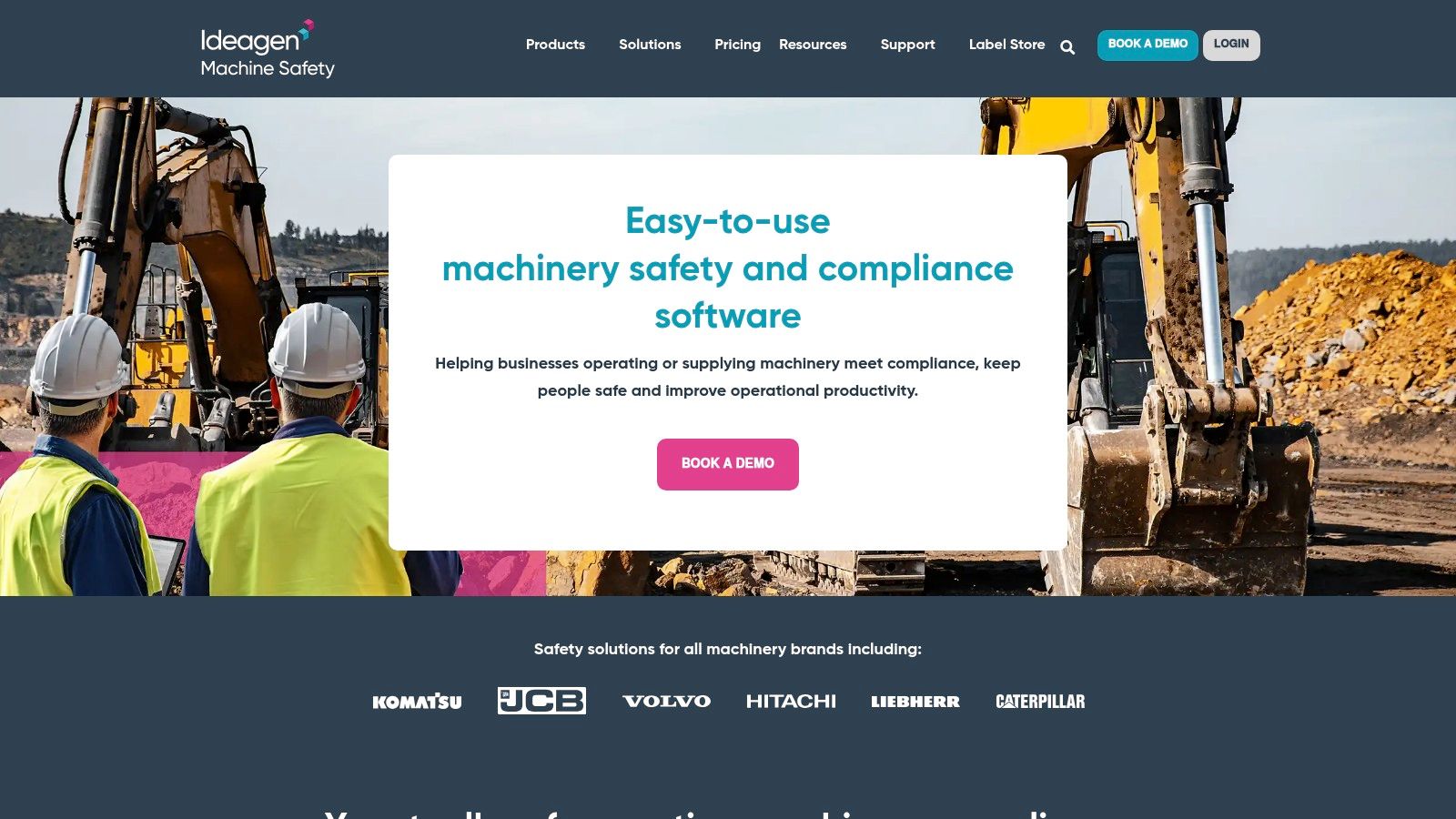
Ideagen Plant Assessor is the specialist choice in this list for machine-level risk and compliance documentation. It is relevant to manufacturers operating forklifts, presses, hoists, CNC equipment and mobile plant, where a broad WHS manual won't provide enough detail about each asset.
The platform supports machine-specific risk assessments, downloadable SOPs, a digital library, asset and site management, personnel records and audit trails. That makes it particularly valuable for businesses with a large or changing fleet, multiple sites or recurring plant inspections.
Why plant-level records need their own control
A machine risk assessment should identify the asset, its hazards, required controls, inspection status, competency requirements and related operating procedure. It should also remain connected to maintenance and corrective action records. If the guarding changes, an interlock fails or the machine is relocated, the assessment and SOP may need review.
Plant Assessor's strength is this asset relationship. It can help a manager see which documents belong to which machine and site, rather than relying on filenames such as “Press SOP final revised”. Professional services and onsite assistance may also help teams that need support assessing equipment.
The limitation is scope. This is not a complete WHS management system for policies, psychosocial risk, emergency planning, incident investigation, consultation or contractor governance. It should complement those controls.
Cost and scale
Pricing is charged per machine, so the cost can grow with a larger fleet. Before procurement, count the assets that require individual records and define whether inactive, leased or contractor-owned equipment needs inclusion. Then test how the system handles duplicate machine types, relocation between sites and document review after modification.
For a plant-heavy operation, specialist asset records may provide more value than buying another generic procedure pack. For a smaller business with limited equipment, a controlled central system may be more economical if it can still capture machine-specific assessments and inspection evidence.
8. EcoOnline Australia Chemical and SDS Management
EcoOnline is designed for a narrower problem, chemical and SDS management. It suits manufacturing sites using hazardous substances, coatings, solvents, cleaning agents or other chemicals across production, maintenance and storage areas.
The platform centralises SDS, chemical inventories and chemical risk assessments. It includes version history and audit trails, mobile access for shop-floor visibility and tools that connect chemical hazards with usage and risk assessment.
Where it adds real value
Chemical documentation fails when the register sits in an office, the SDS is stored in an old email and the operator can't access the current information where the chemical is used. A mobile-accessible system can put the record closer to the work area and make it easier to identify what is stored, where it is used and which assessment applies.
This is also relevant to multi-site governance. Corporate teams can establish a common structure while each site maintains its own inventory, storage locations, processes and emergency arrangements. The business still needs a clear owner for supplier information, SDS review, new chemical approval and disposal records.
EcoOnline complements rather than replaces a full WHS system. It won't provide the broader document controls needed for machine procedures, incident investigations, training evidence, contractor induction or general corrective actions unless those functions are available through another system or integration.
Chemical control starts with the inventory. If the business doesn't know what is present, where it is used and which information is current, the risk assessment can't be reliable.
Subscription pricing is quote-based, so compare the cost against the number of sites, chemicals, users and required integrations. Assess offline access, permissions, export capability and how chemical risk actions connect with your wider WHS process. For a broader register and procedure workflow, review SDS management software for Australian operations.
9. SWMS Generator AU
SWMS Generator is a practical low-commitment option for SMEs that need a small number of task-specific documents. It uses pay-as-you-go access, downloadable templates and a task library with prefilled controls. There isn't an ongoing subscription requirement.
That model can work for a one-off high-risk construction task connected to a manufacturing project, a temporary installation job or a small contractor arrangement. It can also help a smaller operator produce a first draft without buying a broad document system.
The boundary of a generated SWMS
A SWMS must describe the high risk construction work, the hazards arising from it and how controls will be implemented, monitored and reviewed. Safe Work Australia says a PCBU carrying out high risk construction work must prepare, keep, comply with and review the SWMS, and must prepare it before work starts. (Safe Work Australia SWMS information sheet)
A generated template doesn't know the exact site, equipment, workers, interfaces or changed conditions. The PCBU must edit the document, brief affected workers, supervise the work and stop or revise the task when the method no longer matches reality.
The main weakness is ongoing control. You must manage version history, approvals, worker acknowledgements, review triggers and superseded copies outside the generator unless another platform handles them. Complex processes may also need competent technical or consultant input beyond a prefilled control library.
Use a safe work procedure template system when you need procedures that remain controlled across sites and recurring work, rather than a downloadable document for an isolated need.
10. Safe Work Australia Free WHS Templates and Guidance
Safe Work Australia is the starting point for authoritative national guidance, model Codes of Practice and governance scaffolding. It provides free downloadable material, including health and safety committee templates, that organisations can use to benchmark policy and procedure content.
This resource is most useful when the H&S team wants to check whether its system reflects current model WHS concepts, or when a multi-site organisation needs a neutral reference point for internal standards. It can help establish consistent language around consultation, risk management, incident notification and worker participation.
What it doesn't provide
Safe Work Australia isn't a state or territory regulator. PCBUs must check the duties and variations that apply in the jurisdiction where the work occurs. Incident notifications go directly to the relevant state, territory or Commonwealth regulator, not to Safe Work Australia. In South Australia, workplace incident notifications must be lodged in writing as soon as reasonably practicable and within 48 hours. SafeWork NSW also requires notification of the insurer within 48 hours. (Safe Work Australia incident notification guidance)
The templates are generic by design. They won't describe your press, chemical process, maintenance access, contractor interface or production layout. They also won't manage approvals, field verification, acknowledgements or corrective actions.
Use the guidance as a benchmark, then tailor the resulting documents to the plant. Record the applicable jurisdiction, identify the document owner and connect the policy to operational evidence. Safe Work Australia's risk management code also makes clear that elimination must be considered first where reasonably practicable, followed by the most effective reasonably practicable controls and review of whether controls are working as planned. (Safe Work Australia risk management code)
Top 10 Safety Document Solutions Comparison
| Product | Core / Unique Features (✨) | UX / Quality (★) | Pricing / Value (💰) | Target Audience (👥) |
|---|---|---|---|---|
| 🏆 Safety Space | ✨ AI form completion, real-time dashboards, multi-site & one‑click subcontractor management, integrations | ★ 4.6/5 (Capterra, 8 reviews), full support & onboarding | 💰 Quote-based; monthly cancel-any-time; free demo, free onboarding & H&S consult | 👥 H&S managers, ops/plant managers, construction supervisors, SMEs |
| SafetyDocs by SafetyCulture | ✨ Large AU-ready editable template library (SWMS, SOPs, policies); branding & instant download | ★, Widely used AU templates | 💰 Per-document pricing; buy as needed | 👥 SMEs needing ready-to-use AU templates |
| BlueSafe Online | ✨ Turnkey WHS Management Systems; subscription portal with version control; AS/NZS ISO 45001 alignment | ★, Portal updates for AU compliance | 💰 Subscription packs; higher upfront than single templates | 👥 SMEs wanting structured, implementable systems |
| Occupational Safety Solutions | ✨ AU-compliant SWMS, policies & registers referencing Safe Work Australia | ★, Established local provider | 💰 Per-item/pack pricing; immediate access | 👥 Manufacturers needing core system documents |
| Solum Safety Consulting – Templates & Packs | ✨ Digital forms + editable Word, full bundles, branding and AI helper (“Solly”) | ★, Fast path to complete, branded suites | 💰 Some bundles quote-based; custom pricing | 👥 Organisations wanting branded, end‑to‑end document suites |
| Risky Digital (AU) – WHS Templates | ✨ Pre-populated risk analysis, legislative refs; explicit manufacturing & warehousing coverage | ★, Practical, shop-floor language | 💰 Per-template/pack pricing | 👥 Manufacturing & warehousing teams |
| Ideagen Plant Assessor (Australia) | ✨ Machine-specific risk assessments, downloadable SOPs, asset & audit-trail library | ★, Strong machinery-focused UX | 💰 Per-machine pricing; scales with fleet size | 👥 Manufacturers operating forklifts, presses, CNCs, hoists |
| EcoOnline (Australia) – Chemical/SDS management | ✨ Automated SDS library, chemical inventory, mobile access & chemical risk tools | ★, Specialist for chemical safety | 💰 Quote-based subscription | 👥 Sites using hazardous substances, multi-site chemical users |
| SWMS Generator (AU) | ✨ Pay-as-you-go SWMS builder, task library & prefilled controls; no subscription | ★, Budget-friendly for one-off jobs | 💰 Pay-per-SWMS; no ongoing fees | 👥 SMEs & contractors needing quick SWMS |
| Safe Work Australia – Free WHS templates & guidance | ✨ Free model templates, Codes of Practice and national benchmarking | ★, Authoritative, government resource | 💰 Free | 👥 Organisations bootstrapping governance or benchmarking WHS content |
Turn Templates Into Controlled WHS Evidence
Start with the work, not the template catalogue. Map your manufacturing hazards and work activities to the documents that control them. That usually includes policies, risk assessments, SWMS or JSAs where relevant, SOPs, permits, isolation procedures, chemical registers, SDS, plant inspection records, maintenance evidence, induction records, incident investigations, emergency documents and corrective actions.
Then assign an owner to every document. The owner isn't merely the person who uploaded the file. They must know when the document needs review, who approves changes, which workers need to understand it and what evidence shows that the control is operating.
A workable sequence looks like this:
- Map the document set: Link each document to a hazard, task, asset, chemical, site or legal duty.
- Set ownership: Name the responsible manager, approver and people who must review the content.
- Control versions: Use document numbers, approval status, effective dates and withdrawal controls for superseded copies.
- Brief affected workers: Confirm that operators, maintainers, supervisors and contractors can access and understand the current document.
- Verify in the field: Observe the task, inspect the control and record defects or deviations.
- Close corrective actions: Assign actions to named people with due dates and evidence of completion.
- Review on triggers: Revisit documents after incidents, near misses, process changes, new plant, maintenance failures, chemical changes, contractor onboarding or regulatory updates.
The execution gap is where many document systems fail. Safe Work Australia reported that 98% of manufacturing businesses provided protective equipment and 79% identified safety issues, but only 66% reported putting safety measures in place and 66% reported internal staff training. The figures point to a practical distinction between identifying a control and implementing it. (Safe Work Australia manufacturing report)
A comparison should therefore cover more than the number of templates included. Check:
- Australian jurisdiction: Can you adapt documents for the state or territory where each site operates?
- Manufacturing specificity: Does the content reflect plant, production, maintenance, chemical and contractor risks?
- Editable formats: Can competent people tailor the document without breaking its structure?
- Workflow control: Does the tool manage approvals, acknowledgements, reviews and corrective actions?
- Audit trails: Can you show who changed, approved, accessed or completed a record?
- Contractor access: Can external workers receive the right induction, SWMS and site controls?
- Chemical coverage: Can the system maintain registers, SDS access and chemical risk assessments?
- Plant coverage: Can it connect machine records, inspections, SOPs and maintenance issues?
- Support: Is implementation assistance available, and can your team obtain help when the system changes?
- Total cost: Include subscriptions, template packs, users, sites, machines, integrations, customisation and internal administration.
Safe Work Australia recommends measuring document-adjacent indicators such as audits against regulatory requirements, safety inspection conformance, incidents reported, investigations, notices and fines or penalties. A useful platform should help produce auditable evidence for those measures across sites, rather than only proving that files exist. (Safe Work Australia measurement guidance)
A template doesn't prove that a hazard was controlled. A signed SWMS doesn't prove that workers followed it. A current SDS doesn't prove that the chemical was stored, handled or disposed of correctly. The business must show that documents are current, accessible, understood, applied and reviewed, then retain the evidence according to the applicable WHS requirements.
Safety Space is worth assessing when the requirement is one system for documents, forms, accountability and multi-site oversight. Its custom workflows, procedure tracking, chemical register, dashboards and subcontractor functions are aimed at the gap between drafting a document and demonstrating that the business used it.
Safety Space brings safety documents, forms, corrective actions, chemical records and multi-site oversight into one customisable platform, with AI-assisted drafting and support for subcontractor workflows. Visit Safety Space to book a free demo or H&S consultation and test whether it fits your manufacturing document controls.
Ready to Transform Your Safety Management?
Discover how Safety Space can help you implement the strategies discussed in this article.
Explore Safety Space FeaturesRelated Topics
Safety Space Features
Explore all the AI-powered features that make Safety Space the complete workplace safety solution.
Articles & Resources
Explore our complete collection of workplace safety articles, tools, and resources.