
Control starts before the subcontractor arrives at the gate. If you're still treating subcontractor risk as a paperwork exercise, you're already behind the work. In Australian construction, subcontractors perform over 80% of all work, and small businesses with fewer than five employees represented 64% of construction-sector insolvencies, according to the Australian Small Business and Family Enterprise Ombudsman material referenced in the SafeWork NSW subcontracting survey report.
That matters because weak vetting, loose payment controls, and poor verification don't stay administrative for long. They turn into rushed starts, missing competencies, unmanaged hazards, and contractors who look compliant on paper but aren't working to standard in the field. The WHS risk usually sits at the bottom of the chain first, then spreads upward through the project.
The practical answer is simple. Manage subcontractors through evidence, clear expectations, and field verification. Not through document collection alone. The nine practices below follow the subcontractor lifecycle for Australian PCBUs, from selection and mobilisation through to work controls, supervision, reporting, and accountability.
At any point, you should be able to retrieve the current SWMS, competency evidence, insurance, induction records, and corrective-action follow-up for the people doing the work. If that takes too long, your system is too loose.
Table of Contents
- 1. Pre-qualification and Contractor Vetting
- 2. Clear Induction and Site Orientation Programs
- 3. Documented Site-Specific Work Method Statements
- 4. Competency Verification and Training Requirements
- 5. Contractual WHS Terms and Performance Accountability
- 6. Active Supervision and Site Monitoring
- 7. Regular Tool Box Talks and Toolbox Meetings with Subcontractors
- 8. Incident and Near-Miss Reporting and Investigation Protocols
- 9. Digital Management Systems and Real-Time Documentation
- 10. Regular Tool Box Talks and Toolbox Meetings with Subcontractors
- 10-Point Subcontractor Management Best Practices Comparison
- Make Subcontractor Control Visible Every Day
1. Pre-qualification and Contractor Vetting
Risk-based pre-qualification saves time later because it removes preventable arguments before award. The mistake I see most often is using the same contractor form for low-risk cleaning, shutdown mechanical work, electrical isolation, and structural steel. That creates noise, not control.
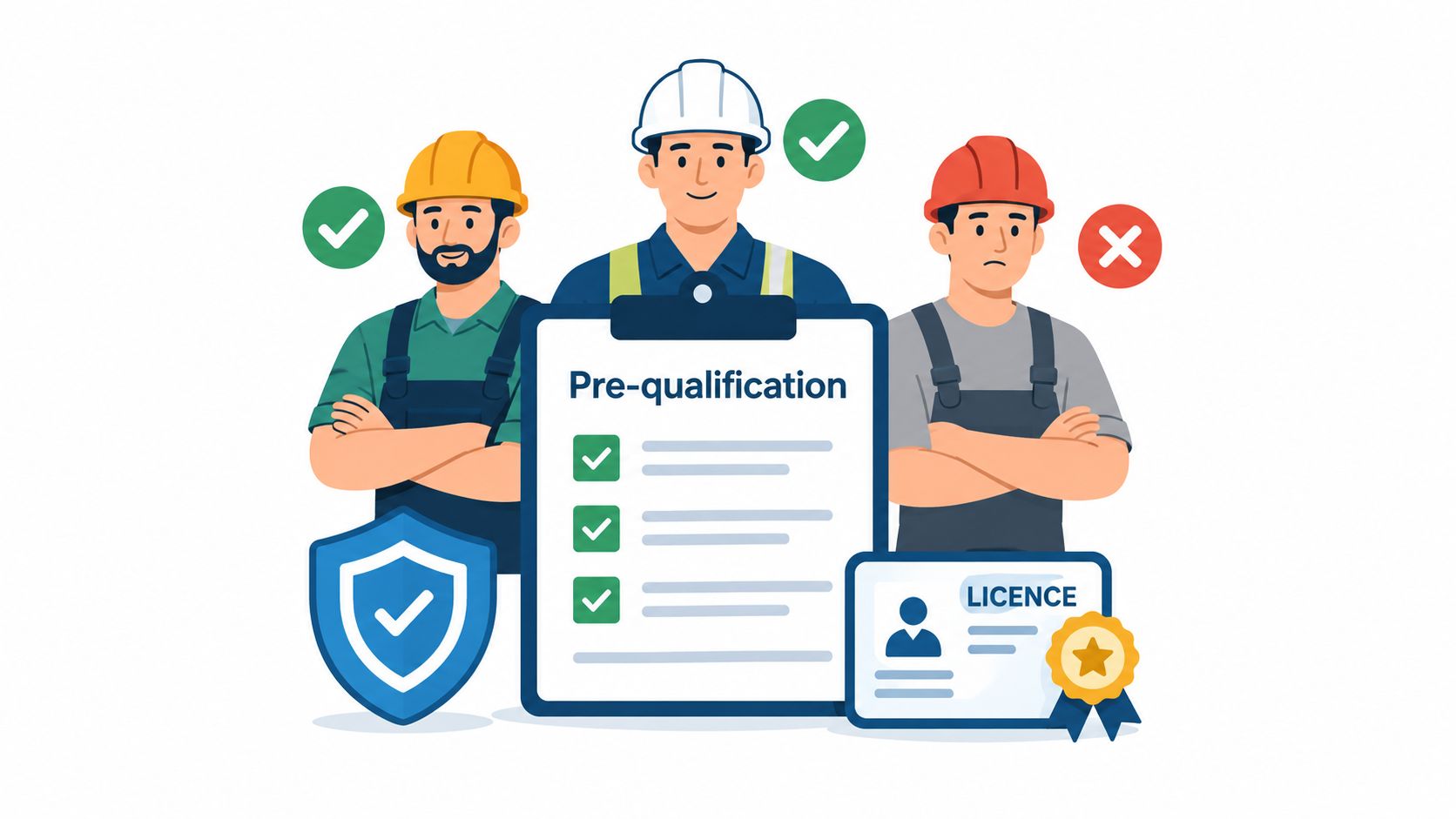
Start with a documented gate. No approved profile, no quote request, no purchase order, no site access. In higher-risk work, ask for direct evidence that the contractor has managed similar scopes under similar conditions. In manufacturing and industrial services, that usually means shutdown exposure, permit interfaces, isolation discipline, and supervision ratios. In construction, it often means principal contractor rules, SWMS quality, trade licences, and site coordination history.
What to check before engagement
- Business and legal status: Confirm the entity you're engaging is the entity holding the insurance, licences, and registrations.
- Scope fit: Ask what work they'll self-perform and what they intend to subcontract further.
- WHS capability: Review recent procedures, risk documents, incident reporting expectations, and how they supervise their own workers.
- Evidence currency: Record renewal dates for insurance, licences, and key tickets in an approved contractor register.
A good prompt for your pre-qual template is: “Describe the highest-risk task in the proposed scope, who will supervise it, and what evidence you can provide that the controls are already understood by your crew.”
If you need a base structure, a subcontractor management policy template can help standardise the pre-qual questions and approval workflow. Safety Space is most useful here when it cuts out email chasing, flags expiring evidence, and shows which contractors are approved, pending, or blocked.
2. Clear Induction and Site Orientation Programs
Poor induction shows up fast on site. The subcontractor knows the trade, but not your traffic routes, permit triggers, muster point, isolation boundary, or who can authorise a change. That gap causes work to start in the wrong area, plant to be touched before handover, and hazards to go unreported because the worker assumes their own supervisor will handle it.
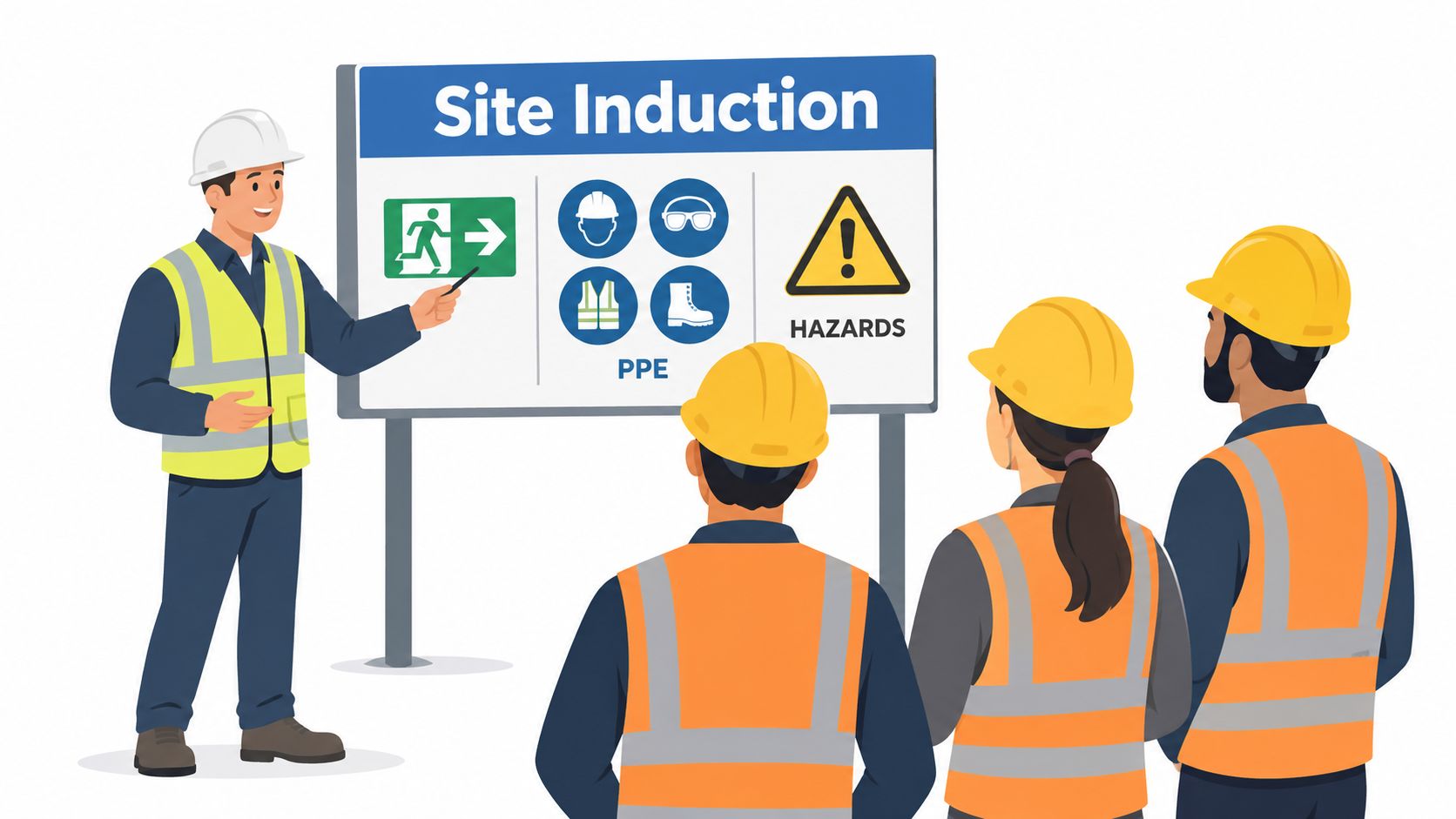
The point of induction is control transfer. Before a person starts, they need to understand how this site runs, what can hurt them here, and what they must do before the scope changes. In construction, that often means principal contractor rules, site amenities, exclusion zones, emergency arrangements, and high risk interfaces with other trades. In manufacturing and industrial services, it usually means permit conditions, line of fire risks, mobile plant routes, energy isolation rules, and shutdown coordination.
Safe Work Australia is clear that for construction work, a PCBU must consult with workers and must consult, cooperate and coordinate activities with all relevant duty holders. A PCBU also cannot remove WHS duties by subcontracting part or all of the work, as set out on Safe Work Australia's construction WHS duties page.
A useful induction does not need to be long. It needs to be specific, role-based, and checked for understanding.
Use this quick field test after the induction:
- Ask the worker to point out the exact work area they are approved to enter.
- Ask what permit or authorisation they need before starting.
- Ask what condition would make them stop and call the supervisor.
- Ask how they would report a near miss on this site.
If they hesitate, rework the induction before issuing access.
The practical trade-off is time versus control. Full inductions for every visitor slow mobilisation. Short generic inductions miss the hazards that matter. The fix is a two-stage process. Use a base induction for common site rules, then add a short task or area briefing for the actual workfront, supervisor, and shift conditions. That keeps mobilisation moving without treating all subcontractors as if they face the same risks.
For the record itself, capture the details that matter later during an inspection, permit review, or incident investigation:
- worker name and employer
- date, time, and site or area inducted
- trade or role
- supervisor responsible for the workfront
- local rules covered
- permits or access restrictions explained
- verification method used, verbal check, practical check, or both
- access status, approved, conditional, or held
A good template prompt is: “What three site-specific conditions could stop this task today?” Build that into the sign-on process, not as an afterthought. A site induction template for subcontractor and visitor onboarding can help standardise the base content while leaving room for area-specific controls.
Safety Space is useful here when it ties induction status to access approval, stores the signed record against the contractor profile, and shows who still needs a refresher or area briefing. That reduces manual follow-up and gives supervisors a clearer picture of who is ready to start work.
3. Documented Site-Specific Work Method Statements
A generic SWMS is one of the fastest ways to lose control of subcontractor work.
The problem is rarely the document itself. The problem is timing, ownership, and whether the method matches the workfront. Crews often arrive with a SWMS prepared for the tendered scope, then the site changes, access changes, other trades move in, or the plant isolation sequence shifts. If the document does not move with those changes, supervisors end up relying on verbal adjustments that are never checked or recorded.
For high risk construction work, a SWMS must be prepared or already prepared before the work starts, the work must be carried out in accordance with it, a copy must be given to the principal contractor before work starts, and it must be reviewed and revised if necessary under the Model Code of Practice for Construction Work.
On site, the practical test is simple. Can the leading hand walk the job in the same order as the SWMS and point to the actual controls in place?
Use that test before start-up, after a scope change, and when the work interface gets tighter. In construction, that often means excavation near live services, roof access after weather changes, or structural alteration around occupied areas. In manufacturing and industrial services, it may be line shutdown work, vessel entry, hot work near process hazards, or simultaneous operations with production still running.
A field-ready SWMS review looks like this
Ask the supervisor to mark up the SWMS against the live workfront, not in the site office. Check these points in conversation, while looking at the area:
- Sequence of work: Does the document match the order the crew will follow today?
- Site conditions: Are traffic routes, overhead services, stored energy, adjacent trades, weather, access limits, and plant interfaces specific to this location?
- Critical controls: Which controls must be in place before work starts, and who confirms them?
- Hold points: Where does the job stop for inspection, permit sign-off, isolation verification, or engineering approval?
- Change triggers: What conditions would force a revision before the next step?
A useful template prompt is: “What has changed since this SWMS was last reviewed, and what does that change in the method?” That question usually gets a better answer than asking whether the SWMS is current.
One more check matters. Pick one worker from the crew and ask them to explain the highest-risk step, the stop-work trigger, and the control that would fail first if the job drifted. Signed pages alone do not show understanding.
Safety Space can help by storing the current SWMS against the job, recording revision history, and showing which workers have acknowledged the right version. That cuts manual chasing and makes version control easier to see during pre-starts, permit reviews, and audits.
4. Competency Verification and Training Requirements
A ticket isn't the same as competence. It proves one part of the picture. You still need to know whether the worker can perform the task safely in your conditions, with your equipment, under your permit and supervision arrangements.
Australian research on construction subcontracting found that subcontractor workers reported less positive safety-climate perceptions than other worker groups on site, based on findings summarised in the ACT construction safety culture report. In practice, that means you can't assume the same level of briefing, support, or escalation behaviour across every crew.
Check the person, not just the paperwork
In a construction setting, that might mean confirming a scaffolder's high risk work licence, then checking how they inspect altered sections before handover. In a manufacturing plant, it might mean confirming confined space training, then testing whether the crew understands atmospheric monitoring, standby arrangements, and rescue interfaces on your site. In industrial services, it often means checking whether a leading hand can run the permit sequence and stop work when conditions change.
- Define task competency: List the licence, training, plant familiarity, and supervision level needed.
- Verify currency: Check expiry and issuing details before mobilisation.
- Use field confirmation: Ask the worker or supervisor to talk through the job setup.
- Record decisions: Keep date, verifier, and any restrictions applied.
Field test: Ask, “Show me how you'd set up this task before you start.” Competent people can usually explain and demonstrate the sequence without guessing.
A useful template prompt is: “What task can this worker do unsupervised, what requires direct supervision, and what are they not authorised to do on this site?” Safety Space can help by storing licences, certificates, and role-based approvals in one place so supervisors aren't searching inboxes at the gate.
5. Contractual WHS Terms and Performance Accountability
Poor contract wording creates argument at the gate, during a permit review, or after a stop-work call. By then, the job is already exposed. The agreement needs to set the WHS rules before mobilisation, in terms a project manager, supervisor, and subcontractor can all apply the same way.
The legal position is straightforward. A PCBU cannot transfer its WHS duties to a subcontractor through contract wording. Safe Work Australia makes that clear in its fact sheet on duties in a contractual chain. The contract still matters because it sets the operating conditions, evidence requirements, escalation steps, and consequences for non-conformance.
Good WHS clauses do two jobs. They make expectations clear, and they remove hesitation when work needs to be paused.
A workable contract review prompt is below:
- Before start: What documents, licences, insurances, and SWMS must be accepted before site access?
- During work: What meetings, permits, inspections, and reporting duties must the subcontractor participate in?
- If conditions change: Who must be told, how quickly, and what work must stop until the change is reviewed?
- If there is a breach: Who can direct a stop, what rectification period applies, and what happens if the issue is repeated?
- If lower-tier subcontractors are used: Is prior approval required, and do the same WHS conditions flow down in writing?
The weak point in many contracts is enforcement language. Site teams are told to "manage performance" but the document does not say what that means in practice. Write the clause so a supervisor can use it on a bad day. For example: no work starts until required evidence is current and accepted; principal contractor representatives can suspend work where a critical control is absent; incident, hazard, and supervisor changes must be reported immediately; repeated WHS breaches can trigger removal from site, subject to the contract terms and any lawful process.
That level of detail protects both sides. The subcontractor knows the rules early. Your team is less likely to improvise after something has already gone wrong.
One useful test is simple: if a crew bypasses isolation, brings in an unapproved second-tier contractor, or changes method without review, can the site team point to one clause and one record that support immediate action?
Safety Space can reduce admin at this stage by linking contract conditions to the live compliance register, action records, and subcontractor profile, so the contractual requirement is visible to the people enforcing it rather than buried in a PDF.
6. Active Supervision and Site Monitoring
A lot of subcontractor management best practices either work or fall apart. Documents can set expectations. Supervision shows whether the controls are in place.
A SafeWork NSW study of construction subcontracting found that only 29% to 44% of high-risk jobs across NSW, Queensland, Victoria, and the ACT had a risk-assessment form attached to the job record, and only 6 of 25 jobs with incidents, near misses, or uncontrolled hazards had a risk assessment uploaded, as reported in the ASBFEO procurement inquiry report.pdf). That tells you exactly why field verification matters.
Supervision that actually adds control
Turn up while the work is happening. Check the setup against the SWMS or permit. Speak to the people doing the task, not just the supervisor. Look for drift. Barriers moved. Exclusion zones reduced. Isolation points assumed. Ladders used where platforms were planned. Spotters named but not present.
- Use a short checklist: Focus on the critical controls for that task.
- Record the gap clearly: What was expected, what was observed, what changed.
- Assign action owners: Contractor supervisor, site supervisor, permit issuer, or project manager.
- Verify closure: Don't close actions from the desk.
For teams wanting a simple benchmark outside their own system, the Pacific Mobile platinum safety award announcement is a reminder that formal contractor oversight is visible and assessable, not just informal supervision.
A supervisor who only checks attendance isn't supervising the risk.
Safety Space can reduce manual follow-up by tying inspections, photos, and corrective actions to the job and contractor. That improves visibility, but the field walk still has to happen.
7. Regular Tool Box Talks and Toolbox Meetings with Subcontractors
Short, task-focused pre-starts prevent more drift than long toolbox meetings that nobody uses once work starts.
Use this part of the subcontractor lifecycle to reset the job each day. By this stage, the contractor has been vetted, inducted, and briefed on the SWMS. The job now needs live coordination between crews, supervisors, permit holders, and plant operators. That is the point of the talk.
On construction sites, the main failure is usually interface risk. Two trades enter the same area, access changes, a lift path crosses another work front, or a service isolation affects someone outside the permit. In manufacturing and industrial services, the pressure points are shutdown sequencing, line restarts, cleaning, confined space support, and maintenance work continuing after production assumptions have changed.
Run a short pre-start that checks today's interfaces
Keep it to the work that will happen in the next shift. Start with scope, then changed conditions, then the handoffs between crews. End with actions, owners, and stop-work points.
A simple format works:
- Scope today: What each subcontractor crew is doing, where, and during which shift window.
- What changed: Access, weather, plant status, isolations, deliveries, traffic routes, adjacent trades, or late design changes.
- Interface risks: Who else can affect this task, and what control depends on another crew doing their part.
- Control check: One question on the highest-consequence control for that job.
- Action owners: Name who will fix gaps before work starts.
Use one control question, not five. Examples:
- Roof work: “What changes if the exclusion zone cannot be held?”
- Process maintenance: “Who confirms zero energy before covers come off?”
- Mobile plant and pedestrians: “What condition stops vehicle movement in this area?”
Rotate voices, but keep accountability clear
Leading hands, subcontractor supervisors, permit issuers, and host supervisors should all speak when their decisions affect the work. That improves attention and exposes mismatched assumptions early.
Still, one person must close the loop. Usually that is the area supervisor, project supervisor, or permit controller. If actions come out of the talk, record who owns them and when they will be verified. Verbal agreement is not enough once multiple subcontractors are involved.
Checklist prompt:
- Which crews are sharing this area today?
- What control relies on another party?
- What changed since the permit, SWMS, or yesterday's plan?
- What has to be confirmed in the field before tools start?
Toolbox records only need enough detail to prove the message reached the people doing the work and that unresolved risks were assigned. Date, work area, attendees, key risk, action, owner, close-out status.
Safety Space can reduce manual follow-up by logging attendance, actions, and photos against the job and contractor. That helps supervisors see which issues are still open across shifts, but the value still depends on a disciplined pre-start and field check.
8. Incident and Near-Miss Reporting and Investigation Protocols
You find out what subcontractor control really looks like after something nearly goes wrong.
A clean pre-qualification file means little if a dropped shackle, permit breach, line strike, or unstable load stays inside the subcontractor crew for half a shift. On a mixed site, delay is the problem. Facts get blurred, the area changes, and the same conditions stay live for the next crew.
Set the rule early. If an incident, near miss, uncontrolled hazard, or work stoppage happens on your site, the host business is told at once, and the subcontractor's employer is told through the same process. No parallel systems, no uncertainty about who owns the first response.
A simple field test works well: ask one worker, one leading hand, and one subcontractor supervisor separately, “Who do you call first if this job becomes unsafe?” If the answers differ, the reporting pathway is not clear enough.
What needs to happen after the first call is where many sites lose control. Treat the first report as an operations response, not just a compliance event.
First-hour actions
- Make the area safe and preserve the scene where needed
- Confirm who is in control of the response
- Capture names, workgroup, permit reference, plant involved, and exact location
- Record what changed just before the event
- Decide what work stops now, and what related work should also pause
Then investigate at the level of risk, not at the level of paperwork. A minor hand strain and a crane near miss do not need the same process, but both need the same discipline about causes. Look past worker error. Check whether the job was rushed, whether interfaces between crews were poorly defined, whether isolations were assumed, or whether site conditions had changed since the SWMS or permit review.
Use prompts that force specifics:
- What was the task meant to look like?
- What changed in the field?
- Which control failed, was missing, or relied on another party?
- Who had authority to stop or reset the job?
- What needs to change before this work starts again?
That learning must go somewhere practical. Update the relevant SWMS, permit conditions, induction content, supervisor briefing points, or contractor performance review. If the same subcontractor reports repeated near misses on access, lifting, traffic interaction, or stored energy, that should affect how you supervise and approve their next package of work.
For teams tightening this process, a clear near miss reporting process helps standardise first notifications and close-out expectations. Safety Space can reduce manual follow-up by linking the report, photos, actions, and contractor record in one place, which makes repeat issues and overdue close-outs easier to spot across jobs.
9. Digital Management Systems and Real-Time Documentation
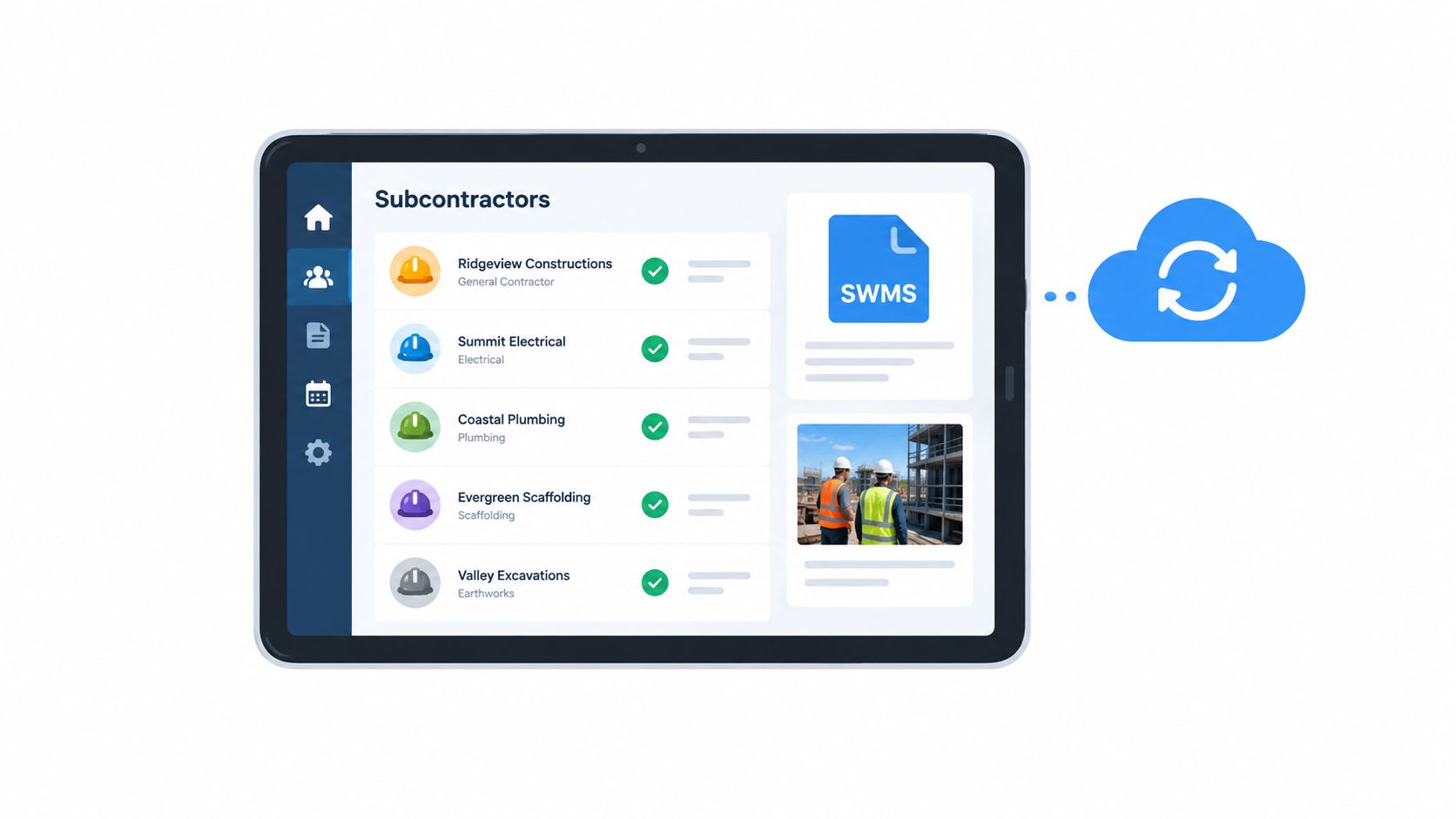
If subcontractor control lives in folders, screenshots and inboxes, the gaps stay hidden until a supervisor is chasing a licence at the gate or approving work off an old SWMS. Digital control matters because it changes that timing. It lets you catch expired, missing or superseded records before the crew starts.
Safe Work Australia says SWMS are required for the 18 high risk construction work activities defined in the WHS Regulations, and for other construction activities a SWMS isn't required, as explained in its information sheet on safe work method statements. Use that same logic in the system design. High-risk construction work, isolations, confined space entry and plant interaction need tighter controls than a low-risk delivery or short inspection visit.
A useful test is simple. Stop at the workfront and ask for four things. Current contractor approval, site induction status, the right SWMS or permit for today's task, and any open actions that still affect the job. If any of that depends on calling the office, checking a glovebox, or trusting that yesterday's version is still current, the system is not doing its job.
Set the workflow around decision points, not around document storage. That is the difference between a shared drive and an actual control process.
What the system should prevent
- Work starting with an expired licence, VOC, insurance or induction
- Old SWMS versions staying in circulation after a scope or site change
- Permits being approved without linked isolations, gas test results or area authority
- Corrective actions closing on paper while the field issue stays open
- Supervisors holding partial records across text messages, email and printed copies
In practice, the minimum build usually needs:
- a contractor master record with approval status and expiry dates
- role-based competency requirements by task or work package
- linked job records for SWMS, permits, inspections, incidents and actions
- mobile access for supervisors and permit issuers in the field
- timestamps, version history and visible approval ownership
That setup brings a trade-off. If every field is mandatory, crews and supervisors will work around it. If the workflow is too loose, the system becomes a digital filing cabinet. The better approach is to make hard stops only for controls that would change the decision to let the work proceed.
Use a short configuration prompt when you build or review the process:
| Control point | Ask this question |
|---|---|
| Pre-start approval | What missing record should block site access or work commencement? |
| Task documentation | Which activities need a current SWMS, permit, JSA or isolation record attached? |
| Change management | What event forces reapproval, such as scope change, new plant, weather impact or simultaneous operations? |
| Close-out | What evidence proves the action, inspection or permit is actually complete? |
Safety Space can reduce manual follow-up here by keeping the contractor record, expiries, field documents and actions in one place. That improves visibility for supervisors and makes overdue approvals or repeated gaps easier to see across projects.
10. Regular Tool Box Talks and Toolbox Meetings with Subcontractors
A subcontractor record is only useful if it changes future decisions. The final control point is close-out, review and re-qualification. If a contractor finishes three jobs with late permits, unresolved actions or repeated supervision findings, that history should affect the next approval decision.
Good contractor management does not end when the work pack is closed. It ends when the business decides, with evidence, whether that subcontractor stays approved, stays approved with conditions, or needs rework before the next engagement. That is the point many systems miss. Teams collect incidents, inspections and actions, but nobody converts them into a usable performance view.
Use a simple monthly or project-close scorecard:
| Review area | What to check |
|---|---|
| Safety performance | Incidents, near misses, permit breaches, repeat hazards, housekeeping standard |
| Documentation discipline | SWMS updates, permit close-out, training and licence expiry management |
| Supervision results | Inspection findings, rework, stop-work directions, action close-out time |
| Cooperation | Response to changes, attendance at required reviews, willingness to correct issues |
| Re-approval outcome | Approved, approved with conditions, suspended pending corrective action |
A practical review prompt is: “Would we let this contractor perform the same work again next week under the same approval status?” If the answer is no, record why and set the condition for re-approval.
This stage needs clear thresholds. One minor paperwork miss should not trigger removal from the panel. Repeated permit breaches, poor isolation discipline, or the same field finding across multiple jobs usually should. The trade-off is straightforward. If the bar is too low, poor performers stay in the system. If the bar is too rigid, operations start bypassing approved supplier controls to get urgent work done.
Keep the close-out decision short and visible:
- record the top three findings from the job or review period
- note whether issues were one-off or repeated
- assign corrective actions with due dates
- set the next approval status and any conditions
- nominate the date for the next review
Safety Space can reduce manual follow-up here by pulling incidents, actions, document gaps and inspection results into one contractor view. That gives procurement, operations and HSE a cleaner basis for re-approval decisions and makes repeat findings easier to spot across sites.
10-Point Subcontractor Management Best Practices Comparison
| Item | Implementation complexity 🔄 | Resource requirements ⚡ | Expected outcomes ⭐ | Ideal use cases 📊 | Key tips 💡 |
|---|---|---|---|---|---|
| Pre-qualification and Contractor Vetting | Medium–High, establish templates, verification workflows, renewal controls | Moderate, admin time, checks, documentation systems | ⭐⭐⭐⭐ Fewer unsuitable contractors; reduced regulatory risk | Projects with many subcontractors or high-risk trades | Standardise templates, maintain approved register, review annually |
| Clear Induction and Site Orientation Programs | Low–Medium, develop role/site‑specific content and delivery plan | Moderate, trainers, time for inductions, attendance records | ⭐⭐⭐ Improved site understanding; fewer early-stage incidents | New site starts, transient workforce, high‑hazard sites | Use visuals and walkthroughs, confirm understanding, document attendance |
| Documented Site‑Specific Work Method Statements (SWMS) | Medium, prepare, review and approve task‑level method statements | Moderate, technical review, updates, storage and access | ⭐⭐⭐⭐ Systematic hazard control and clear task guidance | High‑risk construction, energized work, confined spaces | Provide templates, actively review, update when scope or conditions change |
| Competency Verification and Training Requirements | Medium–High, define standards, assess and document competence | Moderate–High, assessors, verification tools, training records | ⭐⭐⭐⭐ Reduces competency‑related errors; supports enforcement | Safety‑critical roles (crane, rigging, electrical) and complex tasks | Verify currency, use practical assessments, retain documented evidence |
| Contractual WHS Terms and Performance Accountability | High, legal drafting, negotiation and incorporation of KPIs | Moderate, legal support, contract administration | ⭐⭐⭐⭐ Creates enforceable obligations and accountability | Long‑term contracts, outsourced services, high‑liability projects | Use clear achievable clauses, include audit rights and insurance proof |
| Active Supervision and Site Monitoring | Medium, schedule inspections and define supervisor roles | High, competent supervisors' time, inspection tools, reporting | ⭐⭐⭐⭐ Early detection of non‑compliance; stronger WHS practice | Ongoing works, dynamic sites, high‑risk activities | Use checklists, document findings and corrective actions, supervise during active work |
| Regular Tool Box Talks and Toolbox Meetings | Low, brief prepared sessions delivered regularly | Low–Moderate, time per meeting, simple records | ⭐⭐⭐ Reinforces controls and improves two‑way communication | Daily operations, high‑risk shifts, onboarding new crews | Keep short and relevant, document attendees, rotate leaders, use real examples |
| Incident and Near‑Miss Reporting and Investigation Protocols | Medium, establish reporting channels and investigation process | Moderate, investigation expertise, tracking and follow‑up systems | ⭐⭐⭐⭐ Identifies root causes and systemic trends; prevents recurrence | All workplaces, especially where under‑reporting exists | Make reporting simple and non‑punitive, investigate promptly, share anonymised learnings |
| Digital Management Systems and Real‑Time Documentation | High, select, configure and integrate software and workflows | High, purchase, implementation, user training and maintenance | ⭐⭐⭐⭐ Real‑time visibility, audit trails and analytics | Large programs, multiple sites, high contractor volume | Start with core modules, ensure mobile access, train users, enforce data quality and security |
Make Subcontractor Control Visible Every Day
The strongest subcontractor management best practices aren't complicated. They're disciplined. Verify the contractor before engagement. Confirm induction and competency before access. Approve task controls before work starts. Observe the work in the field. Close actions properly. Review performance at set intervals.
That review cycle works across construction, manufacturing, and industrial services because the core failure points are similar. Wrong contractor. Expired evidence. Weak mobilisation. Generic risk controls. Poor supervision. Slow reporting. Actions left open. Once you know those failure points, you can build your checks around them instead of relying on habit.
A compact monthly dashboard helps. Keep it focused on records that show whether control is current and visible. I'd include approval status, expiring evidence, induction completion, SWMS reviews, inspections completed, incidents and near misses, overdue corrective actions, and repeat findings by contractor or work area. If you can see those items clearly, you'll spot drift earlier.
This also helps with trade-offs. A smaller contractor might be technically strong but weak on administration. A large contractor might submit polished documents but perform inconsistently in the field. Your system should let you see both. Good subcontractor management isn't about rewarding the best paperwork. It's about deciding who can work safely under your conditions and proving that the controls still hold once the job starts.
For Australian PCBUs, that means keeping the legal position in view as well. Duties remain with the parties involved in the work. You can delegate tasks. You can't delegate accountability. So don't treat digital records, inductions, contracts, or SWMS as substitutes for site leadership. They're support tools.
If you want one operating rule, use this. Every subcontractor control should answer three questions. Was the requirement set clearly. Was the evidence checked before work. Was the control verified in the field. If any answer is no, the system needs tightening.
Safety Space can be one practical option for centralising those records, automating reminders, and maintaining visibility across sites and contractors. That's useful. But the responsibility still sits with your team to check that the controls work in practice, not just in the software.
Safety Space gives you one place to manage contractor approvals, inductions, SWMS, inspections, incidents, and corrective actions without relying on scattered folders and spreadsheets. If you want tighter visibility across subcontractors and sites, visit Safety Space and see how it can support the controls you still need to verify in the field.
Ready to Transform Your Safety Management?
Discover how Safety Space can help you implement the strategies discussed in this article.
Explore Safety Space FeaturesRelated Topics
Safety Space Features
Explore all the AI-powered features that make Safety Space the complete workplace safety solution.
Articles & Resources
Explore our complete collection of workplace safety articles, tools, and resources.