
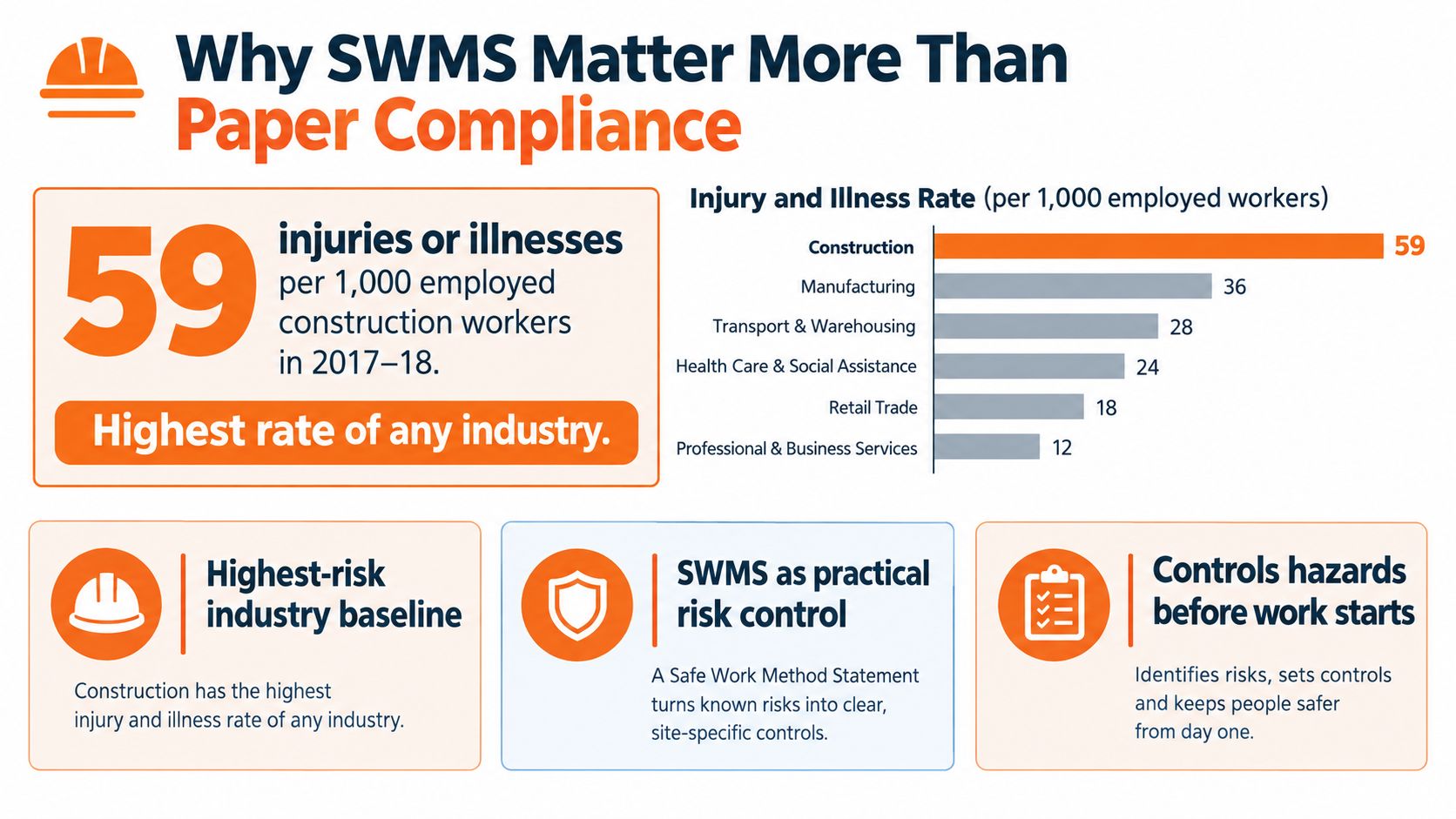
Construction recorded 59 injuries or illnesses per 1,000 employed people in 2017–18, the highest rate of any industry. SWMS for construction should therefore operate as live controls for high-risk work, not as paperwork completed once and filed away.
That distinction matters to H&S managers, WHS officers, operations managers and business owners across construction, residential building, property development, manufacturing, cleaning, facilities services and waste management. A document can contain the right headings and still fail if workers can't access it, supervisors don't verify the controls, or the method changes without a review.
Table of Contents
- Why SWMS Matter More Than Paper Compliance
- The SWMS Workflow from Task Screening to Controlled Methods
- Why Generic SWMS Fail and What to Do Instead
- Digitising SWMS in Safety Space
- PCBU Duties, Principal Contractor Collection, and Review Triggers
- Common SWMS Drafting and Implementation Mistakes
- Practical Checklist and FAQs for Site Teams
Why SWMS Matter More Than Paper Compliance
The Australian Bureau of Statistics recorded 59 injuries or illnesses per 1,000 employed people in construction in 2017–18, the highest rate of any industry, compared with 58 per 1,000 in manufacturing. Those figures make SWMS foundational controls in Australian construction, because the document forces the business to consider how high-risk work will be performed before the task begins. The ABS work-related injuries release provides the relevant industry comparison.
A useful SWMS identifies the high-risk construction activity, records the hazards and resulting health and safety risks, sets out controls, and communicates the sequence to the people doing the work. That makes it different from a form that merely proves someone completed a compliance task.
The document is evidence, not the control
The control is the method being followed in the field. The SWMS is the written system that makes the method visible, testable and reviewable. It should show what workers must do, which controls must exist before the task proceeds, who checks them, and what causes the work to stop.
A static document has limited value if it sits in an office, remains generic across different sites, or uses broad instructions such as “take care” and “wear PPE”. A field-ready SWMS connects each work step to actual plant, access arrangements, substances, exclusion zones, competence requirements and emergency responses.
Practical rule: An auditor should be able to trace a control from the document to the work area, the responsible person and the verification record.
The distinction between a SWMS and a JSA also matters. Teams that use both should define the purpose of each rather than copying the same risk content into separate forms. The difference between a JSA and a SWMS is useful when establishing that document boundary.
A strong system asks a harder question than “Was the SWMS signed?”. It asks whether the relevant workers understood the method, whether the controls were in place, and whether the method was reviewed when conditions changed.
The SWMS Workflow from Task Screening to Controlled Methods
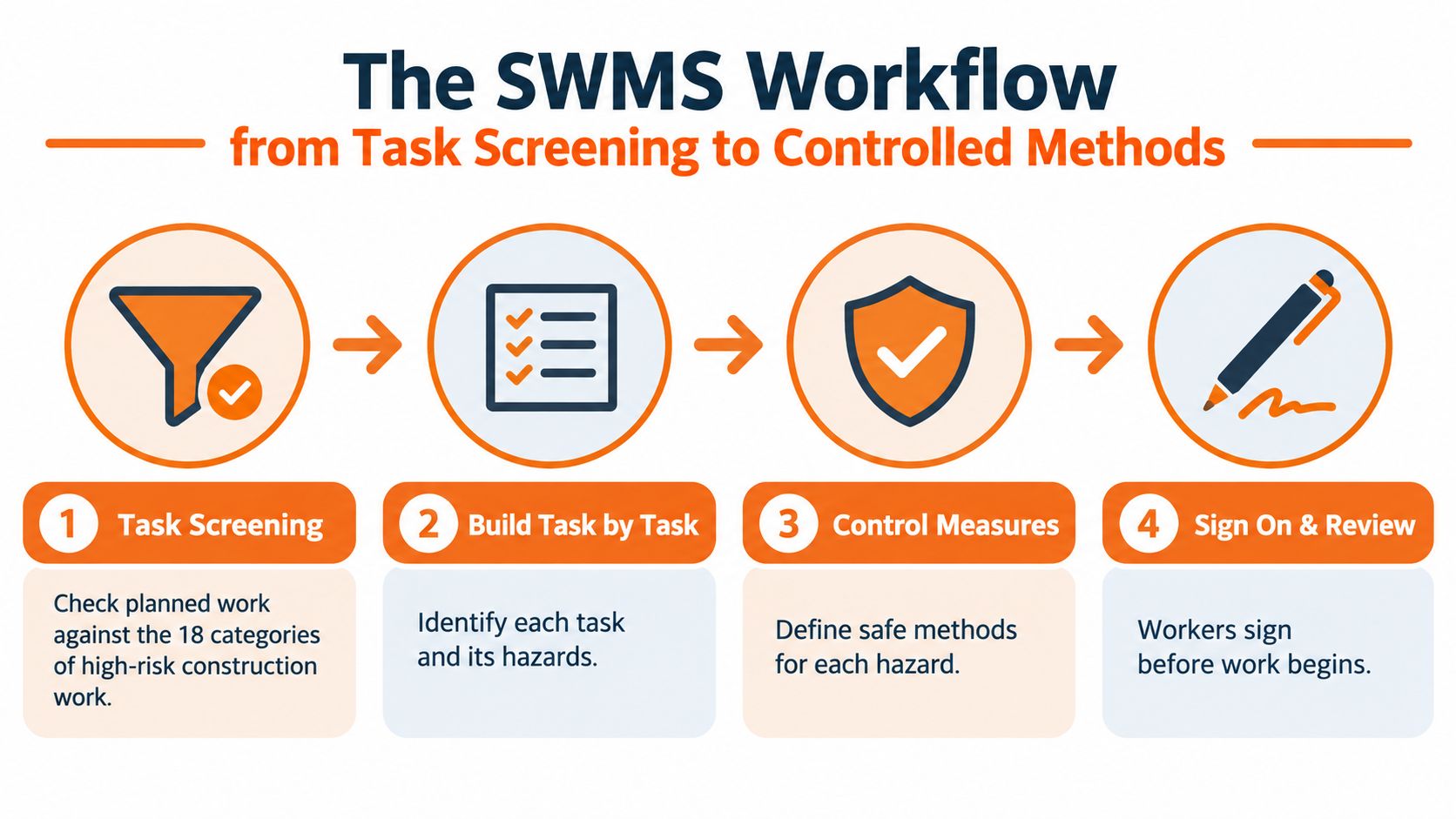
The drafting process should begin before anyone writes a control. First, screen the planned work against the 18 categories of high-risk construction work recognised under the Australian WHS framework. Examples include falls over 2 metres, demolition affecting structural integrity, asbestos disturbance, confined-space work, trenches or shafts deeper than 1.5 metres, work near energised services, traffic corridors, powered mobile plant, tilt-up or precast concrete, and work where drowning is a risk.
The trigger is the nature of the work and its associated risk. It isn't the size of the contractor or the number of workers involved. The Safe Work Australia guidance on high-risk construction work requiring a SWMS sets out the screening requirement and the need to state how controls will be implemented, monitored and reviewed.
Build the method around work steps
Break the job into a sequence that reflects how workers will perform it. For each step:
- Identify the high-risk activity. State the activity plainly, including the relevant work area and stage of the job.
- Identify hazards and risks. Describe what could cause harm during that particular step, not just what exists somewhere on the site.
- Select controls using the hierarchy of control. Consider whether the hazard can be eliminated, substituted, isolated or reduced through engineering before relying on administrative controls and PPE.
- Describe implementation. State who installs, checks or authorises each control, and what must be true before work continues.
- Define monitoring and review. Record how supervisors will check the control, how often checks occur, and what prompts a revision.
“Use PPE” is not a method. A useful entry might identify the task, the exposure, the specified PPE, the person who checks it, and the stop-work condition if the equipment is unavailable or unsuitable.
Treat consultation as a quality gate
Workers and their representatives should test the sequence before sign-on. They can identify access restrictions, plant limitations, awkward manual handling, visibility problems, incompatible trades and emergency arrangements that aren't obvious from an office-based risk assessment.
The consultation should result in changes where the field method requires them. A signature confirms communication, but it doesn't prove that the method was practical or that the controls were later verified.
Why Generic SWMS Fail and What to Do Instead
Generic SWMS fail because they describe an imagined job rather than the job taking place. They often contain long hazard lists, repeated control language and no clear connection between a work step and a supervisor's field check. Workers then sign a document that doesn't help them decide what to do when the site differs from the template.
A SWMS should be site-specific, available to workers, followed during high-risk construction work and reviewed when the work process, site environment or hazards change. If workers aren't performing the work according to the SWMS, the activity must stop until the document is reviewed and the work can safely resume, as set out in SafeWork NSW guidance for preparing a SWMS.
Use a defensible operating cycle
A practical cycle looks like this:
- Worker sign-on: Each person confirms the relevant method before starting, with an opportunity to raise a concern.
- Pre-start verification: The supervisor checks that the stated plant, access, exclusion zones, permits, PPE and emergency arrangements exist.
- Field observation: The supervisor observes the work against the method rather than treating the signed document as proof of compliance.
- Change-triggered review: The team revises the SWMS when sequencing, weather, plant movements, subcontractor involvement or ground conditions change.
- Stop-work escalation: Workers and supervisors know who can stop the activity and how the revised method is authorised.
- Version history: The business retains the previous version and records what changed, why it changed and who communicated the revision.
Shorter can be safer
A shorter SWMS can provide better control than an overly detailed document that workers can't follow. Brevity isn't an excuse to omit hazards or review arrangements. It means removing material that doesn't apply and keeping the instructions close to the decisions workers must make.
The test is practical. Can the supervisor find the relevant work step quickly? Can the worker explain the critical controls? Can the business show what changed after a new hazard appeared? If the answer is no, adding more pages won't solve the problem.
Digitising SWMS in Safety Space
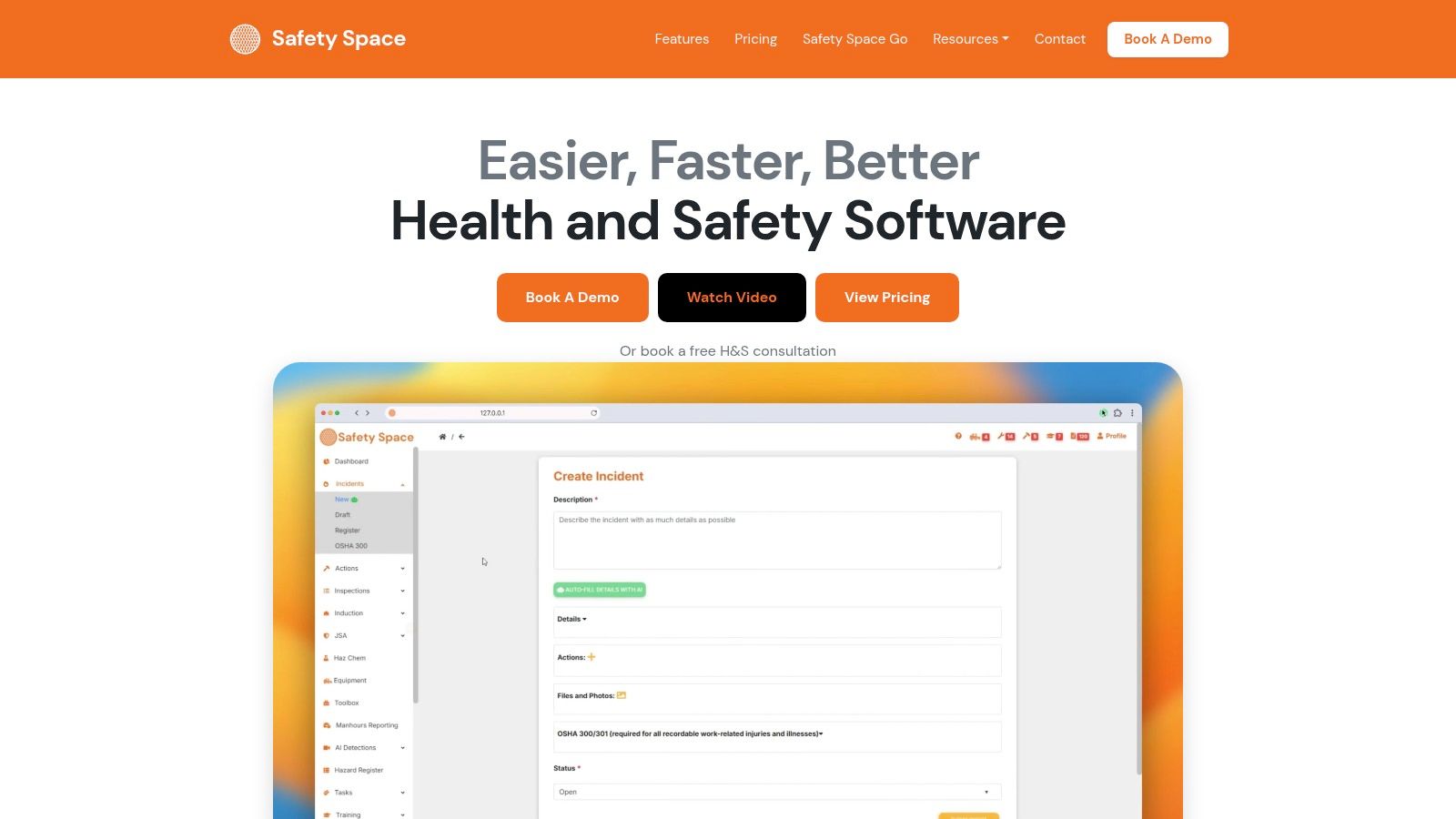
The move from paper to software should interrupt the old process at the point where control evidence is usually lost. Instead of drafting a SWMS in one location, printing it, collecting signatures and storing it separately from site records, the business can create the method against a site or project, collect worker sign-on, record reviews and keep the current version available to field workers.
Safety Space is cloud-based WHS software used in residential construction, property development, manufacturing, commercial cleaning and waste services. Its relevant functions include SWMS and JSA workflows with worker sign-on, permits to work with approvals, hazard registers, inspections, corrective actions and AI drafting for SWMS and related safety documents.
Put the review where the work happens
A digital workflow is useful when it makes supervisors stop at the right moments:
- Before work: Confirm the SWMS matches the job, site and current crew.
- At sign-on: Capture which workers received and acknowledged the method.
- During the task: Record inspections, hazards and corrective actions against the relevant site or project.
- After a change: Create or approve the revised version before work resumes.
- For oversight: Use dashboards and map views to see records by site or project.
Safety Space also keeps records by site or project and supports document control, inspections, audits, corrective actions, toolbox talks, training registers, equipment registers and contractor or visitor inductions. Those functions matter because SWMS evidence rarely stands alone. A control may depend on a permit, a plant inspection, a competency record or an action raised during a site inspection.
Digitisation doesn't make an unsafe method safe. It gives the business a clearer point at which to challenge the method, communicate a change and retain the evidence.
PCBU Duties, Principal Contractor Collection, and Review Triggers
The legal duty sits with the person conducting a business or undertaking, or PCBU, carrying out the high-risk construction work. That PCBU must prepare a SWMS, or ensure one has been prepared, before the work starts. Where the work forms part of a construction project, the principal contractor must obtain the relevant SWMS before the high-risk work begins, as explained in Queensland's guidance on safe work method statements.
The principal contractor's collection duty doesn't transfer the subcontracting PCBU's responsibility for preparing a suitable method. Nor does receiving a document prove that the controls are adequate or that the subcontractor follows them.
Map the responsibilities
The practical compliance map is straightforward:
- PCBU carrying out the work: Prepare or ensure preparation of the SWMS, arrange for work to follow it, keep it available until the high-risk work is completed, and review or revise it when necessary.
- Principal contractor: Obtain the relevant SWMS before the high-risk work starts, coordinate the project environment and make the document available where required.
- Supervisors: Verify that the method matches the work and that stated controls are present.
- Workers: Participate in consultation, understand the method and raise concerns when the conditions or sequence no longer match it.
The Australian construction health and safety regulations provide useful context for organisations coordinating multiple PCBUs and work fronts.
Define review triggers in advance
A review shouldn't depend on someone remembering the document during a crisis. The trigger should be built into the pre-start and change process.
Review the SWMS when the work sequence changes, access is altered, plant movements create a new interface, a subcontractor or crew changes, weather affects stability or visibility, ground conditions differ from the plan, a control proves ineffective, or a worker raises a safety concern. Record the revised version, communicate the change and confirm that the affected workers understand it before restarting.
Common SWMS Drafting and Implementation Mistakes
The same failures appear across many work environments. The document may be technically complete, but the control system around it is weak.
Generic controls are the most visible problem. “Use PPE”, “follow site rules” and “work safely” don't explain how a worker will control a hazard during a specific step. PPE can be necessary, but it sits at the least effective end of the hierarchy and shouldn't hide missing isolation, engineering or administrative detail.
Missing implementation arrangements create another gap. A compliant SWMS must identify the high-risk construction work, specify associated hazards and risks, describe the controls, and explain how those controls will be implemented, monitored and reviewed, as stated in the Queensland excavation code of practice.
Correct the failure at source
- No stop-work condition: State what makes the task unsafe and who can halt it.
- No named responsibility: Assign the check to a role, not to “the team”.
- No worker input: Ask the people doing the work to test the sequence and controls.
- No field verification: Use a pre-start check or observation to confirm implementation.
- No change record: Capture the reason, revision and communication method when conditions change.
Teams that need a practical communication framework can also review guidance on avoiding change management gaps when revising methods and communicating changes to frontline workers.
The preventive habit is simple: compare the SWMS with the actual work area before sign-on, then compare it again when the method or conditions change. A document that never leaves the office can't control a site.
Practical Checklist and FAQs for Site Teams
A supervisor can use the following checklist before high-risk work starts:
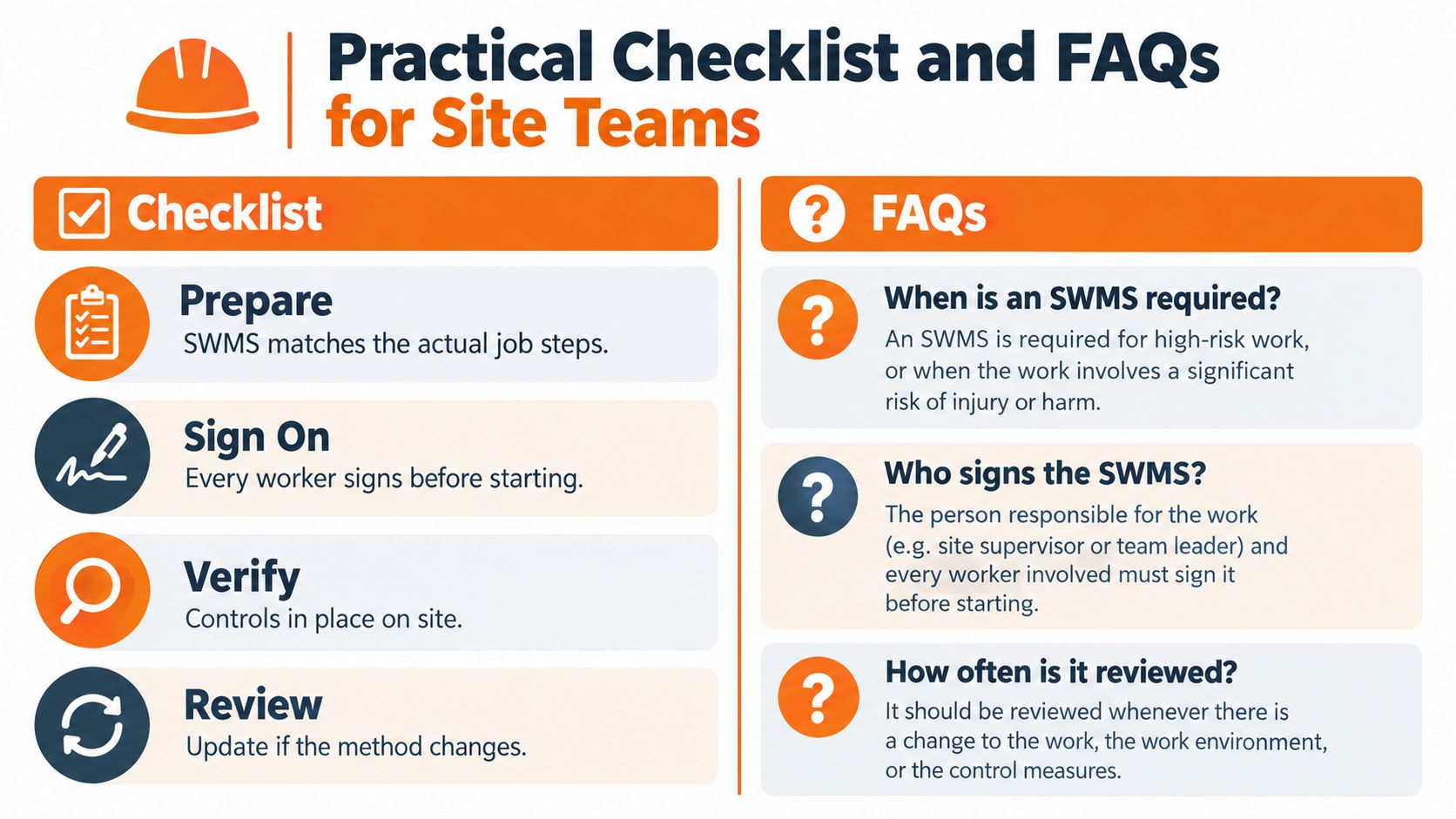
- Prepare: Confirm that the SWMS names the actual high-risk activity and matches the site's work steps.
- Consult: Ask the workers and their representatives to test the sequence, hazards, controls and emergency arrangements.
- Sign on: Make the current version available and record worker acknowledgement before work begins.
- Verify: Check that plant, access, exclusion zones, permits, PPE, competence and emergency arrangements are in place.
- Observe: Compare the documented method with the task as it is being performed.
- Review: Stop and revise the SWMS when the method, environment, hazards or controls change.
- Control versions: Remove obsolete copies from the work area and retain a clear record of the current approved version.
Frequently asked questions
When is a SWMS required?
The Australian WHS framework identifies 18 categories of high-risk construction work that trigger the SWMS requirement. The trigger is the nature of the work and its associated risk, not the contractor's size or worker count, as explained in Queensland's interactive SWMS tool guidance. A SWMS isn't automatically required for every construction task, although a principal contractor may require broader planning documents for other work.
Who prepares and signs the SWMS?
The PCBU carrying out the high-risk construction work must prepare the SWMS or ensure it has been prepared. The principal contractor collects the relevant document where the work forms part of a construction project. Workers and their representatives should participate in consultation, and affected workers should acknowledge the method before starting the task. A signature doesn't replace supervision or verification.
How often should the SWMS be reviewed?
There is no useful review interval that can replace a change trigger. The SWMS should be reviewed when the work process, site environment or hazards change, and when the documented controls aren't being followed or aren't effective. The review must result in communication and, where necessary, a revised method before work resumes.
What should a multi-PCBU site check?
The principal contractor should know which PCBU controls each high-risk activity and should obtain the relevant SWMS before work begins. Each PCBU must still manage the work it carries out, while the project team coordinates interfaces such as access, traffic, plant movements, simultaneous work and emergency arrangements.
Where should the records sit?
The current SWMS, sign-on evidence, pre-start checks, inspections, corrective actions and review history should be accessible to the people who need them. Organisations looking to organise those records can use construction safety forms as part of a wider site-control process. Peer discussion can also help business owners compare practical approaches through peer groups for construction owners.
For New Zealand operations, the comparable framework is the Health and Safety at Work Act 2015, administered by WorkSafe New Zealand. The terminology and documentation approach differ from Australian SWMS practice, so businesses operating across both countries should map the local duty and site-specific safety plan requirements rather than copy an Australian form unchanged.
Safety Space provides digital SWMS and JSA workflows with worker sign-on, permits to work, hazard registers, inspections, corrective actions and records organised by site or project. Visit Safety Space to assess whether its cloud, browser and mobile workflows fit the way the business prepares, verifies and reviews high-risk work.
Ready to Transform Your Safety Management?
Discover how Safety Space can help you implement the strategies discussed in this article.
Explore Safety Space FeaturesRelated Topics
Safety Space Features
Explore all the AI-powered features that make Safety Space the complete workplace safety solution.
Articles & Resources
Explore our complete collection of workplace safety articles, tools, and resources.