
When someone says "Workplace Health and Safety," what comes to mind? For many people, it’s just hard hats, high-vis vests, and a mountain of paperwork.
And sure, those things are part of it. But they don't get to the heart of what real safety is all about.
What Workplace Health and Safety Really Means
Good WHS isn’t a reactive checklist you tick off to keep regulators happy. It’s a practical system for finding, assessing, and controlling anything that could hurt your people. It's about setting up a work environment where risks are managed so well that safety just becomes part of getting the job done right.
This way of thinking is critical in high-risk industries like manufacturing and construction, where the line between a productive day and a serious incident can be thin. It's about making sure your team goes home in the same condition they arrived.
The Two Sides of WHS: Health and Safety
To get a proper grip on WHS, it helps to split the term into its two core parts: health and safety. They’re closely related but cover different kinds of risk.
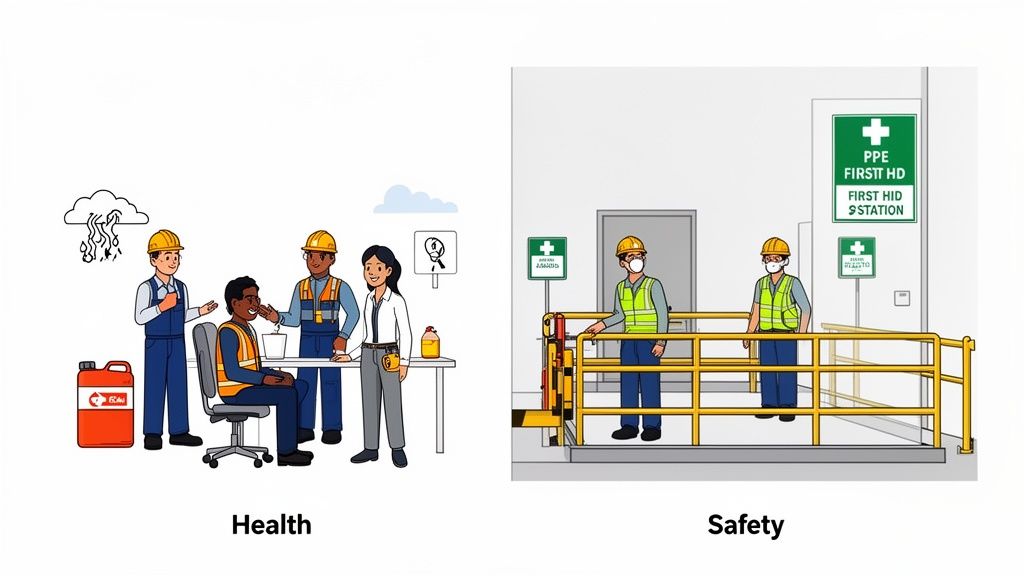
- Workplace Health is about the long game. It focuses on preventing illnesses and conditions that develop over time, like hearing loss from constant noise or respiratory issues from inhaling dust.
- Workplace Safety is about the here and now. It’s concerned with preventing the sudden incidents and accidents that cause immediate injuries like slips, falls, or equipment malfunctions.
Think of it this way: a guard on a machine prevents a hand injury right now (that’s safety). Proper ventilation that removes chemical fumes prevents a lung condition that could develop over 10 years (that’s health). Both are essential. Truly protecting your people starts with investing in employee health and well-being from all angles.
To make this clearer, let's break down how these concepts apply in real-world industrial settings.
Health vs Safety at a Glance
| Concept | What It Covers | Example in Manufacturing | Example in Construction |
|---|---|---|---|
| Health | Preventing long-term, chronic conditions caused by workplace exposures. | Providing respirators to protect against welding fumes. | Using water suppression to control silica dust during cutting. |
| Safety | Preventing immediate injuries from sudden accidents and equipment failure. | Implementing lockout/tagout procedures for machine maintenance. | Ensuring scaffolding is properly erected and inspected daily. |
As you can see, a good WHS system has to tackle both the immediate dangers and the slow-burning risks. You simply can't have one without the other.
Why a Practical Approach Matters
A safety plan gathering dust on a shelf is useless. For WHS to actually work, it has to be grounded in what people do every single day on the factory floor or construction site.
It all comes down to asking simple but powerful questions. Is that walkway clear of cables? Is that machine properly isolated before maintenance begins? Does every single person know the emergency evacuation plan?
The goal isn’t to have a perfect safety manual. It’s to have a workplace where safe practices are part of the daily routine.
This is what makes the real difference. While Australia has seen a 24% decline in the workplace fatality rate since 2014, we still lost 188 workers to traumatic injuries on the job just last year.
That fact drives home the point: consistent, hands-on safety management isn't a 'nice-to-have', it’s a non-negotiable part of doing business.
Understanding Your Legal Duties and Responsibilities
In Australia, the law is clear about who's accountable for health and safety at work. We've moved past the old idea of pinning everything on the "employer." Instead, the law uses a broader term to make sure everyone with influence over the work is responsible. This makes safety a shared responsibility, not a task dumped on one person's desk.
The central figure in all this is the PCBU, which stands for a 'Person Conducting a Business or Undertaking'. Don't let the acronym fool you; it's a critical concept. The PCBU is the primary duty holder, and in most cases, that’s the company itself. But it could also be a sole trader, a partner in a firm, or even a volunteer organisation with employees.
Bottom line: if you have management or control over a workplace, you have a legal primary duty of care. Your core job is to ensure, so far as is reasonably practicable, the health and safety of your team and anyone else who could be affected by your work like visitors, clients, or contractors.
Who Is Responsible for What
Safety is a team effort, not a solo mission. While the PCBU holds the main responsibility, the law smartly outlines specific duties for different roles within the business. Everyone has a part to play.
Officers: These are the people at the top making the big decisions like company directors or CEOs. They have a duty of 'due diligence' to make sure the PCBU is meeting its obligations. This isn't a passive role; they must be proactive, stay informed about safety matters, and make sure the right resources are available to manage risks.
Workers: This group includes everyone from direct employees and contractors to apprentices and even volunteers. Their duty is straightforward: take reasonable care of their own health and safety and make sure their actions don't put others in harm's way. They also have to follow any reasonable safety instructions and company policies.
Others at the Workplace: Even visitors, customers, and subcontractors have a responsibility. They must take reasonable care for their own safety and follow the safety rules of the workplace they're in.
Getting these roles straight is crucial. For a deeper dive into the specific obligations, particularly in Western Australia, it’s worth exploring the full requirements of the Work Health and Safety Act WA.
What "Reasonably Practicable" Actually Means
The phrase 'reasonably practicable' is the engine of Australian WHS law. It’s not a legal loophole for cutting corners or avoiding costs. It’s a practical test for balancing the level of risk against the effort required to control it.
Imagine a minor, slow drip from a pipe in a factory corner, pooling on a non-essential floor area. The risk is low. A simple fix might just involve tightening a valve, a low-cost, low-effort solution. In this case, it's clearly 'reasonably practicable' to sort it out immediately.
Now, picture that same pipe gushing a hazardous chemical right over a busy work area. The risk is sky-high. Even if the permanent fix means shutting down the production line for a day and calling in specialist technicians (a high-cost, high-effort solution), it is still considered 'reasonably practicable'. Why? Because the potential for severe harm is so great that the cost and effort are completely justified.
Your legal duty is to eliminate risks if you can. If you can’t, you must minimise them by doing everything that is reasonable and practical in the circumstances. This involves weighing the likelihood and severity of an incident against the availability, suitability, cost, and effort of the solution.
This principle touches every part of your operation. When planning complex jobs, for instance, you have to think through all foreseeable risks. To properly understand your legal duties, this means looking at specific guidelines like scaffolding safety compliance best practices, especially when you're dealing with high-risk installations. Your legal duties aren't just about ticking boxes in a rulebook; they’re about actively thinking through risk and taking sensible, practical steps to keep people safe.
The Core Parts of an Effective Safety System
An effective safety system isn't a massive document you create once and then file away. It's a living process made up of a few essential, connected parts that work together to protect your team.
Think of it like maintaining a vehicle. You need a working engine, good brakes, a way to steer, and regular check-ups to keep it running safely. A solid safety system operates on the same principle, built on four key pillars that provide a practical framework for managing health and safety in the workplace. These aren't just theories; they're the actionable components every business needs, from a small workshop to a massive construction site.
Risk Management: Identifying and Controlling Hazards
First up is risk management. This is the engine of your safety system. It's a straightforward process of spotting what could go wrong, figuring out how likely it is to happen and how bad it could be, and then actually doing something about it.
It follows a simple, three-step logic:
- Identify Hazards: This means actively looking for anything in the workplace with the potential to cause harm. It could be a trailing electrical lead on a factory floor, an unguarded saw blade, or an unmarked trench on a building site.
- Assess Risks: Once you've found a hazard, you need to assess the risk. How likely is an incident? And how severe could the injury be? A wobbly ladder used once a year is a very different level of risk than one used daily by multiple workers.
- Implement Controls: This is the most critical step. Here, you use control measures to either eliminate the hazard completely or, at the very least, reduce the risk to an acceptable level.
The best way to choose a control is by using the hierarchy of controls. This is a step-by-step guide for picking the most effective and reliable safety measures, starting with the strongest options first. The goal is always to start at the top of the hierarchy, not the bottom.
For example, instead of just giving workers earplugs (Personal Protective Equipment), the hierarchy pushes you to first see if you can buy a quieter machine (Substitution) or enclose the noisy equipment (Engineering Control). PPE should always be the last line of defence.
Worker Training and Competency
The second pillar is making sure your team has the knowledge and skills to do their jobs safely. You can have the best procedures in the world, but they're useless if nobody knows how to follow them.
This goes far beyond a quick induction on day one. Training and competency means making sure every worker understands the specific hazards tied to their role and the control measures in place. This covers everything from proper manual handling techniques to the safe operation of complex machinery or working with hazardous chemicals. It’s about confirming people aren't just told what to do but can actually show they can do it safely.
Incident Management
No matter how good your systems are, incidents can still happen. The third pillar, incident management, is your plan for when things go wrong. A well-organised process makes sure you respond effectively and, most importantly, learn from the event so you can stop it from happening again.
This involves a few clear actions:
- Reporting: A simple, blame-free way for workers to report all incidents, including near misses. A near miss is a crucial warning sign that a system is failing.
- Investigation: A process to find the root cause of the incident. This isn’t about finding someone to blame; it’s about figuring out why it happened. Was it a training gap? A faulty machine? A flawed procedure?
- Corrective Actions: Implementing practical changes to fix the root causes you identified. This closes the loop and makes your workplace safer.
This diagram shows the flow of responsibility, from the PCBU setting the overall direction down to the workers who execute tasks safely.

This structure shows that while the PCBU holds the ultimate responsibility, every level has a critical role in making the safety system function day-to-day.
Monitoring and Review
The final pillar is monitoring and review. This is your regular check-up. It’s how you confirm if your safety efforts are actually working. You can't just "set and forget" your safety system; you have to regularly check that your controls are effective and that your team is following the procedures.
This involves practical activities like regular workplace inspections, safety audits, and simply talking with your workers to get their feedback. This pillar makes sure your system stays relevant and effective over time, adapting to new challenges as they arise. To get a complete picture, you can explore the 9 key elements of a health and safety management system that build upon these core pillars.
Spotting The Real Dangers: Common Workplace Hazards
Knowing health and safety theory is one thing, but being able to walk onto a site and spot what could actually hurt someone is a completely different skill. Every industry has its own unique set of risks, but some hazards are so common and so serious that they deserve your constant attention.
Let's face it, some sectors are just more dangerous than others. Recent Australian data drives this point home, showing that a massive 80% of traumatic workplace fatalities and 61% of serious compensation claims came from just six industries, including construction and manufacturing. The usual suspects? Body stressing, falls from height, slips and trips, and people being hit by moving objects. Knowing this helps us focus our energy where it matters most. You can dig deeper into these Australian workplace safety statistics for more insights.
Top Hazards in Construction
A construction site is a dynamic place. The risk landscape can change by the hour, which means staying ahead of the game is non-negotiable. Here are the big ones that consistently cause the most harm.
Falls from Height: This is still one of the biggest killers in the industry. Whether it’s work on scaffolding, roofs, or even a ladder, one slip without the right controls can be catastrophic. The absolute best control is to design the work so no one has to go up there in the first place, like assembling structures on the ground. If you can’t, physical barriers like guardrails are your next best bet.
Mobile Plant and Vehicle Collisions: Excavators, trucks, and cranes are the workhorses of any site, but they create a huge risk. Most incidents happen because there’s no clear separation between people and machines. The simple, effective fix is designing the site layout with designated, physically separate walkways and vehicle-only zones from day one.
Trench Collapses: An unsupported trench can give way in a split second, burying workers under tonnes of earth. Hope is not a control measure. The only reliable approach is an engineered solution, like using shoring or benching to stabilise the trench walls and stop them from moving.
Electrical Hazards: Hitting an overhead power line or using damaged gear can be fatal. Before any digging or overhead work starts, the first step is always to identify every power source, then de-energise and lock them out. No exceptions.
Key Risks in Manufacturing
Factories and workshops have their own set of persistent hazards, often tied to powerful machinery, hazardous materials, and the repetitive nature of the work. Getting these under control is fundamental to keeping people safe.
The core idea is to engineer safety into the process itself. Instead of just telling people to be careful, the goal is to design the work so that the hazard is removed or isolated at the source, making the job safer for everyone.
It's this proactive mindset that makes all the difference when tackling common manufacturing risks like these.
Unguarded Machinery: Exposed moving parts on conveyors, presses, or lathes can cause horrific injuries. The most reliable control is simple and effective: fixed guarding. A physical barrier that makes it impossible to touch dangerous parts while the machine is running is the gold standard.
Hazardous Chemicals: Solvents, acids, and other chemicals can cause immediate burns or life-changing illnesses down the track. The hierarchy of controls tells us to first try swapping the nasty chemical for a safer one. If that’s not an option, using local exhaust ventilation to suck fumes away at the source is a powerful engineering control.
Manual Handling Injuries: The sprains and strains from lifting, carrying, and moving awkward items are the bread and butter of manufacturing injuries. The best fix? Get rid of the manual task altogether. Use forklifts, hoists, or conveyors to do the heavy lifting.
Noise-Induced Hearing Loss: Being around loud machinery all day causes permanent hearing damage. Earplugs are a last resort, not a solution. A much better approach is to engineer the noise out by enclosing the machine in a soundproof box or keeping it running quietly with a solid preventative maintenance schedule.
Common Hazards and Key Controls by Industry
To make this more practical, here’s a quick reference table for managers. It highlights some of the most frequent hazards in construction and manufacturing and points to the most effective primary control you should be thinking about first.
| Hazard | Industry | Primary Control Example |
|---|---|---|
| Falls from Height | Construction | Design work to be done at ground level; install physical edge protection (guardrails). |
| Mobile Plant Collisions | Construction | Create physically separate pedestrian walkways and vehicle-only zones. |
| Trench Collapse | Construction | Use engineered shoring or benching to support trench walls. |
| Unguarded Machinery | Manufacturing | Install permanent, fixed guarding that prevents access to moving parts. |
| Chemical Exposure | Manufacturing | Substitute the hazardous chemical with a safer alternative. |
| Manual Handling Strain | Manufacturing | Introduce mechanical aids like hoists, conveyors, or forklifts. |
Remember, this isn't an exhaustive list. The goal is to train your eye to see the risk and immediately think about the strongest, most reliable control, not just the easiest one. Relying on PPE or procedures alone is a sign that the real problem hasn't been solved.
How to Improve Safety at Your Workplace Today
It’s one thing to understand the theory of health and safety, but making a real difference comes down to action. The good news is that improving workplace safety doesn't need to be a massive, drawn-out project. Real change often starts with simple, practical steps you can take right now.
Here are five straightforward things you can do today to get immediate results and start building a safer workplace. They’re designed to be quick, direct, and effective.
1. Walk the Floor with Fresh Eyes
Get up from your desk and walk through your work area. But this time, do it with a single purpose: spot the hazards. Forget about production numbers, deadlines, or other tasks for a few minutes. Just look.
See that power cord stretched across a walkway? The fire exit partially blocked by a pallet? A missing guard on a machine that’s only used once a week? The goal is to see your workplace the way a new employee would, noticing the little risks that have become invisible through familiarity.
2. Talk Directly to Your Team
Let's be honest, the people doing the work every single day know where the real dangers are. They also know which processes are awkward, frustrating, or slow them down, the exact things that lead to risky shortcuts.
Go and ask them a few simple, direct questions:
- "What's the most dangerous part of your job?"
- "If someone were to get hurt here, what task do you think they'd be doing?"
- "Is there anything that makes it harder for you to follow the safety rules?"
Their answers are pure gold. This on-the-ground perspective is something you’ll never find in a report or a spreadsheet. Listen closely, because this feedback is one of the most valuable resources you have.
3. Dig Up Your Last Incident Report
Pull out the report from your last recordable incident or even a serious near-miss. Read through the investigation notes, but pay special attention to the corrective actions that were meant to be put in place.
Now, go and check. Was that machine guard actually replaced? Was the new chemical handling procedure communicated to everyone, including the night shift? Far too often, the loop is never closed, and the root cause of an incident is left to fester. Confirming that past fixes are still working is a quick and powerful win.
4. Check Your Training Records
A well-trained team is a safer team. It’s as simple as that. Spend thirty minutes looking over your training matrix or records. Are there any obvious gaps?
The key is to match the training to the reality of the work. It’s not enough that someone had a general induction two years ago. You need to confirm that everyone is competent and trained on the specific equipment they use every single day.
For instance, has an employee who recently moved to a new machine received formal training on its specific operations and safety features? A quick check can prevent an incident just waiting to happen.
5. Simplify One Safety Process
Safety paperwork can quickly become a burden. When it does, people stop taking it seriously and compliance drops off a cliff. Find one safety process that’s just too complicated and fix it.
Could you swap a long, paper-based pre-start checklist for a simple digital form on a tablet? Can you turn a wordy, ten-page safe work procedure into a one-page visual guide with photos?
Making a safety task easier and faster doesn't just improve compliance; it shows your team you respect their time. This one change can make a surprisingly big difference.
Fixing Common Safety Headaches with Digital Tools
Let's be honest. Managing workplace health and safety can feel like you're constantly fighting paperwork, wrestling with outdated systems, and trying to patch up information gaps.
Key documents go missing. Chasing signatures eats up half your day. And getting a clear, real-time picture of what’s happening on site? It often feels impossible. These everyday headaches aren't just frustrating, they create genuine risks.
This is where the right digital tools come in. They aren't about adding another layer of complexity. Instead, they strip away the administrative grind so you can focus on what actually keeps people safe. It’s a simple trade: swap the inefficient paper trail for a system that's connected, immediate, and accountable.
From Lost Paperwork to Live Information
One of the biggest pain points is managing Safe Work Method Statements (SWMS), checklists, and inductions. Paper forms get soaked, lost in a ute, or filed away in a cabinet, never to be seen again. This makes it incredibly hard to prove compliance or even just check if a task is being done safely.
A platform like Safety Space brings all these crucial documents online, right where you need them.
- Accessible Anywhere: Your team's SWMS, pre-starts, and site inductions are live on any phone, tablet, or computer. A supervisor can pull up a SWMS and review it on the spot, right where the work is happening.
- Never Lose a Record: Every single form is automatically saved, time-stamped, and stored securely. You get a perfect audit trail without a single filing cabinet in sight.
- Instant Updates: Need to update a procedure? You can push the new version out to everyone instantly. No more worrying about someone working off an old, unsafe document.
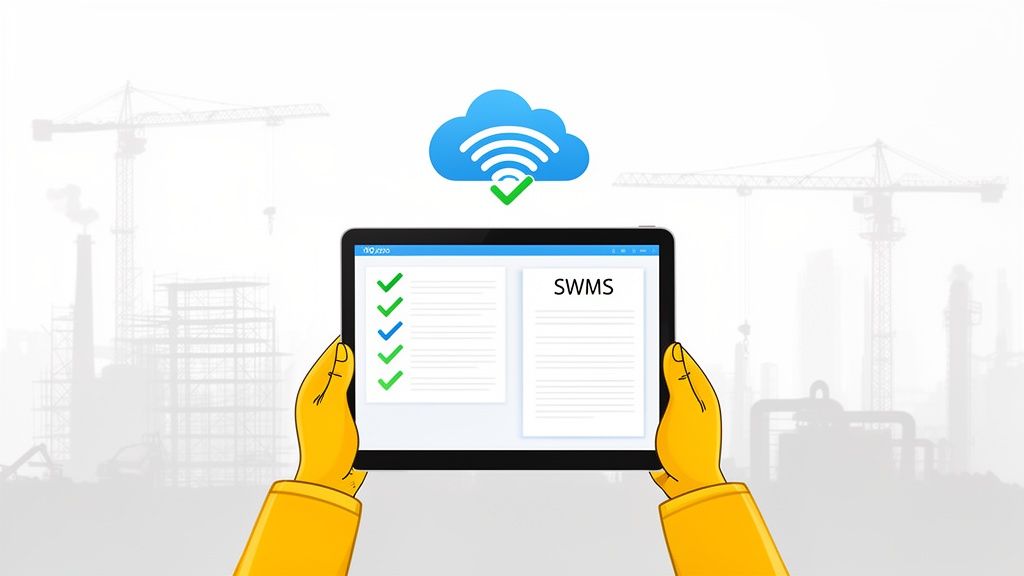
This connected approach means critical safety information is always current and within reach, finally closing the gap between the office and the worksite.
Gaining Real-Time Oversight
Another massive challenge is simply knowing what’s happening right now across multiple sites or with different subcontractors. Without a live view, you're always playing catch-up, reacting to problems long after they’ve occurred. Digital tools give you a real-time dashboard for a bird's-eye view of your entire operation.
You can instantly see who has completed their induction, which pre-start checks are done, and where potential issues are flagging. This lets you spot problems and act before they turn into incidents.
Imagine a site manager seeing that a subcontractor hasn't completed their required machinery checklist. They can follow up immediately, not at the end of the week when it's too late. That level of immediate visibility is just impossible with paper. Using a dedicated health and safety compliance software connects all these moving parts into one clear picture.
Speeding Up Processes Without Cutting Corners
Safety admin is slow and tedious, but it doesn’t have to be. Modern platforms are built with smart features that make compliance faster and easier for everyone on your team. For instance, AI-powered tools can help pre-fill repetitive parts of forms based on project details, saving valuable time while making sure everything is consistent.
The result? Your crew is far more likely to complete forms correctly and on time because the process isn't a burden. By fixing these common safety headaches, digital tools help you build a more robust, practical safety system that actually works in the real world.
Got Questions? We've Got Answers.
As you start putting health and safety principles into action on-site, a few common questions always seem to pop up. Getting these fundamentals right is the key to building a system that actually works.
Let's clear up a few of the big ones.
What’s the Difference Between a Hazard and a Risk?
This one trips people up all the time, but the distinction is actually simple and incredibly practical.
A hazard is anything with the potential to cause harm. Think of it as the source of the danger. It could be an unguarded saw, a drum of chemicals, a slippery floor, or an open trench.
A risk, on the other hand, is the chance that the hazard will actually hurt someone, combined with how bad the injury could be.
So, that unguarded saw (the hazard) becomes a very high risk if someone is working right next to it all day. The whole point of a good safety system is to spot the hazards and implement controls that knock the risk down to a level we can all live with.
Who Is Actually Responsible for Contractor Safety on My Site?
This is crystal clear under the law: you are.
As the Person Conducting a Business or Undertaking (PCBU), you have the primary duty of care for everyone on your site. That absolutely includes the chippy, the sparky, their apprentices, and any other contractor who steps through the gate.
Sure, contractors have their own duty to work safely, but you can't just handball your responsibility to them. You have to make sure they're properly inducted, know your site's specific hazards, and that their work isn't creating new dangers for your own crew. It’s a shared duty that requires genuine consultation and co-operation between everyone involved.
How Often Should I Be Doing Risk Assessments?
You won't find a rule that says "review every 12 months" set in stone. Instead, the law requires you to review your risk assessments whenever something changes to make sure they're still relevant. It's about keeping them as living documents.
As a rule of thumb, you need to conduct a review when:
- You bring in a new piece of machinery, a new chemical, or change a work process.
- An incident or even a near-miss happens. This is a massive red flag that your current controls might not be working.
- Your team raises a concern. Consultation isn't a buzzword; if your crew says something has changed, you need to listen.
- A scheduled review date arrives (e.g., setting an annual review for your highest-risk tasks is just plain smart).
The bottom line? A risk assessment should reflect the reality of the work being done today, not a box-ticking exercise that was filed away and forgotten last year.
Stop chasing paperwork and start building a safer, more efficient worksite. Safety Space replaces outdated systems with a simple, all-in-one platform for real-time safety management. See how you can fix your biggest safety headaches by booking a free demo and consultation.
Ready to Transform Your Safety Management?
Discover how Safety Space can help you implement the strategies discussed in this article.
Explore Safety Space FeaturesRelated Topics
Safety Space Features
Explore all the AI-powered features that make Safety Space the complete workplace safety solution.
Articles & Resources
Explore our complete collection of workplace safety articles, tools, and resources.