
WHS management is a continuous four-step risk management cycle: identify hazards, assess risks, control them with the most effective reasonably practicable measures, and review the controls. It operates as a core business system under the model WHS Act, not as a compliance checklist.
A typical Monday exposes whether that system works. A construction business has supervisors across several sites, subcontractors using different forms, and plant arriving before the site manager. In a manufacturing operation, production changes faster than the risk assessments, while paper prestarts sit in folders that no one checks until an incident occurs. Each process may look complete on its own, yet critical controls can still fail between the office, the supervisor and the work area.
Table of Contents
- Introduction to Occupational Health and Safety Management in Australia
- How the WHS Risk Management Cycle Works
- Key Components of a WHS Management System
- Why Critical Risks Need Verified Controls Not Checklists
- Psychosocial Hazards and Modern WHS Management
- Putting WHS Management Into Practice on High Risk Sites
- Benefits of Effective WHS Management and Next Steps
Introduction to Occupational Health and Safety Management in Australia
Occupational health and safety management, usually called WHS management in Australia, is the organised way a PCBU identifies hazards, controls risks and checks that those controls remain effective. It covers the decisions, people, processes, records and verification activities that keep work safe during normal operations and change.
That definition matters because ad-hoc safety activity rarely survives operational pressure. A risk assessment prepared for a tender may not reflect the actual sequence of work. A contractor induction may confirm attendance without confirming competence. An incident report may record what happened without testing whether the underlying control was suitable.
Australian WHS management sits within the duties established by the WHS Act and supported by Safe Work Australia's model guidance. The national approach is built around a formal cycle of hazard identification, risk assessment, risk control and control review. Safe Work Australia's model code of practice has provided the national guidance framework for this approach since the harmonised WHS regime introduced in 2011. Safe Work Australia's national statistics show why organisations need that system. Australia's current work-related injury rate is 3.5%, compared with a global rate of 12.1%, yet Australian workplaces recorded 146,700 serious workers' compensation claims in 2023–24, more than 400 serious claims every day.
Operational test: If a control only exists in a document, you haven't yet shown that the risk is controlled.
A functioning system gives supervisors a clear operating method. It gives workers a practical way to report hazards and influence controls. It gives officers evidence that the organisation has allocated resources, maintained suitable processes and verified their use.
The rest of this article focuses on that operating method. You'll see how the risk cycle works, which system components support it, why critical controls need evidence, and how physical and psychosocial risks fit into one WHS framework.
How the WHS Risk Management Cycle Works
The WHS risk process has four connected steps. Each step answers a different management question, and none replaces the others.
Identify hazards
Start by finding anything with the potential to cause injury or ill health. Sources include plant, substances, energy, work at height, traffic interaction, manual handling, work organisation and contractor interfaces. Workers, supervisors and maintenance personnel often see hazards that a document review misses, so consultation should form part of the identification process.
Assess risks if needed
Assess the risk where you need to understand the likelihood or severity of harm, compare options, or decide what action is reasonably practicable. The assessment should reflect the task, including duration, exposure, people affected, interactions between hazards and foreseeable changes.
Control the risk
Choose the most effective reasonably practicable control. Safe Work Australia ranks the hierarchy of controls from the highest level of protection and reliability to the lowest. Elimination and substitution sit above engineering controls, administrative controls and PPE. The WHS risk management guidance can help teams organise this work, but the control decision still needs to reflect the actual hazard and workplace.
Consider a maintenance task involving access to a moving machine. Removing the need to enter the danger area is stronger than relying on a warning sign. Separating people from the machine through guarding is stronger than asking workers to remember a procedure. A permit, training and PPE may still have a role, but they rely more heavily on consistent human behaviour.
Review the controls
Review confirms whether the controls work as planned and remain suitable. Trigger reviews after incidents, near misses, changes to plant or materials, altered work methods, new contractors, or evidence that workers are bypassing a control. A review should test the control in the field, not confirm that the document has the correct approval.
Skipping the final step creates a false sense of completion. Equipment changes, production pressure and informal workarounds can weaken controls long after the original assessment. A review closes the loop and turns experience into a safer operating method.
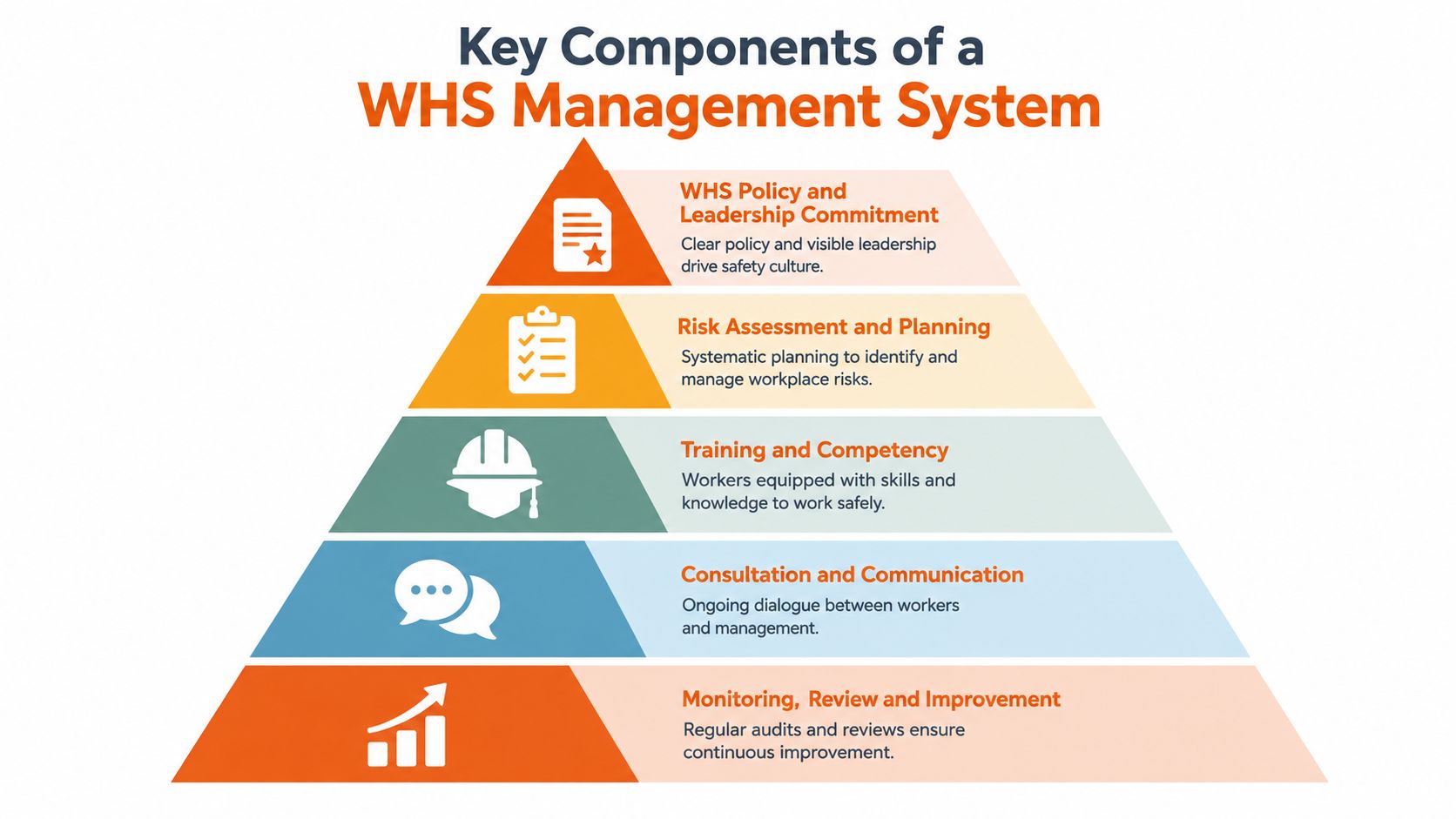
Key Components of a WHS Management System
The cycle needs practical infrastructure around it. Without clear ownership, accessible information and routine verification, even a sound risk process becomes inconsistent across sites.
Policy and leadership
A WHS policy should establish the organisation's commitments, responsibilities and decision principles. It must connect to operational planning. Senior leaders should ask about critical controls, unresolved corrective actions and resource constraints, not only injury totals.
Officer due diligence provides the governance layer. Under the model WHS framework, an officer of a PCBU must take reasonable steps to acquire and maintain current WHS knowledge, understand the business and its hazards, ensure suitable resources and processes exist, and verify that people use them. Safe Work Australia's officer duty guide makes clear that due diligence is active oversight, not passive approval.
Planning and risk information
The organisation needs current hazard registers, task risk assessments, plant information, emergency arrangements and change controls. Keep these records connected to the work. A supervisor should be able to find the current control requirements before a task begins, while a manager should be able to see where controls remain unverified.
Competence and work instructions
Training must match the task and the person's level of responsibility. Competence includes knowing how to apply a control, recognising when conditions have changed and stopping work when the control no longer works. Job safety analyses and SWMS should describe the actual sequence, hazards, controls and required checks rather than repeat generic wording.
Reporting and corrective action
Workers need a simple route to report hazards, near misses, incidents and control failures. The process must lead to action. Assign an owner, set a practical due date, record the decision and verify completion in the field. Closing a task because someone uploaded a photograph isn't enough if the photograph doesn't show the risk has been addressed.
Consultation and visibility
Consultation works best when it changes decisions. Use prestarts, toolbox discussions, planning meetings and worker representatives to test whether controls are workable. On multi-site operations, centralised records can give managers visibility across locations, contractors and open actions without forcing each site to maintain a separate version of the truth.
Monitoring and improvement
Monitor both outcomes and control activity. Useful evidence may include inspections completed, isolation checks, permit reviews, training competence, corrective action quality and worker feedback. Audits should test effectiveness, not just document presence.
For a broader system view, review the nine key elements of a health and safety management system. The value lies in how the elements connect. A report should update the risk picture. A changed risk picture should alter controls, training and supervision. Monitoring should then test the revised arrangement.
Why Critical Risks Need Verified Controls Not Checklists
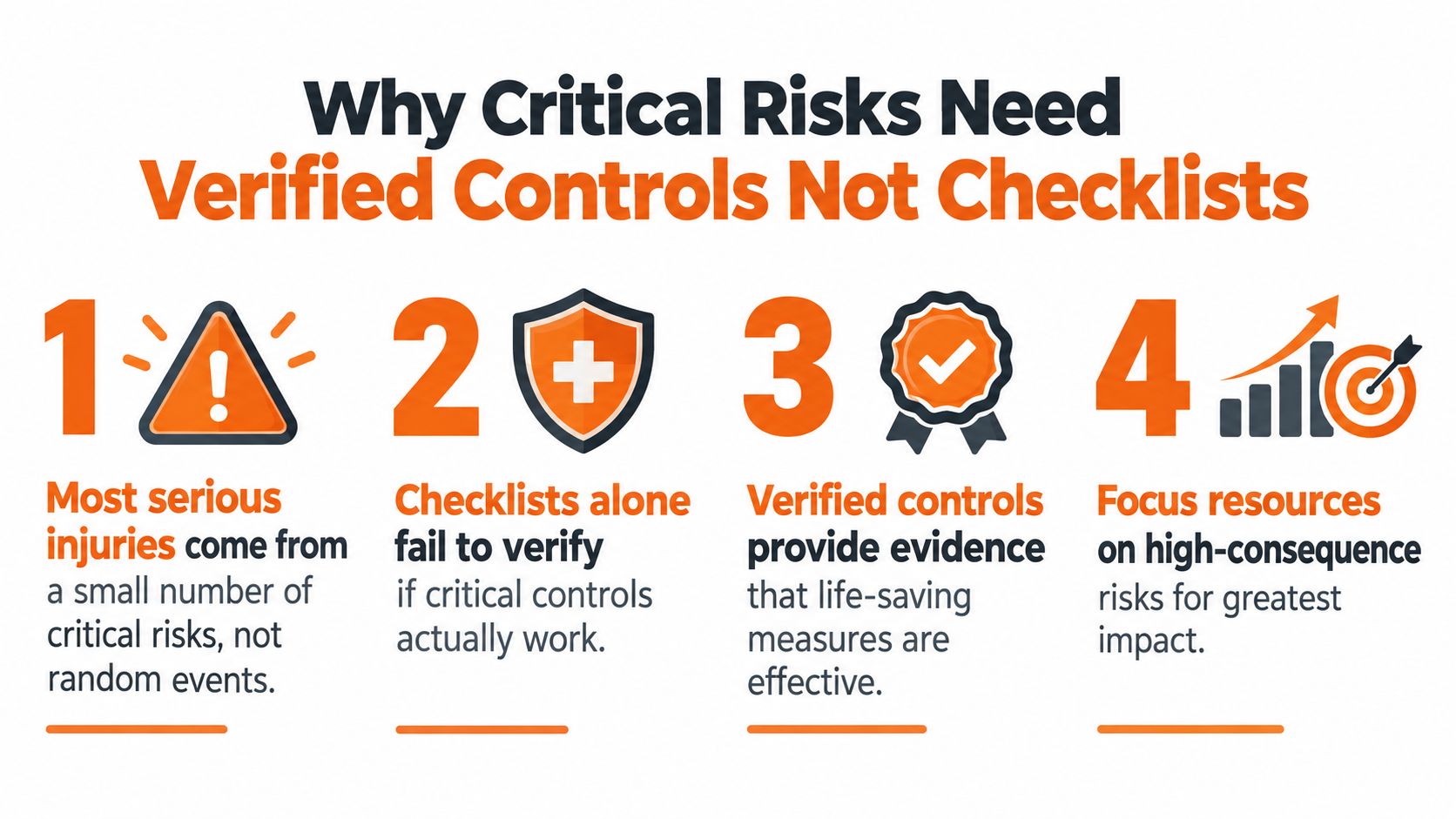
National data shows that serious harm is concentrated in particular failure modes and industries. Safe Work Australia reports that 80% of traumatic injury fatalities and 61% of serious workers' compensation claims occur in six industries. Vehicle incidents account for 42% of fatal injuries, while falls from height contribute 13%. These figures support an industry-specific WHS strategy that gives priority to high-consequence risks and verifies the controls that prevent them. Safe Work Australia's latest WHS statistics provides the national context.
A checklist can confirm that someone ticked a box. It can't, by itself, confirm that a vehicle exclusion zone was maintained, an isolation was effective, a scaffold remained suitable or a fall prevention system was correctly installed. The manager needs evidence that the control operated at the point of risk.
What control assurance looks like
For a construction or industrial operation, leading indicators should reflect the controls that prevent serious harm:
- Control assurance: A competent person checks whether critical controls are present, suitable and used.
- Permit-to-work discipline: The issuer confirms conditions, boundaries, isolations and handover requirements before work starts.
- Prestart verification: Workers and supervisors confirm the condition of plant, access routes, guarding and required protective systems.
- Isolation verification: The person doing the work confirms that hazardous energy has been isolated and cannot be reintroduced.
- Asset inspection and maintenance: The organisation records inspections and defects for high-risk plant and equipment, then tracks corrective action.
These indicators work because they measure the mechanism of prevention. An increase in completed forms may indicate administrative activity, but it doesn't necessarily show that a life-critical control is effective.
The practical conclusion: Predictable failure modes require verified controls, not a larger collection of generic checklists.
Mental health risks require the same discipline. Mental health conditions now represent 12% of all serious claims, so a system that verifies physical controls while ignoring work design is incomplete. Managers need evidence that workload, supervision, role clarity and change controls operate as intended.
Psychosocial Hazards and Modern WHS Management
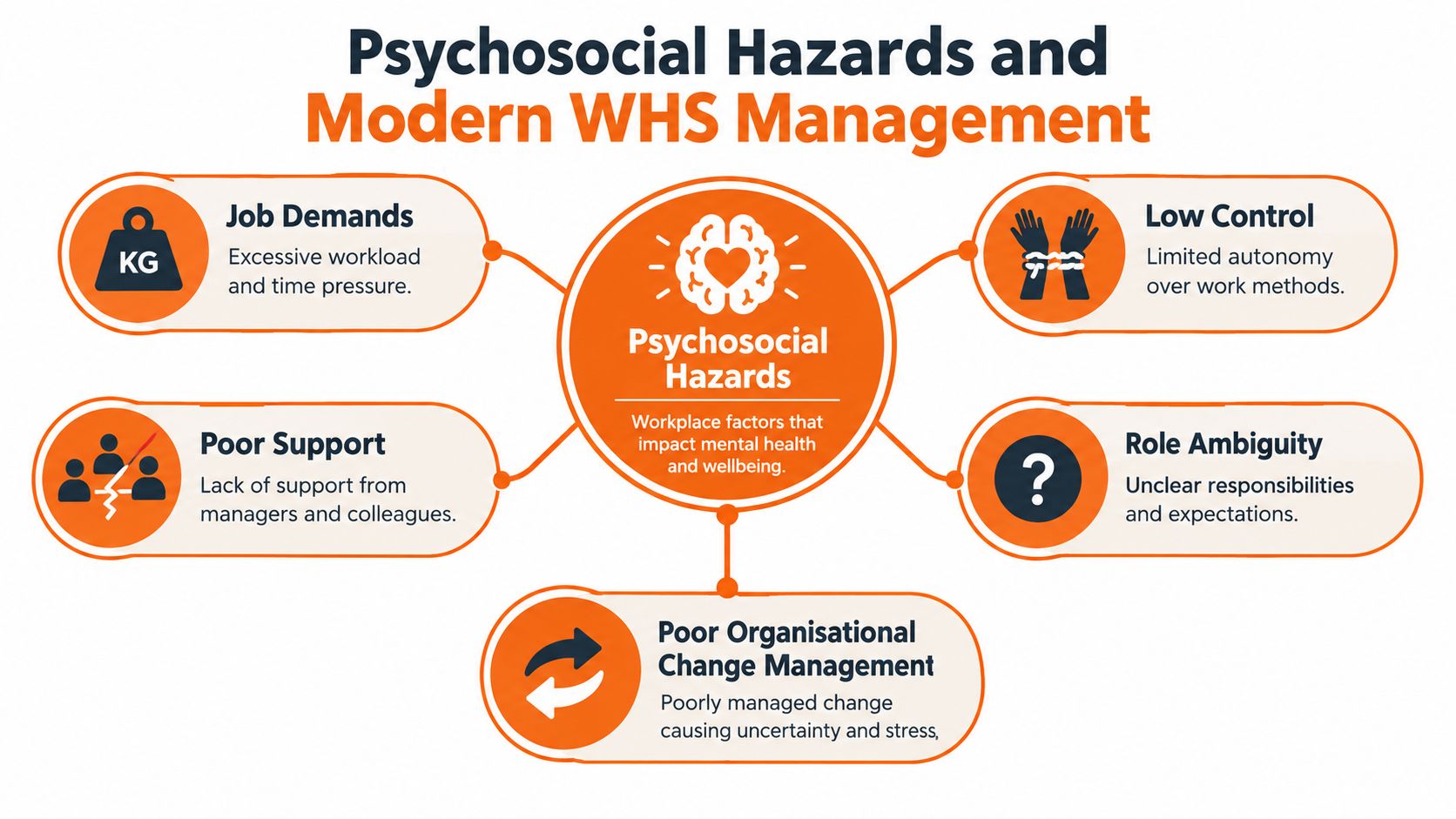
A supervisor notices rising overtime, unclear priorities and more conflict between crews. Treating these signs as individual resilience issues misses the control problem. Psychosocial hazards are work factors that can cause psychological harm, including job demands, low control, poor support, role ambiguity, poor change management, bullying, harassment and violence. PCBUs must manage them within the WHS system, using the same cycle as other hazards: identify the exposure, assess the risk, apply controls and check whether they work.
Assessment requires more than asking whether people feel positive about work. Consider duration, frequency, severity and interactions between hazards when choosing controls, as outlined in the guidance on psychosocial hazards. For definitions and practical examples, see this psychosocial hazards definition. A short period of intense workload can combine with low control and poor support. A poorly managed restructure can create role ambiguity while supervisors are already carrying excessive demands.
Controls must change the work
Psychosocial controls usually start with work design. A manager may revise workload allocation, clarify decision rights, improve staffing plans, establish escalation routes, train supervisors in early intervention and set clear behaviour standards. A reporting channel still has a role, but it cannot be the only response when the hazard comes from how work is organised.
Mental stress is one of the four sources behind 84% of serious workers' compensation claims, according to the Safe Work Australia information linked above. Construction is also among the six industries driving 61% of serious claims and 80% of traumatic fatalities. In construction, manufacturing and industrial services, psychosocial risks can sit alongside fatigue, remote supervision, production pressure and contractor conflict.
Regulation and accountability
Safe Work Australia has published new model WHS Regulations and a model Code of Practice for psychosocial hazards. Victoria's Occupational Health and Safety (Psychological Health) Regulations 2025 commence on 1 December 2025. Organisations must check the requirements in their jurisdiction because model provisions do not operate identically everywhere.
A mature system assigns owners to psychosocial controls and checks evidence such as workload discussions, consultation records, supervisor actions, reported behaviour, change communications and early intervention pathways. Psychological health belongs in operational control, alongside the other conditions that shape how work is planned and performed.
Putting WHS Management Into Practice on High Risk Sites
On a multi-contractor construction site, WHS management starts before the crew arrives. The principal contractor reviews the work scope, identifies interfaces and confirms which PCBUs control each part of the work. Each party must consult, cooperate and coordinate where duties overlap, as far as reasonably practicable, under Safe Work Australia's consultation, cooperation and coordination code.
Before work starts
For high risk construction work, the contractor prepares a SWMS before the activity begins. SafeWork NSW states that a SWMS is required for the high risk construction work activities defined in the WHS Regulation. SafeWork Tasmania identifies 18 high risk construction work activities, with the SWMS required before work starts. The SafeWork NSW construction code provides the jurisdictional detail.
The site team should then test the document against the planned work:
- Confirm the sequence: Check that the SWMS describes the actual task, plant, access and work area.
- Confirm interfaces: Resolve conflicts between cranes, vehicles, excavation, services, deliveries and other contractors.
- Verify permits and isolations: Check that authorisations and energy controls are active before exposure begins.
- Brief the workforce: Ask workers to explain the critical controls and the stop-work conditions.
- Record field checks: Capture prestart findings, control assurance and corrective actions where the work occurs.
A centralised system can replace disconnected paper forms and spreadsheets with current records across sites and subcontractors. A platform such as Safety Space can centralise incident reporting, risk assessments, inspections, training records, corrective actions and compliance information, giving managers a common view of open issues and control activity.
During and after the task
Supervisors need to observe whether workers use the controls in the SWMS. If site conditions change, pause the work, reassess the risk and revise the method before restarting. The signed document isn't a substitute for supervision.
Microlearning can support short, task-specific briefings when teams work across different sites or include subcontractors. Guidance on designing scannable microlearning for OSHA offers useful principles for making safety content easy to scan, although Australian organisations must align the content with Australian WHS duties and terminology.
After completion, review defects, deviations and worker feedback. Feed the findings into the next risk assessment, procurement decision, training update or contractor review. That is how a site turns a completed task into better operational control.
Benefits of Effective WHS Management and Next Steps
Effective WHS management gives leaders better information for operational decisions. It helps teams identify hazards before work begins, focus resources on serious risks and detect when controls are weakening. It also supports a stronger compliance position because the organisation can show how it made decisions, consulted people, allocated resources and checked performance.
The practical benefits extend beyond incident prevention. Clear controls reduce uncertainty for supervisors and contractors. Accessible reporting helps maintenance and production teams act on defects sooner. Consistent consultation improves coordination where several PCBUs share a workplace. Accurate records help business owners distinguish genuine control assurance from paperwork volume.
Use this verification check with your H&S and operations teams:
- Hazard coverage: Do registers and assessments reflect current plant, tasks, contractors and changes?
- Hierarchy decisions: Do assessments show why the selected controls are reasonably practicable and where stronger controls were considered?
- Critical control evidence: Can supervisors show that prestarts, permits, isolations, inspections and high-risk asset maintenance are working in the field?
- SWMS discipline: Are SWMS prepared before relevant high risk construction work and reviewed when conditions change?
- Consultation quality: Do workers and overlapping duty holders influence the control decisions?
- Psychosocial coverage: Does the system address workload, control, support, role clarity, change, bullying, harassment and violence?
- Review quality: Do audits and incident investigations test control effectiveness rather than document completion?
Start with the risks that could cause the greatest harm. Map each critical control to an owner, a verification method and an escalation path. Then give officers and operational leaders a regular view of whether those controls are present and effective.
Safety Space provides a customisable platform for centralising incident reports, risk assessments, inspections, training records, corrective actions and compliance monitoring across sites and subcontractors. Visit Safety Space to arrange a free demo and H&S consultation focused on turning your WHS processes into a visible, verifiable operating system.
Ready to Transform Your Safety Management?
Discover how Safety Space can help you implement the strategies discussed in this article.
Explore Safety Space FeaturesRelated Topics
Safety Space Features
Explore all the AI-powered features that make Safety Space the complete workplace safety solution.
Articles & Resources
Explore our complete collection of workplace safety articles, tools, and resources.