
A toolbox talk can be fully attended, signed and filed, yet still fail to show genuine WHS consultation. The test is whether affected workers had relevant information, a real opportunity to influence the decision, and timely feedback about what happened to their concerns.
That distinction matters on Australian construction sites, in manufacturing plants and across industrial service operations. Shift patterns, labour-hire arrangements, subcontractor interfaces and language barriers can leave important work groups outside the conversation. A defensible WHS consultation process must reach those workers and leave an evidence trail showing how their input shaped controls.
Table of Contents
- Why Consultation Fails Even When Paperwork Looks Right
- The Four-Part Legal Minimum Under Section 47
- Who Must Be Consulted in Complex Workplaces
- Embedding Consultation Into Existing Work Processes
- Consulting Across Shifts, Language Barriers, and Contractor Groups
- Building an Audit Trail That Proves Consultation Changed Decisions
- Practical Consultation Records That Meet Legal Requirements
Why Consultation Fails Even When Paperwork Looks Right
A construction project holds daily toolbox talks. The supervisor keeps signed attendance sheets, the safety file contains the SWMS, and the contractor induction records appear complete. The incident involves a subcontractor who worked nights and wasn't present when the day crew discussed an altered traffic route.
The records prove that a meeting occurred. They don't necessarily prove that the affected worker received the information, had a reasonable opportunity to raise concerns, or influenced the decision. Under the model WHS framework, consultation must involve workers directly affected, or likely to be directly affected, by the health and safety matter. The model WHS Act sets out the duty to share information, obtain views, consider those views and communicate the outcome.
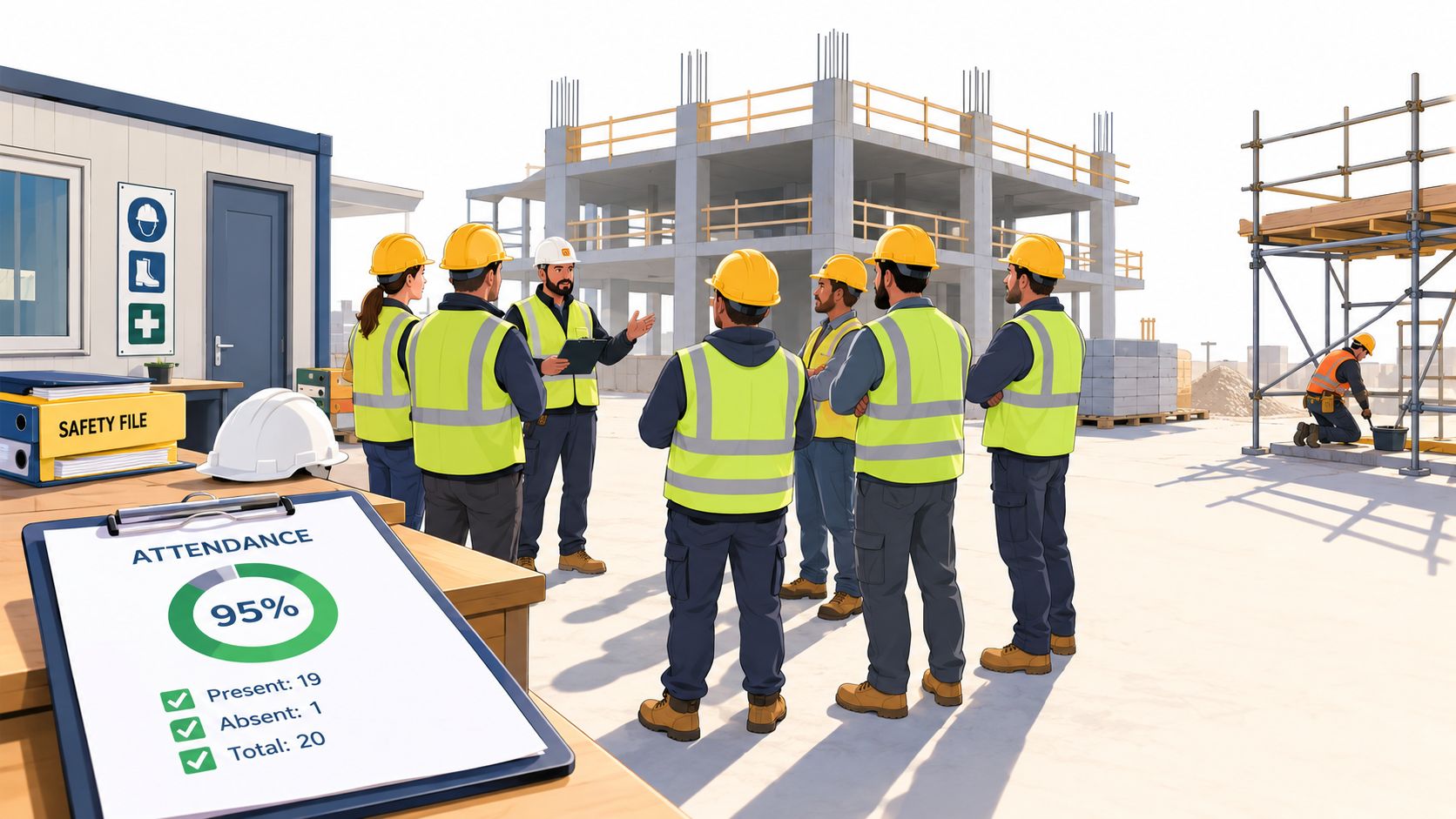
Attendance is not participation
An attendance sheet answers one narrow question: who was recorded as being present. It doesn't show:
- The issue discussed: What hazard, proposed change or control was put to workers?
- The information provided: Did workers understand the plant movement, chemical exposure or altered work sequence?
- The feedback received: What did workers, HSRs or contractors say?
- The decision rationale: Which suggestions were accepted, modified or rejected, and why?
- The close-out: How did the business tell affected people what it decided?
A day-shift meeting can also exclude night crews, weekend workers, mobile teams and subcontractors who arrive after the discussion. A translated procedure sitting in the safety file may not help a worker who never received it or couldn't use the format provided.
Practical rule: Treat an attendance record as evidence of presence, not evidence that consultation was meaningful.
Multiple duty holders create blind spots
A principal contractor may control site traffic, while a specialist subcontractor controls the work method and a labour-hire provider manages personnel. Each party may assume another party consulted the people exposed to the risk. That gap becomes obvious when a worker can't explain who made the decision or where to raise a concern.
The model framework requires PCBUs with overlapping duties to consult, cooperate and coordinate with one another. A compliant file therefore needs more than individual contractor meetings. It should show how businesses exchanged information, identified interfaces and reviewed controls when the work changed.
The strongest process follows the work rather than the organisational chart. It identifies every affected work group, checks when and how each group can participate, and links feedback to the control decision. That is what separates a procedural meeting from an operationally credible consultation process.
The Four-Part Legal Minimum Under Section 47
A consultation process fails fast when the paperwork looks tidy but the workers who carry the risk were never properly involved. Section 47 sets the floor. A PCBU must give relevant information, give workers a reasonable chance to raise views, take those views into account, and tell people what was decided. If workers are represented by an HSR, that person must be involved as well. The Act does not require one fixed meeting format, but written procedures make the process easier to run and audit, as set out in Safe Work Australia's model Code of Practice: Work Health and Safety Consultation.
1. Share relevant information
Workers need enough detail to judge the risk and respond properly. For a plant change, that means the proposed sequence, the changed exclusion zones, stored energy risks, and any temporary controls. For a chemical change, it means the substance, the exposure route, the handling method, and the protective measures being proposed.
A link to a procedure is not enough if no one is told what is changing. Information must match the exposure of the work group and reach them before the decision is locked in.
A documented PCBU responsibility framework helps managers assign who prepares the information, who leads the consultation, and who closes the action.
2. Provide a reasonable opportunity to contribute
Reasonable depends on the work pattern and the decision. A short notice meeting during one shift may suit a stable team, but it will miss rotating crews, remote technicians, and subcontractors working outside standard hours.
Give people a practical way to respond. A meeting, a pre-start discussion, a digital form, a representative channel, or a mix of those methods can work if it lets people ask questions before the decision is fixed. Anonymous feedback can help where workers may hesitate to challenge a supervisor, especially during a change that affects production or contractor arrangements.
The test is simple. If the process only reaches the people who happened to be in the room, it is not a reasonable opportunity.
3. Take views into account
Taking views into account does not mean accepting every suggestion. It means the decision-maker considers the feedback and can show what happened to it. If a worker proposes a different isolation point, the record should show whether the idea was adopted, tested, adjusted, or rejected.
A note that says “no issues raised” tells an auditor very little. It may mean no one had concerns, or it may mean workers were not given enough information or enough time to speak.
Operational records need to show the link between the concern and the outcome. That is where many consultation files fail. The discussion exists, but there is no trail showing how it changed the control, if it changed it at all.
Compliance records often sit beside wider governance material. Resources such as AnchOps helps with compliance can support the wider control environment, but the operational owner still needs to capture the actual WHS discussion and decision.
4. Communicate the outcome
Workers need to know what the business decided and what happens next. That message should go back to the same work groups that were consulted, including people who could not attend the original discussion.
Record the final control, the action owner, and the timing. If the decision changes a SWMS, traffic plan, isolation procedure, or work instruction, the affected people need the revised information before the change starts. A signed form filed after the work begins does not fix a consultation failure that happened before the decision.
Who Must Be Consulted in Complex Workplaces
Start with the work, not the payroll. The relevant question is who carries out work for the business or undertaking and who is directly affected, or likely to be directly affected, by the WHS matter.
That scope can include employees, contractors, subcontractors and their workers, labour-hire personnel, apprentices, trainees, work-experience students, volunteers and other people working for the PCBU. The relevant WHS instrument confirms that consultation isn't limited to direct employees and that an HSR must be included where workers are represented.
Map affected groups before choosing the meeting
For a construction activity, list the people exposed to the work sequence, not just the company names on the project register. That may include the excavation crew, survey team, traffic controllers, plant operators, delivery drivers and nearby specialist installers.
For a manufacturing change, consider operators on every shift, maintenance technicians, cleaners, quality staff and labour-hire personnel who use or work near the equipment. For industrial services, include mobile technicians, client-site contacts and subcontractors who share access, isolation or lifting arrangements.
A useful mapping exercise records:
- Work group: Who performs or supports the task?
- Exposure: Which hazard or decision affects them?
- Work pattern: When and where can they realistically participate?
- Representation: Is an HSR involved?
- Control interface: Which PCBU controls the relevant part of the work?
Involve HSRs as representatives
An HSR isn't an optional attendee added after management has reached a decision. Where the affected workers have an HSR, the representative must be involved in consultation affecting that work group. Provide the same relevant information and allow enough time for the HSR to raise issues and contribute.
A common failure occurs when a project manager consults a subcontractor supervisor but doesn't involve the HSR for the host work group. Another occurs when a principal contractor sends a revised SWMS to a contractor manager and assumes the document will reach every exposed worker.
Coordinate the businesses, not only the documents
Overlapping duties require PCBUs to consult, cooperate and coordinate. Establish who controls each interface, who supplies information and who approves changes. Then bring the affected contractors into the decision before work starts or resumes.
This approach avoids a common chain-of-command error. A host employer may control the workplace, a subcontractor may control the task and a labour-hire provider may control worker placement. None can safely assume that another party has completed the full consultation process.
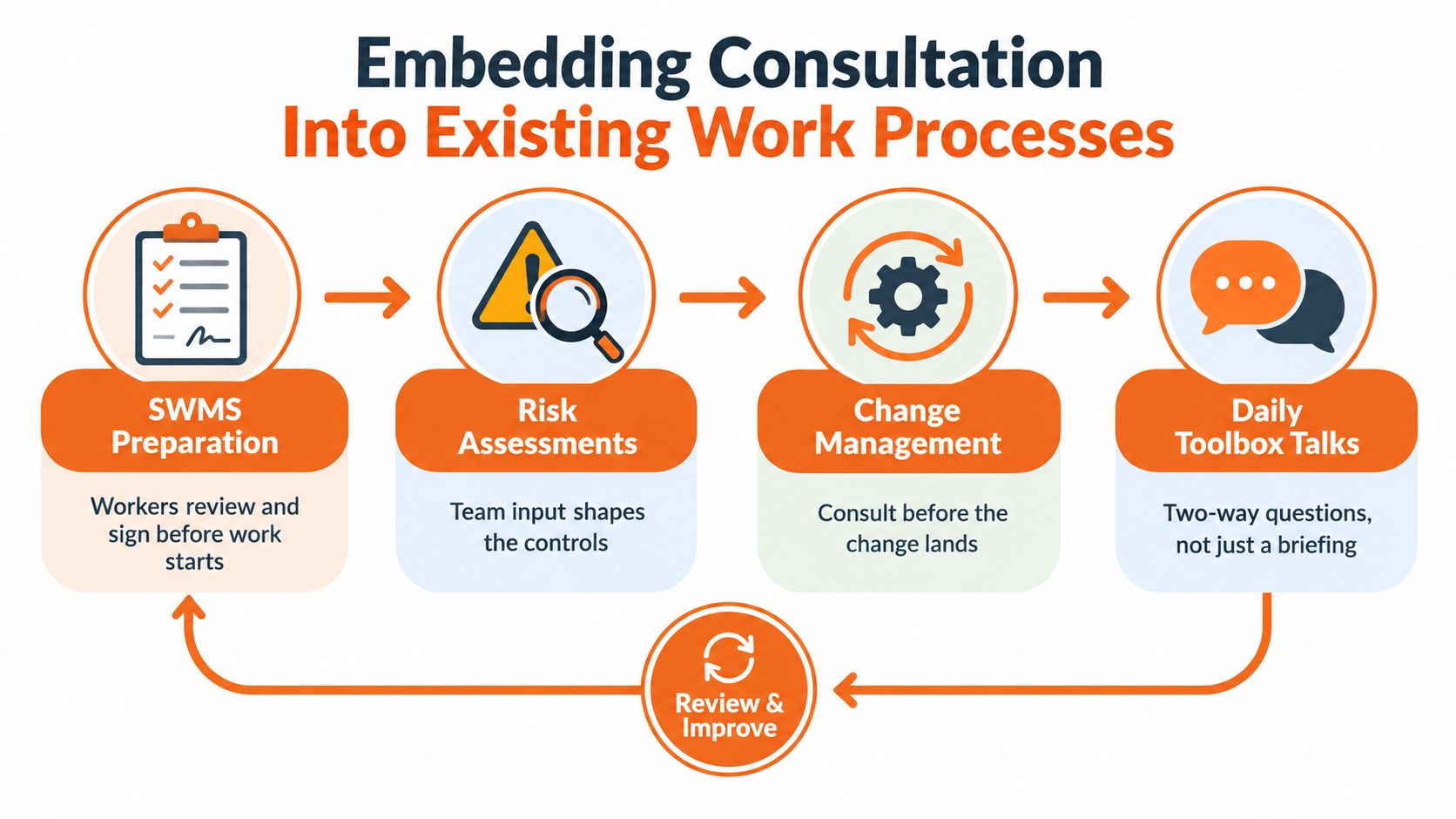
Embedding Consultation Into Existing Work Processes
Consultation works best at the point where a decision is still open. If the risk assessment, SWMS or change notice already contains the final control, asking workers to sign it turns consultation into notification.
The operational fix is to place consultation fields inside workflows managers already use. A risk assessment can include the affected work group, information provided, worker feedback, decision rationale and close-out communication. A pre-start can capture a new site condition, the person who raised it and the action taken before work continues.
SWMS preparation
For high risk construction work, a SWMS must be prepared before work starts. Workers and their HSRs must be consulted while the SWMS is prepared and reviewed. If workers weren't engaged during planning, consultation must occur when the SWMS is first made available, such as through workplace-specific training or a toolbox talk. These requirements appear in Safe Work Australia's model code for construction work.
A generic SWMS copied from another project doesn't address the actual site, sequence, plant, interfaces and controls. Ask the people carrying out the work to test the method against site conditions. Record their changes, even when the final document remains familiar.
Risk assessments and pre-starts
Use the risk assessment as a decision record, not just a risk score. Ask operators where the proposed control may fail in practice. For example, a barrier plan might look adequate until a plant operator explains that deliveries will block the only sightline during a particular stage of the work.
Pre-starts are useful for short-cycle changes. They shouldn't replace consultation on a major decision, but they can identify conditions that require the risk assessment or SWMS to be reviewed. Make the escalation path clear so workers know when a concern needs management action.
Change management
Consult before the change lands. If a new chemical, production sequence, access route or isolation method affects workers, provide information early enough for their input to influence the arrangement. A documented management of change procedure can define triggers, approval points and review responsibilities.
Digital workflows can support this structure, especially across multiple sites. Teams considering scalable automation for service businesses should still design for human feedback, not just automated notifications. The system must make it easy to record who contributed, what changed and how the outcome reached the workforce.
Consulting Across Shifts, Language Barriers, and Contractor Groups
A single day-shift toolbox talk is efficient for the supervisor. It isn't necessarily effective for the workforce. Night crews, labour-hire workers and subcontractors may miss the meeting, while culturally and linguistically diverse workers may attend but have limited opportunity to challenge a technical explanation delivered in unfamiliar language.
Safe Work Australia recommends staggering consultation times, using anonymous surveys or feedback forms, and adapting communication for workers with disability, special language or literacy needs. Its consultation review material supports a practical approach: map each workforce group, identify participation barriers, provide adapted methods, and record how feedback was considered and communicated.
Match the method to the barrier
| Workforce situation | Weak approach | More reliable approach |
|---|---|---|
| Night or rotating shifts | One meeting during day shift | Repeat the discussion across agreed shift windows and provide a channel for follow-up questions |
| Labour-hire and subcontractor workers | Send information only to the contract manager | Include the workers performing the task and track their feedback separately |
| Limited literacy or language differences | Long written procedure with a signature page | Use translated or visual material, demonstrations and checks for understanding |
| Disability or communication needs | Assume the standard meeting format suits everyone | Adapt the format, timing and channel to the person's participation needs |
| Workers reluctant to speak publicly | Ask for questions at the end of a group briefing | Offer anonymous feedback and private access to a supervisor or HSR |
The right method may combine a short face-to-face discussion, visual controls at the work area and an anonymous digital form. The goal isn't to provide the same material in every format. The goal is to give each affected group a genuine opportunity to understand the issue and influence the decision.
Track participation by exposure
Don't report only total attendance. Identify which work groups participated and which still need contact. A contractor who starts after the main meeting needs the same opportunity to contribute if the work affects them.
For a high-risk change, record the work group, shift, contractor status and HSR involvement. Then document any different feedback between groups. Night workers may identify access or fatigue risks that day workers don't encounter. A subcontractor may identify an interface hazard that isn't visible to the principal contractor's employees.
A consultation process is incomplete when the people exposed to the change have no practical way to participate, even if the meeting register is full.
Building an Audit Trail That Proves Consultation Changed Decisions
A regulator, client or incident investigator needs to see the path from issue to decision. A signed attendance sheet shows that people were present, but a decision record shows whether the business listened and acted.
Build the record around the control decision. Start with the health and safety matter, identify the affected groups and list the information provided. Capture questions, concerns, suggestions and disagreements in plain language. Then name the decision-maker, record the rationale and assign actions with owners and review dates.
Make influence visible
A useful record might show that operators raised a concern about blind spots around a temporary traffic route. The project team then changed the route, added a spotter arrangement or introduced another control. If the recommendation wasn't adopted, the record should explain why and identify the alternative control.
That doesn't require a transcript of every conversation. It does require enough detail to demonstrate that feedback was considered rather than ignored.
For each consultation, retain:
- The matter: What hazard, risk, control or change was under review?
- The affected groups: Which employees, contractors, shifts and HSRs were involved?
- The information: What drawings, SWMS, chemical details or work instructions were provided?
- The feedback: What issues and recommendations did participants raise?
- The decision: What changed, what stayed the same and why?
- The follow-up: Who implemented the action, who checked it and how was the outcome communicated?
Coordinate high-risk interfaces
Where multiple businesses operate at a workplace, PCBUs must consult, cooperate and coordinate so far as is reasonably practicable. The model code for excavation work highlights the need to identify the businesses involved, define control interfaces, exchange information and review changes.
For excavation, the principal contractor may manage site access while a specialist contractor controls the excavation method and a plant supplier controls equipment information. The record should show how those parties addressed the interface, not just that each company held an internal briefing.
For high-risk work, the PCBU must prepare, keep, comply with and review the SWMS, and provide it to the principal contractor where one exists. Store consultation records with the related risk assessment, SWMS and change documentation. A clear document retention policy helps managers preserve the evidence needed to reconstruct the decision later.
More meetings won't automatically improve consultation. Decision traceability is the better measure. If the record connects worker input to changed controls, assigned owners and verified close-out, it serves both compliance and operational control.
Practical Consultation Records That Meet Legal Requirements
A practical record is short enough for a supervisor to complete and detailed enough for another person to understand the decision later. It shouldn't ask for a signature before it captures the worker's view.
The core fields should reflect the four-part legal minimum. The consultation guidance available through Comcare describes the operational evidence needed: the issue, affected work group, information provided, worker feedback, decision rationale, actions, owners and close-out communication.
Use the record at the decision point
For a hazard identification workshop, record the hazard, who was exposed, what workers observed and which controls were proposed. For a risk assessment, add the assumptions tested with workers and the reason for the selected control.
For a SWMS consultation, link the record to the task and work area. Note the site-specific sequence, plant, interfaces and controls that workers reviewed. If the SWMS was prepared before workers were engaged, record how the document was first made available and how workers contributed before starting.
A change notification should capture more than “change communicated”. Include the old arrangement, proposed change, affected groups, questions raised, final decision, implementation owner and review trigger.
Capture feedback in a usable format
A toolbox record can use a compact structure:
- Matter discussed: Describe the hazard or proposed decision.
- Information provided: List the document, drawing, demonstration or instruction used.
- Worker input: Record the issue raised and the person or work group raising it.
- Response: State whether the suggestion was accepted, modified or not adopted.
- Action and owner: Assign the implementation task and responsible person.
- Outcome communication: Record when and how the affected workers were informed.
Don't write “no feedback” if the meeting ended without questions. Record the method used to invite views and give workers another channel where needed. If an HSR wasn't available, explain how the affected work group was represented and whether follow-up was required.
Close the loop
The final step is often missed. Tell workers what changed, what didn't change and what they must do before work continues. For distributed operations, make the outcome available through the channels each group uses, then verify that contractors and later shifts received it.
A retrievable digital record can connect consultation to the SWMS, risk assessment, corrective action and review. Paper forms can also work when they are controlled, legible and stored where managers can retrieve them. The method matters less than whether the record proves a two-way process and shows how worker input affected the decision.
Safety Space provides a configurable WHS management platform for shared worker and HSR communication, documented workflows, and retrievable consultation records across sites and subcontractors. Visit Safety Space to review how it can support a practical, auditable WHS consultation process in your organisation.
Ready to Transform Your Safety Management?
Discover how Safety Space can help you implement the strategies discussed in this article.
Explore Safety Space FeaturesRelated Topics
Safety Space Features
Explore all the AI-powered features that make Safety Space the complete workplace safety solution.
Articles & Resources
Explore our complete collection of workplace safety articles, tools, and resources.