
Let's be blunt: workplace health and safety isn't just about ticking boxes on a compliance form. It’s about protecting lives, sidestepping huge financial penalties, and keeping your business from grinding to a halt. It’s a mix of legal duty, smart financial planning, and a fundamental responsibility you have to your team.
Get it right, and you prevent the kind of incidents that stop projects cold, wreck your reputation, and, most critically, cause serious harm to your people.
Why Workplace Health And Safety Is Essential
Workplace health and safety is a core pillar of any strong, resilient business. Forget the jargon; it really boils down to three things: your legal obligations, financial common sense, and the human element.
Legally, you have a duty of care to protect your people. The penalties for getting that wrong are getting more severe every year. Financially, preventing incidents saves you from crippling costs, project delays, and operational chaos. But the most important reason? Good safety practices protect people's lives and wellbeing.
This guide is for managers on the ground, especially in high-risk fields like construction and manufacturing. We’ll show you why safety isn’t a cost centre; it’s a fundamental investment in a stable, profitable operation.
The numbers tell a story that every site manager needs to take seriously. In 2024, a shocking 188 workers in Australia lost their lives to traumatic on-the-job injuries. That’s a fatality rate of 1.3 deaths per 100,000 workers. While it’s a 24% drop from 2014, it’s a stark reminder of how high the stakes are.
For a Health and Safety Manager in manufacturing or a construction supervisor juggling subcontractors, those aren't just statistics. They represent an urgent call to action. One sloppy risk assessment could shatter a family. You can find the full details in the latest Safe Work Australia report.
The Core Pillars Of Workplace Safety
To truly grasp why health and safety is so important, you need to understand its core pillars. These aren't just abstract ideas; they are the tangible elements that directly impact your operations every single day. Each one supports the others, creating a stronger, more stable business. Let one crumble, and you introduce serious risk.
The table below breaks down these foundational pillars and what they mean for your business in practical terms.
The Core Pillars Of Workplace Safety
| Pillar | Why It Matters For Your Business |
|---|---|
| Legal & Compliance | This is your non-negotiable duty of care. Failing here leads to heavy fines, potential shutdowns, and even prosecution for directors. It’s the baseline requirement for operating. |
| Financial Viability | A safe workplace is a profitable one. Fewer incidents mean less downtime, lower insurance premiums, and no costly equipment damage. It directly protects your bottom line. |
| Human Impact | This is the heart of it all. Protecting your people from injury builds trust, improves morale, and helps you keep skilled workers, a massive advantage in a competitive market. |
When you view safety through these three lenses, its true importance becomes crystal clear. It stops being an expense you have to minimise and becomes an essential investment in your people, your finances, and your company's future.
For deeper dives and ongoing insights into building safer work practices, checking out a dedicated health and safety blog is a great next step.
The Real Financial Cost Of Ignoring Safety
It’s one thing to talk about safety in abstract terms, but the financial hit from ignoring it is very real, very immediate, and can easily cripple a business. We're not talking about vague risks here. We're talking about hard numbers that show up on your balance sheet and can wipe out a project's entire profit margin in the blink of an eye.
The costs of an incident snowball far beyond the obvious. While everyone braces for the immediate expenses, it’s the hidden, indirect costs that usually cause the most long-term damage to your bottom line.
The Direct Costs You Can See
Direct costs are the tangible expenses you’re hit with right after an incident occurs. They're the most visible part of the problem and often the first financial blow a company takes. Think of them as the tip of the iceberg, the part everyone sees.
These costs typically include:
- Workers' Compensation Claims: Straightforward payments for medical bills and lost wages for the injured employee.
- Regulatory Fines: Hefty penalties from bodies like SafeWork Australia for breaching safety laws.
- Legal Fees: The cost of defending your company against prosecution or legal action.
These expenses add up fast. A single serious claim or a heavy fine can instantly flip a project from profitable to a loss, making the initial investment in good safety measures seem trivial in comparison.
The Hidden Costs That Do The Most Damage
What really hurts a business are the indirect costs. These are the cascading consequences of an incident that are harder to track but often add up to be four to ten times greater than the direct costs.
An unsafe worksite is an inefficient worksite. Every minute spent dealing with the fallout of an incident is a minute not spent on productive work, directly torpedoing your project timelines and budgets.
Just think about the ripple effect of one serious injury on a construction site or a factory floor. You’re not just dealing with a compensation claim; you’re facing a whole chain of operational headaches that grind your entire workflow to a halt.
This infographic lays out some of the stark realities of what happens when safety fails.
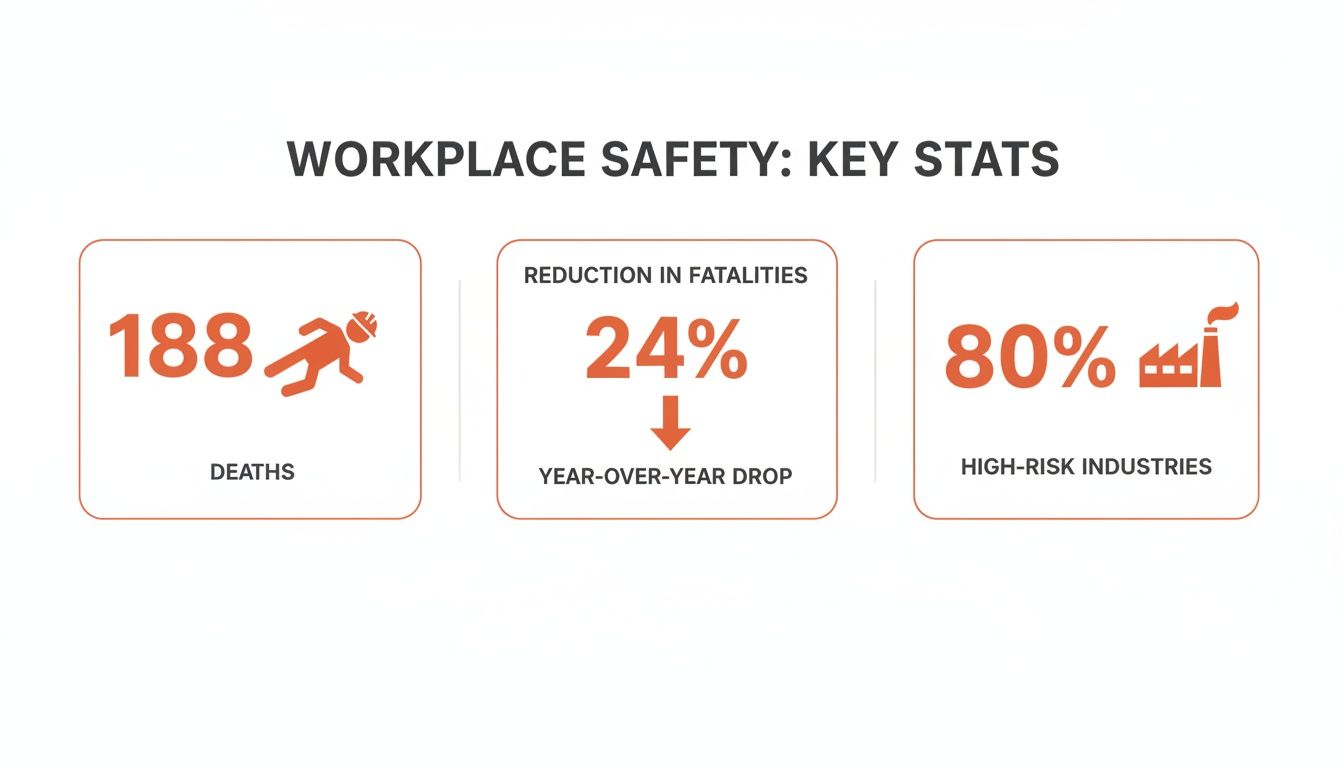
These numbers aren't just statistics; they represent the severe human and business cost of safety failures, especially in those high-risk sectors we all know so well.
Some of these damaging hidden costs include:
- Lost Productivity: Work stops dead in its tracks for investigations, clean-up, and just general shock.
- Equipment Damage: The bill to repair or replace machinery that was damaged during the incident.
- Hiring and Training: The expense of recruiting and getting a replacement worker up to speed.
- Project Delays: Missed deadlines can trigger contractual penalties and seriously damage your relationship with clients.
The statistics from Safe Work Australia paint a crystal-clear picture. In 2023–24, Australia saw 146,700 serious workers’ compensation claims, that’s over 400 claims every single day. A massive 84% of these claims stemmed from common incidents like body stressing, falls, slips, and being hit by objects. Industries like construction (12%) and manufacturing (10.1%) were among the hardest hit, proving these aren't rare events but daily risks. You can read more about these key work health and safety statistics for Australia.
Understanding how often these incidents are happening is the first step. You can use simple tools to get a baseline for your own sites. For instance, you can measure your incident rates with our free accident frequency rate calculator.
At the end of the day, proactive safety management isn't just another compliance task. It's a critical financial strategy that protects your profitability, keeps operations running smoothly, and makes sure your projects stay on track. The return on investment is undeniable: preventing just one serious incident can save you hundreds of thousands of dollars and safeguard your company’s future.
Understanding Your Legal and Regulatory Obligations
Let’s be honest, navigating work health and safety (WHS) law can feel like a headache. But at its core, the law is about one simple, non-negotiable goal: making sure every single worker gets home safely at the end of the day.
As a business owner or manager, getting your head around your specific legal duties is the first, most critical step. It’s not just about ticking boxes; it’s about protecting your people and shielding your company from some seriously heavy consequences.
Who Is Responsible? The PCBU
In Australia, the law uses a specific term for the person or company in charge: a Person Conducting a Business or Undertaking (PCBU). This isn't just for massive corporations. The term covers everyone from a huge construction firm to a small workshop owner, and even a sole trader who brings on contractors.
If you’re a PCBU, you hold the primary duty of care. This isn't a suggestion, it’s a legal requirement to ensure, as far as is reasonably practicable, the health and safety of your workers. That duty extends to anyone else who might be affected by your work, like visitors, clients, or the general public.
Your Core Responsibilities in Plain English
So, what does this "primary duty of care" actually look like on the ground? It boils down to a handful of practical actions that form the foundation of a safe and legally compliant workplace.
You are legally required to provide:
- A Safe Work Environment: Your physical worksite, be it a factory floor, an office, or a construction site, must be free from hazards that could cause illness or injury.
- Safe Plant and Structures: All your machinery, tools, and equipment must be installed correctly, kept in good nick, and used properly to prevent failures.
- Safe Systems of Work: You need clear, documented procedures for high-risk tasks. These are the practical guides that show workers how to get the job done without putting themselves or others in danger.
- Proper Information and Training: You can't expect people to work safely if they haven't been shown how. Providing the right information, instruction, training, and supervision is a fundamental part of your legal duty.
- Ongoing Monitoring: Safety isn't a "set and forget" task. You have to actively monitor the health of your workers and the conditions on-site to catch problems before they lead to an injury.
If you want to look a bit deeper into these frameworks, our guide on what WHS and OHS really mean is a great place to start.
What Does "Reasonably Practicable" Actually Mean?
You’ll see the phrase "reasonably practicable" all over WHS legislation, and it's a crucial concept to grasp. It means you must do what is reasonable to ensure health and safety in your specific circumstances.
It’s a balancing act. You have to weigh the likelihood and severity of a risk against the time, effort, and cost of removing or reducing it.
Essentially, if a safety measure is available and suitable to fix a known risk, you are legally required to use it. You can only argue against it on the basis of cost if that cost is grossly disproportionate to the risk involved.
Think about it this way: on a construction site, falls from height are a well-known, severe risk. Providing scaffolding, guardrails, or fall arrest systems is standard industry practice. Trying to argue that these measures are too expensive simply won't fly, because the risk of a fatal fall is so high.
In a factory, if a machine has moving parts that could sever a finger, installing a physical guard is a reasonably practicable control. Just sticking up a warning sign isn't good enough because a far more effective solution exists and is readily available.
The Heavy Penalties for Getting It Wrong
Ignoring these duties comes with a very steep price. Australian regulators don’t mess around, especially when a safety breach leads to serious injury or death. The penalties are designed to be a powerful deterrent, hitting businesses in the pocket and, in serious cases, putting individuals behind bars.
The penalties are tiered, depending on how serious the breach is:
- Category 1 (Reckless Conduct): This is the most serious offence. If a PCBU is reckless and exposes someone to a risk of death or serious injury, the consequences are severe. We’re talking fines of over $3 million for a company and up to five years in jail for an individual officer.
- Category 2 (Failure to Comply): This applies when a failure to meet a safety duty exposes someone to the risk of death or serious injury. Fines can reach $1.5 million for a corporation and $300,000 for an individual.
- Category 3 (Failure to Comply): This covers a general failure to comply with a safety duty. While less severe, the fines are still substantial, hitting up to $500,000 for a company and $100,000 for an individual.
These legal obligations are the hard edge of workplace safety. They provide a clear framework for what’s expected and prove that failing to act is a risk no business can afford to take.
How Good Safety Drives Productivity And Quality
Too many managers fall for the old myth that safety procedures are just another source of delays and paperwork. The reality on the ground, however, is the exact opposite. A well-organised, safe workplace is an efficient and productive one. Understanding why health and safety is important at workplace means seeing it not as a brake, but as the engine for better performance.
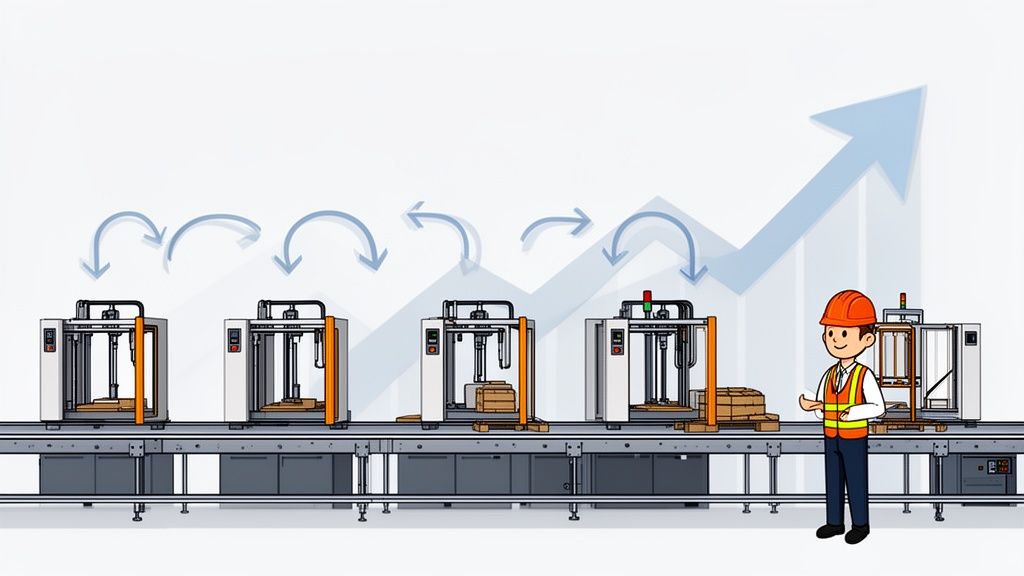
This isn't just a theory; it's what happens when you create a stable working environment. When your team isn't worried about immediate physical risks, they can focus completely on the task at hand. Clear, logical safety procedures reduce confusion, prevent errors, and create smoother, more predictable workflows that directly improve both the speed and the quality of the work.
Safety As A Performance Tool
Think of a Formula 1 car for a moment. It hits incredible speeds not just because of its powerful engine, but because it has world-class brakes, a strong chassis, and advanced safety systems. It's those safety features that give the driver the confidence to push the machine to its absolute limit.
Your workplace operates on the exact same principle. Good safety isn't about slowing people down; it's about giving them the confidence and the clear processes needed to perform their jobs correctly and efficiently, every single time.
This translates into tangible gains on the floor. When a job is done right the first time because the process is clear and safe, you eliminate the need for costly and time-consuming rework. This direct link between safety and quality is one of the most overlooked benefits of a strong safety program.
Reducing Errors And Unplanned Downtime
Unplanned downtime is a massive drain on productivity and profitability, and a huge chunk of it is caused by safety failures. These aren't always major incidents, either. Often, they are small, preventable issues that cascade into significant delays. A safe process is a reliable process.
Just think about these common scenarios:
- In Manufacturing: Proper machine guarding doesn't just prevent horrific injuries. It also stops materials from getting caught in moving parts, which prevents jams and keeps the production line moving.
- In Construction: A well-organised site with clear pathways for vehicles and designated material storage areas doesn't just prevent collisions. It makes sure materials and equipment are exactly where they need to be, when they need to be there, stopping delays and keeping the project on schedule.
Every time a workflow is interrupted to deal with a near-miss, a minor injury, or a process failure, you lose valuable time and momentum. Good safety protocols are designed to prevent these very interruptions.
A safe workflow is an uninterrupted workflow. By designing processes to be safe from the start, you are also designing them to be more resilient, predictable, and free from the kinds of errors that lead to costly halts in production.
Boosting Worker Confidence and Focus
The psychological impact of a safe environment is a powerful driver of productivity. When workers feel secure, they can fully commit their mental and physical energy to their tasks. They work with a focused confidence that's impossible to achieve when they’re constantly on edge or second-guessing unsafe conditions.
This confidence leads directly to higher-quality work. A worker who has the right tools, proper training, and a clear, safe procedure is far more likely to perform a task with precision than someone who is trying to find a risky shortcut because the official process is broken or unsafe. Better safety leads to better craftsmanship, fewer defects, and a final product that meets quality standards.
Ultimately, proactive safety management is one of the most effective operational strategies you can use. It builds a foundation of stability and predictability that allows your teams to work at their best, delivering higher quality results in less time. It proves that keeping people safe and running a productive operation aren't competing goals; they are two sides of the same coin.
Protecting Your Most Valuable Asset: Your People
Strip away all the regulations, spreadsheets, and financial reports, and you're left with the single most important reason health and safety matters: your people. They aren't just another line item or a resource to be managed; they are the skilled engine driving your entire operation forward. A genuine commitment to keeping them safe isn't just a cost, it's a direct investment in your company's greatest asset.
When you visibly put time and resources into safety, you send a clear and powerful message: you value your team as human beings, not just as workers. This builds the kind of trust and loyalty that is incredibly difficult to earn and almost impossible to replace, especially in competitive industries where good people are hard to find. At the end of the day, people want to work where they feel protected and respected.
This isn't just about feelings; it has a direct impact on business outcomes. A team that trusts its leadership is more stable, more reliable, and far more committed to the company's long-term success.
Reducing Physical and Mental Stress
A worksite riddled with hazards is a worksite full of stress. Constantly worrying about potential injuries from faulty equipment, unclear procedures, or a rushed schedule takes a serious toll on a person's physical and mental wellbeing. This background anxiety leads to distraction, fatigue, and poor decision-making, ironically increasing the very risk of an incident.
A safe, well-managed environment actively lifts this burden. When your crew knows that risks are being properly managed, they can focus their energy and attention on doing their job well. The practical benefits are immediate:
- Fewer Sick Days: Reduced physical and mental strain leads to a healthier workforce with lower rates of absenteeism.
- Higher Engagement: People who feel safe are more likely to be actively engaged and invested in their work and the company's goals.
- Improved Focus: Removing the constant worry about safety allows for greater concentration, which improves the quality and precision of the work.
Mental wellness is just as critical as physical health. The construction industry, for example, has one of the highest suicide rates of any profession. By creating a physically safe and supportive environment, you help reduce one of the major stressors that can contribute to poor mental health.
Becoming an Employer of Choice
In today's job market, your reputation as an employer matters more than ever, particularly for skilled trades in manufacturing and construction. A strong, visible safety record is one of your most powerful tools for recruitment and retention.
When you invest in protecting your people, you're not just preventing incidents. You're building a reputation as a company that genuinely cares, making it far easier to attract and keep the best talent in the industry.
Top performers have options. They'll choose the company that not only offers good pay but also demonstrates a clear, non-negotiable commitment to their wellbeing. A worksite known for its high safety standards becomes a magnet for skilled professionals looking to build a long-term career.
Lowering Staff Turnover and Its Costs
High staff turnover is a financial drain. The costs of recruitment, hiring, and training a new employee are immense, to say nothing of the lost productivity while that new person gets up to speed. One of the most effective ways to lower turnover is simply to create an environment people don’t want to leave.
A safe workplace is a huge part of that equation. When your team feels secure and valued, they are far more likely to stay. This stability provides a massive return on your safety investment by cutting down on the constant, expensive cycle of hiring and training. From this perspective, investing in safety is one of the smartest business decisions you can make for long-term stability and growth.
Practical Steps To Improve Workplace Safety Now
Knowing why workplace health and safety is so important is one thing. Now it’s time to move from the 'why' to the 'how' with practical actions you can get started on today.
Let’s be clear: building a safer worksite doesn't mean you have to overhaul everything overnight. It all starts with a few foundational, consistent actions. These simple but effective measures are what build real momentum, moving you beyond just talking about safety to actively managing it in a way that truly protects your people and your business.
Start With a Solid Foundation
Before you can fix problems, you need to know exactly where they are. This means getting the basics right and making sure everyone on site understands and applies them, every single time. No exceptions.
Think of these core actions as the bedrock of any decent safety program:
- Conduct Thorough Risk Assessments: This is more than a box-ticking exercise. Get out on site, walk around, and actively look for hazards in every task, whether it's operating heavy machinery or simple manual handling. Document what you find, and most importantly, identify practical control measures to knock the risk on the head.
- Create Simple Safety Policies: Forget the legal jargon and long, complicated documents nobody reads. Your safety policies should be clear, concise, and written for the people actually doing the work. Focus on creating practical, easy-to-follow rules for your high-risk activities.
- Provide Regular and Relevant Training: Training isn't a one-and-done event. It has to be ongoing and specific to the actual jobs your team performs day in, day out. A critical piece of this is training on how to use Personal Protective Equipment (PPE) the right way, as it’s often the last line of defence against serious injury.
Implement Consistent Monitoring
A plan is just a piece of paper without follow-through. Consistent monitoring is how you make sure your safety rules are actually being followed and are working as intended. This isn't about catching people out; it's about making sure the system itself is sound.
Set up simple routines to keep an eye on things. This could be daily pre-start checks, weekly site inspections, or regular safety observations. The key is consistency. When your team sees that safety is a daily priority, it just becomes part of the normal workflow.
The purpose of monitoring isn't to assign blame after an incident. It's to gather real-world information that allows you to spot weaknesses in your system and fix them before they lead to an injury.
If you want a more structured approach, it’s worth learning about the 9 key elements of a health and safety management system. This will help you build a far more robust framework.
Move Beyond Paper and Spreadsheets
In this day and age, relying on paper forms and messy spreadsheets is not just inefficient, it’s risky. Documents get lost, handwriting is impossible to read, and you have zero real-time visibility into what’s happening across your sites. This administrative drag slows you down and creates dangerous blind spots.
This is where digital tools come in. A modern platform like Safety Space allows you to manage everything in one place. Imagine completing a site inspection on a tablet, attaching photos, and having it instantly available to your entire management team. It cuts the admin work and gives you a clear, immediate picture of your safety performance.
This shift isn't just about convenience. It’s about accuracy and speed. Using a digital system means reports get filled out correctly and completely every time. You get better data, you can spot trends faster, and you can take corrective action before a minor issue blows up into a major incident.
Common Questions We Hear on Site
Once managers see the legal, financial, and human cost of getting safety wrong, the conversation usually shifts to the practical stuff. The "what do we do now?" questions. Here are some of the most common ones we hear, along with some straight-up answers.
Where Do I Even Start If Our Safety System Is All Paper and Spreadsheets?
The best place to begin is by digitising your most frequent and highest-risk tasks. Don't try to boil the ocean. Instead, focus on things like site inspections, incident reports, and toolbox talks.
Moving these critical jobs to a modern platform gives you an immediate win. It cuts down on the paperwork shuffle, stops vital documents from vanishing into the ether, and gives you a real-time picture of what’s actually happening on site. This creates a solid foundation you can build on, without the headache of trying to overhaul everything at once.
How Do I Convince the Higher-Ups to Invest in a Better Safety System?
You’ve got to speak their language, and that language is finance. Use the data from this article. Talk about the heavy costs of fines, the inevitable hikes in insurance premiums, and the productivity drain that follows every single incident.
Frame the investment as what it is: essential risk mitigation. A good safety system isn't a cost centre; it's a direct protection for the company's continuity and profitability.
Show them how a digital platform offers a clear return on investment by cutting administrative hours and, most importantly, helping to prevent those incredibly costly incidents in the first place. When you frame it as a smart financial decision, not just a safety one, it becomes a much easier conversation to have.
Our Subbies Have Their Own Safety Systems. Why Do I Need to Oversee Them?
Because as the PCBU for that site, the buck stops with you. You hold the ultimate responsibility for every single person on that project, and that absolutely includes your subcontractors. Relying on their separate, often paper-based systems creates massive blind spots and exposes your business to serious compliance risks.
A central platform lets you standardise how safety is managed and reported for every team on your site. This means everyone is working to your standards. It gives you a single, reliable source of truth for compliance, giving you the complete oversight and control you’re legally required to have.
Ready to move beyond the messy paperwork and get real-time control over your worksite safety? Safety Space is an all-in-one platform that makes it simple to manage compliance, oversee subcontractors, and spot risks before they turn into incidents. Book a free demo today and see how you can build a safer, more efficient workplace.
Ready to Transform Your Safety Management?
Discover how Safety Space can help you implement the strategies discussed in this article.
Explore Safety Space FeaturesRelated Topics
Safety Space Features
Explore all the AI-powered features that make Safety Space the complete workplace safety solution.
Articles & Resources
Explore our complete collection of workplace safety articles, tools, and resources.