
Work safety procedures are the step-by-step instructions you follow to get a task done safely. They are not just paperwork. They are practical guides designed to stop incidents before they happen by tackling real-world risks on your job site.
Building a Foundation for Realistic Safety Procedures
Effective work safety procedures don’t come from a generic template you downloaded off the internet. They start with a deep understanding of the actual risks your team faces every day. The process has to begin on the ground, by observing the jobs people are doing.
This foundation is built using a method called a Job Safety Analysis (JSA), sometimes known as a Job Hazard Analysis (JHA). It’s a structured way to break a task down into its individual steps, pinpoint potential hazards at each stage, and then map out the safest way to complete the job. If you skip this initial analysis, your procedures will be nothing more than guesswork, not practical solutions people can rely on.
Starting with a Job Safety Analysis
A proper JSA is the first, non-negotiable building block for any safety documentation. It’s how you gather the details needed to write instructions that people will actually follow because those instructions directly relate to their work.
Think about a high-risk task on a manufacturing floor, like clearing a jam in a conveyor system. A JSA for this job would involve:
- Breaking down the job: Listing every single action, from shutting down the machine and isolating the power source to the final system restart.
- Identifying potential hazards: Pinpointing risks like the machine unexpectedly starting up, nasty pinch points, electrical exposure, or even just awkward postures that could lead to strains.
- Developing control measures: Creating specific, clear steps to eliminate or reduce each hazard. This could mean strict lockout/tagout procedures, using specially designed tools, or requiring a second person to act as a spotter.
This process ensures your final procedure is grounded in reality, not assumptions made from behind a desk. To get into the details of this process, check out our detailed guide on how to do a risk assessment.
This simple process flow shows you the core steps for building that solid safety foundation.
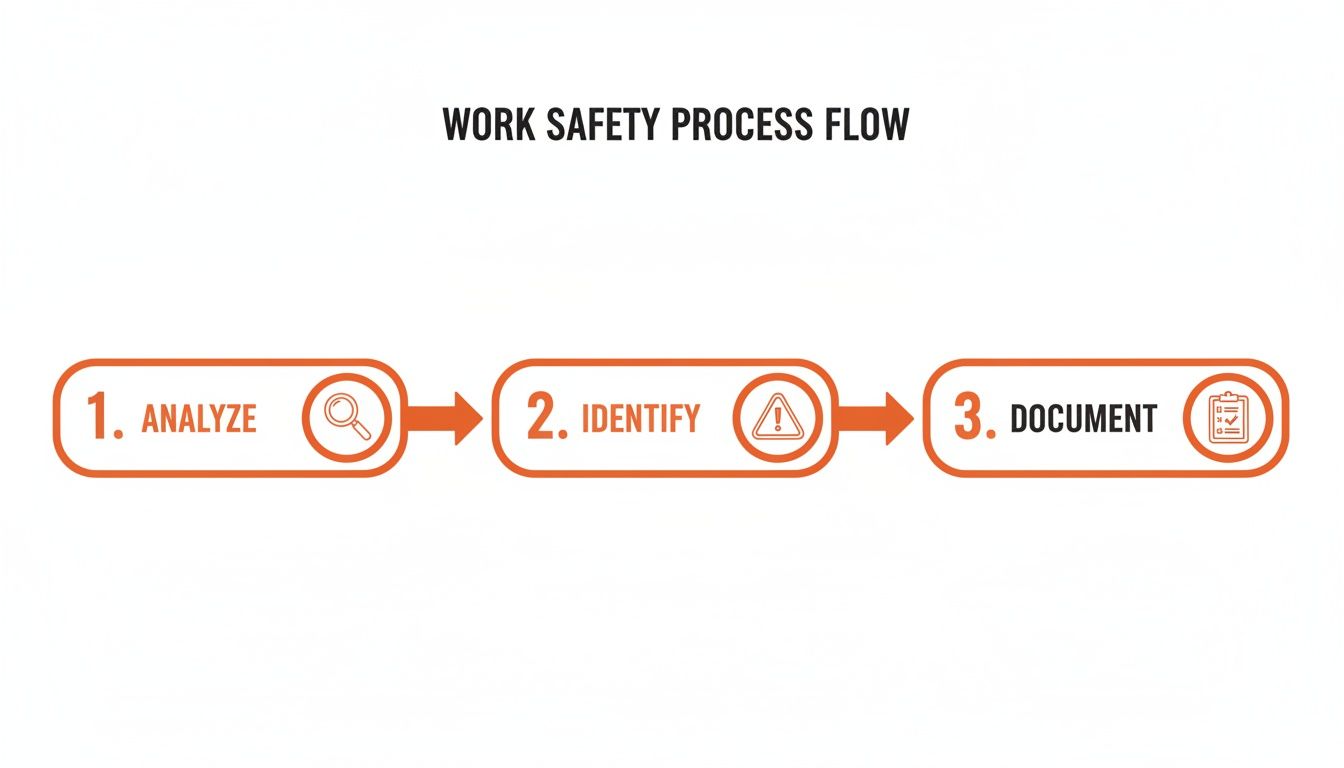
As you can see, effective work safety procedures are the final output of a structured analysis, not the starting point.
From Analysis to Actionable Steps
Once your JSA is complete, all the information you've gathered becomes the raw material for your formal procedures. The hazards you’ve identified are the problems, and the control measures you developed are the solutions. Now, you just need to write them down as clear, direct instructions.
This groundwork is important. Slips, trips, and falls are consistently among the leading causes of workplace injuries, often making up over 35% of all non-fatal incidents that result in lost workdays. So many of these are preventable with procedures that address specific site hazards you’d spot during a good analysis.
The most effective safety procedures are those created with the people who do the work. They are the experts on the task and can provide insights into the shortcuts people take and the real-world difficulties they run into.
For instance, on a busy construction site, a JSA for setting up scaffolding would go beyond the manufacturer’s assembly instructions. It would identify site-specific risks like uneven ground, the proximity of overhead power lines, or potential interference from other trades working nearby. The procedure that comes out of that analysis would include precise controls for these very real, on-the-ground dangers.
Part of building a strong safety foundation also involves the physical layout and visual cues of the workspace, like implementing effective warehouse floor marking guidelines. By documenting these real-world conditions and controls, you create procedures that are relevant, practical, and respected by your team. This is how you build a solid base for rules that actually protect everyone on site.
Writing Clear, Simple, and Usable Procedures
You've done the hard work mapping out the real-world risks on your site. Now comes the part where you turn that analysis into clear, direct instructions your team can follow.
A confusing or overly complex work safety procedure is just as dangerous as having no procedure at all. The goal here isn't to create a document that gets signed off and forgotten. It’s to make a tool that people will use on the job, day in and day out.
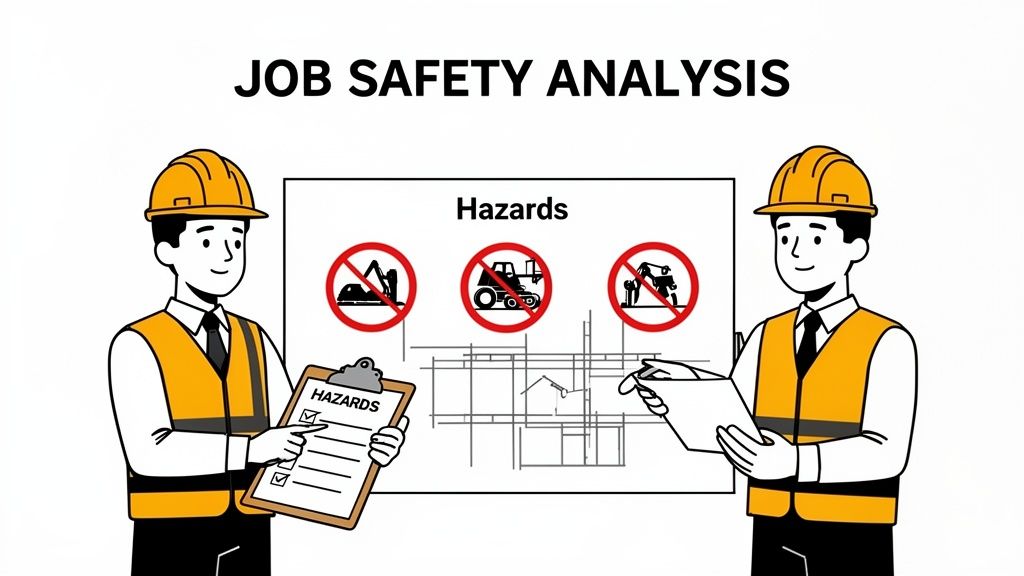
The best safety instructions are simple, visual, and grounded in the reality of your worksite. Ditch the corporate jargon and hard-to-read technical language. If an apprentice on their first day can't make sense of it, it's not good enough.
From Complex to Clear
The single biggest mistake companies make is writing for compliance instead of clarity. A document stuffed with legalese might tick a box for an auditor, but it fails the person who needs to know exactly what to do in a high-pressure moment.
Always write with the user in mind.
To get your procedures from confusing to crystal clear, try these simple rules:
- Use direct, everyday language. Instead of "Personnel must ensure the cessation of mechanical operations," just write, "Turn off the machine."
- Write short, active sentences. Always start with a verb. "Check the gauges" is much clearer than "The gauges should be checked."
- Use photos from your actual site. Generic stock photos are useless. A picture of the exact machine on your floor, with arrows pointing to the correct emergency stop, is instantly recognizable and leaves no room for error.
- Use diagrams and flowcharts. For tasks with multiple steps or decision points, a simple visual guide will beat a dense paragraph of text every single time.
Here's the real test of a safety document: does it prevent a mistake when someone is tired, stressed, or distracted? Clarity is your most powerful tool.
Structuring a Safe Work Method Statement (SWMS)
For any high-risk construction work in Australia, a Safe Work Method Statement (SWMS) is a legal requirement. But a compliant SWMS doesn't need to be a 20-page novel. It just needs to logically and clearly outline the high-risk tasks, the hazards involved, and the specific controls you'll use.
A truly effective SWMS follows a simple, logical flow:
- Identify the high-risk work: Be specific. Not just "scaffolding," but "Erecting mobile scaffolding over 4 metres."
- Break the job into steps: List the main tasks in the order they'll happen.
- Pinpoint the hazards: For each step, think about what could go wrong.
- State the control measures: This is the most critical part. For each hazard, describe the exact actions that will be taken to control that risk.
Vague controls are a major red flag. "Use PPE" is lazy and unhelpful. Instead, write: "Wear a hard hat, steel-capped boots, safety glasses, and a high-visibility vest at all times." For more hands-on guidance on getting this right, you can explore some real-world job safety analysis examples to see this level of detail in action.
The Bones of a Good Standard Operating Procedure (SOP)
Beyond high-risk work, you need consistent instructions for all the routine tasks. This is where a Standard Operating Procedure (SOP) comes in, providing a reliable playbook for workers to ensure both quality and safety. Consistency is key, so make sure your SOPs all follow the same format. It helps people know exactly where to look for the information they need.
Every effective safety procedure document, whether it’s an SOP or something else, needs a few core components to be useful. Here’s a breakdown of what to include.
Key Parts of an Effective Safety Procedure Document
| Component | Why It's Important | Practical Example |
|---|---|---|
| Clear Title & ID | Helps everyone find the right document quickly and reference it in reports. | "SOP-M04: Lockout/Tagout Procedure for Conveyor Belt #2" |
| Purpose | A one-sentence summary explaining why the procedure exists. | "To prevent accidental machine start-up during maintenance." |
| Required PPE | Lists all personal protective equipment so there’s no guesswork. | "Safety glasses, cut-resistant gloves, steel-capped boots." |
| Step-by-Step Actions | The core of the document, using action verbs and simple language. | "1. Notify supervisor. 2. Press the red 'Stop' button. 3. Isolate power at breaker B-17." |
| Visual Aids | Photos or diagrams that show critical steps, locations, or parts. | A photo of breaker B-17 with a red arrow pointing to the correct switch. |
| Emergency Actions | What to do if something goes wrong during the task. | "In case of electrical shock, use the emergency shutoff at the main panel and call 222." |
| Review Date | Shows the document is current and has been reviewed for accuracy. | "Last reviewed: 15 October 2024. Next review: 15 October 2025." |
Think of these elements as a checklist for your own documents. If you’re missing any of them, you’re likely leaving room for confusion.
By taking a simple, visual, and direct approach to writing your work safety procedures, you stop creating shelf-ware and start building practical tools that your team will use.
Getting New Procedures Off the Page and Into Practice
A perfectly written procedure is useless if it just sits in a folder on a server or in a dusty binder on a shelf. The real work begins when you roll it out to your team. Success isn't just about telling people what the new rules are; it's about making sure everyone understands, accepts, and actually uses the new procedures correctly from day one.
The numbers show just how critical this is. Recently, Australian workers filed 146,700 serious compensation claims which is around 400 per day with each claim involving at least one week off work. Key industries like construction (12%) and manufacturing (10.1%) were major contributors, highlighting exactly where effective procedures need to be more than just documents. You can get the full story in this worker compensation claims report.
This data proves that the gap between having a procedure and using a procedure is where people get hurt. Closing that gap is your number one job during implementation.
Explain the ‘Why’ Behind the ‘What’
The first step in getting buy-in is simple but often missed: explain the ‘why’ behind each procedure. People are far more likely to follow a rule when they understand its purpose and see the logic. A quick toolbox talk won't cut it.
Instead of just handing out a document, hold a dedicated session. Walk your team through the Job Safety Analysis you did. Show them the specific hazards you identified and how the new steps directly shut down those risks.
For instance, if you’re introducing a more complex lockout/tagout procedure for a machine, tell them about the near-miss that prompted the change. Connect the dots so they see it not as more red tape, but as a direct response to a real threat that could have seriously injured one of their mates.
People don't resist change; they resist being changed. When you bring them into the reasoning and show you’re protecting them from specific dangers, they become partners in the process.
This has to be a two-way conversation. Give your team a chance to ask questions and give feedback. They’re the ones on the tools, and they might spot a practical issue you’ve overlooked. Addressing their concerns builds trust and makes the procedure stronger.
Training That Actually Sticks
Reading a document is not training. For a safety procedure to become second nature, the training has to be hands-on, practical, and directly relevant to the tasks your team performs every day.
Think beyond the classroom and get people doing the work under supervision.
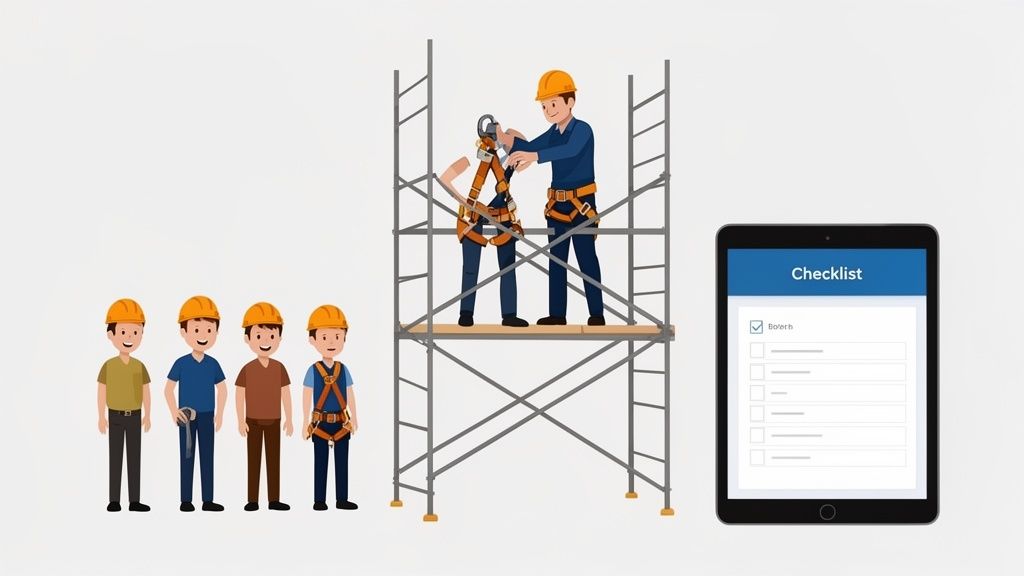
- Hands-On Demonstrations: For a new working at heights procedure, don't just show a video. Get the team into their harnesses. Have them go through the inspection, fitting, and anchor point connection process themselves in a safe, controlled environment.
- Realistic Simulations: If you're rolling out a new chemical handling procedure, set up a mock spill scenario. Let the team practice using the spill kits and following the emergency steps. This builds muscle memory for when a real incident happens.
- Supervisor-Led Coaching: Your supervisors are your most credible trainers. A supervisor walking a new worker through a procedure on the job is far more powerful than an H&S manager doing it once during induction. Equip them to lead this coaching.
Proper training isn't a one-and-done event; it's an ongoing effort. For a deeper look into structuring these programs, check out our guide on effective workplace safety training.
Making Procedures Part of the Daily Routine
The final piece of the puzzle is to weave the new procedures into the daily workflow. The goal is to make following the procedure the easiest and most natural way to do the job. This is where digital tools can be a game-changer.
Modern safety platforms like Safety Space get your procedures out of the filing cabinet and onto the frontline.
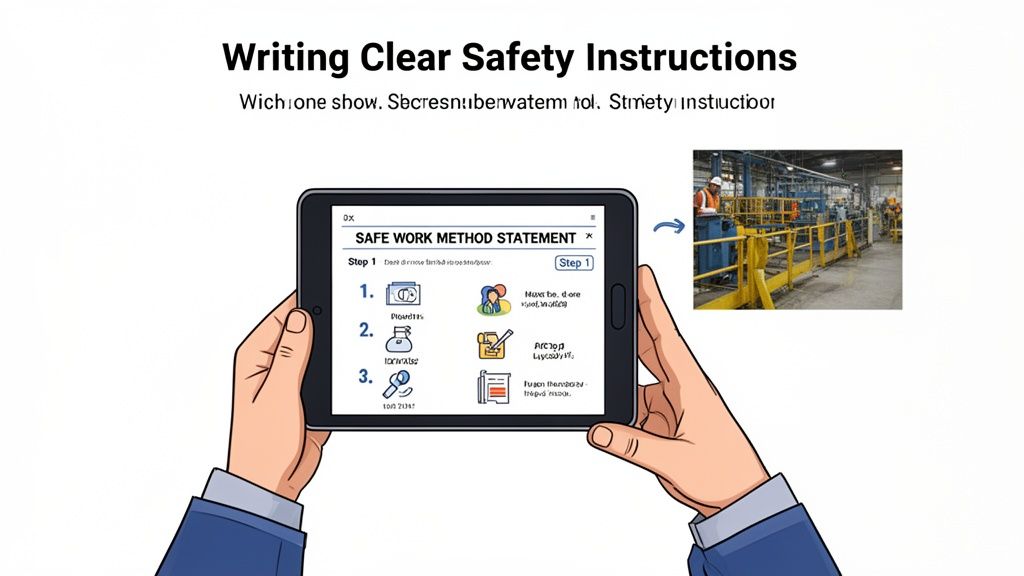
- Digital Checklists: Convert your new SOP into a step-by-step digital checklist on a tablet or phone. Before starting a high-risk task, the worker has to complete the checklist, confirming each safety step has been done.
- Real-Time Monitoring: This gives supervisors a live view of compliance. They can see that the pre-start check for the excavator was completed ten minutes ago or that the hot work permit was signed off. No more chasing paper.
- Instant Access: A worker can pull up the correct SWMS or procedure right on their device, complete with photos and diagrams, instead of having to find a paper copy tucked away in a ute.
By making the procedure a required, integrated part of starting a job, you make compliance the path of least resistance. It stops being an extra task and simply becomes "the way we do things here."
Monitoring and Enforcing Procedures Consistently
You've written your work safety procedures and run the training sessions. Job done? Not even close. Procedures are only worth the paper they're written on if they're being followed, day in and day out.
Consistent monitoring isn't about playing "gotcha" with your team. It's about getting out on the floor, observing work as it happens, and confirming the safety systems you’ve built are holding up in the real world. You can't manage safety from behind a desk.
From Audits to Action
Regular site inspections and formal safety audits are the backbone of any good monitoring program. They give you a structured way to check that what’s on paper is happening on the job. But the key is to move beyond a simple tick-box exercise.
A proper inspection isn't about asking, "Did you do the pre-start check?" It's about watching them do it. This gives you a much clearer picture of whether the steps are being followed correctly and, just as importantly, if the procedure itself is practical.
Document everything. Use a digital platform to record what you find, attaching photos of both good practice and non-compliance. This creates an objective record that makes it easy to track corrective actions through to completion. It’s worth remembering that consistent monitoring directly influences your Workers comp Experience Mods and, ultimately, your bottom line.
Using Real-Time Information
If you’re only relying on scheduled weekly inspections, you’re missing what happens in between. This is where digital tools like Safety Space really change the game, giving you a live view of what's happening on the ground.
Imagine a supervisor running through a quick site safety checklist on a tablet each morning. That information hits your dashboard instantly. You can spot trends as they emerge, maybe one crew consistently misses a specific step, and step in with coaching before it leads to an incident.
Real-time monitoring helps you shift from reacting to incidents to proactively preventing them. It’s about spotting the small deviations from procedure before they have a chance to become big problems.
This proactive approach is critical when you look at the stats. Vehicle incidents still account for a staggering 42% of work fatalities in Australia, with falls from height following at 13%. A massive 72% of all fatalities occurred in just three industries: transport, agriculture, and construction. The procedures exist, but these numbers prove we need to support our workers with tools that help them follow the rules consistently.
Measuring What Matters with Safety KPIs
You can't manage what you don't measure. Setting clear Key Performance Indicators (KPIs) is how you objectively track whether your procedures are working.
Your KPIs should be simple, measurable, and directly tied to your safety goals. Ditch the vague targets and focus on concrete actions and outcomes.
Here are a few practical safety KPIs you can start tracking:
- Procedure Compliance Rate: The percentage of audits and inspections completed with zero non-conformances. This is a direct measure of adherence.
- Near-Miss Reporting Frequency: It might sound strange, but an increase here is often a good sign. It means your team feels safe enough to report hazards before they cause an injury.
- Corrective Action Closure Rate: What percentage of identified issues are actually fixed within the agreed timeframe? A high rate shows you're closing the loop effectively.
- Safety Checklist Completion Rate: For high-risk tasks, what percentage of jobs start with a completed digital checklist? This is a powerful leading indicator.
These metrics provide hard data, taking the guesswork out of safety performance. They help you pinpoint which procedures are hitting the mark and which ones might need a rethink or more training.
Reviewing and Improving Procedures Over Time
Your job site isn’t static. New gear arrives, projects pivot, and your team’s experience grows. If your work safety procedures don’t evolve with your operations, they quickly become irrelevant, ignored, outdated, and ineffective.
Creating a system to review and improve them isn't just a "nice-to-have." It's fundamental to keeping people safe. Static procedures are a liability because they fail to account for the small, constant shifts in tasks and environments that happen every day on a real work site.
The goal here is to build a living safety system. One that adapts, learns, and gets stronger over time, based on the real-world lessons your site teaches you.
Setting a Review Schedule That Works
Sticking an annual review in the calendar for all your procedures is a common starting point, but it’s rarely enough to be truly effective. A far more practical system uses a two-tiered approach that combines regular, planned check-ins with event-based triggers.
Your planned review schedule needs to be manageable. Don't fall into the trap of trying to review every single procedure in one frantic week. Instead, break them down by risk:
- High-Risk Procedures: Anything involving tasks like confined space entry, working at heights, or complex lockout/tagout procedures should be reviewed at least every six months.
- Medium-Risk Procedures: For jobs like operating mobile plant or handling specific chemicals, an annual review is a solid baseline.
- Low-Risk Procedures: Your general workshop or site housekeeping procedures can be reviewed every 18 to 24 months.
This tiered schedule keeps your focus sharp, concentrating your energy on the areas with the most potential for serious harm.
Triggers for an Immediate Update
Even more important than your planned schedule are the unplanned events that must trigger an instant review. These are the moments when your procedures have been put to the test in the real world and potentially found lacking. Waiting for the next scheduled review isn't an option.
An immediate review of the relevant work safety procedures is non-negotiable after:
- An Incident or Injury: This is the most obvious red flag. The procedure failed to prevent harm, and you have to find out why and fix the gap right now.
- A Near-Miss: This is a free lesson. Something almost went badly wrong, and digging into the "why" is your best chance to prevent a future incident that actually causes harm.
- Introducing New Equipment or Materials: A new machine or a different chemical brings new risks. Procedures must be updated before this new element is put into service.
- A Change in the Work Environment: Reorganizing the workshop layout or starting work in a new area of the site can introduce hazards that your old procedures never considered.
- Receiving Team Feedback: If a supervisor or worker tells you a procedure is confusing or impractical, it’s a sign that requires immediate attention.
Think of your procedures as a living document. An incident or a near-miss is the system telling you exactly where the weak points are. You have to listen to it.
Analysing Feedback and Incident Data
To make meaningful improvements, you need to collect and analyze the right information. Your team is your best source of on-the-ground intelligence. They’re the ones who know what actually works, what doesn't, and which steps are routinely skipped because they’re impractical.
Set up a simple system to capture their feedback. This could be a standard agenda item in toolbox talks, a dedicated section on your digital safety forms, or just informal chats during your site walks.
Ask direct questions: "Is this procedure still the best way to do this job? What's the most frustrating part of it? What would you change?"
You then combine this qualitative feedback with the hard data from your incident reports and site audits. Look for patterns. Are near-misses for hand injuries all happening around one particular machine? Do your audits constantly flag the same missing guardrail in Area B? These patterns point you directly to the weaknesses in your work safety procedures.
This continuous cycle of review and improvement has a proven track record. In 2023, Australia recorded 188 work-related fatalities from traumatic injuries, a fatality rate of 1.3 deaths per 100,000 workers. This figure represents a 24% decline since 2014, a success driven by decades of refining work safety procedures under Work Health and Safety (WHS) laws. You can read more about the latest Australian work health and safety statistics.
By creating this constant feedback loop, you ensure your procedures stay relevant and effective, protecting your team as your business continues to grow and change.
Got Questions? We've Got Answers
Even with the best plan in place, a few questions always pop up when you're rolling out new safety procedures. Here are some of the most common ones we hear from managers on the ground in construction and manufacturing, along with our straight-up answers.
How Often Should We Review Our Work Safety Procedures?
For high-risk tasks, you should be reviewing procedures at least once a year. But waiting for a calendar date is a mistake. The most valuable reviews happen right after a specific event.
You absolutely need to conduct a review when:
- An incident or a near-miss happens. This is non-negotiable.
- New gear, materials, or work processes are introduced.
- Work health and safety regulations are updated.
- Your team tells you a procedure is confusing, impractical, or just being ignored.
The point is to keep your procedures useful and accurate in the real world, not just to have a compliant document sitting in a folder.
What's the Best Way to Get Employees to Actually Follow Safety Procedures?
Want your team to buy in? Get them involved in creating the procedures. When your crew helps identify the risks and build the solutions for the jobs they do every day, they take ownership of the outcome.
Clarity and accessibility are also massive. Ditch the jargon and use plain language. Snap a few photos on your actual site to show what ‘right’ looks like. Run hands-on training, not just a talk-fest.
And most importantly, leadership has to walk the talk. If the team sees a supervisor taking a shortcut, those carefully written procedures become meaningless.
A procedure followed by management becomes the standard. A procedure ignored by management becomes a suggestion.
Using a digital tool like a checklist on a tablet is also a game-changer. It bakes the procedure right into the daily workflow, so it stops being an "extra step" and just becomes part of getting the job done.
How Can We Manage Safety Procedures for Subcontractors on Our Site?
Managing subcontractor safety starts with a crystal-clear induction. Don't just hand them a folder and expect them to read it. You need to walk them through your critical site-specific rules and emergency plans from day one.
You also have to verify their Safe Work Method Statements (SWMS). Make sure they are specific to the job they’re doing on your site, not just some generic template they’ve copied and pasted. A SWMS for roofing a two-storey house is useless when they’re working on your five-storey commercial build.
Get them onto a digital system where they can submit required forms and pre-start checklists. This gives you real-time visibility into who’s compliant and who’s not.
Finally, get out on site and do joint inspections with their supervisors. Hold them to the exact same safety standards you expect from your own crew. Accountability has to be consistent for everyone on that site.
Ready to move your work safety procedures from dusty binders to a dynamic, real-time system? Safety Space replaces outdated paperwork with a single, easy-to-use platform that gives you complete oversight of your sites, staff, and subcontractors. Book your free demo and H&S consultation today.
Ready to Transform Your Safety Management?
Discover how Safety Space can help you implement the strategies discussed in this article.
Explore Safety Space FeaturesRelated Topics
Safety Space Features
Explore all the AI-powered features that make Safety Space the complete workplace safety solution.
Articles & Resources
Explore our complete collection of workplace safety articles, tools, and resources.