
A workplace health and safety policy is the official document that spells out your company’s commitment to keeping everyone safe and healthy at work. Think of it as the operational plan for preventing injuries, clarifying responsibilities, and making sure you're meeting your legal obligations. It’s much more than just paperwork; it’s a practical plan for protecting your most valuable asset: your people.
What Are WHS Policies and Why Do They Matter?
You can think of a WHS policy as the official rulebook for your worksite. It's a formal document that lays out your overall approach and goals for managing Work Health and Safety (WHS). It's a systematic approach to finding, assessing, and controlling risks before they can cause harm.
A good policy gives everyone a single source of truth. It clearly states who is responsible for what, from the managing director’s commitment right down to the specific duties of each person on the floor. That kind of clarity gets rid of confusion and helps make safety a shared responsibility, not just an afterthought.
The Practical Importance of a Written Policy
Without a documented policy, safety efforts can feel disjointed and inconsistent. A formal policy provides structure and direction. It ensures that critical safety procedures are standardised and followed by everyone, every single time. This is especially vital in high-risk environments like construction or manufacturing, where one small mistake can have devastating consequences.
The stakes are incredibly high. In the last reporting year alone, 188 Australian workers lost their lives to work-related traumatic injuries. Vehicle incidents are still the leading cause of fatalities, accounting for a staggering 42% of all worker deaths, with falls from height coming in second at 13%. These numbers make robust workplace health and safety policies a non-negotiable part of doing business. You can explore more about these key WHS statistics in Australia for 2025.
A WHS policy is more than a legal document. It's a practical management tool that protects people, prevents costly downtime, and proves your business is committed to operating responsibly.
Beyond Compliance
While ticking the legal boxes is obviously a major driver, the real value of a solid WHS policy goes much further. When properly implemented, it becomes fundamental to running an efficient and resilient operation. It directly contributes to:
- Injury Prevention: The number one goal is to stop accidents before they happen, keeping your team safe.
- Reduced Costs: Fewer incidents mean lower workers' compensation premiums, less equipment damage, and fewer disruptions to your workflow.
- Clear Accountability: When roles and responsibilities are clearly defined, everyone understands the part they play in maintaining a safe site.
- Business Reputation: A strong safety record shows clients, partners, and employees that your company is professional and trustworthy.
Effective workplace health and safety policies are the foundation of any well-run business. They provide the framework you need to manage risks properly and build a workplace where everyone goes home safely at the end of the day.
The Key Components of a Strong WHS Policy
Think of your WHS policy like the blueprint for a building. If you miss a foundational element or a critical support beam, the whole structure becomes unstable. A solid policy isn't just a single grand statement; it’s a practical document built from clear, interconnected parts that work together to keep people safe.
Breaking it down into these essential components makes the whole thing far less intimidating to create and much easier for your team to understand. It gives you a roadmap to follow, ensuring nothing critical gets overlooked. If you're looking for a solid framework, the structure of a comprehensive policy and procedure manual is a great place to start.
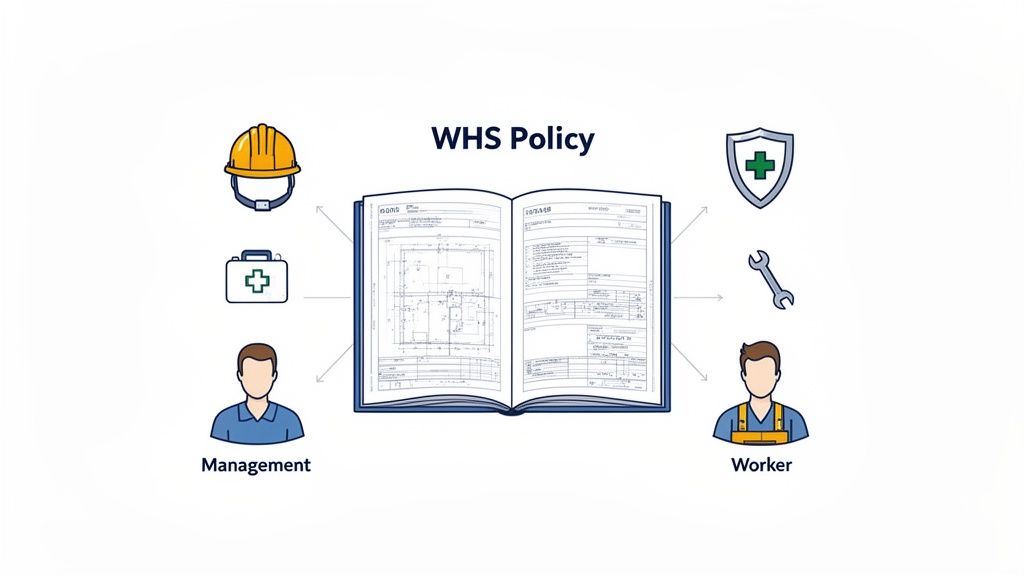
To make sure you've got all your bases covered, here’s a quick checklist of the non-negotiable sections every WHS policy needs.
Essential WHS Policy Components Checklist
| Component | Purpose |
|---|---|
| Policy Statement | A clear declaration from leadership showing the company's commitment to safety. |
| Responsibilities | Defines who is accountable for what, from the CEO down to every worker. |
| Risk Management | Outlines the practical, specific procedures for controlling workplace hazards. |
| Emergency Procedures | Step-by-step instructions for what to do when things go wrong. |
| Consultation & Training | Explains how workers will be involved and kept competent in safety matters. |
| Policy Review | Sets a schedule for keeping the policy up-to-date and effective. |
By ensuring each of these components is included and well-defined, you create a policy that is not just compliant, but genuinely useful.
The Main Policy Statement
This is the heart of the entire document. It needs to be a direct, no-fluff declaration of your company's commitment to creating and maintaining a safe and healthy workplace. This isn't the place for vague corporate jargon.
Your policy statement sets the tone for everything else. To give it real weight, it must be signed by the highest level of management, like the CEO or Managing Director. This signals to everyone that safety starts right at the top.
A Clear Breakdown of Responsibilities
One of the quickest ways for a safety system to fail is confusion over who is supposed to do what. A strong policy kills that ambiguity dead. It has to clearly spell out the specific WHS duties for every single role in the organisation.
For instance, your policy should detail the distinct responsibilities of:
- Senior Management: Their role in providing resources, setting safety objectives, and leading by example.
- Supervisors: Their duty to conduct daily checks, enforce safe work procedures, and manage their team's safety on the ground.
- Workers: Their responsibility to follow the rules, wear their personal protective equipment (PPE), and report any hazards they spot.
- Safety Officers/Managers: Their function is to advise, audit, and coordinate training, not to be the sole owner of safety.
When these roles are clearly defined, you create an unbreakable chain of accountability. A welder knows their job is to operate their gear safely, and their supervisor knows it's their job to ensure the right controls are in place and the welder is properly trained. No grey areas.
Specific Arrangements for Managing Risks
Now we get to the nuts and bolts. This is the most detailed part of your policy, and it needs to address the real, specific hazards found in your workplace. Generic statements about "being safe" are useless here. You need practical procedures for controlling your biggest risks.
This section is where you turn your safety goals into action. For a structured way to tackle this, our practical guide to the hierarchy of control measures offers a proven framework for choosing the most effective hazard controls.
A policy is only as good as its procedures. Detailing specific arrangements for high-risk tasks like working at heights, handling chemicals, or operating forklifts is non-negotiable.
Emergency Procedures
When an incident happens, hesitation can be dangerous. Your policy must lay out simple, well-defined emergency procedures that every single person understands and can follow under pressure.
This includes clear protocols for:
- First Aid: Where to find the kits and who the trained first aiders are.
- Fire and Evacuation: Clear maps, designated assembly points, and the duties of fire wardens.
- Incident Reporting: A straightforward process for reporting accidents and, just as importantly, near misses.
- Serious Incidents: What to do when you need to notify SafeWork and preserve an incident scene.
These aren't just paper procedures; they need to be drilled regularly. In a real emergency, muscle memory takes over, and that only comes from practice.
Consultation, Training, and Review
Finally, a great policy is a living document, not something that gathers dust on a shelf. This last section outlines how you'll keep it relevant and effective. It must state your commitment to consulting with your workers on safety, because they're the ones at the coalface who know the risks best.
It also needs to detail your approach to training, how and when people will be taught the right safety procedures. And crucially, it should set a formal review schedule (usually annually or after a major change) to ensure your workplace health and safety policies stay current and fit for purpose.
A Step-by-Step Guide to Developing Your Safety Policy
Creating a solid workplace health and safety policy isn't about ticking boxes on a form. It's a hands-on process of building a plan that actually works for your specific site and, most importantly, for your people. Let’s break down this complex task into a manageable, step-by-step workflow to get you from a blank page to a policy that makes a real difference.
Start with Worker Consultation
Before you even think about writing, get the right people in the room. Your workers on the tools are your single greatest source of information on what’s really happening out there. They know which guards get bypassed, what shortcuts people take, and where all the near misses happen.
Involving them right from the start isn’t just good practice; it's a legal requirement. You can do this through toolbox talks, safety committee meetings, or even just one-on-one chats. Ask them directly: "What's the most dangerous part of your day?" and "What would make you feel safer doing your job?" Their answers will form the bedrock of a policy that reflects reality, not just theory.
Perform a Thorough Risk Assessment
A policy built on guesswork is worse than useless. It has to be based on the actual hazards present in your work environment. This means rolling up your sleeves and conducting a thorough risk assessment to systematically identify what could harm someone and figure out reasonable ways to control it.
This process breaks down into three key parts:
- Identifying Hazards: Walk through the site. Look for every potential source of harm, from the obvious stuff like unguarded machinery and chemical storage to the less obvious things like trip hazards and excessive noise.
- Assessing the Risk: For each hazard you find, work out how likely it is to cause harm and how bad that harm could be. A simple risk matrix can be a huge help here, allowing you to prioritise the most serious dangers first.
- Controlling the Risk: Decide on the most effective ways to eliminate or minimise the risk. Always follow the hierarchy of controls, start by trying to eliminate the hazard completely before you look at less effective measures.
This assessment gives you a clear, evidence-based list of what your policy absolutely must address.
This simple flowchart shows the core structure of a good policy, moving from the high-level commitment to specific, on-the-ground actions.
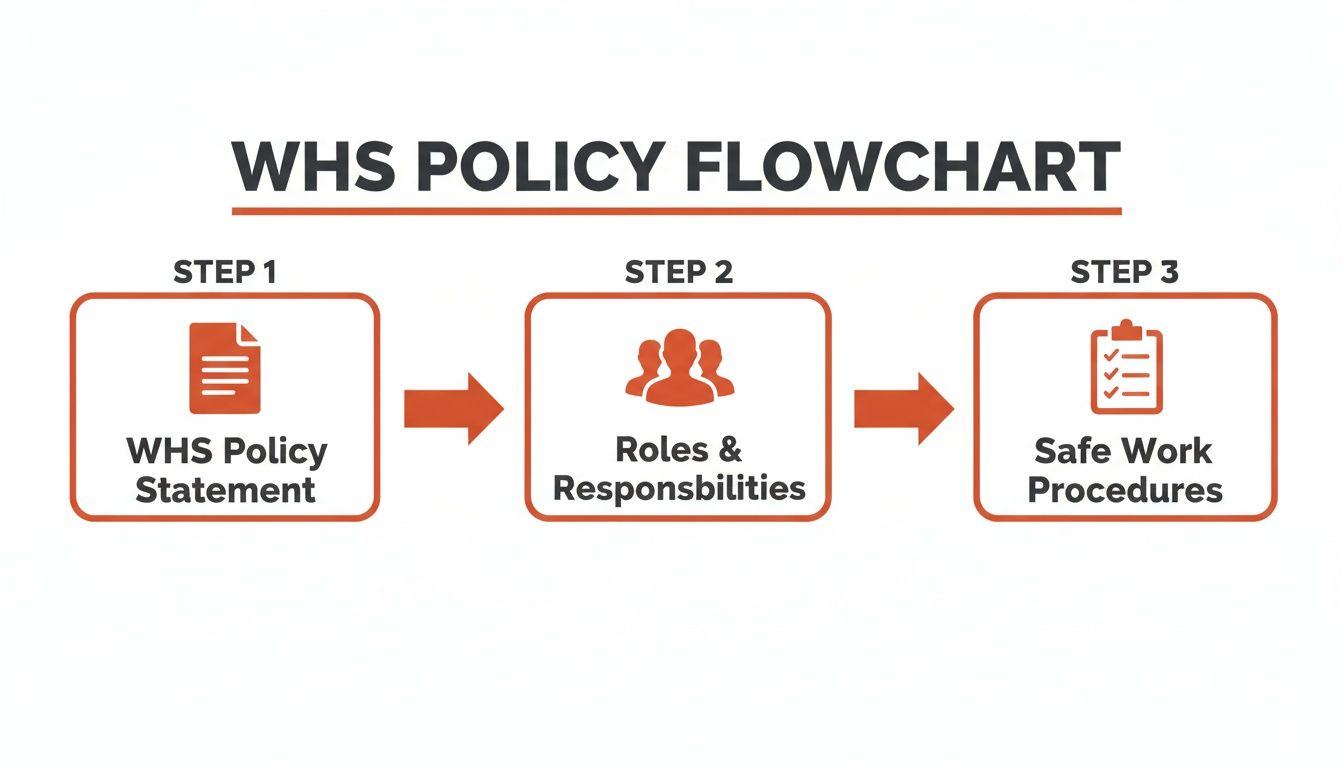
As you can see, a strong policy connects the company's official statement to individual responsibilities and, finally, to the detailed, practical procedures everyone needs to follow.
Understand Your Legal Obligations
While your risk assessment tells you what’s dangerous on your site, WHS legislation tells you what your minimum legal duties are. It’s absolutely critical to understand the specific laws, regulations, and codes of practice that apply to your industry and your state or territory in Australia.
These legal frameworks lay out the non-negotiables for things like training, incident reporting, consultation, and managing specific risks like asbestos or falls from height. Your policy has to reflect and meet these obligations. Ignoring them doesn't just create an ineffective policy, it exposes your business to massive legal and financial penalties.
Draft the Policy in Simple Language
Alright, now it’s time to start writing. The goal here is clarity, not complexity. Ditch the legal jargon and corporate buzzwords. Write the policy in direct, simple language that a brand-new apprentice can understand on their first day.
Your policy is a communication tool first and a legal document second. If your team can't read and understand it easily, they won't follow it.
Use short sentences, clear headings, and bullet points to break up the text.
When you start drafting, it's often much easier to work from a solid foundation. You can find a customisable WHS policy template that covers all the essential components, which saves a heap of time and ensures you don't miss anything critical. From there, you can adapt it with the specific findings from your risk assessment and consultation. This approach helps you produce a compliant and genuinely useful document without starting from scratch.
Review the Draft and Get Feedback
Once you have a first draft, the process comes full circle. Take it back to the very people you consulted at the beginning. Share it with your workers, supervisors, and managers and ask for their honest feedback.
Ask them practical questions:
- Does this actually make sense?
- Is there anything we've missed?
- Can we realistically do this every single day?
This review stage is your golden opportunity to catch any gaps or impractical procedures before the policy is locked in. It ensures the final document is not just technically correct but also workable and supported by the people who have to live by it every day. A policy developed this way has a much, much higher chance of being put into practice.
Putting Your WHS Policy into Action
A first-class workplace health and safety policy is useless if it just sits in a binder gathering dust. The real work begins when you turn those words into everyday practice.
The goal is to get the policy out of the document and into the hands and minds of every person on your site, from the newest apprentice to the most seasoned contractor.
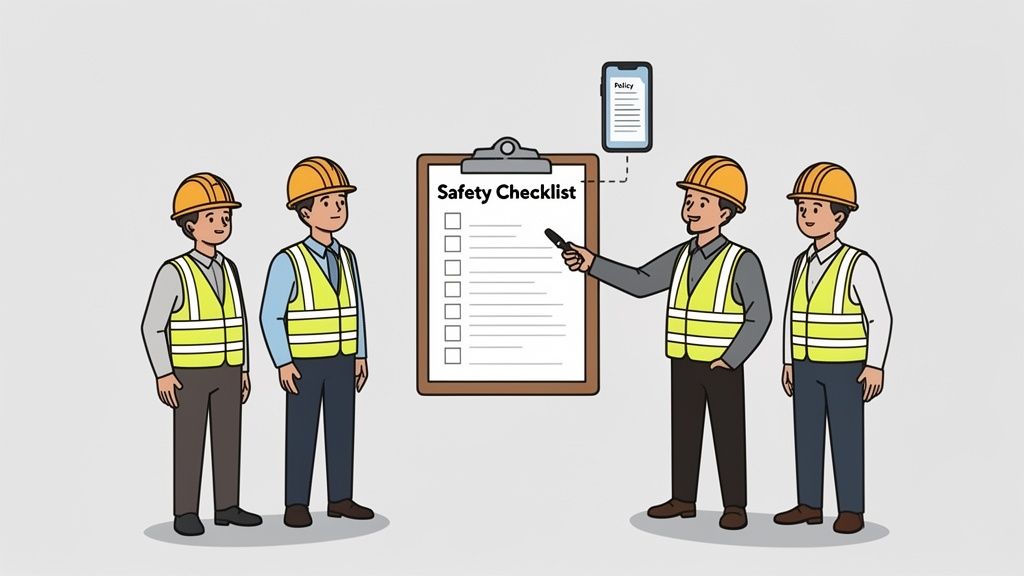
This whole process boils down to communication and training. It’s about making sure your team not only reads the policy but truly understands their specific roles and how to follow procedures correctly. Without this step, even the most carefully written policy is just an administrative box-ticking exercise.
Communicating Your Policy Effectively
Just sending out a mass email with the new policy and hoping for the best is a recipe for failure. Effective communication needs a proper strategy to reach everyone in a way that makes sense for their role and work environment.
You’ll want to hit this from multiple angles:
- Toolbox Talks: On a construction site or factory floor, these short, sharp sessions are perfect for hammering home specific policy points relevant to the day's tasks.
- Formal Training Sessions: For major policy rollouts or high-risk procedures, you need dedicated training sessions that allow for deeper discussion and Q&A.
- Team Meetings: Use your regular meetings to reinforce key safety messages and talk through any recent incidents or near misses. It keeps the conversation going.
- Digital Platforms: Company apps or online portals are great for sending reminders and making sure the policy is accessible on any device, at any time.
The trick is to talk about the policy regularly, not just once during induction. This keeps safety front-of-mind and proves to everyone that management is serious.
Training That Actually Works
Training isn't just about getting bums on seats; it's about making sure people actually get it. Your training has to be practical and directly tied to the real-world hazards your team faces every single day.
A worker's understanding of their safety responsibilities is the single most important outcome of any policy implementation. True comprehension, not just attendance, is the measure of success.
For example, don't just talk about manual handling risks. Get your team to physically demonstrate the correct lifting techniques. When covering lockout/tagout procedures, take them to the actual machine and walk through the isolation process step-by-step. This hands-on approach is what makes procedures stick.
A huge part of this now involves mental wellbeing. Mental health conditions currently account for 12% of all serious workers' compensation claims, and that number has shot up by a staggering 161% in the last decade. By building mental health support and stress management into your policy and training, you’re tackling a significant and growing workplace risk.
Initiatives like implementing high-impact employee wellness programs are no longer just a "nice-to-have"; they're essential for a healthier, safer, and more engaged workforce.
Making Policies Easy to Find
When an incident happens or a worker isn't sure about a procedure, they need the answer right now. Your workplace health and safety policies must be incredibly easy for everyone to access, including visitors and subcontractors.
This means having both physical and digital copies ready to go:
- Physical Binders: Keep clearly labelled binders in common areas like the site office, lunchroom, or workshop.
- Digital Access: Store policies on a shared network drive or, even better, a dedicated safety management platform that workers can pull up on a phone or tablet.
- Visible Summaries: Post summaries of critical rules, like emergency procedures or PPE requirements, on noticeboards in high-traffic spots.
If a worker has to hunt for a policy, they're more likely to take a shortcut or just guess. Making the information impossible to miss is a simple but powerful way to build consistent, safe work habits. This is how you turn a document into a living, breathing part of your daily operations, the final, crucial step in protecting your people.
How to Monitor and Review Your Safety Policies
Getting your workplace health and safety policies written and rolled out is a massive step forward, but the job isn't done. These aren't "set and forget" documents you can file away. They need to live and breathe with your business, adapting as your team, your site, and your work evolves.
An effective policy is a living document. To keep it that way, and to keep people safe, you need to constantly monitor and regularly review it.
Think of it like this: monitoring is the daily check-up to see if the rules are actually being followed on the ground. Reviewing is the scheduled, bigger-picture look to make sure the rules themselves are still the right ones for the job. You can't have one without the other. Without this cycle, even the most perfectly written policy becomes irrelevant, and dangerous.
Key Triggers for a Policy Review
While setting a regular review schedule, say once a year, is a great baseline, some events should ring the alarm bell for an immediate re-evaluation. These are the moments when the risks in your workplace have almost certainly shifted, and your policy needs to catch up.
You should always kick off a review under these circumstances:
- After a significant incident: If there's an accident or a serious near-miss, a review isn't optional. You need to dig in, find out what went wrong, and make sure it never happens again.
- When new equipment or processes are introduced: Rolling out a new piece of machinery or changing how a task is done introduces new, unknown hazards. Your old policy won't cover them.
- Following changes in legislation: Work health and safety laws change. Your policy must change with them to keep your business compliant.
- Based on worker feedback: Your team is on the front line. If they’re telling you a procedure is clunky, impractical, or just plain unsafe, it’s time to listen and take a hard look at it.
Practical Methods for Monitoring Compliance
Monitoring is all about seeing your policies in action. It's how you confirm that the procedures you carefully wrote are being applied correctly on the workshop floor or out on the construction site. This isn't about catching people out, it's about spotting the gaps between policy and reality before they lead to an injury.
Simple, effective monitoring can include:
- Regular Site Inspections: Grab a checklist based on your policy and walk the site. Are machine guards in place? Is PPE being worn properly? Are fire exits clear? These quick visual checks are one of the most powerful tools you have.
- Safety Audits: This is a more formal, deeper dive than a simple inspection. An audit examines your entire safety management system to see if it’s functioning as intended, from checking training records and maintenance logs to interviewing staff.
- Reviewing Incident Reports: Don't just file these away. Look for patterns in your incident and near-miss reports. If you see the same type of incident popping up again and again, it's a massive red flag that a specific part of your policy is failing.
Monitoring isn’t about generating more paperwork. It’s about creating a feedback loop. You implement a policy, check that it's working, and then adjust your approach based on what you find. Simple as that.
Conducting a Simple Internal Audit
An internal audit doesn’t need to be a bureaucratic nightmare. Just think of it as a health check for your safety system. You're simply checking your own processes against your written policies and legal duties to find any weak spots. If you need a bit of structure, exploring dedicated tools for audits and compliance can give you a clear framework to follow.
The process is pretty straightforward:
- Plan: Decide what you're going to audit. You could focus on one high-risk area, like chemical handling, or a specific procedure.
- Check: Gather the evidence. Talk to workers, observe tasks as they happen, and review your documents and records.
- Report: Write down what you found. Be honest about what's working well, but more importantly, where the gaps are.
- Act: This is the most crucial step. Create a corrective action plan with clear tasks, assign them to specific people, and set deadlines to fix the problems you found.
By regularly monitoring and reviewing your workplace health and safety policies, you close the loop and build a cycle of continuous improvement. This proactive approach ensures your policies stay relevant, effective, and actually protect your team.
How Safety Space Simplifies Policy Management
If you're still managing your workplace health and safety policies with paper, spreadsheets, and a jumble of Word documents, you know the struggle. It's a constant battle to track versions, get confirmation that everyone’s actually read the latest updates, and see what’s happening on site. This is exactly the kind of mess that dedicated software is designed to fix, bringing everything into one central, easy-to-use system.
Safety Space cuts through the messy paperwork and endless administrative headaches. It gives you a single platform to create, store, and share your policies, making them instantly available to anyone who needs them, whether they're in the head office or out on a remote job site. This isn't just about digital storage; it's about active, real-time management.
Centralise Your Safety System
Instead of crucial policies getting lost in filing cabinets or buried deep in email chains, Safety Space puts everything in one place. Every worker, supervisor, and contractor can pull up the most current procedures right from their phone or tablet. When a quick decision is needed on the ground, that immediate access is critical.
You can finally stop chasing signatures and printing endless reams of paper. With a digital system, you get a clear, auditable trail showing who has acknowledged each policy and when. Accountability is baked right into the process.
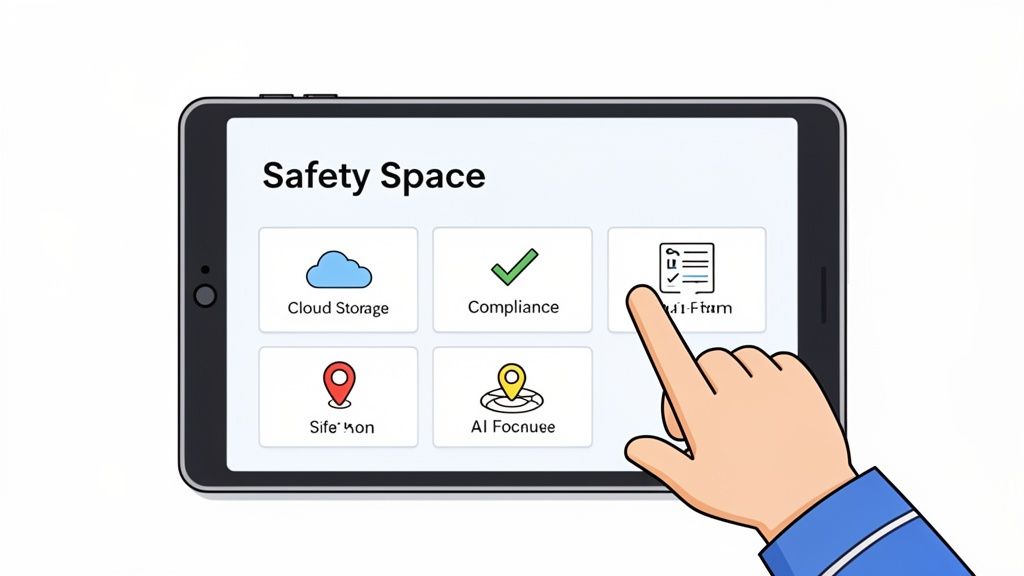
This kind of immediate visibility helps you spot trends and get ahead of potential issues before they escalate into serious incidents.
From Reactive to Proactive Management
One of the biggest wins you get from a platform like Safety Space is the shift from reacting to incidents to proactively managing safety. With tools like real-time dashboards, you can monitor compliance across multiple sites and teams, all from a single screen.
It’s about having tools designed for the real-world needs of high-risk industries:
- AI-Assisted Forms: Speed up incident reporting with smart forms that guide users through the process. This ensures you get the critical information needed to take action, quickly and accurately.
- Multi-Site Oversight: Effortlessly manage different safety requirements for various locations or keep an eye on subcontractor compliance, all within the same system.
- Automated Reminders: Set up automatic notifications for policy reviews, training refreshers, or equipment inspections. Nothing falls through the cracks.
The goal is to spend less time on administration and more time focusing on what really matters: keeping your people safe. A centralised platform gives you the tools and, just as importantly, the time to do just that.
At the end of the day, using a system like Safety Space makes it far simpler to keep your workplace health and safety policies up to date, accessible, and effective. It claws back a huge amount of administrative time, creates clear lines of responsibility, and gives you the oversight needed to run a safe, compliant operation.
Common Questions About WHS Policies
Even with a solid guide, a few practical questions always pop up when you're in the trenches, dealing with workplace health and safety policies. Here are some straight answers to the queries we hear most often from business owners and managers.
How Often Should a WHS Policy Be Reviewed?
As a general rule of thumb, you should give your entire WHS policy a thorough review at least once a year.
But don't just set a calendar reminder and forget about it. A review is needed immediately after any significant workplace incident, anytime you bring in new machinery or change a work process, or if WHS legislation gets updated.
Who Is Responsible for Enforcing the Policy?
Look, everyone has a part to play, but enforcement really starts at the top with management and supervisors. Senior leaders are on the hook for providing the right resources and making it crystal clear that the policy isn't optional. Supervisors are the ones on the floor day-to-day, making sure their teams are following procedures correctly.
Ultimately, a policy is a team effort. While managers enforce the rules, every single worker is responsible for following them and for reporting any hazards they see. This shared accountability is what makes a policy effective.
What’s the Difference Between a Policy and a Procedure?
It's simpler than it sounds. Think of it like this: the policy is the what and the why. It’s your company's high-level promise to keep people safe and it outlines your main goals.
A procedure, on the other hand, is the how. This is where you get into the nitty-gritty. It gives detailed, step-by-step instructions for a specific task, like how to operate a forklift or the right way to isolate equipment before maintenance. These are often called Safe Work Method Statements (SWMS).
Your policy is the foundation you build on. Your procedures are the practical, everyday building blocks that make it all work. You absolutely need both.
Ready to move beyond messy paperwork and get real-time control over your safety management? See how Safety Space simplifies everything from policy deployment to incident reporting. Book a free demo today to build a safer, more efficient workplace.
Ready to Transform Your Safety Management?
Discover how Safety Space can help you implement the strategies discussed in this article.
Explore Safety Space FeaturesRelated Topics
Safety Space Features
Explore all the AI-powered features that make Safety Space the complete workplace safety solution.
Articles & Resources
Explore our complete collection of workplace safety articles, tools, and resources.