
Australia recorded 497,300 work-related injuries or illnesses among 14.1 million workers in 2021–22, yet only 34.9% of affected workers made a workers' compensation claim, according to Safe Work Australia's health monitoring data. That gap is the operational problem. A claims register can look controlled while exposure, fatigue, hearing damage, chemical contact, and psychosocial hazards continue across the site.
For construction, manufacturing, and industrial services, workplace health monitoring must sit closer to production than to an annual wellbeing programme. It should show who is exposed, where the exposure occurs, which controls are working, whether subcontractors follow the same standard, and what action follows an adverse result.
Table of Contents
- The Reality of Workplace Harm and Monitoring
- Core PCBU Obligations for Exposure Tracking
- Moving Beyond Lagging Safety Metrics
- The Limits of Annual Wellbeing Surveys
- Monitoring Subcontractors Across Fragmented Sites
- Integrating Health Data into WHS Platforms
- Auditing Your Current Monitoring Setup
The Reality of Workplace Harm and Monitoring
A low workers' compensation count does not establish that a site is safe. Workers may manage symptoms informally, supervisors may resolve cases without a claim, and exposure-related disease may remain unrecognised for years. Safety managers should therefore treat claims as one signal, not the full record of workplace harm.
Australia's work-related injury rate fell from 4.2% in 2017–18 to 3.5% of people who worked in the previous 12 months in 2021–22, compared with 6.4% in 2005–06, according to Safe Work Australia. The decline is useful context, but it does not show whether a particular cutting process is generating dust, whether a night crew is exposed to excessive noise, or whether subcontractors follow the same controls.
What the site actually needs to see
A practical monitoring system joins four operational views:
- Exposure: noise, airborne contaminants, hazardous chemicals, heat, vibration, manual handling, fatigue, and psychosocial hazards.
- People: direct employees, labour hire workers, subcontractors, visitors, and short-term crews.
- Controls: engineering measures, isolation, ventilation, PPE, supervision, SWMS controls, competency, and maintenance.
- Outcomes: symptoms, health assessments, incidents, near misses, corrective actions, claims, and regulator notifications.
Record the task, location, shift, worker group, hazard, control status, and action owner. A generic “site safe” score cannot show a plant manager where exposure is occurring or which control has failed.
Practical rule: If a monitoring result cannot change a task, roster, control, medical referral, or supervisor action, it is probably not useful enough.
Gradual harm needs the same discipline as acute incidents. Noise provides a clear example. Managers assessing hearing risk can use hearing loss data by Z Audiology as background when designing communication arrangements, audiometry, and noise controls. Workers may not report progressive hearing damage as an incident, so exposure records and scheduled health checks must help detect it.
The same principle applies to chemical contact, vibration, heat, and fatigue. Monitoring should show whether exposure remains within the intended control conditions and identify changes in task, equipment, roster, or workforce composition that require a new assessment.
Head office visibility must match site reality
The WHS Act requires PCBUs to ensure, so far as is reasonably practicable, that workers and others are not exposed to health and safety risks. Reviewing claims after an event does not meet that operational need. Leaders need evidence that exposure was assessed, controls were implemented, workers understood them, subcontractors were included, and exceptions received an owner and a timely response.
Core PCBU Obligations for Exposure Tracking
Health monitoring becomes a defined compliance process when workers handle hazardous chemicals or face specified exposure risks. The timing matters. A medical assessment arranged after months of exposure may provide useful information, but it cannot show that the PCBU controlled the risk from the worker's first shift.
Comcare's WHS guidance sets out the required points in the process. Build them into induction, role assignment, exposure registers, and contractor plans. Do not leave compliance to individual supervisors or assume a completed induction covers the medical requirement.
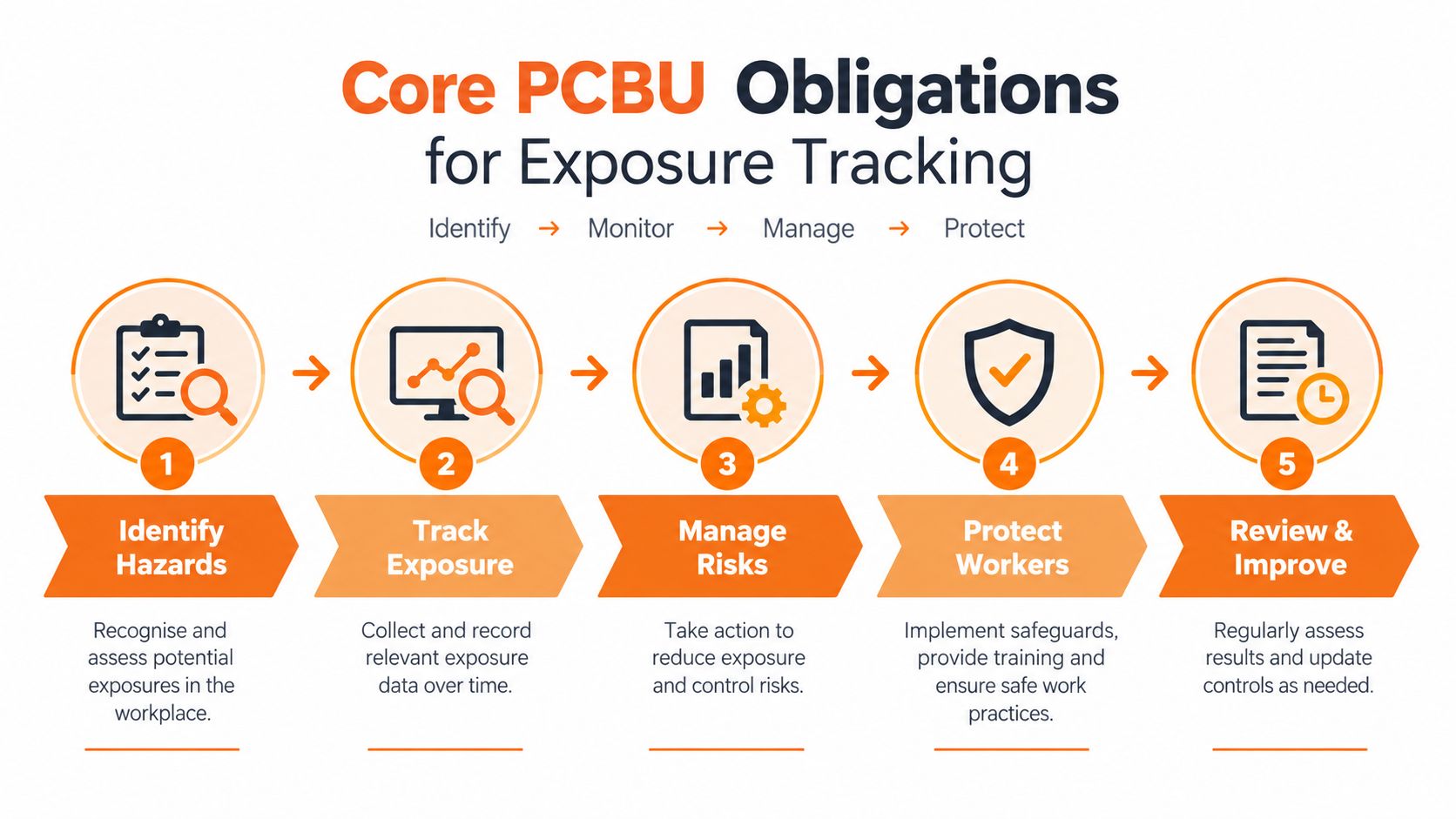
Build the sequence into the work process
Before hazardous work starts: Confirm the worker's exposure profile and arrange health monitoring before the person handles the hazardous chemical. Induction completion does not prove that the required assessment has occurred.
During exposure: Continue monitoring while the worker remains exposed. Set the method and frequency according to the substance, work pattern, control environment, and advice from the relevant health monitoring practitioner.
When a worker raises a concern: Treat symptoms or other exposure concerns as a defined review trigger. Give supervisors a clear route to H&S, occupational health, and the PCBU, with enough information to identify the task and exposure history.
When the work stops: Arrange monitoring when the worker finishes the hazardous work. This matters where health effects may appear after exposure has ended.
After the programme: The PCBU must take all reasonable steps to obtain the health monitoring report as soon as practicable after the programme ends, or at regular intervals for longer-term or ongoing monitoring.
The site system should show every handoff. Record the exposure assessment, practitioner appointment, attendance, report status, restrictions or recommendations, and the person responsible for implementing controls. Apply the same discipline to related controls, including heat stress monitoring, where conditions, work intensity, acclimatisation, hydration, and supervision must lead to specific site decisions.
Treat adverse results as an escalation point
A health monitoring report is an operational trigger, not an administrative attachment. If test results indicate that a worker may have contracted a disease, injury, or illness from the work, the PCBU must submit a copy to the regulator under the WHS Regulations, as stated in the Comcare guidance.
Medical confidentiality and operational accountability must operate together. Restrict access to authorised personnel, while giving supervisors the information needed to control the task. The escalation workflow should name the person who reviews the report, contacts the practitioner, reassesses exposure, changes or isolates the task, and completes any regulator notification. The same ownership should apply to subcontractor records, so exposure history does not disappear when a worker changes employer or site.
Moving Beyond Lagging Safety Metrics
Claims and fatalities are essential measures, but they arrive after the organisation has failed to prevent harm. A site that only reviews those figures is looking in the rear-view mirror. National data works better when safety teams use it as a benchmark and then build a more detailed leading-indicator system around their own work.
Safe Work Australia describes a national monitoring system built from six main collections, including traumatic injury fatalities, compensation-based statistics, comparative performance monitoring, and WHS prosecutions. The National Dataset for Compensation-based Statistics draws on every state, territory, and Commonwealth workers' compensation authority. That structure supports long-term comparisons across jurisdictions.
Use the national model at site level
The same logic works inside a business. Separate signals into two groups, then connect them rather than allowing each register to operate alone.
| Lagging indicators | Leading indicators |
|---|---|
| Claims and lost time | Exposure assessments completed |
| Recordable injuries | High-risk tasks observed |
| Fatalities | Hazard reports by location and task |
| Regulator actions | Control verification and overdue actions |
| Diagnosed work-related illness | Fatigue, symptoms, and worker concerns |
A claims dashboard tells you where harm has already been recognised. An exposure dashboard tells you where controls deserve attention now. For example, repeated dust observations, incomplete respiratory protection checks, and maintenance failures may point to a control problem before a diagnosis or claim appears.
Target resources at exposure, not averages
Safe Work Australia's latest national statistics recorded 188 workers who died from traumatic injuries at work in Australia in 2024, down from 200 in 2023. Fatality surveillance provides a high-severity benchmark, but it can't tell a supervisor whether today's lift plan, isolation, or chemical handling control is adequate.
The Beta Occupational Hazards Dataset combines occupational exposure information with ANZSCO, workers' compensation claims data, and ABS employment data. Safe Work Australia is also extending this work through the Australian Worker Exposure Survey, including dangerous substances and psychosocial hazards. Businesses should apply that exposure-based thinking locally by asking:
- Which tasks create the highest exposure?
- Which worker groups move between sites or tasks?
- Which controls depend on behaviour rather than engineering?
- Which hazards produce repeated observations or concerns?
- Which actions remain overdue after verification?
This approach costs more effort at the front end, but it gives operations managers a better basis for deciding where to spend time, maintenance capacity, training effort, and specialist support.
The Limits of Annual Wellbeing Surveys
An annual wellbeing survey can identify broad themes, but it cannot show whether a subcontractor's crew is working excessive hours, a manufacturing team is bypassing guarding, or a supervisor has closed every psychosocial hazard action.
The Australian Well-Being at Work Index rose from 4.07 in 2024 to 4.11 in 2025, while remaining below its 2022 peak of 4.23, according to Great Place to Work Australia. The figures provide workforce context. They do not replace task-level monitoring in construction, manufacturing, or other high-risk operations.
Measure what can trigger action
Use broad feedback alongside operational checks. Weekly or monthly reviews should focus on signals a manager can investigate and control:
- Fatigue: roster patterns, overtime concerns, travel demands, unplanned shift changes, and worker-reported fatigue.
- Psychosocial hazards: role conflict, unreasonable workload, poor consultation, bullying reports, isolation, and task-related distress.
- Physical exposure: noise, dust, chemicals, heat, vibration, manual handling, and interaction with high-risk plant.
- Control performance: SWMS verification, permit compliance, guarding, ventilation, PPE use, maintenance, and supervision.
- Workforce feedback: concerns raised, response time, repeat issues, and whether workers can see the outcome.
The survey has limited value without a defined response. A fatigue report should trigger a review of the roster or task. A psychosocial hazard needs an owner, due date, control plan, and review. A repeated PPE failure calls for checks on availability, fit, compatibility, training, and whether the control works under production conditions.
Keep wellbeing connected to work design
Generic mental health content can place responsibility on the individual. Operational monitoring examines whether the work system creates or increases the risk. That distinction matters in construction, manufacturing, and industrial services, where production pressure, changing crews, isolation, noise, heat, and uncertain work fronts can interact.
Construction remains a major claim category, with 17,600 claims, a 17.7 incidence rate, and a median of 8.4 weeks lost. These figures reinforce the need to connect wellbeing discussions with physical conditions, work organisation, and recovery from injury.
An annual pulse check can support the monitoring system. It cannot replace it. Site leaders need a shorter feedback loop that links worker experience to task controls and closes actions before issues become accepted as normal.
Monitoring Subcontractors Across Fragmented Sites
A principal contractor can have strong internal controls and still lack visibility across short-term crews, specialist contractors, and changing work fronts. The risk increases when each site keeps separate spreadsheets, induction records, incident forms, and health monitoring arrangements.
Federal Safety Commissioner data for accredited building sites recorded three fatalities in 2024, including one machinery or fixed plant incident and two related to materials or substances. The same 2024–25 annual data report recorded an improved fatality frequency rate of 0.61, compared with 1.02 over the prior five-year average. Improvement doesn't remove the need to control the exposures that remain.
Set one minimum data standard
Every contractor should provide the same core information before mobilisation:
- Business and workforce: legal entity, supervisor, worker list, roles, licences, competencies, and contact details.
- Exposure profile: hazardous chemicals, plant, noise, dust, heat, vibration, confined spaces, and other task-specific risks.
- Control evidence: SWMS, permits, plant inspections, maintenance status, PPE requirements, and health monitoring arrangements.
- Event data: incidents, near misses, hazards, symptoms, worker concerns, and corrective actions.
- Status: accepted, restricted, expired, overdue, or requiring principal contractor review.
The platform should associate that information with the project, work area, task, and contractor. A single worker may move between projects, so the system should prevent duplicate records while preserving the exposure history needed by the PCBU and health monitoring practitioner.
Close the feedback loop
The National WHS Radar survey has been launched to capture worker feedback on current and emerging WHS challenges. That signals a useful shift toward more frequent worker-reported information, but feedback only helps when it reaches someone who can act.
Use a site review that combines worker concerns, supervisor observations, contractor compliance, and incident records. Rank actions by exposure and potential severity, not by which contractor submits the most forms. Give each action an owner and verification date, then show the contractor whether the control was accepted, rejected, or changed.
For a practical framework covering shared responsibilities, evidence, and contractor controls, use subcontractor safety management. The principal contractor still needs to verify that the arrangement works in the field. A signed SWMS without observation, consultation, and follow-up is weak evidence.
Integrating Health Data into WHS Platforms
Health monitoring produces value only when the result changes work. A completed assessment sitting in an email inbox won't protect the next worker assigned to the same exposure.
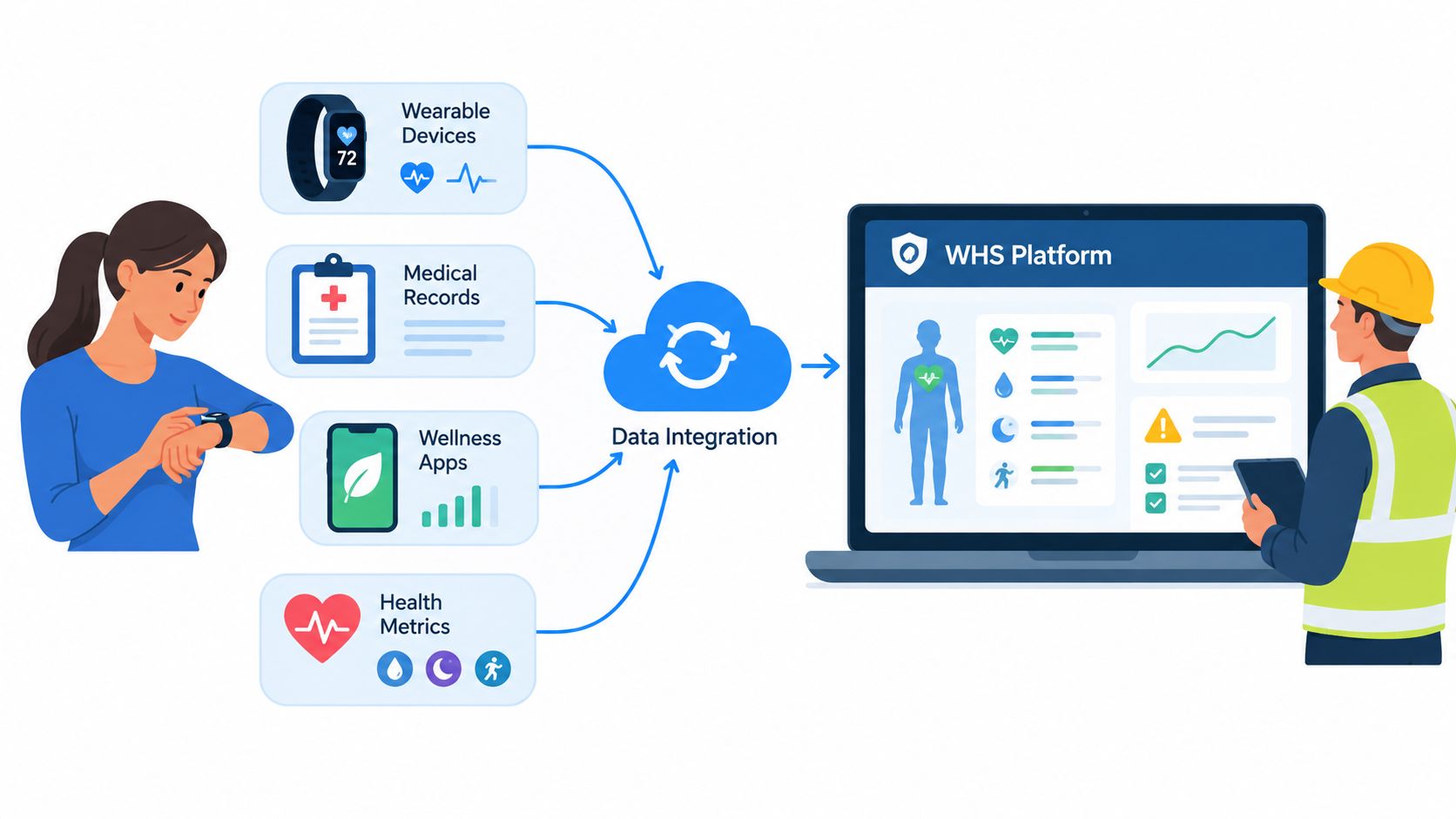
A functional WHS platform should connect the exposure register, worker profile, practitioner workflow, report status, hazard records, incidents, corrective actions, and contractor access. It doesn't need to expose private medical information to supervisors. It does need to show whether monitoring is due, completed, received, reviewed, and connected to a control decision.
Design the handoffs before choosing features
Start with the operational event, not the dashboard. For a hazardous chemical task, the workflow might look like this:
- The supervisor assigns the worker to a defined exposure profile.
- The system checks whether pre-work monitoring is required and whether the worker is cleared to begin.
- H&S records the practitioner appointment and report status.
- An adverse or restricted result creates a controlled escalation for authorised review.
- The responsible manager reassesses the task, exposure, and controls.
- The system records the action, owner, due date, and verification evidence.
- The worker's future assignment reflects the current control or restriction.
This arrangement prevents a common failure. The medical process remains separate from general personnel data, while the operational system still records the control consequences. Access permissions, retention rules, audit trails, and practitioner communication need to be defined before implementation.
A platform can also correlate leading signals with lagging outcomes. For example, site leaders might compare exposure observations, overdue actions, worker concerns, and incident records by location or contractor. The point isn't to create a complex score. It's to identify a pattern early enough to intervene.
Use technology with a clear purpose
Wearables, sensors, digital forms, and exposure calculators can support decisions, but collection alone isn't control. A sensor that generates alerts nobody owns will create noise. A form that records hazards without escalation will create a larger archive of unresolved risk.
External specialists may help with testing design and interpretation. For example, managers evaluating structured assessment methods can review Telomyx health and performance testing as one reference point for health and performance data. The method still needs to fit the exposure, worker population, privacy requirements, and clinical advice.
For teams assessing connected devices, wearable safety devices should be evaluated against purpose, reliability, worker acceptance, data governance, and the action that follows an alert. Safety Space is one option that provides configurable dashboards for safety performance, incidents, corrective actions, alerts, and multi-site oversight. The decision should follow the workflow, not the other way around.
Auditing Your Current Monitoring Setup
A useful audit starts with one worker and follows the exposure from assignment to control review. Take a person working with a hazardous chemical, on a noisy production line, or across several construction sites. Can you show what they were exposed to, whether the required monitoring occurred, where the report went, what action followed, and whether the contractor or supervisor verified the control?
If the answer depends on searching email, checking several spreadsheets, or asking someone who is on leave, the system has a visibility gap.
Run the audit against real work
Use these checks with a sample of current roles and sites:
- Exposure baseline: Can the organisation identify hazardous tasks, substances, physical exposures, psychosocial hazards, locations, and affected worker groups?
- Pre-work control: Does the induction or mobilisation workflow prevent hazardous work from starting before required monitoring is arranged?
- Ongoing monitoring: Does the system identify due assessments, worker concerns, changing exposure conditions, and cessation monitoring?
- Medical handoff: Can authorised staff confirm that reports were obtained, reviewed, protected, and escalated where required?
- Subcontractor visibility: Do contractors provide equivalent exposure, competency, SWMS, incident, and corrective-action information?
- Action closure: Does every adverse result, repeated hazard, or worker concern have an owner and a verification record?
- Platform integrity: Can managers relate leading exposure signals to incidents, claims, locations, shifts, and contractors without relying on manual reconciliation?
A manufacturing manager may find that audiometry is scheduled, but noise readings aren't linked to specific lines or maintenance activities. A construction H&S manager may find that contractor inductions are complete, while exposure reports and plant-related corrective actions remain outside the project record. Those are not paperwork defects. They prevent leaders from seeing whether the control works where the work occurs.
Fix the highest-risk handoff first. Define the data owner, escalation trigger, action deadline, and verification method. Then test the process again with a different site or subcontractor.
Safety Space provides configurable WHS dashboards, real-time monitoring, incident and corrective-action tracking, and multi-site and subcontractor oversight. Use Safety Space to review how a central system could connect exposure records to accountable site actions, then book a demonstration or H&S consultation for your current monitoring gaps.
Ready to Transform Your Safety Management?
Discover how Safety Space can help you implement the strategies discussed in this article.
Explore Safety Space FeaturesRelated Topics
Safety Space Features
Explore all the AI-powered features that make Safety Space the complete workplace safety solution.
Articles & Resources
Explore our complete collection of workplace safety articles, tools, and resources.