
Think of Australian Auditing Standards (ASAs) as the official rulebook for financial audits. They are the blueprint that makes sure every audit is consistent, high-quality, and reliable. These standards are not just suggestions; they are legally enforceable for many companies and are important for maintaining trust in financial reporting across all industries, including construction and manufacturing.
What Are Auditing Standards and Why Do They Matter?
Just as a builder follows specific plans to make sure a structure is safe and sound, an auditor follows the ASAs to make sure a company's financial report is accurate and trustworthy. Without these common rules, every audit would be different, making it impossible for investors, regulators, or even your business partners to compare results or trust the numbers.
These standards are developed and looked after by the Auditing and Assurance Standards Board (AUASB). This is the official body responsible for setting the bar for audit quality in Australia. Their work makes sure that audits are not just a box-ticking exercise, but a rigorous, systematic review that provides real confidence in a company's financial health.
The Core Ideas Behind the Standards
Auditing standards in Australia have come a long way, growing from vague guidelines to the structured requirements we have today. By 1969, the first major Statement of Auditing Standards laid down the core principles that continue to protect stakeholders in high-risk sectors like manufacturing and construction.
At their heart, the standards are built on a few simple but powerful concepts. Let's break down the key principles that drive every official audit.
| Principle | What It Means in Plain English | Why It Matters for Your Business |
|---|---|---|
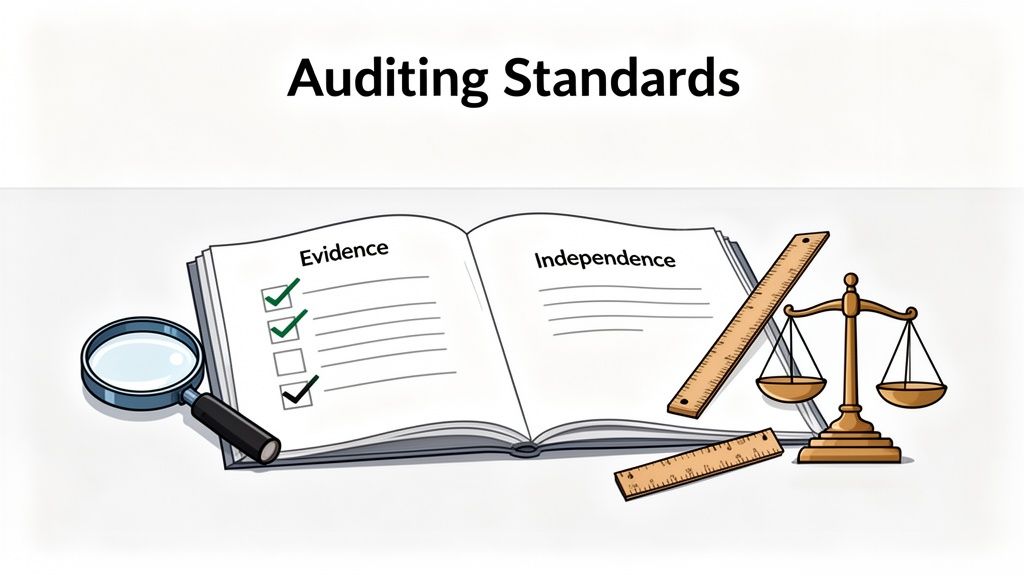
| Evidence | An auditor can't just take someone's word for it. They need to collect enough solid proof to back up their findings. | It confirms your financial statements (or safety records) are based on fact, not fiction, building credibility with stakeholders. |
| Independence | The auditor must be completely objective and free from any biases or conflicts of interest that could sway their judgment. | It guarantees the audit results are fair and unbiased, giving everyone confidence that the assessment is trustworthy. |
| Systematic Process | Audits must be planned, carried out, and documented in a logical, repeatable way. No winging it. | A consistent process means reliable results every time, whether it’s a financial audit or an internal safety check. |
These principles are the bedrock of any credible audit, providing a framework that ensures integrity and thoroughness.
From Financial Rules to Better Safety Audits
Now, you might be thinking, "This is all about finance, what does it have to do with me?"
While the ASAs are designed for financial reporting, their logic is directly transferable to managing workplace safety compliance. Think about your internal safety audits. Are you gathering real evidence, like signed training records and completed inspection forms? Are your reviews genuinely independent, or do they carry some internal bias? Is your process documented and consistent across all your sites?
Adopting the mindset of a financial auditor can make your internal H&S audits far more credible and effective. It shifts the focus from simply looking for problems to proving that your safety systems are actually working as intended.
Applying these core audit principles makes your internal processes stronger and much more defensible if something goes wrong. And this line of thinking applies across the board, from safety to finance. To see how these fundamentals play out in another area, it’s helpful to review guidance on Understanding Tax Audits in Australia, which shows how the same core concepts of evidence and process are key to all forms of compliance.
The AUASB and the Legal Framework for Australian Audits
When you hear “auditing standards,” it’s easy to think of them as just professional guidelines. But in Australia, for many businesses, they’re much more than that. They are legal requirements. This isn’t by accident. The authority comes from a specific government body and is baked directly into Australian law, giving these standards real teeth and creating serious consequences if they're ignored.
The organisation at the heart of this is the Auditing and Assurance Standards Board (AUASB). Think of them as the official rule-makers. The AUASB is an independent, government-appointed body tasked with developing, issuing, and maintaining the legally enforceable auditing standards for the country. Their core job is to keep the rules clear, relevant, and effective, which in turn helps maintain trust in the entire Australian market.
Where Law and Standards Meet
So, how do these standards get their legal muscle? They aren't just suggestions floating in a professional vacuum. Their power comes directly from the Corporations Act 2001. This is the key piece of legislation that officially recognises and enforces the standards set by the AUASB.
For any company required to lodge a financial report under the Corporations Act, following the relevant Australian Auditing Standards (ASAs) is not optional, it’s mandatory. This connection instantly transforms the ASAs from a 'best practice' guide into a strict legal obligation.
What does this mean in practice? It means ignoring an ASA isn’t just poor professional conduct; it can be a direct breach of corporate law. This elevates the importance of every single audit, including the internal ones that often feed into formal financial reporting.
Understanding this link is crucial, especially for managers in high-risk sectors like manufacturing and construction. It means the structured, evidence-based approach demanded by financial auditors has a solid legal foundation that ripples through the entire business.
Why This Legal Authority Matters to You
The legal status of these standards has very real, practical effects for every business leader and compliance manager. It shifts auditing from a simple financial check-up to a critical risk management activity.
Here’s what’s at stake:
- Legal & Financial Risks: Failing to comply can lead to hefty penalties from regulators like ASIC. Worse, it can open the door to legal action from shareholders or investors who relied on financial reports that were not up to scratch.
- Business Credibility: On the flip side, a clean audit conducted according to legally mandated standards is a powerful signal of credibility. It tells banks, investors, and potential partners that your business is transparent, organised, and well-managed.
- A Foundation for All Compliance: The discipline and rigour demanded by financial audits sets a high bar for the whole organisation. This provides a strong, proven model for other internal checks, like those for workplace health and safety. You can see how this applies to your legal duties by reviewing our guide on WHS Act compliance.
This framework is anything but static; it’s constantly updated to tackle new risks. The ASAs, overseen by the AUASB, include over 40 active standards. For example, ASA 701 was updated in 2022 and now requires auditors to report on Key Audit Matters, giving managers much better insight into the most critical business risks. It’s no coincidence that these evolving standards have helped drive a 15% improvement in reported audit quality scores since 2018. To dive into the details, you can learn more about the Auditing Standards on the AUASB website.
The AUASB works hard to make its resources and standards accessible, making sure there’s no confusion for stakeholders.
This portal shows just how structured and transparent the board is in presenting information, making it easier for professionals to find the specific auditing standards australia requires. For managers, the message is clear: the rules are well-defined and publicly available, leaving no room for excuses when it comes to compliance.
How Financial Audit Rules Can Improve Your H&S Audits
You probably see financial audits and health and safety (H&S) audits as two completely different worlds. One is all about spreadsheets and financial statements; the other is about high-vis vests and machinery guards. But what if they have more in common than you think?
While the Australian Auditing Standards (ASAs) don't directly govern your toolbox talks, their core principles offer a powerful, proven model for making your internal H&S audits far more effective and, crucially, defensible.
Adopting the mindset of a financial auditor means shifting from a simple "pass/fail" checklist to a systematic process of proving your safety systems actually work. It’s about building a solid case, backed by hard evidence, that your workplace is compliant and your people are protected. This structured approach doesn't just improve safety outcomes; it creates a clear, defensible record that holds up under scrutiny from regulators, insurers, or even in legal proceedings.
Building a Defensible Audit Process
Financial auditors don't just look for problems; they gather proof. Their guiding star is the principle of 'sufficient appropriate audit evidence'. For them, this means collecting invoices, bank statements, and contracts. For an H&S manager, it means collecting tangible proof of safety compliance.
Instead of just ticking a box that a machine guard is in place, you collect evidence that it's regularly inspected. This means having a completed, signed, and dated inspection form for that exact piece of equipment. Simple, right? But the shift is critical.
This small change moves you from simply observing compliance to documenting it in a way that proves your systems are alive and functioning. A strong H&S audit, inspired by financial rules, is built on a foundation of solid, organised evidence.
The goal is to create a clear, unbroken chain of evidence. If a regulator asks you to prove a specific risk is being managed, you should be able to instantly pull up the relevant documents like training records, inspection checklists, or maintenance logs.
The value of this systematic approach is not just theoretical. Public sector audits have shown just how powerful it can be. Recent updates to the Auditor-General Auditing Standards in Queensland, for example, focused on managing multimillion-dollar risks from non-compliance, a challenge most H&S managers know all too well. These audits identified a massive AUD $1.2 billion in potential savings, showing how a structured process drives real-world gains. You can explore how professional bodies like CPA Australia approach these evolving standards on their website.
Applying Key Principles to Your Workplace
So, how can you practically apply these big ideas to your day-to-day H&S tasks in a construction or manufacturing setting? It's really about adapting the formal rules to fit your operational reality. Think of it as borrowing a proven recipe and adjusting the ingredients to suit what you have in the kitchen.
This table breaks down how to translate core financial audit principles directly into your H&S world.
Applying Financial Audit Principles to H&S Audits
| ASA Principle | How It Applies to Your H&S Audit | Practical Example in a Factory |
|---|---|---|
| Objectivity and Independence | The person conducting the audit should be impartial and not have a direct stake in the outcome of the area they are reviewing. | Instead of having a shift supervisor audit their own team's safety practices, assign an H&S officer from another department or site to conduct the review. This brings a fresh, unbiased perspective. |
| Professional Scepticism | Don't just accept what you're told. Ask for proof and question assumptions to verify that safety procedures are actually being followed, not just talked about. | If a worker says they've been trained on a new piece of machinery, ask to see their signed training record and the competency assessment they completed. "Trust, but verify." |
| Systematic Planning and Documentation | Every audit should follow a clear, repeatable plan. Document the scope, the process, and the findings consistently every single time. No more "back of a napkin" audits. | Create a standardised H&S audit template for all sites. This makes sure every audit covers the same critical areas, from chemical storage to emergency exits, and makes it easy to compare results over time. |
By weaving these principles into your process, your internal audits become more than just a routine check. They transform into a powerful management tool that provides reliable information, identifies real weaknesses, and demonstrates a serious commitment to workplace safety and compliance with auditing standards australia best practices.
A Practical Checklist for Audit Readiness
Let’s be honest, audit readiness is not about a last-minute scramble to find paperwork. It’s about building a system that keeps you prepared all the time.
This practical checklist is built for managers in construction and manufacturing who want to move from being reactive to proactively compliant. Think of it as your pre-flight check before the auditor even steps on-site.
Each step is designed around one core principle: providing clear, organised evidence that shows your systems are working exactly as they should be. This doesn't just tick the boxes for auditors; it builds a stronger, more transparent safety process for your entire team.
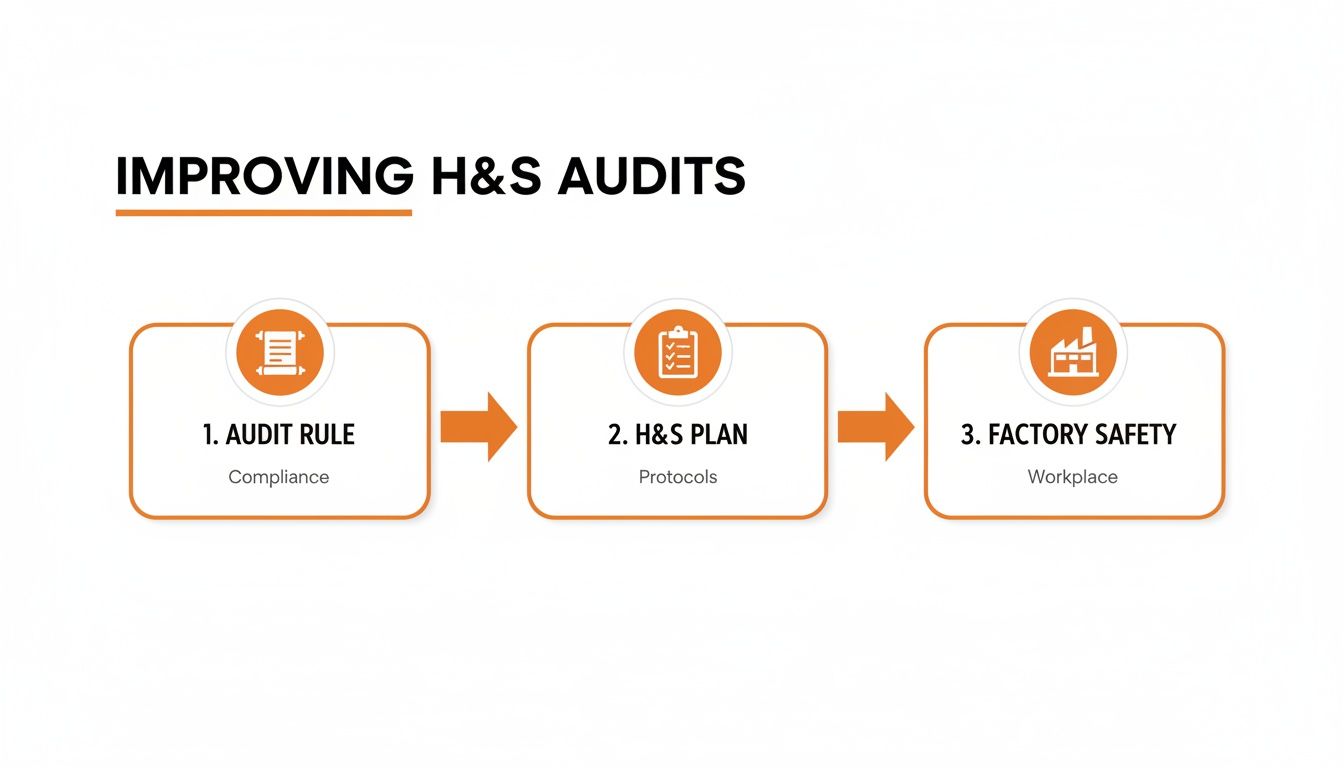
The flow here is simple but powerful. It connects the formal audit rules to your practical safety plan and how it’s actually executed on the factory floor.
Step 1: Organise Your Documentation
The single most common failure point in any audit? Disorganised or missing documents. Auditors need to see a clear, logical trail of evidence. If they can’t find something quickly, their default assumption is that it doesn’t exist.
Your first job is to get everything into one place. This could be a physical filing system or a digital platform, the key is accessibility.
- Policies and Procedures: Are your official H&S policies current, signed, and dated? Critically, they must reflect your actual operations, not just a generic template you downloaded.
- Risk Assessments: These are non-negotiable. Every high-risk task needs a corresponding assessment that’s regularly reviewed and updated, especially after an incident or a change in process.
- Safe Work Method Statements (SWMS): For any high-risk construction work, your SWMS must be site-specific and available to the teams doing the work. An auditor will definitely check this.
Having these foundational documents in order is the first impression you make. It tells an auditor everything about your commitment to compliance before they even ask a question.
Step 2: Verify Records and Evidence
Once your core documents are sorted, the next step is to prove your systems are actually being followed. This is where you show that your policies are more than just words on a page.
This evidence is what brings your safety system to life. Without it, your policies are just good intentions.
An auditor's job is to verify, not just trust. They work on a simple principle: "show me, don't tell me." Your goal is to make it easy for them to see the proof.
Go through the following records and check them for accuracy and completion:
- Training and Competency Records: Can you instantly pull up a record for any employee that shows what training they’ve done, when they did it, and that they were deemed competent? Gaps here are a massive red flag.
- Inspection and Maintenance Logs: All critical equipment, from forklifts to fire extinguishers, must have up-to-date inspection and maintenance logs. To be considered valid evidence, they need to be signed and dated.
- Incident Reports: Make sure every incident report is fully filled out, including the investigation findings and, crucially, the corrective actions taken to stop it from happening again.
For a deeper look at managing the entire lifecycle, explore our complete guide to audits and compliance to see how every piece fits together.
Step 3: Confirm Corrective Actions Are Closed Out
One of the very first things an auditor will ask for is the report from your last audit. They want to see that you took the previous findings seriously and actually fixed the problems identified.
Leaving corrective actions open sends a clear signal that your company doesn’t have a real system for continuous improvement. It suggests that issues are found but never properly resolved.
- Review Past Reports: Pull up your last two or three audit reports, both internal and external.
- Create a Master List: Make a simple list of every non-conformance or recommendation.
- Gather Evidence of Closure: For each item on that list, find and attach the proof that the issue was fixed. This could be a new procedure, a photo of a new machine guard, or a signed training record.
When you can show an auditor you have a reliable process for closing out actions, you build incredible credibility. It proves you are actively managing your compliance, which is a key principle underpinning Australian auditing standards.
Common Audit Failures and How to Avoid Them
Even the most organised businesses can get tripped up during an audit. It’s rarely a sign of a bad company, but more often a case of small, overlooked gaps in your processes that suddenly become big problems under an auditor's microscope. Knowing where these common tripwires are gives you a huge advantage. You can shore up your weak spots long before an auditor even sets foot on site.
An audit failure isn't just a black mark on a report; it points to deeper operational risks. Whether it's a financial audit or a health and safety review, the most frequent issues are surprisingly basic and almost always preventable with a bit of structure.

Let’s break down the four most common reasons audits go wrong and, more importantly, the practical steps you can take to make sure they don't happen to you.
Problem 1: Incomplete or Missing Records
This is, without a doubt, the number one cause of audit non-conformance. It’s a simple story: an auditor asks for a specific training record, an inspection log from three months ago, or a risk assessment for a new piece of machinery, and... crickets. It just can’t be found.
If you can't produce the evidence, an auditor has no choice but to assume the activity never happened. This issue usually comes down to messy, decentralised systems. Think binders in different site offices or shared drives where documents get lost, filed incorrectly, or were never even filled out in the first place.
- Practical Solution: Centralise everything. Get all your compliance records into a single digital platform where they’re stored, version-controlled, and easy to search. You can even set up automated reminders for recurring tasks, like monthly equipment checks, to make sure the records are actually created on time, every time.
Problem 2: Inconsistent Documentation Between Sites
For businesses with more than one location, consistency is a massive headache. You might have one site with pristine, up-to-date records while another is still using outdated forms or missing inspections entirely. To an auditor, this inconsistency is a huge red flag. It shows that your company’s safety and compliance systems aren't being applied uniformly.
An auditor needs to see that your standards are the same everywhere; that’s a core principle when they assess compliance with the auditing standards Australia requires.
The real problem here is the lack of a single source of truth. When every site manager is left to create their own system, consistency becomes impossible to maintain or prove.
- Practical Solution: Standardise all your forms, checklists, and procedures across the whole organisation. A central digital system is the best way to do this, as it guarantees every site is using the latest, approved version of any document. This also gives head office a real-time view of compliance across all locations, letting you spot and fix inconsistencies before they become audit failures.
Problem 3: No Evidence of Corrective Actions
Finding a problem is only half the job. An auditor will always dig into what you did about the findings from previous audits or internal inspections. If they see the same issues popping up year after year with no documented proof of resolution, it signals a systemic failure to improve.
Just saying "we fixed it" isn't going to cut it. You need a clear paper trail showing the problem was identified, a solution was implemented, and you actually verified that the fix worked.
- Practical Solution: Set up a formal corrective action tracking system. When an issue is raised, assign it to a specific person with a non-negotiable deadline. To close out the action, require proof to be uploaded, like a photo of the new machine guard in place or a signed training record for a new procedure.
Problem 4: Poor Tracking of Subcontractor Compliance
Finally, your responsibility doesn't stop with your own employees. In industries like construction and manufacturing, you're on the hook for the compliance of every subcontractor working on your site. Auditors will definitely check if your subs have the right licences, insurances, and safety paperwork.
Failing to manage this opens your business up to enormous risk. A messy folder of subcontractor documents or being unable to produce a subbie's Safe Work Method Statement (SWMS) on demand is a critical failure waiting to happen.
- Practical Solution: Use a dedicated system for managing your subcontractors. It allows you to collect, verify, and store all their compliance documents before they even set foot on site. You can also get automated alerts when a subcontractor's insurance or licence is about to expire, so you’re always partnering with compliant, low-risk companies.
Using Technology to Simplify Audit Compliance
Let’s be honest, trying to keep up with the paperwork and records required by Australian auditing standards can feel like a constant battle. If you’re a Health and Safety Manager in a busy construction or manufacturing environment, you know this all too well. The time you spend chasing signatures, digging up lost forms, and wrangling spreadsheets is time you’re not spending on the factory floor or worksite where it counts. This admin trap is a massive source of audit failures, but thankfully, there’s a much better way.
Modern digital tools are built to solve these exact headaches. Instead of relying on scattered paper records or confusing spreadsheets, a single, central system makes gathering and finding audit evidence simple and fast. This is not just about making life easier; it’s about building a solid, always-on, audit-ready compliance framework from the ground up.
From Paperwork to Real-Time Proof
The biggest game-changer with technology is the shift from reactive record-keeping to proactive evidence collection. Digital platforms give you live visibility across your entire compliance system, turning abstract data into genuinely useful information.
Modern dashboards, for example, give you an immediate, bird's-eye view of your compliance status. You can see exactly where you stand, from open incident reports to overdue actions, giving you the chance to fix issues long before an auditor even sets foot on site. It completely changes how you manage evidence by linking every activity directly to a verifiable, time-stamped record. For a deeper look into how these systems work, our overview of health and safety compliance software breaks down the core features.
Here are a few features that make a direct, practical impact on audit readiness:
- Automated Form Completion: Digital forms can be filled out right there on a phone or tablet, with photos attached and automatic time-stamping. This makes sure that records are complete, legible, and locked in at the right time.
- Real-Time Monitoring: Dashboards give managers a live feed of compliance across all sites. You can instantly spot which inspections are overdue or which corrective actions are still hanging. No more surprises.
- Integrated Subcontractor Oversight: Managing subcontractor paperwork is a classic weak spot. A digital system lets you collect, verify, and track all their compliance documents in one place, sending automated alerts for expiring insurances or licences.
Focusing on Safety, Not Administration
When it comes down to it, technology serves one main purpose: it cuts down the administrative burden of compliance. By automating reminders, centralising documents, and making reporting a breeze, it frees up your managers to focus on what actually matters, managing safety risks and protecting your people.
This approach lines up perfectly with the principles that auditing standards Australia promotes, which are all about verifiable evidence and systematic processes. Modern tools just make achieving this standard far more practical. It's a trend happening across the board; looking at developments in AI in accounting shows how automation is taking over complex admin tasks in other business functions, too.
By bringing these tools into your safety program, you build a compliance system that is not just prepared for an audit but is fundamentally stronger and more effective every single day.
Your Questions Answered
When you're trying to connect the dots between formal auditing rules and your on-the-ground safety duties, a few questions always seem to pop up. Here are some straight answers to the most common queries we get from managers in construction and manufacturing.
Do Australian Auditing Standards Actually Apply to My H&S Audits?
The short answer is no, not directly.
The official Australian Auditing Standards (ASAs), set by the AUASB, are legally binding for financial audits under the Corporations Act 2001. They don't carry the same legal weight for your internal health and safety reviews.
However, thinking like a financial auditor is a massive advantage. Their core principles, like demanding objective evidence, ensuring independence, and following a clear, systematic process, are a gold-standard framework. Applying that mindset to your H&S audits makes them far more robust, credible, and easier to defend if a regulator ever comes knocking.
What’s the Difference Between a Qualified and Unqualified Audit Report?
This language comes straight from the world of financial auditing, but it’s a really useful concept for anyone doing reviews.
- An unqualified opinion is the goal. It’s a clean bill of health, meaning the auditor is confident the records are accurate and follow all the rules.
- A qualified opinion is a big red flag. It means the auditor found a specific problem they couldn't sign off on, even if the rest of the report looks okay. Think of it as the auditor saying, "Everything here seems fine, except for this one major issue we need to call out."
For a safety audit, a 'qualification' would be like reporting that your safety system is generally effective, but you have a serious concern about one area. For instance, noting that machine guarding in the fabrication workshop is completely inadequate.
Who Is Actually in Charge of Creating Auditing Standards in Australia?
The official body with this responsibility is the Auditing and Assurance Standards Board (AUASB).
They're a government-appointed board that operates independently to make sure Australia's auditing standards are tough, trustworthy, and maintain public confidence in financial reporting. They're the ones who write the legally binding ASAs that financial auditors must follow.
Can We Just Conduct Our Own Internal Audits?
Absolutely. In fact, you should be. Regular internal audits are a cornerstone of any strong safety and compliance system.
The trick is to make them as objective as possible. While you don’t need to be a certified external auditor, the person doing the review shouldn't be auditing their own work. For example, it’s not ideal to have the warehouse manager audit the warehouse team’s safety processes. You’ll get a much more honest assessment if an H&S officer or a manager from a different department handles it.
Ready to stop chasing paperwork and build a truly audit-ready compliance system? Safety Space replaces messy spreadsheets and forgotten forms with a single platform for real-time monitoring and evidence collection. Book a free demo today to see how you can simplify compliance and focus on what really matters.
Ready to Transform Your Safety Management?
Discover how Safety Space can help you implement the strategies discussed in this article.
Explore Safety Space FeaturesRelated Topics
Safety Space Features
Explore all the AI-powered features that make Safety Space the complete workplace safety solution.
Articles & Resources
Explore our complete collection of workplace safety articles, tools, and resources.