
Taking corrective action doesn't necessarily mean a workplace is learning from its incidents. In Safe Work Australia's construction-industry perceptions study, almost all respondents agreed that corrective action followed reports of unsafe practices, yet only four in 10 employers said their workplace reviewed incident reports and statistics. A corrective action register template should connect those activities: record the response, preserve the evidence and make recurring failures visible.
The useful distinction is between finishing a task and verifying a control. A revised procedure, completed toolbox talk or uploaded photograph may support closure. None should replace a clear test of whether the risk has been controlled.
Table of Contents
- Fields Every Corrective Action Register Needs
- Where Each Action Comes From and How to Rank It
- How to Log an Action from Finding to Verified Closure
- Setting Owners, Deadlines and Escalation Rules
- Verifying Closure and Proving the Control Works
- Set Up Your Register This Week
Fields Every Corrective Action Register Needs
Required fields and what each one records
| Field | What to Record | Why It Matters |
|---|---|---|
| Action ID | Unique number linked to the source record | Lets a reviewer trace one action across reports |
| Source | Incident, inspection, audit, regulator notice, worker report or consultation | Shows where the issue came from and which process owns the fix |
| Site or project | Location and responsible business unit | Supports site-level trends and contractor reporting |
| Finding | Objective description of the condition, not the cause | Stops vague actions such as “improve housekeeping” |
| Risk rating | Consequence and likelihood score from the risk assessment | Sets the deadline and escalation level |
| Interim control | Immediate containment, such as isolating faulty plant | Separates temporary containment from permanent treatment |
| Root cause | Investigation method, such as 5 Whys or ICAM, and its findings | Shows whether the response addresses the system or only the symptom |
| Corrective action | Permanent change to the control, procedure, plant or training | Describes what changes on the ground |
| Control hierarchy level | Elimination, substitution, engineering, administrative or PPE | Shows whether the fix relies on people remembering |
| Accountable owner | A named manager who answers for closure | Establishes clear management accountability |
| Action owner | The person doing the work | Makes day-to-day responsibility clear |
| Target date and status | Due date; open, in progress, awaiting verification or closed | Drives overdue reporting |
| Verification method and evidence | Inspection, measurement, worker confirmation or attached records | Tests whether the control works, not just whether a task finished |
| Closure approval and effectiveness review date | Sign-off by someone other than the owner, plus a follow-up date | Prevents self-closure and helps detect recurrence |
An action without a source, owner and verification requirement is a to-do item, not a complete corrective action record. Keep the source reference specific enough to retrieve the original inspection, incident report or consultation record. Where a finding generates several actions, retain their connection rather than copying an incomplete description into unrelated rows.
The finding needs observable detail. Pallets stacked two high in aisle 4 at the north gate identifies a condition that a supervisor can inspect. Improve housekeeping describes an intention and leaves the actual problem open to interpretation.
Separate the event, cause and response
The finding records what happened. The root-cause field records why the system allowed it, while the corrective-action field states what will change. Combining these into a single notes cell makes it difficult to challenge weak reasoning.
Keep interim controls separate too. Isolating a defective machine controls immediate exposure; changing procurement, maintenance or guarding arrangements addresses the longer-term failure. Recording isolation as the permanent fix can leave the original cause untouched.
This design supports AS/NZS ISO 45001:2018, clause 10.2, which requires organisations to respond to incidents and nonconformities, address consequences, assess the need to eliminate causes, implement action, review effectiveness and retain documented evidence. The standard doesn't prescribe this spreadsheet layout. The fields provide a practical way to preserve that improvement trail.
Readability test: Someone who wasn't there should be able to read the record and understand what happened, who must act and how effectiveness will be judged.
A spreadsheet can hold these fields. Supporting investigation reports, photographs and measurements can remain in controlled storage, provided the register links to the correct records and those links remain accessible.
Where Each Action Comes From and How to Rank It
Federal Safety Commissioner 2020 corrective action categories
| Category | Reports (2020) | Share | Register Field to Add |
|---|---|---|---|
| Mobile plant | 554 | 14% | Critical control flag and plant ID |
| Emergency preparedness and response | 441 | 11% | Emergency drill date and response owner |
| Hazard identification, risk assessment and control | 348 | 9% | Linked risk assessment ID and revision |
| Subcontractor WHS management | 302 | 8% | Contractor name and prequalification status |
| All corrective action reports | 3,861 | 100% | Severity: major 1,878 (48.6%), minor 1,983 (51.4%) |
These figures come from the Office of the Federal Safety Commissioner's 2020 report, covering 404 on-site audits and 3,861 corrective action reports, of which 48.6% were major. They describe that audit population, not every Australian workplace.
Use the categories as starting drop-down options, then adapt them. A manufacturing plant may need machine guarding and isolation categories. A cleaning contractor may need chemical handling, equipment condition and public-interface controls.
Keep source and priority separate
The source identifies the trigger: incident, inspection, audit, regulator notice, worker report, management review or consultation. Record who raised it and why. An audit finding may expose a system gap; a worker report may identify a changed site condition that the formal inspection missed.
Set priority through the organisation's risk criteria, not the seniority of the person reporting it. Major findings warrant senior-manager review; failed critical controls require immediate containment. Minor findings still need a named local owner and an agreed deadline. For investigations requiring structured causal analysis, an ICAM investigation template can support the linked investigation record.
For notifiable incidents, Safe Work Australia's notification guidance requires immediate notification by the fastest available method and, when requested after a telephone report, written notification within 48 hours. Record the timestamp, regulator, method, people affected, treatment, site actions and site-preservation status, including any inspector direction. Under New Zealand's Health and Safety at Work Act 2015, notifiable events are reported to WorkSafe NZ; retain those fields, but check current NZ requirements rather than applying the Australian sequence.
Read category totals as prompts for investigation, not automatic solutions. If mobile plant dominates, examine pre-start checks, maintenance records, traffic separation and defect isolation before assigning another training session.
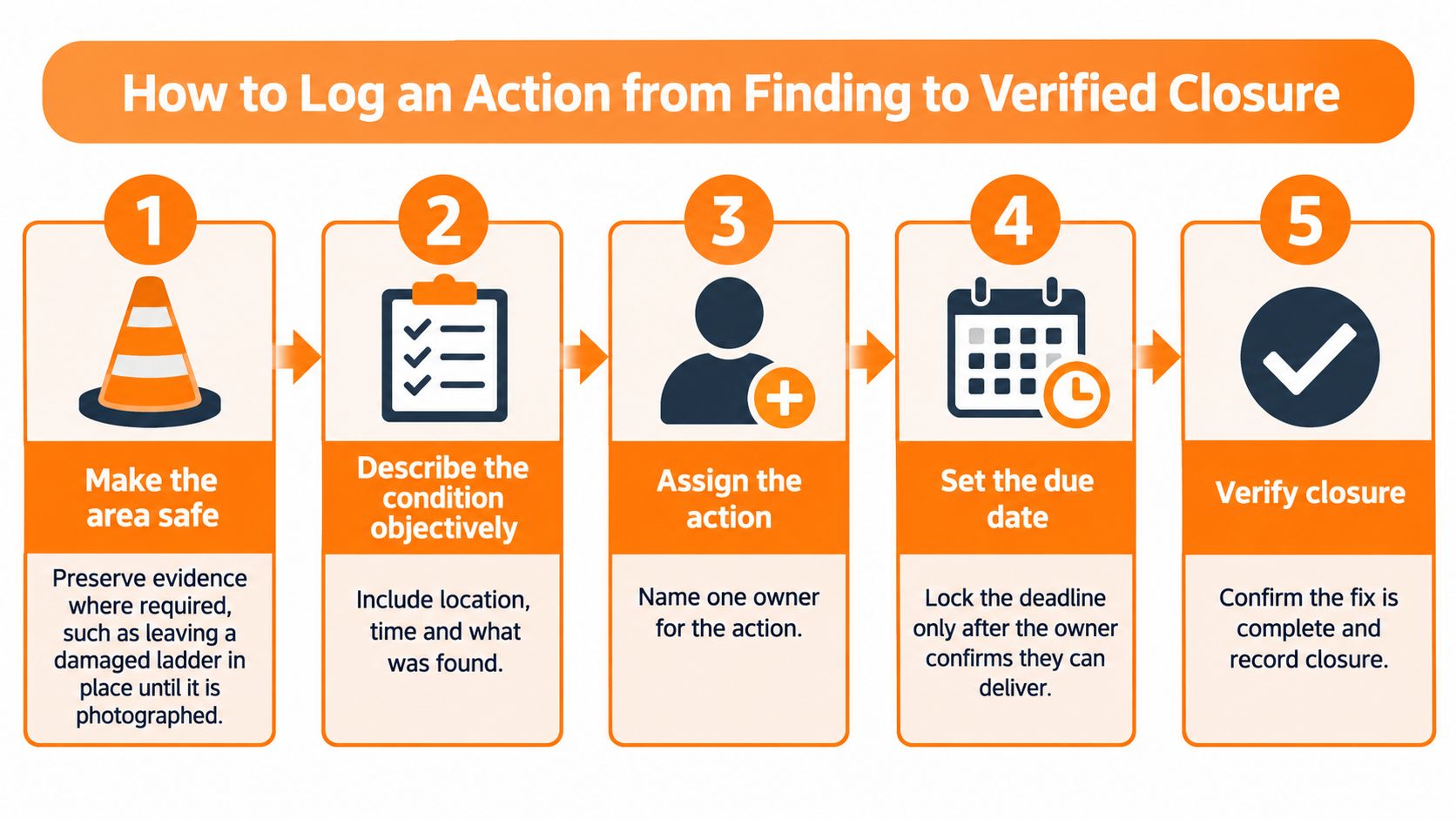
How to Log an Action from Finding to Verified Closure
The workflow should preserve decisions made between discovery and closure. A status change alone won't explain why a control was selected or what the verifier checked.
Record the response before assigning the fix
Make the area safe and preserve evidence. Stop exposure, isolate equipment or restrict access as appropriate, while meeting any incident-site preservation requirements. A damaged ladder should be photographed where safe, but evidence collection mustn't delay assistance or leave people exposed.
Describe the condition objectively. Record the location, time, equipment and observed condition, with photographs or document references where useful. Avoid conclusions such as careless operator before the investigation establishes what happened.
Assess consequence and likelihood. Apply the organisation's approved risk matrix to the actual exposure and failed controls. Don't downgrade the rating just because nobody was injured this time.
Confirm the interim control is operating. Record who isolated the machine, installed the barrier or stopped the activity, then confirm the restriction holds across shifts. A note saying supervisor advised doesn't establish that exposure has stopped.
Investigate, implement and test
Investigate the system causes. Use a proportionate method such as 5 Whys or ICAM, supported by evidence rather than assumptions. A consistent root-cause analysis format helps distinguish the immediate event from maintenance, supervision, design or work-planning failures.
Select a control that addresses the cause. Consider elimination, substitution and engineering before relying on reminders or retraining. If fatigue or workload contributed, examine staffing and task design; for an education workplace, teacher stress training from Premiere Education may support a targeted action, but it shouldn't replace changes to harmful work demands.
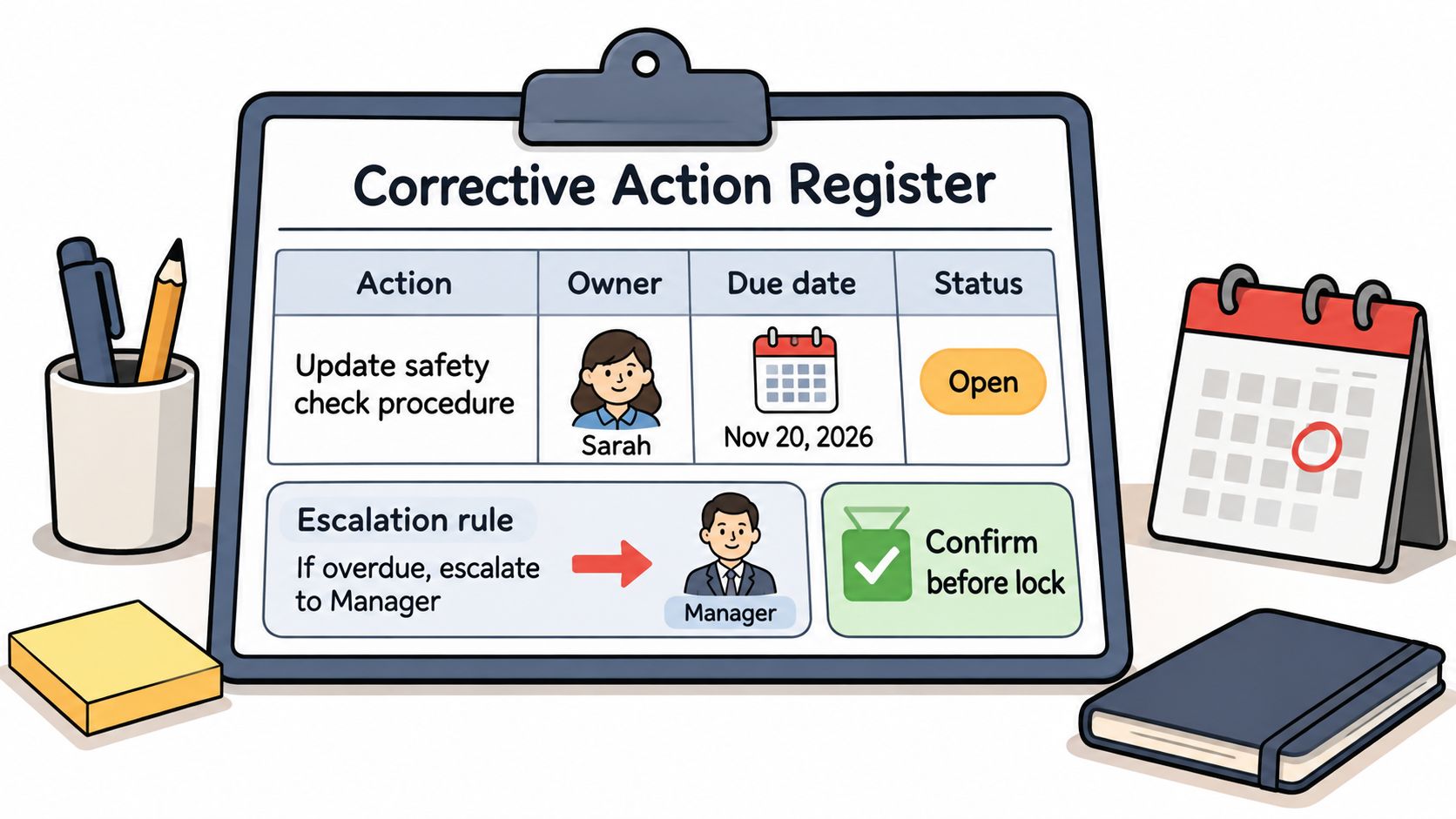
Agree ownership, timing and acceptance criteria. Name the person delivering the action and the manager accountable for it, then confirm resources before locking the deadline. Replace revise guarding with an acceptance criterion that specifies the affected machine, required guarding outcome and commissioning checks.
Verify implementation and reduced risk. Inspect the change during representative work, including relevant operating modes, rather than relying solely on an installation photograph. Record the result and any remaining limitations before seeking closure approval.
A manufacturing example makes the distinction clear. If operators remove a guard to clear recurring jams, replacing the guard doesn't address why access keeps occurring. The investigation should examine the jam mechanism, clearing method, isolation arrangements and equipment design before deciding the permanent treatment.
The Federal Safety Commissioner's 2022 annual report recorded incident-investigation-and-corrective-action findings in 30.6% of audited companies. Investigation quality and follow-through therefore deserve deliberate review, not just additional form fields.
A complete entry explains the problem, the selected fix and the evidence without requiring the reviewer to reconstruct the decision from emails.
Setting Owners, Deadlines and Escalation Rules
Give every action a named accountable manager, even when maintenance staff, supervisors and contractors share delivery. The action owner should accept the work and confirm access, resources and dependencies before the deadline is finalised. If delivery isn't feasible, reassign or resolve the constraint early rather than repeatedly extending the date.
Apply the deadline to the risk
Consider a missing scaffold tie on a residential build. The immediate response is to stop access and tag out the affected scaffold during the same shift, without allowing continued use while paperwork is completed. A competent person must determine the required rectification and release conditions.
The permanent response should address why the tie was missing. Assign the site supervisor responsibility for adding the appropriate pre-shift scaffold inspection to the supervisor checklist, alongside the physical rectification and any necessary change controls. A competent person verifies the scaffold before release, and subsequent checks establish whether the revised inspection process detects defects.
A checklist alone can't compensate for an unsafe scaffold. For contractor findings, identify the contractor company and name the principal contractor's supervising manager as the internal accountable owner, while retaining the contractor's delivery responsibilities.
Make escalation reach someone who can act
In Safety Space, actions can be raised from questions, assigned and closed out; raising an action immediately emails the responsible person and anyone listed under Settings → Action notifications. Include the relevant manager in that notification list. Closure involves adding a note and optional photos, then marking the action complete, so the organisation's verification requirements must determine when that final step is authorised.
Set escalation rules in writing:
- Overdue action: Refer it to the owner's manager, with current exposure and interim-control status.
- Repeat finding: Require review of the previous investigation and treatment, not another copy of the same action.
- Deadline extension: Record the reason, approving manager and continued adequacy of interim controls.
- Major finding: Keep it visible to senior management until the agreed assurance requirements are satisfied.
Reporting rule: Show open major actions, overdue work, repeat findings and elapsed time to verified closure. A completion percentage alone can conceal the actions that matter most.
Verifying Closure and Proving the Control Works
A completed task isn't automatically a controlled risk. Set a closure gate requiring implemented control, independent sign-off and a post-implementation effectiveness check. These are practical assurance requirements for the register, not a claim that every action has an identical statutory approval process.
The model WHS Regulations address corrective action in major-incident and emergency-plan procedures and require workers to inform supervisors about corrective action taken. The register should preserve that communication and the subsequent verification decision.
Closure evidence that holds and evidence that does not
| Evidence Offered | Shows the Task Was Done | Shows the Control Works | Required Next Step |
|---|---|---|---|
| Uploaded procedure revision | Yes | No | Post-implementation inspection of the revised work |
| Photo of a new guard fitted | Yes | Partly | Repeat inspection confirming the guard is used and effective |
| Training attendance record | Yes | No | Observed task or competency check after training |
| Toolbox talk sign-in sheet | Yes | No | Worker confirmation and a spot check of the behaviour |
| Measured exposure below the limit | Yes | Yes, for the conditions measured | Keep the measurement date, method and result on file |
| Ticked completion box alone | No | No | Attach evidence and name an independent verifier |
Match the check to the failure
A procedure revision proves the document changed. It doesn't establish that the revised work is practical during a busy shift. A training record establishes attendance, not competence.
For plant controls, observe operation, cleaning and relevant maintenance activities. For behaviour-dependent controls, schedule the effectiveness review when workers have had a genuine opportunity to use the revised method. An exposure result needs representative conditions and an appropriate measurement method, not merely a favourable reading.
Keep temporary measures identified as temporary. A temporary guard shouldn't pass as final treatment without confirming that it meets the intended control requirements. An internal WHS audit can sample closed actions against those acceptance criteria.
Preserve evidence and reopen failed actions
Safe Work Australia's construction incident-reporting guidance states that relevant risk assessments, WHS management plans and/or SWMS must be retained for two years after a notifiable incident. Certain health-monitoring records can require 30 years' retention under the model WHS Regulations' recordkeeping provisions, and records may need to remain available for inspection.
Check the applicable state or territory requirements rather than adopting a template-wide retention default. Restrict sensitive evidence appropriately and preserve versions, approvals and changes instead of overwriting the original record.
If residual risk remains unacceptable, reopen and escalate the action. A repeat finding within the review window is a trigger to reject the original effectiveness conclusion and investigate why the treatment failed.
Set Up Your Register This Week
Use the setup week to establish the rules, then test them through normal operations. Avoid redesigning every existing record before checking whether supervisors can use the proposed structure.
Run the pilot on live work. Take at least three actions, one each from an incident, an inspection and a contractor finding, and carry them from assignment through to verified closure within 30 days. During the month, log:
- Where each action stalled: unassigned, awaiting evidence, or reopened after review.
- The time from finding raised to a responsible person accepting it.
- What the closure evidence showed, and whether it proved the control works rather than just that a task was done.
- For any action that fails its effectiveness check, what was tried, why it did not hold, and what changed on re-issue.
That failure record matters more than a clean sheet. A register that closes weak fixes hides recurring risk. One that records why a treatment failed gives the next owner something to work from.
At day 30, walk the stalled items back to the step where they stopped and fix that step, whether it is the assignment rule, the evidence requirement or the review window.
Where findings concern suspected asbestos, retain the connection to the relevant asbestos records rather than treating the issue as ordinary maintenance. TP Training's guidance on documenting presumed asbestos-containing materials provides useful context for that distinction.
Before accepting the pilot, have a manager unfamiliar with the findings review the records. The register passes when that reviewer can follow the decisions and assess the evidence without chasing the people involved.
Safety Space provides corrective actions linked to inspection questions, with responsible people, due dates and follow-up records. Visit Safety Space to discuss putting those workflows into practice while retaining the verification and closure rules the organisation needs.
Ready to Transform Your Safety Management?
Discover how Safety Space can help you implement the strategies discussed in this article.
Explore Safety Space FeaturesRelated Topics
Safety Space Features
Explore all the AI-powered features that make Safety Space the complete workplace safety solution.
Articles & Resources
Explore our complete collection of workplace safety articles, tools, and resources.