
A supervisor has a printed SWMS in the ute, a worker has a downloaded copy on a phone, and the office register shows a newer revision. Before work starts, someone needs to establish which instruction applies. A later upload date or a filename ending in final2 won't settle that question.
Document control version rules must establish what governed the work, not just which file was saved last. That means connecting each release to its approval, effective date, affected workers and retention requirements.
Table of Contents
- Version Numbers and Status Labels for Controlled Documents
- How to Run a Revision and Approval Workflow
- Building a Revision History That Proves What Applied
- Keeping Superseded Copies Out of Field Use
- Retention Periods for Superseded Versions
- Fix Version Control Failures This Week
Version Numbers and Status Labels for Controlled Documents
Document status labels and what each allows
| Status | Meaning | Who can use it | Required action |
|---|---|---|---|
| Draft | Being written or reviewed; not for field use | Author and reviewers only | Do not print or issue |
| Approved, not yet effective | Approved but not yet in force | Document owner | Brief workers before the effective date |
| Current | The only version workers may use | All users | Use this version |
| Superseded | Replaced by a newer approved version | Read-only, records only | Keep for investigations and audits |
| Withdrawn | Taken out of use with no replacement | Read-only, records only | Remove from field access and keep the record |
Status answers whether a document can be used. Version identifies the particular release. Neither replaces the other. A higher revision number can still belong to a draft or an approved document awaiting implementation.
Western Australia's State Records Office version-control guidance identifies uncertainty when documents on network drives undergo repeated revisions or involve multiple contributors. It recommends a documented process with consistent filenames, version identifiers and an audit trail, including the ability to establish which version applied historically.
Set a numbering rule that reflects the change
Use whole-number changes for revisions that alter hazards, controls, task sequence or scope. For example, a hypothetical move from 1.0 to 2.0 could identify a changed isolation method. Use decimal changes for minor edits that leave controls unchanged, such as 1.0 to 1.1 for a corrected heading.
This is an organisational convention, not a universal legal numbering system. Document it and apply it consistently. A supposedly minor edit that changes how a worker interprets a control belongs through substantive review.
Each copy should carry a header showing:
- Identity: Unique document ID and title.
- Release: Version, status and effective date.
- Accountability: Owner and named approver.
- Review: Next review date.
Assign the name, version and review date when the document is uploaded, rather than leaving someone to reconstruct them later. Filenames should support those fields, not substitute for them.
For SOP authors checking whether responsibilities and review arrangements are missing, MakeAutomation's guide to mandatory SOP sections and governance provides a useful structural cross-check.
Make status visible without opening another file
Drafts stay with authors and reviewers. Approved future releases stay out of operational use until their effective date. Current copies govern work; superseded and withdrawn copies remain records, not alternative instructions.
Practical rule: A worker should be able to distinguish an operational instruction from a historical record from the header alone.
A useful site check is to select any available copy and attempt to confirm its status against the register in under a minute. If the supervisor has to telephone the author, the identification system needs attention.
How to Run a Revision and Approval Workflow
A revised SOP isn't ready for release just because its author has finished editing. The reviewer must check the controls, the approver must authorise the instruction, and the supervisor must prepare affected workers.
The ISO implementation guidance for migration to ISO 45001:2018 maps document creation and updating to clause 7.5.2, and control of documented information to 7.5.3. Identity and suitability, approval before release, and subsequent access and change control are separate controls.
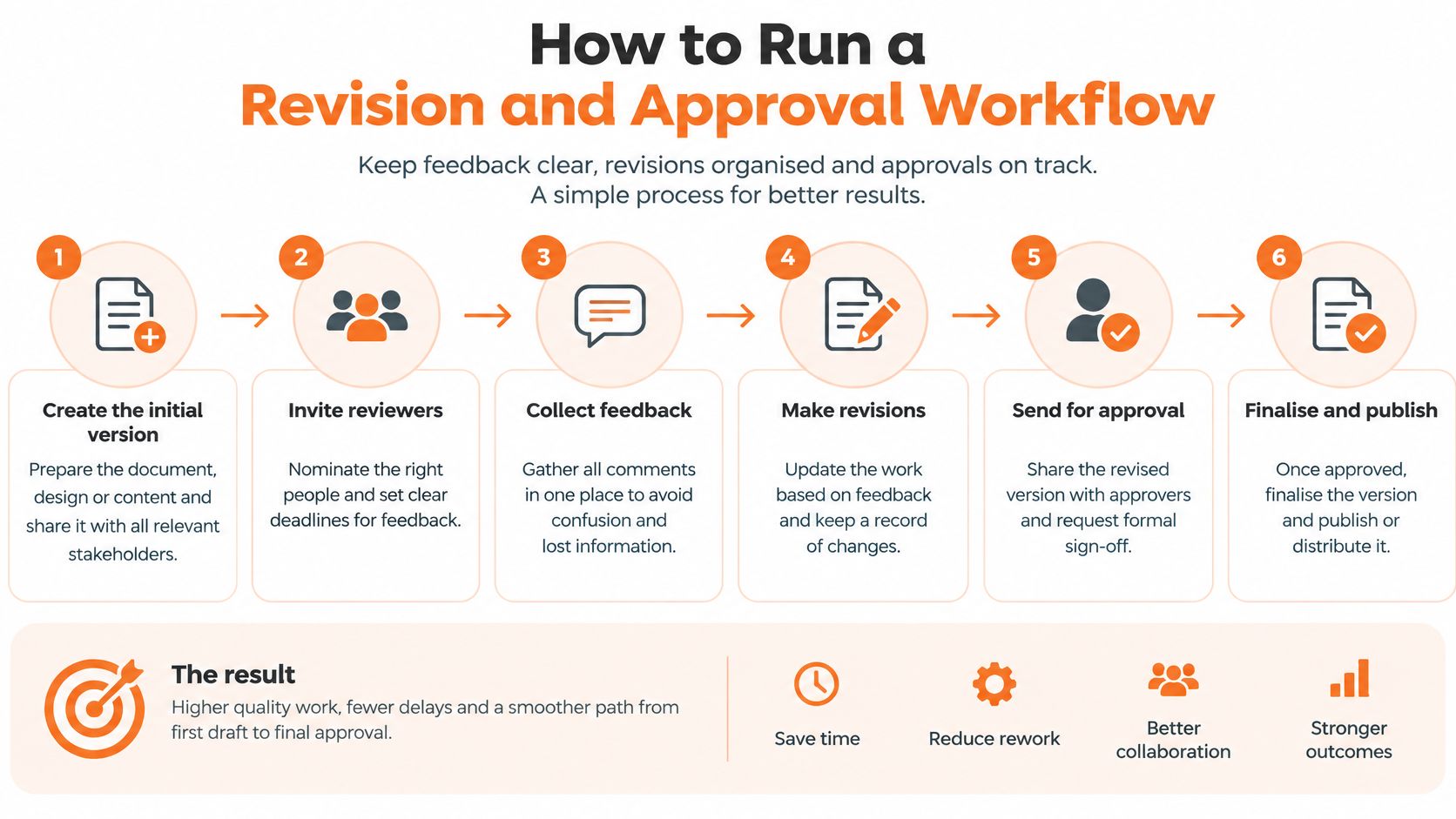
Follow a release routine
Log the change request. Record the trigger, requested change and responsible owner. An incident, audit finding, legislative change or new hazard needs a traceable connection to the resulting revision.
Draft from the current approved copy. Mark changed wording or provide a comparison, rather than asking reviewers to discover edits across a rewritten document. Preserve the source release so the draft doesn't become the live instruction.
Check the dependent controls. Compare the proposed steps with the risk assessment, equipment requirements, permits and training. Moving a cleaning step earlier in a production shutdown, for example, may change the isolation conditions required before access.
Obtain worker comment. Ask the people performing the task to test whether the revised sequence is workable. Record their feedback and how the author resolved it, including reasons for rejecting a suggested change.
Obtain named approval. Route the draft to the person authorised to accept its operational content. Keep the signature or electronic approval evidence against the exact revision, not in an email detached from the file.
Set the effective date and publish. Allow time for briefing, equipment changes or training before implementation. Keep approved future releases separate from drafts and from the version currently governing work.
Close the distribution task. Withdraw replaced copies and collect acknowledgements from affected workers before the change takes effect. Where workers aren't ready, the supervisor needs an explicit decision about whether the affected work can proceed.
The release sequence can be communicated visually alongside the written procedure.
Keep approval separate from administration
The person uploading a file isn't necessarily qualified to approve its controls. WebinOne's explanation of approval roles, stages and gating is useful when defining who can advance a draft and what must be completed before release.
Configure the document management program around those responsibilities, rather than allowing upload access to imply approval authority. Supplier revisions also need a review gate before acceptance into the live register. A changed supplier instruction may affect an existing procedure without changing its title.
Good approval leaves no ambiguity: a named approver, an approval date and a stated reason for the change. An upload timestamp proves receipt, not technical acceptance.
Building a Revision History That Proves What Applied
The auditor's question is specific: which version governed this task, at this site, on this date? Producing the current SOP doesn't answer it. The organisation needs the historical instruction and evidence connecting it to the work.
ISO's records-management guidance treats records as evidence of transactions across digital, paper and other formats. For WHS document control, that means preserving the release history and the evidence of implementation, not merely keeping a folder of old files.
Record the change and its operational reach
Each revision entry should identify the revision number, author, change date and a useful summary of the edit. It should also record the reason or trigger, approver, approval date and effective date.
The operational fields matter just as much:
- Affected work: Sites, tasks, hazards and relevant competencies.
- Communication: Workers affected, notification date and briefing or retraining evidence.
- Historical boundary: When the release became effective and when it stopped governing work.
Each release should generate an audit event that ordinary users cannot edit afterwards. Corrections should create a further attributable entry rather than replace the original record. The audit trail should connect approval, publication and worker acknowledgement without relying on someone's memory.
Preserve the version attached to the evidence
Say a chemical-handling SOP changes its transfer method. The review should identify workers who acknowledged the previous release and trigger their briefing before implementation. A generic training attendance sheet won't establish which transfer instruction they received.
Safety Space's document library stores each document with its name, version and review date from upload. It keeps a review history and records a review once the document has been checked as current. Editing a form that already has submissions creates a new version, while older submissions retain the version they were filled against.
The same identification principle applies outside WHS. NanoPIM's example of controls to prevent wrong regional packaging images illustrates why an asset's intended application matters alongside its revision.
Historical evidence must retain the instruction attached to the event, not silently inherit today's wording.
Keep drafts and approved releases separate. Block routine deletion of superseded records until authorised disposal, and test whether the incident investigator can retrieve the governing version within two minutes.
Keeping Superseded Copies Out of Field Use
Version 4.2 sits in the register. Version 3.1 is laminated to the wall of the site shed, and the crew starting night shift is still working to it. Updating the register changes the record. What the field holds is a separate question with its own controls.
The Australian Digital Health Agency's WHS policy draws the same line between controlled electronic documents and printed copies whose currency must be checked. An uncontrolled-copy notice warns the reader. The check itself still needs a person with access to the current register.
Control the route workers use
Maintain one current effective release for each document ID and applicable scope. A QR code or document link should resolve to that release, rather than a static file that stays reachable after replacement.
Stamp printed copies uncontrolled, with the print date and a clear verification instruction. Where paper is necessary, nominate who replaces it and where copies are held. That nomination is what makes the stamp useful. A warning on paper does nothing once the sheet reaches a site folder, so the named person retrieves each printed copy when the register moves to a new version.
Offline access needs explicit operating rules:
- Before disconnection: Confirm the downloaded release and its effective status.
- At synchronisation: Remove superseded operational downloads while preserving historical records centrally.
- After withdrawal: Prevent new sign-ons and show supervisors which devices still hold the old release.
- During uncertainty: Escalate the discrepancy before the affected task continues.
A device that cannot confirm currency needs a defined fallback, such as a verified controlled site copy held by the supervisor. Workers should never carry the judgement of whether a cached instruction remains acceptable.
Restrict changes and coordinate rollout
Limit master-template editing and release approval to authorised roles. A supervisor may need to complete an inspection without having permission to overwrite the controlled SOP behind it. Granular permissions should distinguish those actions, just as they distinguish closing incidents or approving contractors.
Version inspection templates and coordinate their release across affected teams. Set a common implementation date where the same control must apply across sites, with a documented exception process where conditions differ.
Field check: Treat the register and the field as two separate checks. Confirm the upload, then confirm what the crew is holding.
The release still needs an effective timestamp, visible status, approval authority and acknowledgement. At the daily toolbox talk, the supervisor should compare the version on the talk sheet with the register and resolve any mismatch before discussing the task. When the versions line up, that record stands as proof of which instruction governed the work on that date.
Retention Periods for Superseded Versions
Withdraw superseded versions from active use, but don't delete them during routine housekeeping. Keep them read-only with their effective dates, approval history and applicable sites until authorised disposal.
Safe Work Australia's workplace risk-management fact sheet explains that most workplace risk records have no single prescribed retention period and identifies 28 days after completion for relevant risk assessments, extended to two years when a connected notifiable incident occurs. The risk-assessment figure below is a general minimum where that requirement applies, not a blanket disposal rule for every assessment.
Minimum retention periods for WHS records
| Record | Minimum retention | Extended when |
|---|---|---|
| Risk assessment for general work | At least 28 days after the work is completed, where applicable | Two years if a notifiable incident occurs in connection with the work |
| Health-monitoring reports | At least 30 years after the report is made | Keep confidential and restrict access by role |
| Air monitoring records | At least 30 years | Keep readily accessible to workers who may be exposed |
| Health-monitoring records for asbestos work | 40 years, per Safe Work Australia guidance | Keep apart from general safety documents |
| All other workplace risk records | No single prescribed period | Set by the activity and the applicable WHS Regulation |
The model WHS Regulations published by Safe Work Australia provide the 30-year health-monitoring and air-monitoring requirements and the 40-year asbestos health-monitoring requirement reflected above. The final column also includes handling controls, not just extensions; confidentiality and accessibility don't themselves change the retention clock.
Assign the disposal trigger by category
Separate confidential health-monitoring reports from general safety documents. Restrict access by role while maintaining the required access to air-monitoring records for potentially exposed workers. A normal procedure review must never overwrite these records.
The register needs the document type, related activity, issue date, review date and disposal trigger. An incident, investigation or legal hold should block scheduled deletion pending review.
Activity-specific rules need their own categories. For example, Safe Work Australia's diving requirements require a dive safety log to be kept for one year after its last entry. That trigger isn't the document's upload or review date.
Build the document retention policy around applicable jurisdictional requirements. Retention belongs to each record category in the register, not a single system-wide expiry setting.
Fix Version Control Failures This Week
A duplicate SWMS saved as final2 is a useful starting point. It gives the reviewer something concrete to investigate: who created it, whether anyone approved it, and whether a crew used it. Renaming the file won't resolve those questions.
The correction needs a control that another reviewer can verify. A promise to maintain better filing isn't enough.
Version control failures, causes and fixes
| Symptom | Likely cause | Fix |
|---|---|---|
| Two copies of the same SWMS with similar names | Files saved as final, final2 or revised | Put the document ID and version number in the header and filename, and restrict edit rights |
| Live document changed without sign-off | Edits made directly to the current file | Lock the current version so any change starts a draft with a new version number |
| No one can say which version applied on the incident date | No effective dates or read-only history | Record effective and superseded dates and keep superseded copies read-only |
| Worker signed onto a superseded version | Acknowledgement not tied to a version number | Require acknowledgement against the version and collect it again after a major revision |
| Superseded SWMS deleted after the project closed | Folder clean-up with no retention rule | Apply the retention rule by category and block deletion while the period runs |
| Review date passed with no action | Review dates not tracked or alerted | Set the review date on upload and alert the owner before it falls due |
Treat missing evidence differently from a confirmed operational failure. If an acknowledgement record is absent, the reviewer shouldn't invent a historical sign-off or backdate a briefing. Record the gap, establish what evidence remains, and arrange the required instruction before further affected work.
A review date passing also needs assessment, not an automatic declaration that every control is wrong. The owner must check whether the instruction remains suitable and record the outcome. Where currency can't be established, the supervisor needs an operational decision rather than an overdue alert left unanswered.
Run the register checks
Check release identity. Confirm the ID, version, status, owner, approver, effective date and review date on each controlled document. Compare the header with the register rather than accepting populated fields as proof of consistency.
Allocate overdue reviews. Give every overdue item a named owner and a completion date. Prioritise instructions supporting high-risk work and record interim arrangements where a full review can't be completed immediately.
Test withdrawn access. Attempt to open a superseded document through the routes workers use, including saved links and field devices. Preserve the historical record while removing operational access.
Sample major-change acknowledgements. Select three high-risk tasks as a practical starting sample and inspect whether affected workers acknowledged the relevant release. Check the briefing content as well as the signature.
Test deletion protection. Match each sampled record to its category rule and disposal trigger. Confirm that project closure, a changed review date or an ordinary folder clean-up can't bypass retention or an investigation hold.
Compare a physical site copy. Take an instruction from the toolbox folder, noticeboard or supervisor's ute and match it to the register. Record any discrepancy, the affected work and the person responsible for correction.
Australian retention settings shouldn't be copied unchanged onto overseas sites. For New Zealand operations, confirm requirements under the Health and Safety at Work Act 2015 and relevant WorkSafe NZ guidance before applying them. United States operations likewise need locally applicable retention rules rather than an Australian default.
Close the first failed check this week. Record the correction, its completion date and the evidence that demonstrates it worked, such as a blocked superseded sign-on or a verified replacement site copy.
Safety Space offers document version and review tracking, review histories, and versioned forms that preserve the version attached to earlier submissions. Visit Safety Space to discuss how those controls could support the document register and field workflows at the organisation's sites.
Ready to Transform Your Safety Management?
Discover how Safety Space can help you implement the strategies discussed in this article.
Explore Safety Space FeaturesRelated Topics
Safety Space Features
Explore all the AI-powered features that make Safety Space the complete workplace safety solution.
Articles & Resources
Explore our complete collection of workplace safety articles, tools, and resources.