A signed isolation certificate is not evidence of a safe isolation. The popular habit is to treat the signature as the control. It is not. An electrical isolation certificate template earns its place only when it records every energy source, each personal lock, the prove-test-prove result and a controlled hand-back. A blank line means the isolation is still open, including when a crew or a shift changes.
Construction, residential building, manufacturing, cleaning, facilities and waste sites already run SWMS, permits and contractor control. None of those documents prove a circuit was made dead and kept dead. Low-voltage work on de-energised equipment needs the plant disconnected from every relevant supply and left incapable of being energised without a deliberate act. The isolation point stays with the people doing the work. Locks and danger tags are used where they can be fitted.
File a certificate with a missing source, a missing lock or an unfinished test the same way you would leave a breaker closed. Don't start the task.
Table of Contents
- Fields Every Isolation Certificate Needs
- How to Record the Prove-Test-Prove Check
- Worked Example of a Completed Certificate for a Temporary Board
- Where the Certificate Sits Among Permits, SWMS and Personal Locks
- Handover When the Crew or Shift Changes
- Authorising Restoration and the Final Stop Check
Fields Every Isolation Certificate Needs
The form is a control record for one job. It is not proof that someone intended to isolate. Safe Work Australia's code of practice on managing the risks of plant sets the lock-out order the fields must follow: shut the plant down, identify every energy source and isolation point, isolate all sources, control or de-energise stored energy, lock each isolation point, apply tags, then test by trying to start the plant without putting anyone at risk.
Build the electrical isolation certificate template in that order. A line that sits out of sequence gets skipped when the job is rushed.
| Field | What to record | Why it is on the form |
|---|---|---|
| Equipment and circuit | Name, asset number, board and circuit | Stops the wrong plant being isolated |
| Task and boundary | Work to be done and the area that stays isolated | Sets what the certificate covers |
| Site or project | Location, project and permit or job number | Ties the record to the workplace |
| Energy sources | Mains plus generators, PV, auxiliary boards, back-feeds and stored energy | Stops a second supply being missed |
| Isolation points | Each point, location and method | Shows where the supply was broken |
| Locks and danger tags | Lock and tag numbers, who applied each one | Keeps the point under worker control |
| Stored energy | How capacitors, springs, pressure or gravity were discharged or blocked | Covers energy that remains after switching |
| Verification | Tester, instrument, method, result, date and time | Proves the circuit was tested dead |
| Workers | Each authorised person and their personal lock | One supervisor signature is not enough |
| Restoration | Clearance, covers, lock removal and who authorises re-energising | Controls the hand-back |
What a missing source line actually means
The failure that hurts people is isolating the normal mains and leaving a second supply live. Generators, photovoltaic systems, auxiliary boards, standby plant and back-feeds are energy sources, not footnotes. The plant code notes that electrical isolation may involve multiple sources and standby systems, and that isolation points should be locked where practicable. For more than one person on the same conductors, name each authorised worker and the personal lock that worker fitted. The isolation point has to stay under the control of the person working on those conductors.
Stored energy is its own line. A switch that is open doesn't discharge a capacitor, release a spring, or stop a load that can move under gravity. Write the method used to discharge or block that energy, and who did it.
Practical rule: A blank source line or a blank lock line is an open isolation. It is not a finished certificate.
Keep the permit or job number on the same record so the isolation can be found with the task, not in a separate folder a week later. Number the controlled document template the same way you number other site records, with a revision and a site or asset tie.
A digital form should refuse to close until every source, lock, tag and verification line is complete. It should keep a timestamp against the site or asset. A paper form needs the same discipline. Don't let a supervisor sign across empty rows to "get the permit moving".
How to Record the Prove-Test-Prove Check
A lock and a danger tag show intent. The test shows whether the circuit is dead. Safe Work Australia's guidance on managing electrical risks requires the supply to be stopped from inadvertent re-energisation by a deliberate control that can withstand conditions such as vibration. The same guidance requires instruction, training and supervision so nobody reconnects it. A voltage sticker or a "switched off" label is not that control, and it is not the test.
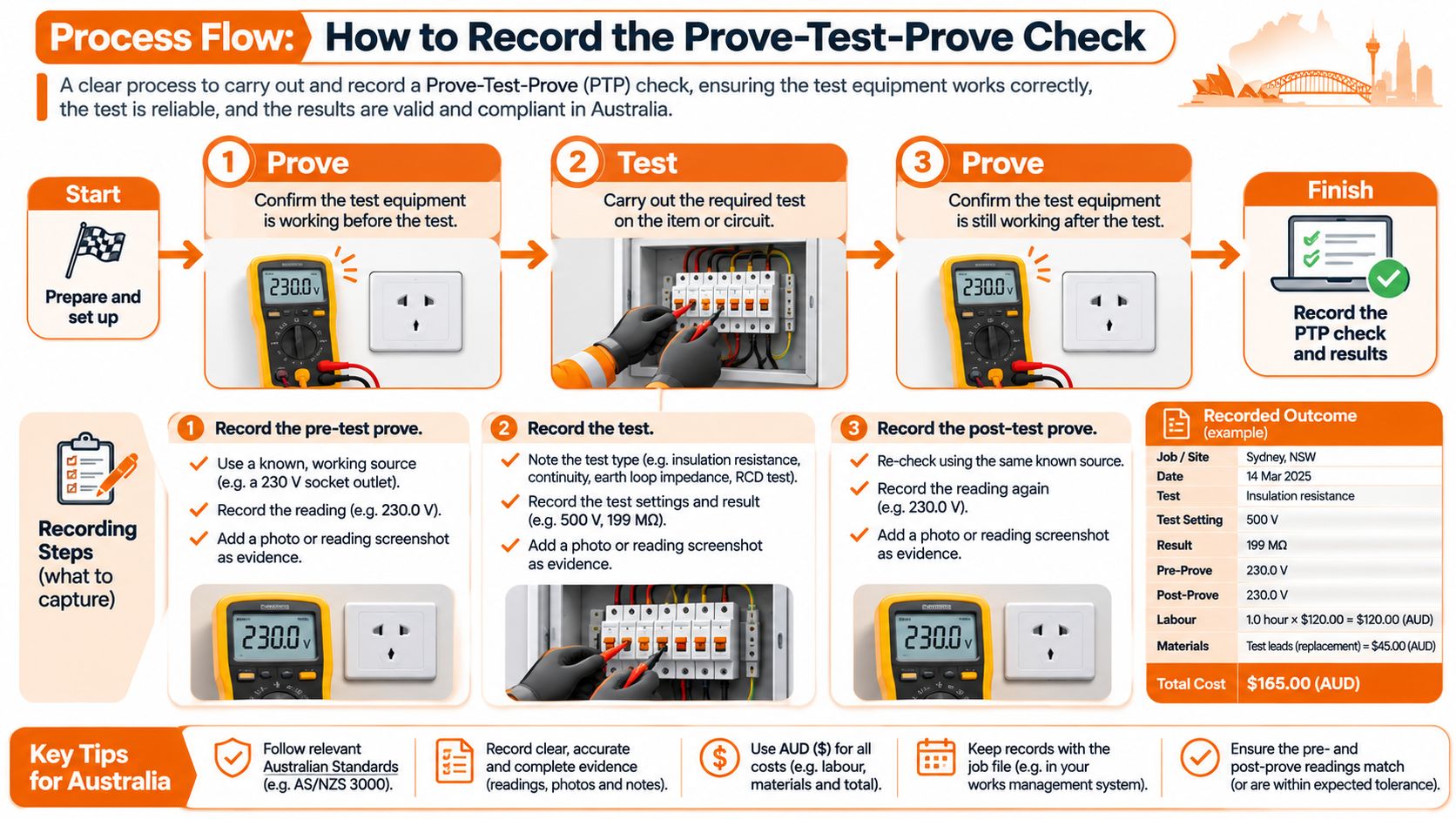
Give the electrical isolation certificate template a dedicated prove-test-prove block. Four actions, in this order, each with its own line.
- Name the circuit and the exact test point. Write the board, the circuit and where the probes go. "At the board" is not a test point.
- Prove the tester on a known live source or an approved proving unit before you touch the isolated circuit. Record the instrument identity.
- Test the isolated circuit for absence of voltage with an instrument suited to that installation. Where the installation has those points, record phase-to-phase and phase-to-earth results.
- Prove the tester again on the same known live source. A tester that fails the second prove invalidates the dead reading.
What else sits on the test block
Record the tester's competency or licence, the date and the time. Add a limitations line. Use it for inaccessible conductors, induced voltage, or a test point that is not the conductor being worked on. A limitation is a reason to stop and find a valid test, not a comment that lets work continue.
An incomplete test, a failed prove, or a result that isn't zero where it should be, stops the job. Don't file it and "confirm later". The people who need that habit reinforced are the same people who should hold current lock out tag out training, including supervisors who sign permits but don't hold the tester.
A lock proves someone intended to isolate. Only the second prove, after the dead test, shows the instrument was still working.
Safe Work Australia points to AS/NZS 3017:2007 for verification after supply is restored, including polarity, switched actives and phase sequence where it matters. Those checks belong on the restoration close-out, not in the dead test. Don't mix them into the prove-test-prove block or the dead test will look finished when it isn't.
Worked Example of a Completed Certificate for a Temporary Board
Every value below is illustrative. Replace it with the site's own board, locks, names and times. The job is a temporary distribution board fed from the street supply and a diesel generator. Two sources, two isolation points, two workers.
| Field | Example entry |
|---|---|
| Equipment and circuit | Temporary board TB-2, circuit 4 feeding the site office |
| Task and boundary | Replace RCD on circuit 4; boundary is the board outgoing terminals |
| Site or project | Lot 14 Greenfield estate, permit PTW-118 |
| Energy sources | Street supply; diesel generator G1 feeding the board; no PV on this board |
| Isolation points | Street supply main MS-1 locked; generator isolator GI-3 locked and tagged |
| Locks and danger tags | Lock L-22 on MS-1 held by Electrician A; danger tag DT-09 on GI-3 signed by Electrician B |
| Stored energy | Generator stopped and cranking disabled; residual energy discharged per method |
| Verification | Tester TST-07 proved on known live source; dead test phase-to-phase and phase-to-earth; tester reproved; date and time recorded |
| Workers | Electrician A and Electrician B, each with competency reference and personal lock |
| Restoration | Guards and covers replaced; each owner removes own lock; supervisor authorises re-energising |
How to read a full page
Equipment and circuit is written out in full. "Temp board" on its own can match three boards on a residential site. Task and boundary says the RCD on circuit 4, and that the outgoing terminals stay inside the isolation. Work past those terminals needs a new record.
Energy sources lists the street supply, generator G1, and a positive statement that this board has no photovoltaic supply. Silence is not the same as "no PV". Isolation points is one line per point, each with its device. Locks and danger tags names who holds L-22 and who signed DT-09. A shared key in a supervisor's pocket doesn't appear on this form because it isn't worker control.
Stored energy records that G1 was stopped and cranking was disabled, then that residual energy was discharged by the method the procedure names. Verification names the instrument, the known live source, both legs of the prove, the dead-test points, and the time. Workers carries a competency or licence reference for each person, not a company name alone.
When the page is still open
A blank in energy sources, isolation points or verification means the isolation is still open. Don't issue the page, and don't let the RCD change start. Restoration stays blank until the work is finished. Filling it in at the start, "to save time at knock-off", hides the hand-back.
If a third supply is found after the page is issued, stop, add the source and its lock, and repeat the dead test. Don't annotate the old result.
Where the Certificate Sits Among Permits, SWMS and Personal Locks
Four documents get mixed up on site. They are not interchangeable.
| Document | What it controls | What it cannot replace |
|---|---|---|
| Isolation certificate | Sources, points, locks, test result and release | The method for the whole task |
| Permit to work | Authority to start and the conditions of the job | Proof the circuit was tested dead |
| SWMS or JSA | How high-risk work will be done | The live status of this isolation |
| Personal lock | That worker's control of the isolation point | A group or supervisor sign-off |
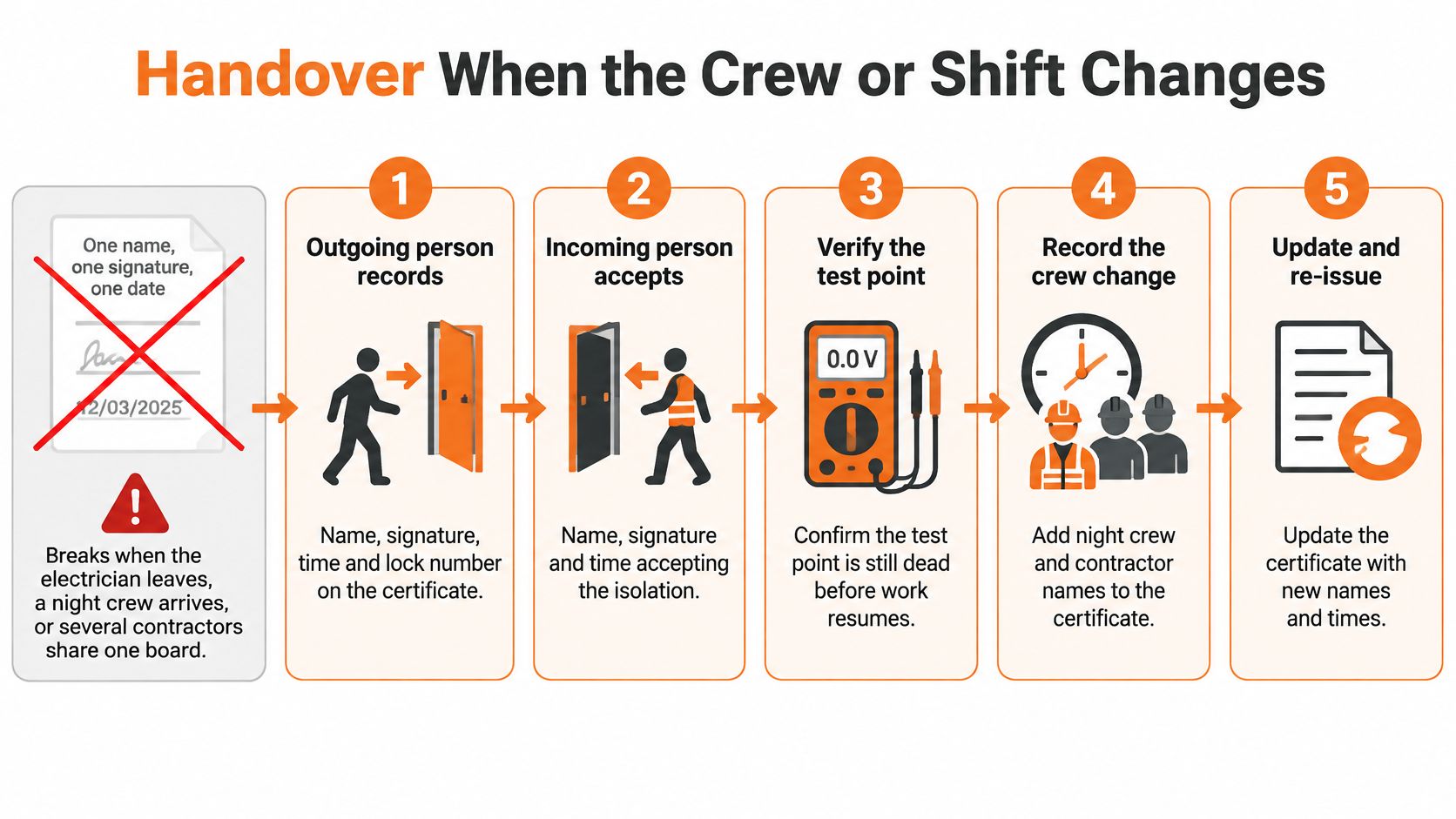
The certificate records sources, points, locks, the prove-test-prove result and the release. The permit authorises the task and its conditions. The SWMS or JSA sets how high-risk work will be done. The personal lock is that worker's own control of the point. A supervisor's signature doesn't replace a worker's lock.
Construction work and the SWMS link
Safe Work Australia's model code of practice for managing electrical risks states that a SWMS must be prepared before high-risk construction work starts, and that the work must be carried out as specified in that SWMS. Work on or near energised electrical installations or services is in that class, as is other work that meets the high-risk definition. The code also says isolation procedures, including locks and tags, should be developed in consultation with the relevant workers and written so everyone involved knows what to do.
The certificate is the field record that the SWMS isolation was made. It doesn't replace the SWMS. Cross-refer the project, location, plant or circuit, SWMS revision, isolation boundaries, authorised electrical worker, affected contractors, test method and restoration approval. An electrical work permit template can carry the task authority. It still needs this certificate underneath it for the dead test.
Where several people work on the same de-energised installation, each person applies a personal lock. If a personal lock can't be fitted, the tagging rules still apply and the certificate must say so. Tell every affected person, not only the electrician. Broader context on how those hazards show up around other trades sits in this electrical safety advice from DLG Electrical.
When the job changes
Facilities, manufacturing and waste sites that aren't doing high-risk construction work keep the same certificate and point it at the permit or task plan. A changed job means a fresh isolation review. An old certificate for a different board, a longer work area or a new temporary supply is not valid.
Australian PCBUs work under the WHS Act and Safe Work Australia codes. In New Zealand, PCBUs work under the Health and Safety at Work Act 2015, and WorkSafe NZ also expects a written isolation record rather than a verbal hand-off.
Handover When the Crew or Shift Changes
A signed certificate does not prove an isolation remains safe. When crews change, the record must show who still controls each isolation point and whether the work remains protected. Safe Work Australia's model code of practice for managing electrical risks says the isolation point must stay under the control of the person doing the work. Danger tags must be signed, dated and prominent, and removed only by their signatories.
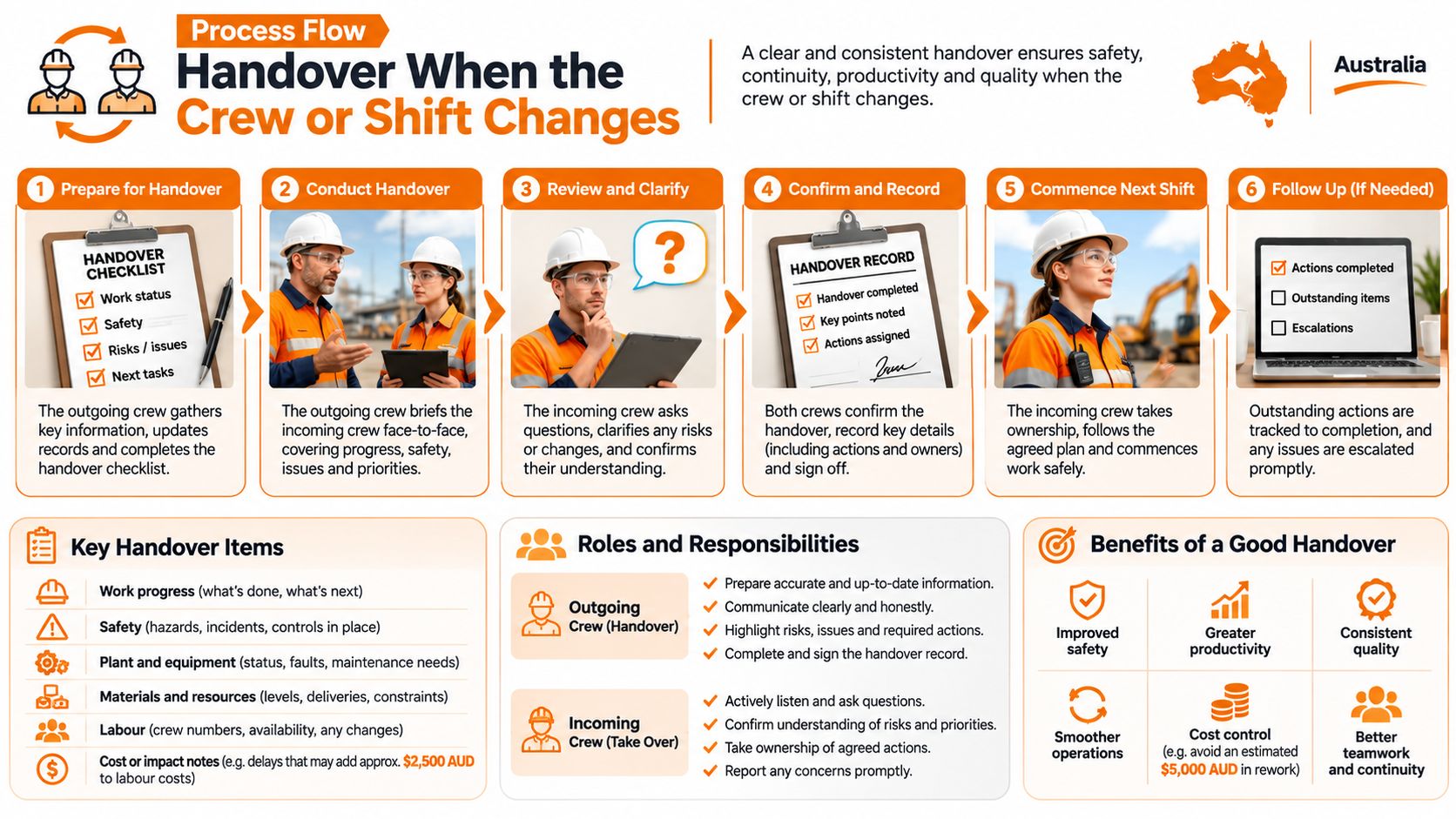
A handover that keeps the point locked
Continue the record on the same certificate so the incoming crew can see the isolation history and the latest test result.
- Confirm the plant. Check the equipment identity, every isolation point, the unfinished work and the recorded prove-test-prove result before changing any lock.
- Fit incoming workers' locks first. Each incoming worker applies their personal lock before an outgoing worker removes theirs. Keep the point controlled throughout the transfer.
- Use a hasp or group lock box when workers need separate protection. A supervisor's lock alone does not account for each worker.
- Record both movements. Enter outgoing lock removal and incoming worker sign-on on the same certificate, with times.
- Stop if a person or lock cannot be accounted for. Follow the written exceptional-removal process. A shift change is not a reason to cut a lock.
Two situations that expose a weak form
A temporary board at a residential building site can be fed by both a generator and the street supply. Record both sources and their isolation points. If the incoming foreman sees only the street-supply lock, the generator may still energise the board.
At a factory, the day electrician leaves with the only key. The night shift must not resume work until the written exceptional-removal process is followed, the isolation is re-tested and incoming workers apply their own locks. Recording the sequence keeps the open isolation visible across the shift change.
Safety Space can keep the open record against a site, with worker sign-on attached to the isolation. A stored PDF with one signature does not record each worker's protection or the handover.
Authorising Restoration and the Final Stop Check
Name the authorised electrical worker and the person who may approve restoration on the certificate before the job starts. Safe Work Australia's duties guidance on electrical work sets the PCBU duty for unsafe electrical equipment: disconnect or isolate it from its electricity supply, and don't reconnect it until it is repaired or tested and found safe, replaced, or permanently removed from use. The close-out is how that duty is shown for this job.
Close out in order
Don't re-energise because the task "looks finished".
- Who inspected or tested the equipment, and what result supports a safe-to-reconnect decision.
- Guards and covers are back on. Tools and people are clear of the plant.
- Who was told, including other contractors and the next shift.
- Who removed each lock and each danger tag. Tags are signed, dated, prominent and removed only by their signatories.
On construction and demolition sites, Safe Work Australia identifies AS/NZS 3012:2010 for inspection and testing of electrical equipment, including the records. As a general rule, plug-connected equipment on those sites is inspected and tested at least once every three months. That interval is not a task isolation. The three-month rule is about routine equipment checks. The certificate controls one intervention and the return to service. Don't write "in test date" on the restoration line and treat the dead test as done.
After supply is restored, check correct polarity, that switched conductors are the actives, and phase sequence where it matters. A failed check puts the plant back out of service and the certificate stays open.
Stop check before anyone re-energises
- Every source named at the start is still isolated, or has been deliberately released.
- Every personal lock and danger tag has a named owner and a removal record.
- The prove-test-prove result is on the certificate, not assumed from memory.
- Guards, covers and tools are restored, and people are clear.
- Contractors and the next shift have been told.
- The person authorising is the person the certificate names.
- Post-restoration checks are planned, not left for "someone on days".
If any line is open, don't re-energise. Leave the locks on, keep the certificate open, and fix the gap before the supply comes back.
Safety Space keeps isolation records, permits and SWMS sign-on in one place for Australian, New Zealand and United States sites, including offline use for field crews. Open isolations stay visible against the site or project until restoration is authorised, so a shift change doesn't bury a live lock. See how that fits your current permits at Safety Space.
Ready to Transform Your Safety Management?
Discover how Safety Space can help you implement the strategies discussed in this article.
Explore Safety Space FeaturesRelated Topics
Safety Space Features
Explore all the AI-powered features that make Safety Space the complete workplace safety solution.
Articles & Resources
Explore our complete collection of workplace safety articles, tools, and resources.