
A passed inspection can still leave an equipment register unfit for audit. A date and a tick don't establish what was examined, which defects were sought or why the inspector accepted the item. An equipment register template needs to connect the physical plant to evidence of a meaningful check, not just show that somebody completed a form.
Table of Contents
- Essential Fields for an Equipment Register Template
- How to Build and Reconcile the Asset List
- Inspection Records That Prove a Real Check
- Inspection Intervals, Owners and Maintenance Records
- Set Escalation Tiers for Overdue Inspections and Defects
- Check the Register Before Your Next Audit
Essential Fields for an Equipment Register Template
| Field group | Fields to capture | Why it matters |
|---|---|---|
| Asset identity | Asset ID, equipment type, manufacturer, model, serial number, location, registration status, intended use | Matches the record to the physical item |
| Responsibility | Owner or person with management or control, named inspector | Shows who answers for each check |
| Inspection | Inspection frequency, standard used, last and next due dates, inspector competency | Drives due-date reports and shows a suitable person did the check |
| Maintenance | Work completed, date, hour-meter reading where fitted, technician name and qualifications | Builds the service history an auditor tests |
| Testing and commissioning | Test results, commissioning date, commissioning status | Shows the item was commissioned and tested before use |
| Defects and corrective actions | Defect description, severity, isolation or do-not-use status, action owner, close-out date | Links each fault to the action that fixed it |
| Risk controls and evidence | Risk control reference, certificates, service reports | Links the item to the controls it relies on and to proof they work |
| Alterations and disposal | Modification details, decommissioning, dismantling, handover date | Records the full life of the plant |
Under Safe Work Australia's model Code of Practice for managing plant risks, the person with management or control should keep an up-to-date register of plant requiring regular inspection and maintenance, while records for registrable plant must cover its testing, inspection, maintenance and lifecycle activities.
Asset identity prevents evidence being assigned to the wrong machine. A description such as site compressor isn't sufficient when similar units move between projects. The internal asset ID should remain stable while location and custody change.
Responsibility and inspection fields separate accountability from execution. The operations manager might own the inspection programme while a competent contractor performs a particular examination. Both roles need identifiable names, not a shared maintenance label.
Keep status separate from evidence
Maintenance, testing and commissioning answer different questions. A completed service doesn't automatically establish that commissioning checks were completed, or that a particular safety function passed testing. Keep the results and supporting documents linked to the relevant activity.
Defects and risk controls show what happened after an adverse finding. The register should connect the fault to an isolation decision, corrective action and release evidence. Where relevant, connect the asset to its risk assessment and SWMS rather than copying uncontrolled extracts into notes.
Alterations and disposal preserve context. An attachment change or structural modification can affect which inspection procedure applies. Mark retired plant inactive instead of deleting its history.
Practical test: Can someone outside the maintenance team find an item's next inspection due date in under a minute, without asking its usual operator?
For New Zealand operations, the same field set supports management of plant under the Health and Safety at Work Act 2015. Check WorkSafe NZ plant guidance for record-keeping or registration differences before applying Australian model-law assumptions. For United States sites, retain the operational fields but check the applicable local requirements separately.
How to Build and Reconcile the Asset List
Start with the equipment under the business's management or control, not just the assets finance has capitalised. Hired excavators, borrowed access equipment and a contractor-supplied machine can otherwise sit outside the inspection workflow.
Safe Work Australia's plant risk code supports a lifecycle record linking plant identification to inspection, maintenance, alterations and competent-person records. Build that structure before importing historical entries.
Reconcile records against physical plant
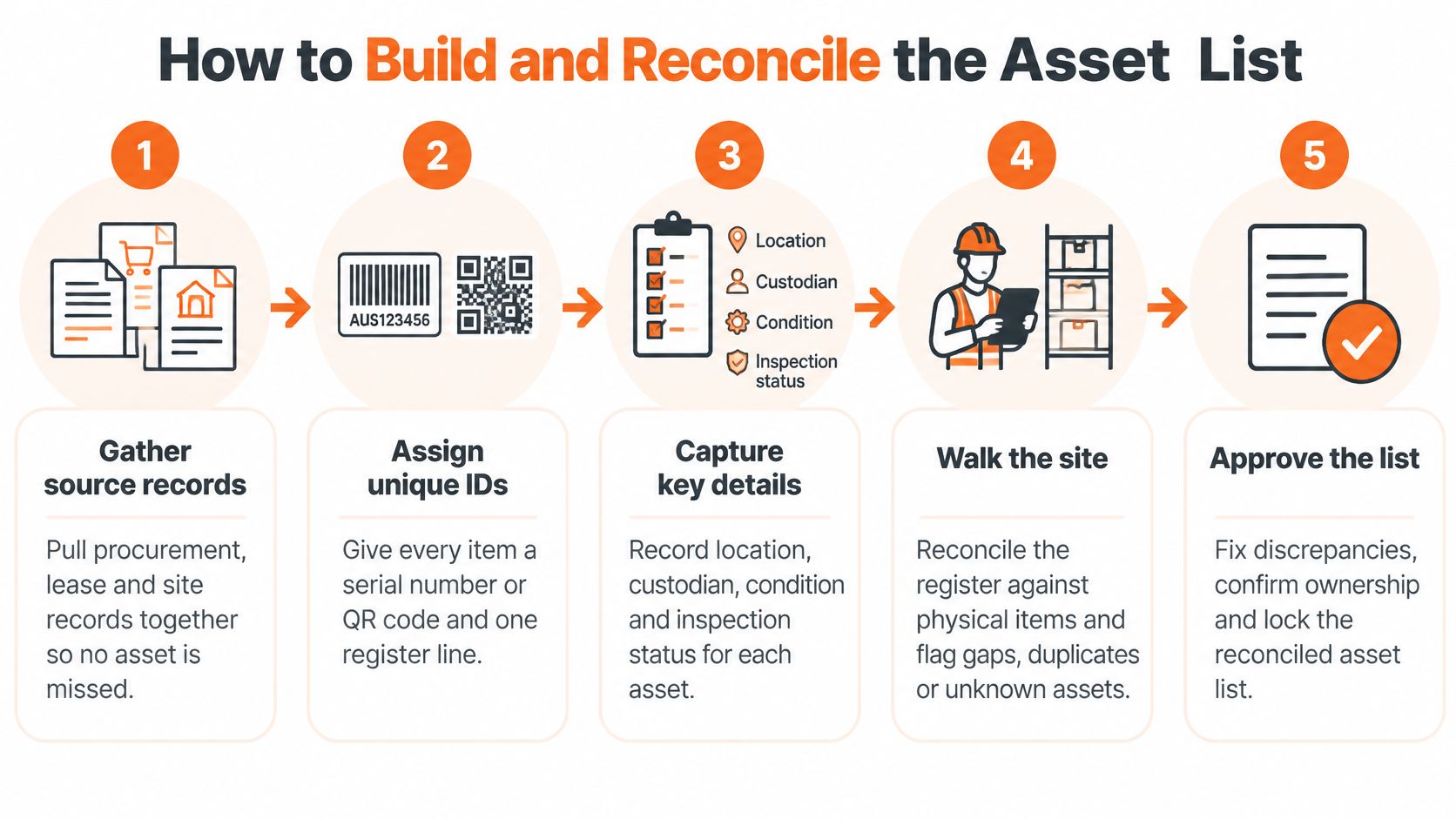
Gather procurement, lease and site records. Combine purchase records with hire agreements, equipment allocations and existing service files, keeping uncertain entries in a reconciliation list. A procurement-only export misses leased and borrowed plant because ownership isn't the same as operational control.
Walk the site and match identifiers. Compare the manufacturer's serial number and internal asset ID or QR code against the physical item, including equipment in stores, vehicles and repair areas. Matching descriptions alone can create duplicate records for the same machine or merge similar machines into one entry.
Classify registration and inspection needs. Separate items requiring design or item registration from those needing routine inspection without registration, and record the classification basis. Restricting the register to registrable plant leaves ordinary inspection-dependent equipment outside the process.
Set intervals from the actual duty. Use manufacturer instructions, operating conditions and the risk assessment, recording the basis rather than copying another machine's calendar interval. For hydraulic systems, MA Hydraulics Ltd's guidance can help teams build a hydraulic maintenance schedule, with the final schedule matched to the specific equipment.
Approve inspection and repair records before release. Require the competent person's identity and confirmation of the work's outcome before changing an item back to available. An invoice or repair booking isn't evidence that the machine is ready to operate.
Resolve gaps before approving the list
Use a separate discrepancy log for missing identifiers, unknown ownership and unmatched records. Assign each discrepancy to someone who can resolve it. Don't fill a mandatory field with a guessed serial number just to complete the import.
An asset manager software assessment should start with this reconciled field structure. Software won't resolve whether an unlabelled compressor belongs to the business, the hire company or a subcontractor.
Keep one master asset record and link repeated inspection and maintenance entries to it. Adding a new asset row for every service makes asset counts unreliable and splits the machine's history across the register.
The acceptance test is straightforward: every item in the yard has one master record, and every active master record matches a physical item. Plant temporarily off site should have a documented location or custody status, not an unexplained absence.
Inspection Records That Prove a Real Check
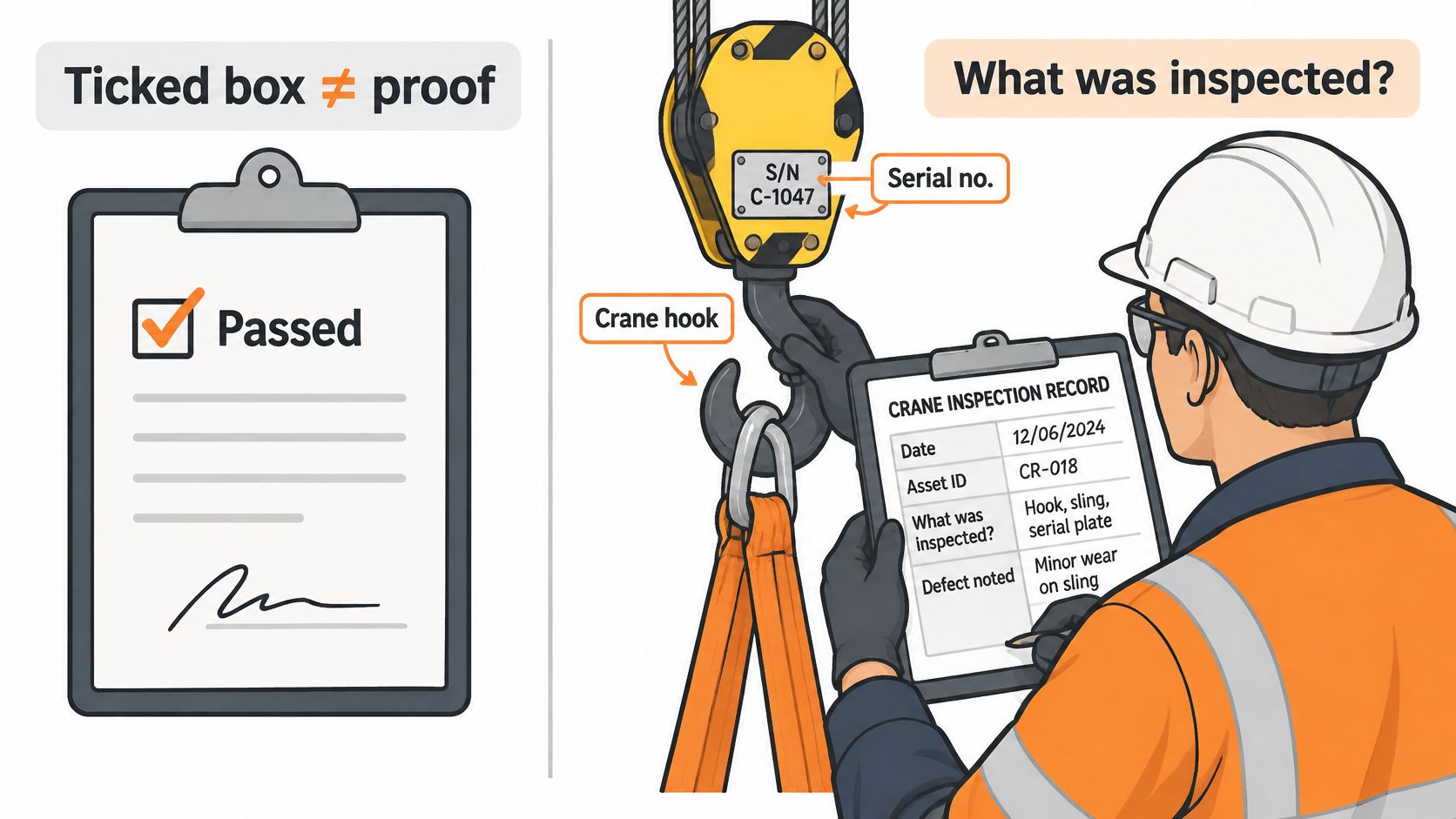
A generic template containing service date, pass status and notes records a conclusion. It doesn't establish the inspection method or the acceptance basis. An auditor needs enough detail to challenge the result, not just confirm that fields aren't blank.
Safe Work Australia's crane inspection guidance identifies what meaningful inspection records should contain: the components inspected, defects sought, rejection criteria, method, findings and competent-person confirmation that the plant is safe to operate. That guidance concerns cranes, but its evidence test is useful when designing records for other equipment.
| Generic template field | What an auditor can test | Field to add |
|---|---|---|
| Service date | Whether the check happened on the stated day and by whom | Inspector name and competency |
| Pass or fail status | Whether pass criteria were defined before the check | Measurable pass criteria per asset type |
| Free-text notes | Whether findings are specific and repeatable | Measurement fields with units and photo attachments |
| No defect field | Whether faults were found and controlled | Defect severity, do-not-use decision, action owner, close-out date |
| Single edit field | Whether changes to the record are traceable | Edit history showing who changed what and when |
Record observations, not just conclusions
A measurement field should specify the component, location and unit. A number without those details can't support a repeat check. The applicable manufacturer limit or inspection criterion should sit beside the finding, not depend on the inspector remembering it.
Photographs need context too. Capture an identification view and a close view of the relevant condition, then describe what the image shows. A rack photo review from Material Handling USA is a useful example of a photo-based assessment workflow, but photographs don't replace any required physical examination or competent-person decision.
Asset-specific checklists prevent broad questions from hiding omissions. A fall protection equipment inspection checklist belongs with the relevant equipment category, not inside an all-purpose machinery form. The inspection record should retain the procedure version used so later revisions don't obscure the original assessment basis.
Make evidence capture workable at the plant
Field workers need a form they can complete beside the equipment. Mobile or offline entry, sensible question order and direct photo capture reduce the need to reconstruct observations later at a desk. Keep mandatory fields focused on decisions and evidence rather than administrative duplication.
Link the inspection to the specific asset and site. Identical machines can have different attachments, environmental exposure, operator requirements or modification histories. A generic model-level checklist still needs room to identify those conditions.
A second competent inspector should be able to identify the component, repeat the method and understand the acceptance decision from the record alone.
An edit history should preserve who changed a finding, when it changed and why. Correcting a transcription error is legitimate; overwriting an adverse result removes evidence the business may need.
Inspection Intervals, Owners and Maintenance Records
An inspection schedule needs an accountable owner and a clear assessment basis for each asset. Include all plant requiring routine inspection and maintenance, including plant outside high-risk registration requirements. Keep inspection owner, assessment standard and inspection frequency in separate fields so the maintenance planner can filter responsibilities and an auditor can test whether checks followed the recorded requirements.
Safe Work Australia's current model plant code recommends an up-to-date register identifying inspection responsibility, assessment standards and frequency, and addresses competent-person maintenance, inspection and testing where required. Dedicated fields make those requirements visible against each asset.
Check the minimum maintenance entry
The Safe Work Australia guide for machinery in rural workplaces identifies minimum maintenance and inspection information, including plant identification, dates, hour-meter readings where fitted, repair details, the worker's name, qualifications and competency, and alterations.
Use a consistent entry sequence:
- Identify the plant. Select the master asset record rather than typing another description.
- Record the event. Distinguish inspection, service, repair and testing, with the completion date.
- Capture the reading. Enter the operating-hour meter value where fitted and note an unreadable or replaced meter.
- Describe the work. Identify the affected component, work performed and relevant outcome.
- Identify the technician. Record the person and relevant qualifications or competency evidence.
- Record alterations. Explain what changed and link revised technical documents where applicable.
Record enough detail to distinguish component replacement from adjustment, alongside any follow-up testing needed. That gives an auditor a traceable account of the work behind the last-serviced date.
Use the correct trigger
For hour-based servicing, calculate the next due reading from the recorded service reading plus the specified interval. Keep the calendar planning date separate: it supports technician bookings, while the meter reading determines when hour-based servicing falls due.
Where calendar and operating-hour limits both apply, plan against whichever becomes due first. Assign responsibility for collecting current readings so maintenance decisions use current operating data.
For facilities teams, a fridge and dishwasher maintenance routine helps distinguish routine operating care from scheduled technical work. Record those activities separately so daily cleaning remains distinguishable from a technical service.
Apply the same distinction in the equipment maintenance and prestart tracking workflow: record operator checks separately and retain the scheduled maintenance trigger after a prestart is completed.
Keep lifecycle records accessible after an item becomes inactive. For registrable plant, retain relevant records while the plant is used or until control is relinquished. Check any other applicable retention requirements before disposing of records.
Set Escalation Tiers for Overdue Inspections and Defects
Define the escalation recipients and triggers before the register goes live. An alert without an accountable recipient is only another message, and an overdue report doesn't itself stop equipment being used.
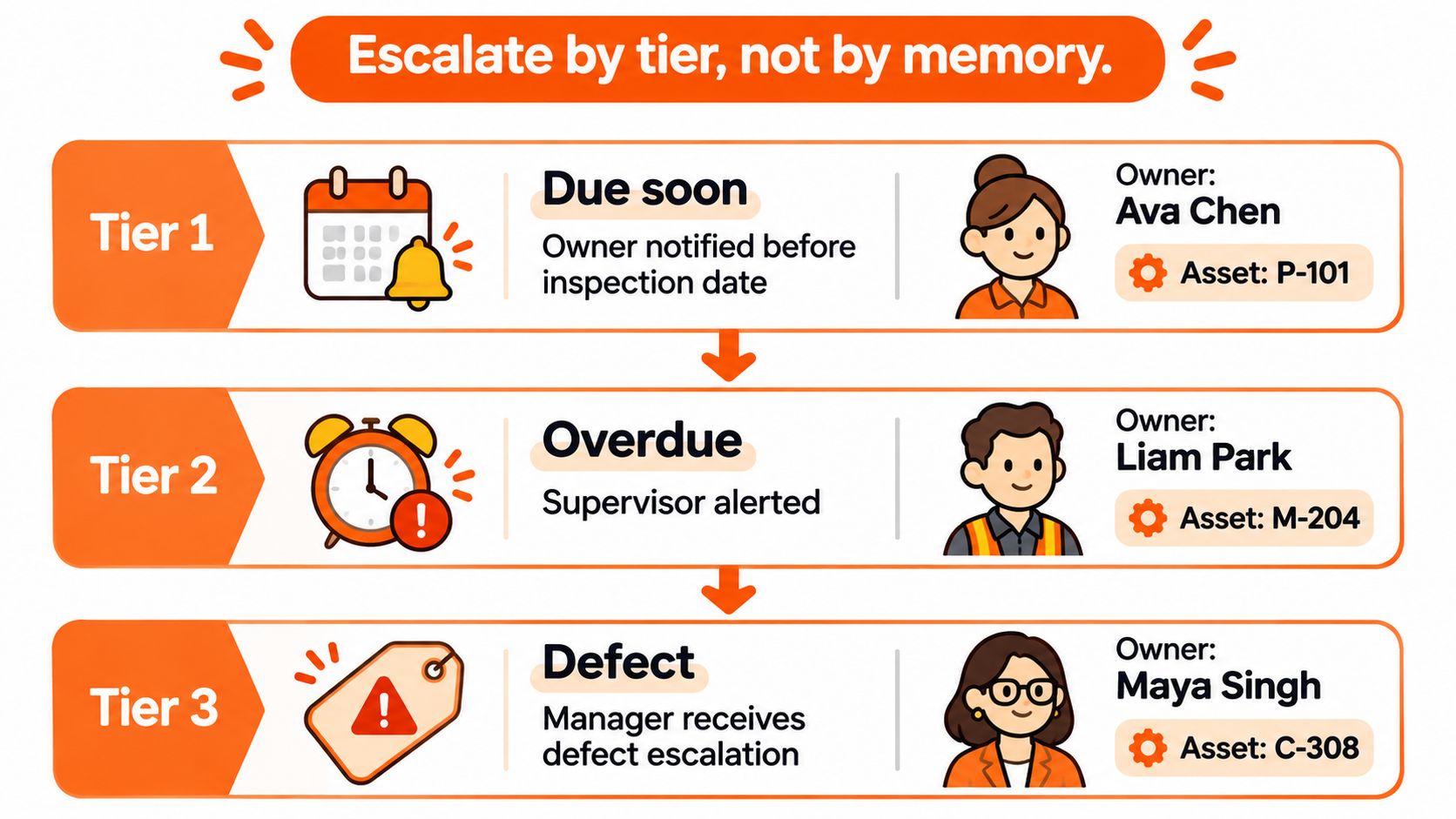
Use the following three-tier operating rule, then document the timing against each equipment category:
| Tier | Trigger | Recipient and required response |
|---|---|---|
| Due soon | The category's recorded reminder lead time is reached | Named asset owner arranges inspection and confirms access |
| Overdue | The inspection passes its due date | Site supervisor confirms operating status and assigns recovery action |
| Unresolved defect | A defect remains open past its action date | Operations or H&S manager reviews controls, resources and continued isolation |
Set timing around the work required
Enter an explicit reminder lead time for each category before activation. Calculate it from booking availability, access arrangements, shutdown needs and any external inspection dependency. A statutory examination requiring a specialist booking needs different preparation from an operator check completed on site.
Prioritise mobile plant, vehicles and machinery when establishing the reminder process. In 2023, vehicle incidents accounted for 42% of worker fatalities, while machinery operators and drivers recorded the highest number by occupation, with 73 deaths, according to Safe Work Australia's key WHS statistics release.
Those national figures don't prove that an equipment register prevents an incident. They support giving equipment-related controls priority rather than treating every overdue administrative task as equally urgent.
Separate notifications from release authority
Write down which overdue inspections require equipment to remain out of use pending competent-person sign-off. Base that decision on the inspection's purpose, applicable requirements and risk assessment. Don't allow a supervisor to extend a safety-critical interval merely by changing the due date.
A dangerous defect requires immediate control, not a wait until its action deadline. The action date governs follow-up; it isn't permission to continue operating unsafe plant.
Release rule: An alert can be acknowledged without the equipment being safe. Keep acknowledgement, corrective-action completion and return-to-service approval separate.
Safety Space account setup starts through its contact page or a demo so the team can capture organisation size, sites, modules and whether Microsoft single sign-on is needed. Its form builder also supports CSV import using the builder's sample file, with one row per question; include the escalation fields and release questions before importing the form.
Test the workflow with a deliberately overdue sample record. Confirm that the recipient can identify the asset, locate it and see the required action. If the notification process can't deliver every escalation tier automatically, assign a documented manual review rather than assuming the software will do it.
Check the Register Before Your Next Audit
Run a pass-or-fail check against physical equipment and supporting records, not just completed spreadsheet cells. A populated field can still contain the wrong identifier, an obsolete procedure or a service report for another machine.
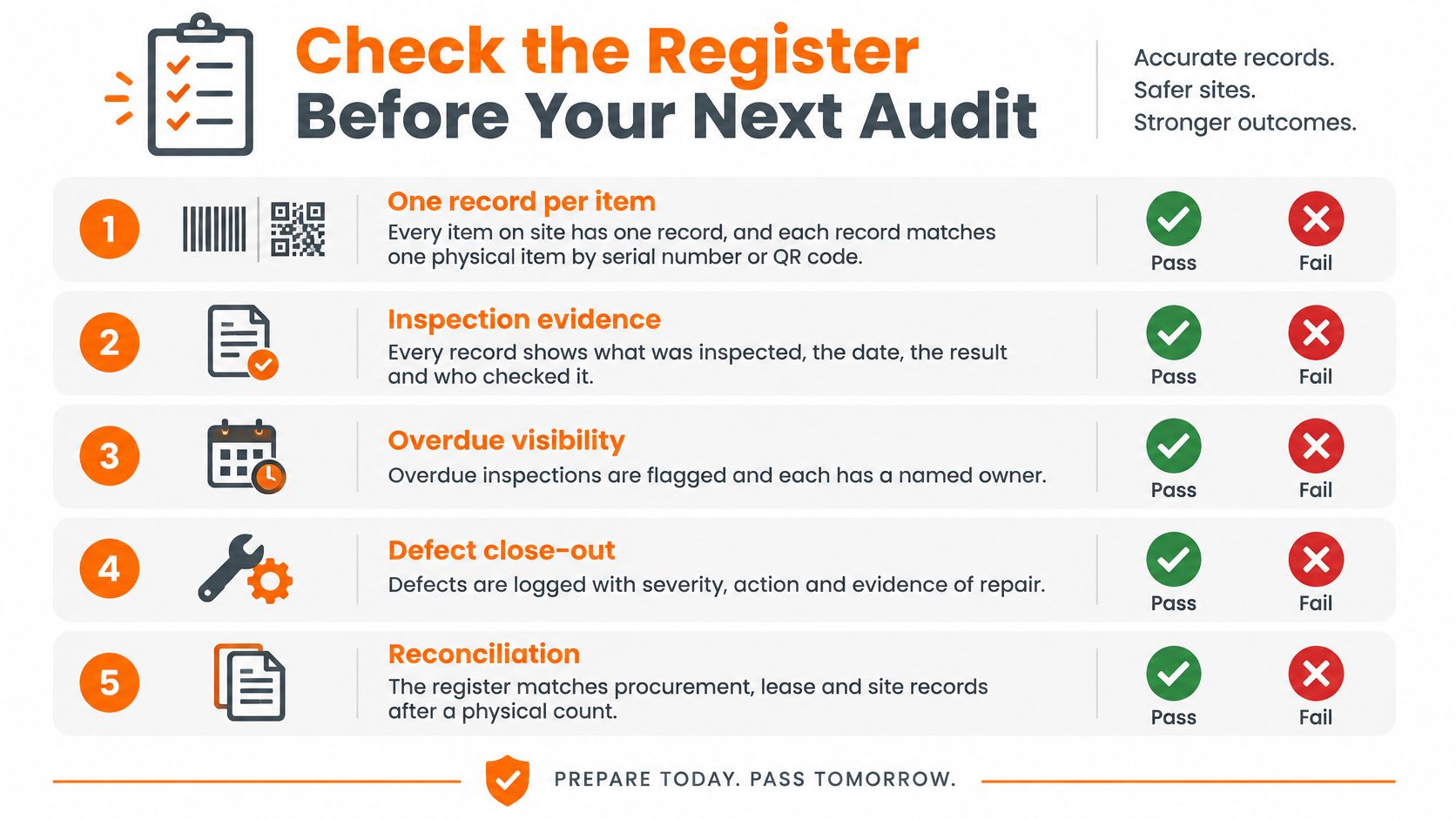
Apply the acceptance checklist
One physical item, one master record. Pass when each item on site matches its record through the serial number or QR-linked asset identity. Fail duplicate records, unexplained missing items and labels that open the wrong machine's history.
Accountability and assessment basis are identifiable. Pass when the record names the owner or person with management or control, the inspector and the assessment standard. Fail entries that rely on a departed employee's name or a generic department with no assigned responsibility.
The inspection can be tested. Pass when the record shows what was examined, the criteria, findings and competent-person confirmation. Fail a passed status unsupported by the observations needed to justify it.
Maintenance evidence identifies the actual work. Pass when the entry contains the date, hour-meter reading where fitted, work details and technician's name and qualifications. Fail an invoice that merely says service completed without identifying the asset and work.
Overdue inspections have active ownership. Pass when each overdue item has an action owner, an operating-status decision and a recovery plan. Fail acknowledged alerts that remain unresolved without a documented response.
Open defects have a control decision. Pass when severity, action responsibility and the do-not-use decision are recorded. Fail faults left in notes with no assessment of whether operation can continue.
Retired and transferred plant has a recorded exit. Pass when disposal or handover is dated and supporting history remains retrievable. Fail deleted records or equipment still shown as available after leaving the business.
Fix the failed control, not just the cell
Classify each failure by what needs correcting. A missing attachment may be an evidence-retrieval issue. An inspection with no defined acceptance criteria needs a revised procedure and potentially a fresh examination, not retrospective wording added to make the record look complete.
Assign corrective actions to people with authority to resolve them. The register administrator can fix a duplicate record, but a competent technical person must resolve uncertainty about plant condition. Keep the original entry visible when adding a correction or supplementary evidence.
Schedule this check every quarter as an internal management practice, with additional checks after major equipment moves or changes. This keeps reconciliation in the operating routine instead of leaving it until an auditor requests the records.
This week, select three random items and trace each from the register to the physical plant and then to its latest inspection. Fix every broken link before the audit, and assign any safety-related uncertainty for immediate review.
Safety Space offers equipment registers, inspection forms and corrective-action records for office staff and field workers. Visit Safety Space to discuss a setup that connects each asset to its inspection evidence, maintenance history and outstanding actions.
Ready to Transform Your Safety Management?
Discover how Safety Space can help you implement the strategies discussed in this article.
Explore Safety Space FeaturesRelated Topics
Safety Space Features
Explore all the AI-powered features that make Safety Space the complete workplace safety solution.
Articles & Resources
Explore our complete collection of workplace safety articles, tools, and resources.