A detailed harness check can still leave a worker unprotected if a failed item goes back into the store. That's why a useful fall protection equipment inspection checklist does more than record condition. It forces a pass, fail or quarantine decision for every component, links that decision to the equipment register, and blocks reuse until a competent person closes the action. The form is the evidence. The control is what happens next.
Table of Contents
- Checklist Items and Fail Criteria for Harnesses and Anchorages
- Inspection Timing and the Component Sequence
- What to Do When Equipment Fails
- Records That Hold Up at Audit
- Decide Whether Fall Arrest Is the Right Control
Checklist Items and Fail Criteria for Harnesses and Anchorages
The stakes are direct. Safe Work Australia's Key WHS Statistics 2024 reported 29 worker fatalities from falls from a height in 2023, representing 15% of all worker fatalities, and construction accounted for 45% of those deaths, or 13 fatalities. Treat the checklist as a critical control, not an admin form. Record the site, equipment type, worker role, inspection date, defect status and corrective action for every item.
Component Checks and Fail Conditions
| Component | Check | Fail if |
|---|---|---|
| Webbing | Inspect full length for cuts, fraying, abrasion, heat or chemical damage | Any torn, cut or frayed section |
| Stitching | Check load-bearing stitching and attachment points | Incomplete, broken or damaged stitching |
| Labels and markings | Confirm the manufacturer tag and AS/NZS 1891 markings are legible | Tag missing, illegible or incorrect |
| Buckles and D-rings | Check for cracks, deformation, corrosion and sharp edges | Any crack, distortion or corrosion |
| Double-action hooks and connectors | Operate every gate and latch by hand | Gate or latch does not close, lock or spring back |
| Lanyard and energy absorber | Check lanyard length, ends and absorber pack for deployment | Absorber deployed, damaged or missing, or lanyard cut or knotted |
| Lifeline | Check tension, sag, end fittings and wear along the line | Wear, damage, unapproved repair or wrong fittings |
| Anchorage point | Confirm it is identified, suitable for the system and undamaged | Unidentified, damaged or unsuitable anchor |
| Contamination | Look for weld spatter, paint, oil, chemicals and mud | Contamination that affects the textile or hardware |
| Rescue and retrieval gear | Confirm it is present, serviceable and matched to the system | Missing, damaged or incompatible |
Don't collapse these rows into one overall condition question. A harness can have sound webbing and a missing manufacturer tag, or clean stitching and a latch that doesn't lock. Each component needs its own result so the defect can't hide behind a general pass. Equipment involved in a fall also gets recorded as exposed to a fall and removed from service pending competent examination.
Where a PCBU is reviewing what to buy or replace, a supplier range of safety equipment for work at height is useful context for comparing component types against the table, provided selection still follows the manufacturer's instructions and the relevant standard.
Practical rule: If a component meets a fail condition, the whole item leaves service. There's no partial pass for fall arrest equipment.
For New Zealand readers, AS/NZS 1891 is a joint Australian and New Zealand standard, so the marking and inspection references in the table carry across. In New Zealand the equivalent duties sit under the Health and Safety at Work Act 2015, enforced by WorkSafe NZ.
Inspection Timing and the Component Sequence
Timing matters as much as criteria. A pre-use check doesn't replace a periodic detailed inspection, and a periodic inspection doesn't excuse a worker from checking the harness before donning it. The Main Roads WA minimum WHS control standards describe equipment being inspected before each use and at regular intervals, maintained according to the manufacturer and applicable Australian Standards, and documented in a height-equipment register. Use the type that matches the trigger.
| Inspection type | Carried out by | When | Record kept |
|---|---|---|---|
| Pre-use check | Worker using the equipment | Before every use | Pass or fail on the daily check sheet |
| Supervisor or site check | Supervisor or site lead | When the work system, anchor or lifeline changes | Dated entry against the work area |
| Scheduled detailed inspection | Competent height-safety equipment inspector | At the manufacturer's interval and as recorded in the height-equipment register | Full component-by-component record with inspector name |
| Post-fall or suspected shock load | Competent inspector | Immediately, with the item withdrawn until assessed | Incident link, quarantine label and disposition |
| After repair or storage | Competent inspector | Before the item returns to service | Closure record with replacement or approval |
The AS/NZS 1891.4 product page from Standards Australia covers scheduled periodic inspections, entry or re-entry into service, post-repair and post-storage inspections, plus inspection records. That scope should shape the register. Each item needs a unique ID so its history follows it between sites, workers and stores.
Seven-Step Sequence for Every Item
- Verify identity first: Match the unique ID to the equipment register and confirm the worker or site allocation. An unidentified harness can't be checked against its history, age or last detailed inspection.
- Confirm the basis: Check the manufacturer's instructions, relevant AS/NZS requirements, inspection frequency and inspection type. This step stops a worker applying pre-use criteria to a post-fall assessment.
- Examine every component: Work through webbing, stitching, buckles, connectors, lanyards, energy absorbers, ropes, lifelines, anchors and attachment points. Turn webbing over and check the inside faces, where abrasion and cuts are commonly missed.
- Operate the hardware: Open and release every double-action hook and latch by hand. A hook that closes but doesn't lock is a fail, even if it looks clean.
- Check exposure history: Look for UV damage, chemicals, welding heat, paint, mud, moisture and sharp-edge contact. These can degrade textile and metal parts even when there's no visible tear.
- Confirm the system fit: Check harness fit on the worker, connector compatibility, anchor identification and whether the selected system matches the work method in the SWMS. Where the task needs formal authorisation, align the check with the permit to work at height form so the equipment record and the work approval don't diverge.
- Record component results: Enter pass or fail for each component, then add the inspector name, date, defects found and corrective action. Don't use a single overall status.
A visual glance without traceability isn't an inspection. It's an opinion that can't be audited the next day.
Completion percentage is worth tracking internally, but it isn't a published national benchmark. Use it as a leading indicator for supervision, not as proof the gear is safe. The proof sits in the component decisions.
What to Do When Equipment Fails
Any fail answer means the item leaves service at once. Move it to a marked quarantine location, attach a defect label with the equipment ID and date, and make sure the store system can't issue it until a decision is recorded. A competent height-safety equipment inspector then decides whether the item is repaired where permitted, returned to service or destroyed. Where the repair question is open, the manufacturer gets consulted before anyone improvises a fix.
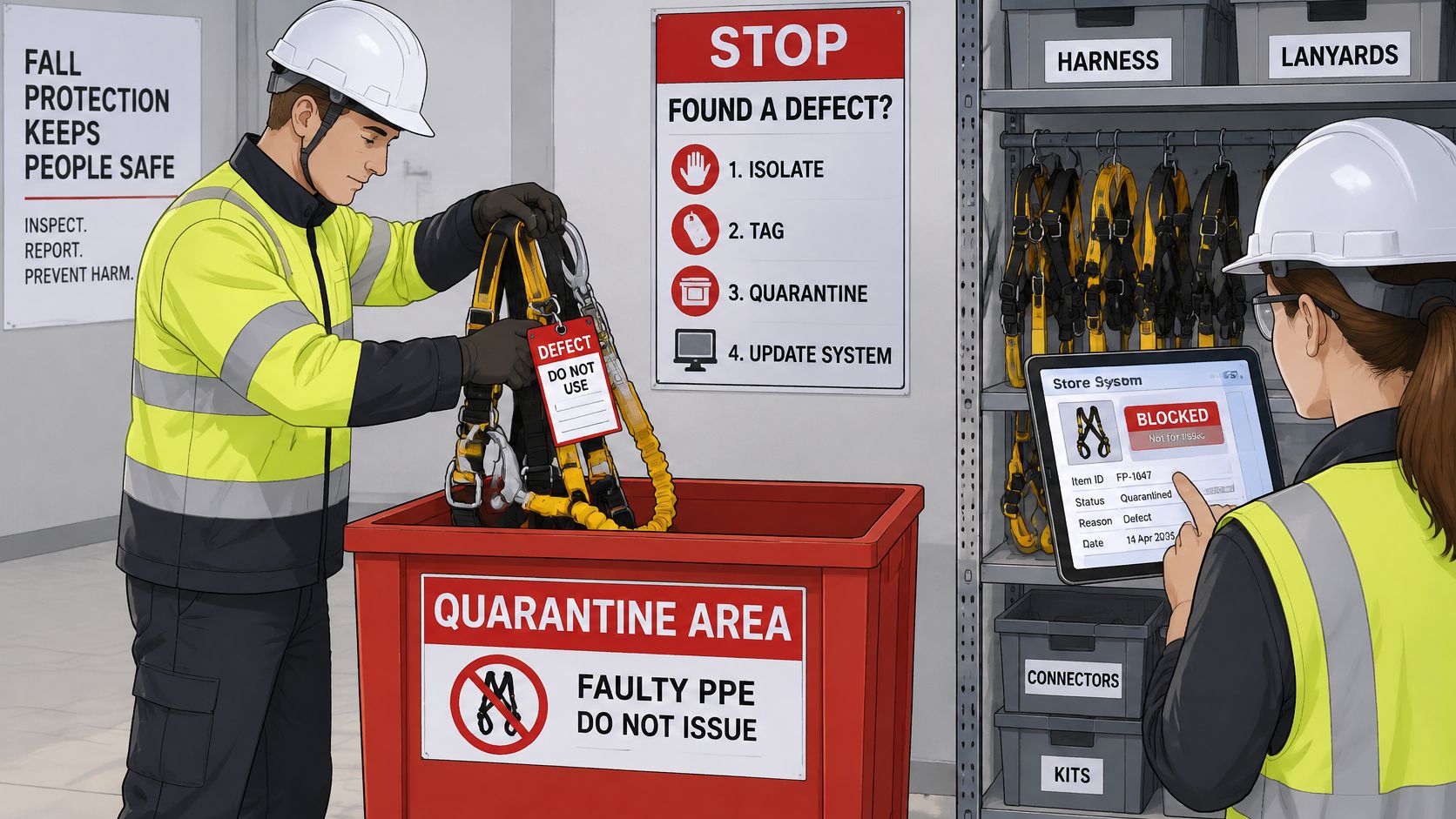
Many checklists fall short here. They list cuts, fraying, deformation, corrosion and missing labels, but they don't define quarantine, competent assessment, disposal or replacement records. SafeWork NSW's 2025 falls from heights findings report found nearly half of inspected PCBUs lacked an adequate system for managing fall risks, after visits to 935 workplaces, including 745 construction workplaces. A defect note without a controlled decision fits that pattern. The system around the form is the weakness.
Close-Out Fields That Prevent Reissue
- Defect classification: State what failed and which fail criterion it met, not just "damaged".
- Quarantine details: Record the location, label number and who removed the item from service.
- Authorised disposition: Name the inspector who decided repair, return or destruction, and the date.
- Corrective action owner: Assign replacement, disposal and register updates to a person with a due date.
Where inspections can trigger mandatory corrective actions based on responses, a fail answer creates the follow-up task automatically instead of relying on someone remembering a note in a margin. That applies to anchors, lifelines and rescue equipment as well as wearable gear. Equipment involved in a fall stays quarantined until it's assessed, regardless of how it looks.
Apply one test the next morning. Could a defective harness still be picked up from the store and signed out? If yes, the quarantine control isn't working, whatever the checklist says.
Records That Hold Up at Audit
An auditor doesn't need a thicker form. An auditor needs to trace one item from purchase to its current status without asking three people to fill gaps from memory. Build the record around the item, then link it to the equipment register so the history moves with the harness, lanyard or lifeline instead of sitting in site paperwork.
Fields Every Record Needs
- Equipment identity: Unique ID, asset number, manufacturer, model and serial number.
- Allocation: Worker, site and work area where the item is in use.
- Inspection details: Date, inspection type, inspector name and signature.
- Component outcomes: Pass or fail for each component, with defect classification where it fails.
- Disposition: Quarantine status, decision, replacement details and evidence.
- Corrective action: Action required, owner, due date and verification that it's complete.
Retaining records by site, asset, inspector and outcome turns a verbal check into evidence. It also exposes patterns a single form hides, such as repeated contamination on one crew, the same connector failing across a fleet, or inspections clustering the day before an audit. Those patterns should drive purchasing, storage and training decisions, not just filing.
If the record sits in software, test one control before anything else. A quarantine status should block issue or sign-out until the inspector records the disposition and supporting evidence. Safety Space is one option to test against that control and the field list here. Its inspection builder lets customers create and revise checklists without developer help, using question types, scoring and photo capture, and templates can be versioned with updates rolled out to teams in a controlled way.
For field completion, check how the form performs on a phone in poor light with gloves nearby and no signal. The mobile safety inspections approach only helps if workers can complete every field on site and see the last inspection date for each item before they start.
Audit test: Pick any harness ID at random. The register should show its last detailed inspection, current status and open actions within one search.
Decide Whether Fall Arrest Is the Right Control
A clean harness doesn't make a task safe. Safe Work Australia's Key WHS Statistics 2025 recorded 24 worker fatalities from falls from height in 2024, or 13% of all Australian workplace deaths. Fall arrest sits fourth in the hierarchy of control, after eliminating the risk, using safer work methods and preventing the fall. A checklist that starts at the harness has already skipped the most important decision.
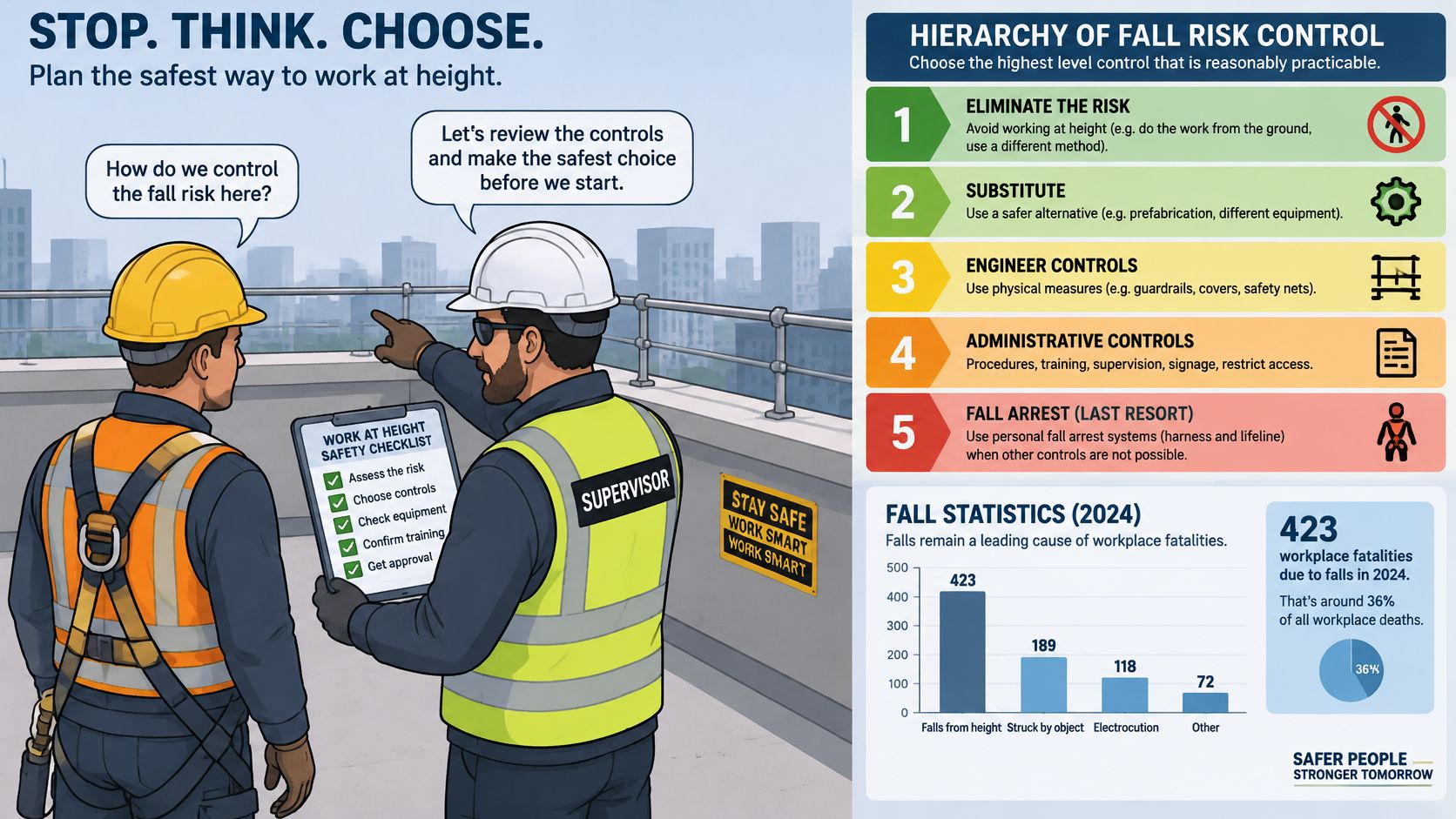
Answer these questions before any equipment check and record them on the form. What's the task, height, surface, duration, weather and access method? Can the work at height be eliminated, or is edge protection or a work platform practicable? If fall arrest is selected, record why. Guidance on fall protection systems helps frame that choice, but the site decision still needs a named owner.
Then confirm two things the harness check can't answer. The anchor must suit the selected system, not just exist nearby. The rescue plan must account for suspension trauma and access constraints, with gear present and workers who know how to use it. A harness that passes inspection on a task that should have used edge protection is still the wrong control, and a worker left suspended without a workable rescue method hasn't been protected.
For the next shift, make three changes. Add a decision section to the inspection form that records the hierarchy-of-control reasoning. Name one anchor and one rescue method for each task. Assign an owner to sign off the rescue plan before work starts.
Build the fall protection equipment inspection checklist as a controlled workflow, with component fail criteria, quarantine blocks, equipment register links and corrective actions that stay open until verified. Safety Space gives WHS teams the inspections, registers and action tracking to run that system across sites, so book a look at the platform and test it against the field list and quarantine control set out here.
Ready to Transform Your Safety Management?
Discover how Safety Space can help you implement the strategies discussed in this article.
Explore Safety Space FeaturesRelated Topics
Safety Space Features
Explore all the AI-powered features that make Safety Space the complete workplace safety solution.
Articles & Resources
Explore our complete collection of workplace safety articles, tools, and resources.