
The medical certificate is the weakest piece of evidence in most fitness-for-work files. It records what a treating practitioner thinks about a person's condition. It says very little about whether that person can climb a ladder, hold a grinder at chest height for a shift, or stay alert through a night roster.
Fitness is a task-matching decision. The person who controls the work, whether that's the supervisor, the leading hand or the operations manager, has to match today's duties to today's capacity and write down what was agreed. A general practitioner can't do that from a consulting room, and a signed form doesn't do it either.
That reframing changes what gets documented, how concerns are escalated, and how quickly work resumes. It also makes the process defensible, because the reasoning is about the task and the controls rather than a label attached to a worker.
Table of Contents
- Fit for Work Requirements by Situation
- What Fit for Work Means on Your Site
- Factors That Reduce Fitness and the Controls That Fit Them
- Assessing Mental Readiness Without Diagnosing
- How to Run a Fair Fitness Check Step by Step
- Return to Work and Reviewing Fitness After Absence
- Confirm Your Fit for Work Process This Week
Fit for Work Requirements by Situation
Under the Work Health and Safety Act 2011, a PCBU must manage risks to workers so far as is reasonably practicable. Fitness sits inside that duty. The question a supervisor has to answer is whether this person can do this task, on this shift, with these controls in place.
The table below gives supervisors a default action for each common trigger. Treat it as a starting point for site decisions; the detail behind each row matters more than the row itself.
| Situation | What the PCBU should do | Record to keep |
|---|---|---|
| Safety-critical task such as plant, height or vehicles | Define observable fitness criteria for the task before work starts | Task criteria and a pre-start declaration |
| Worker reports a symptom, condition or medication change | Review the task with the worker confidentially and agree any restrictions | Functional restrictions agreed with the worker |
| Suspected alcohol or drug impairment | Remove the worker from high-risk work and follow the drugs and alcohol policy | Incident note and the policy relied on |
| Return after significant absence | Set graduated hours and suitable duties, then review as capacity changes | Return-to-work plan with review dates |
| Repeated musculoskeletal symptoms | Review the manual-task risk and adjust duties | Manual task assessment and agreed limits |
| Changed duties or roster | Reassess fitness against the new task demands | Updated task criteria and the reassessment date |
- Safety-critical tasks: the criteria are what make a judgement possible at all. Written as "must be fit to operate plant", a criterion is unusable. Written as reach, balance, vision and sustained attention demands, a supervisor can test it against a worker on the day.
- Symptoms and medication changes: a confidential task review keeps the worker in work and keeps the conversation on function. The record that belongs in the file is what the worker can and can't do, agreed between you both.
- Suspected impairment: taking someone off high-risk work is a control decision, and a published policy is what makes it fair.
- Return after absence: graduated hours and suitable duties separate a first day back from a return that holds.
- Repeated musculoskeletal symptoms: the pattern belongs to the task design as much as to the worker, so review both.
- Changed duties or roster: capacity moves and demands move. A reassessment trigger is what keeps the file current.
The working rule for supervisors: if a worker can't safely do the task as set, change the task or change the worker's duties before work starts. Then record the decision and the functional restriction behind it.
What Fit for Work Means on Your Site
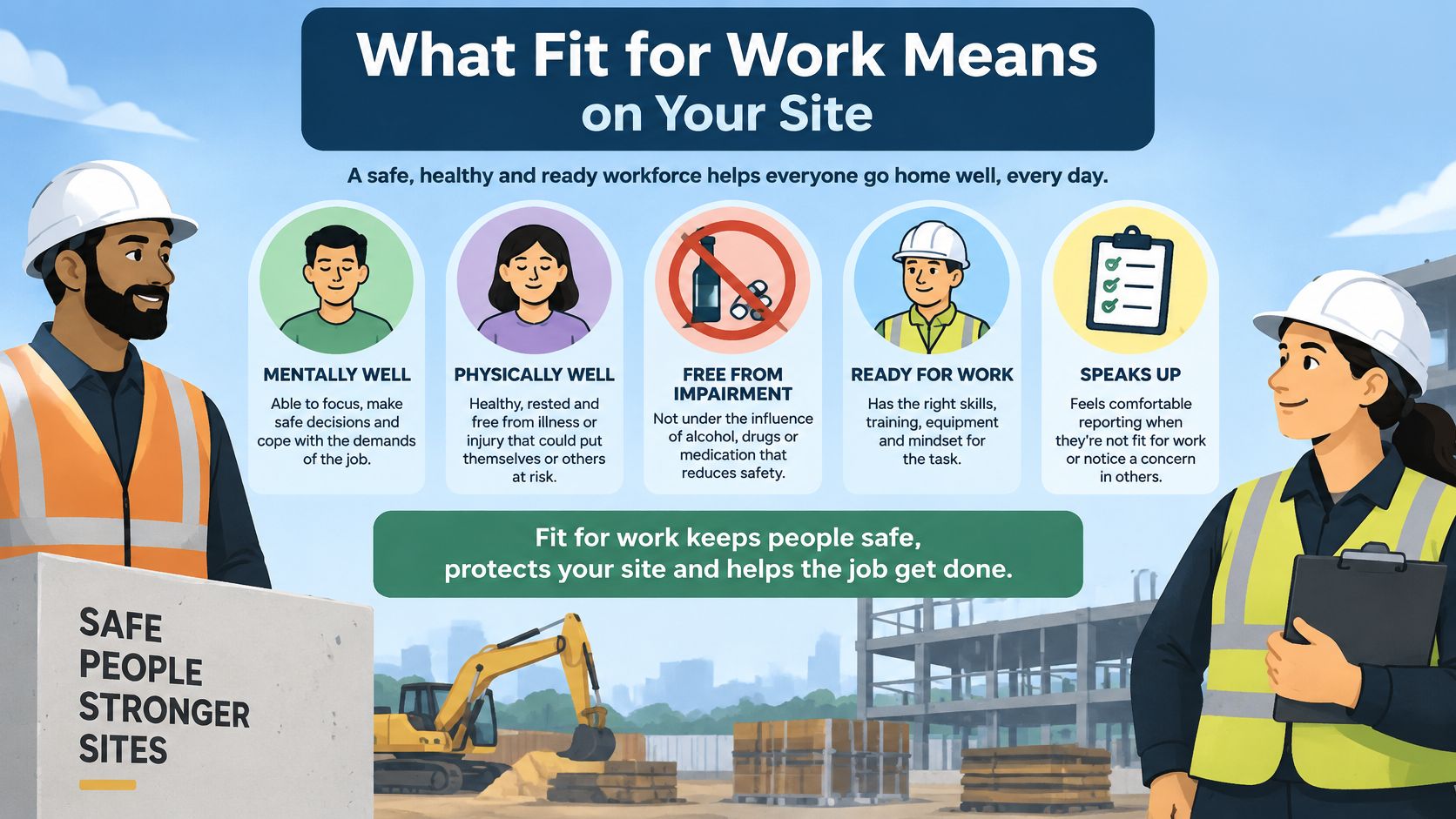
On a site, fit for work means one thing: the worker is physically, mentally and emotionally capable of performing the assigned tasks competently, without endangering themselves or anyone else. This definition is narrower and more useful than a medical clearance, and a supervisor can test it on the day.
The national data reads the same way.
Safe Work Australia's 2025 National Return to Work Survey separates returning to any work from being restored to capacity. Of injured workers receiving workers' compensation, 88.9% had returned to work at some point, down from 91.6% in 2021, while the current rate, meaning people working at the time of the survey, was 78.8%. Only 53.4% had resumed their previous hours, and 43.7% were working fewer hours, up from 38.9%. A first day back is not the same as full capacity for the task.
The same survey found 90.2% of workers with physical injuries had returned to work, compared with 76.5% of workers with psychological injuries. Different return paths, same fitness process, and it has to cover both.
What a task-level judgement looks like
A labourer on a residential build brings in a clearance for light duties. That document says nothing about whether they can carry plasterboard up a stairwell. The task-level answer does: the weight per sheet, the carry distance, the grip, the number of repetitions per hour, and whether a two-person lift or a hoist removes the exposure.
A licensed plant operator reports a new sedating medication. The question is whether that operator can hold alertness and reaction time across the shift. If the answer is no, the control is a change of task and a review date. The prescription itself stays between the worker and their doctor.
The duty reaches past pre-employment screening. A worker has to be well enough to do the job and unaffected by alcohol or drugs while at work, and that applies at 2pm on a Tuesday as much as it does on day one.
New Zealand: the Health and Safety at Work Act 2015, enforced by WorkSafe NZ, runs the same PCBU structure and the same reasonably practicable test. Drug and alcohol practice is where the two countries diverge most, so check WorkSafe NZ guidance before importing an Australian testing policy unchanged.
Factors That Reduce Fitness and the Controls That Fit Them
Fitness failures on site rarely look dramatic. They look like the operator who is sharp at 7am and vague at 3pm, or the labourer who is careful on flat ground and hesitant on the stairs.
South Australia's mining-sector fitness for work guide lists the sources to plan for: medical conditions, fatigue, stress, alcohol or other drugs, and emotional state. Each can affect performance and lift the chance of an incident, and none of them is solved by a one-off medical clearance.
The injury numbers point the same way. Safe Work Australia's key work health and safety statistics recorded 139,000 serious workers' compensation claims in 2022-23, with body stressing the leading cause at 32.7% of serious claims. Pain and musculoskeletal limitation are the daily reality on site, not the rare impairment.
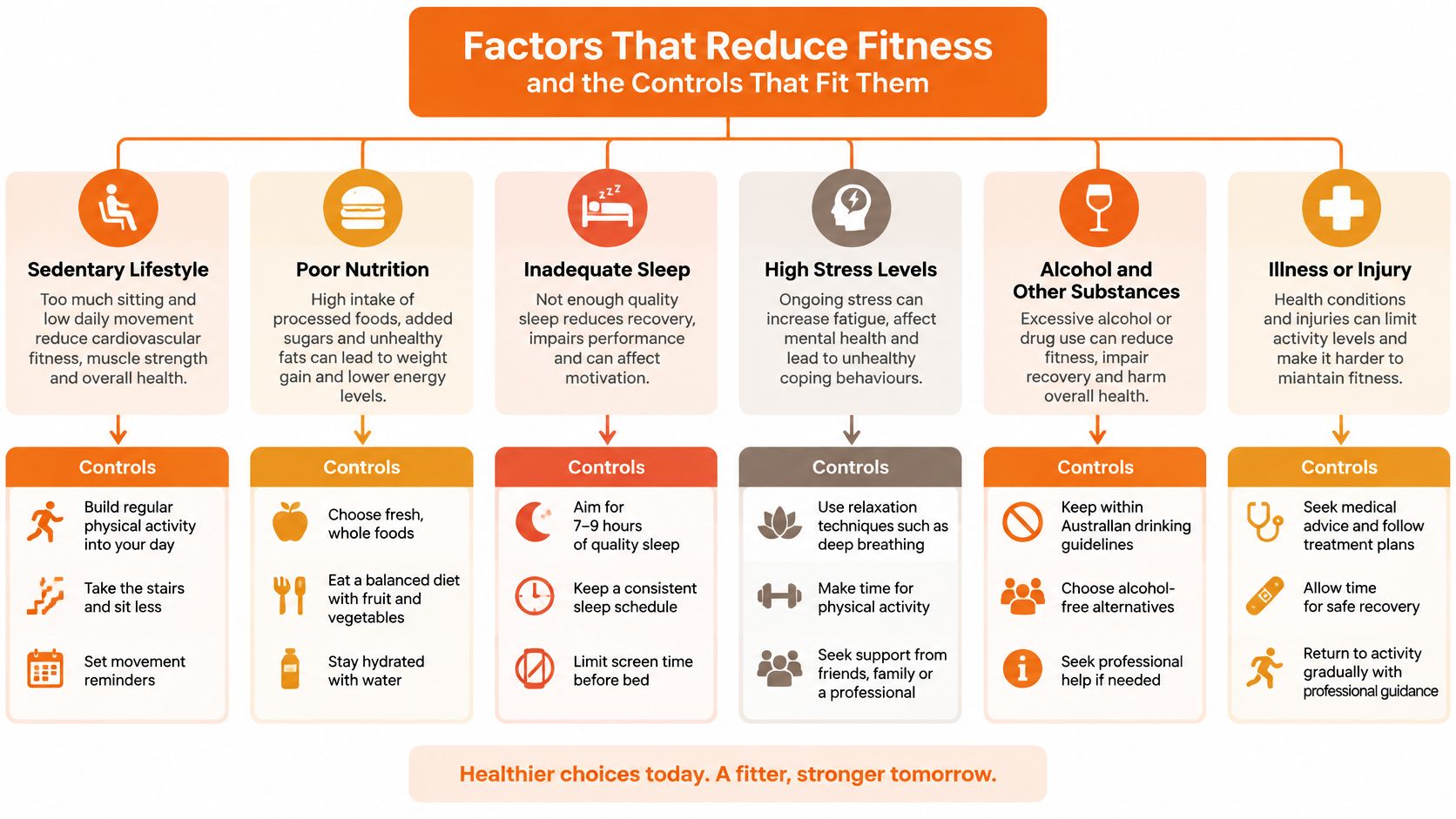
The functional check in the third column asks what the worker can do today, stated against the demands of the task in front of them.
| Impairment source | Typical effect on safe work | Functional check before the task |
|---|---|---|
| Medical condition or medication | Reduced strength, balance or alertness | Can the worker meet the balance, reach and alertness demands of today's task |
| Fatigue | Slower reactions and lapses in attention | Hours worked and rest since the last shift, compared with the roster limit |
| Alcohol or other drugs | Impaired judgement and coordination | Pre-start declaration answered and no observed signs of impairment |
| Musculoskeletal limitation | Reduced lifting, pushing or bending capacity | Stated lifting or bending limit compared with the load of the manual task |
| Pain or illness | Reduced capacity for height, plant or driving | Task restrictions stated in functional terms for height, plant or driving |
| Stress or emotional state | Reduced concentration and decision-making | Concentration and response to routine instructions during the shift |
Fatigue is the hardest row to control because it builds across a roster rather than appearing at the gate. A worker can pass a pre-start declaration on Monday and be impaired by Thursday, which is why hours worked and rest since the last shift belong in the fatigue risk management system, checked against roster limits instead of relying on self-report alone.
Stress and emotional state are the rows most often left blank, and the ones with the longest tail. Knowing the signs of work stress and burnout helps a supervisor frame the conversation as support and task adjustment rather than a quiet removal from the crew.
A supervisor notices reduced balance in a worker rostered to climb a ladder. The control is a move to ground-level work and a note of the restriction. The cause stays with the worker and their doctor, and nobody on site needs to know it.
The hierarchy of controls applies to people as much as to plant. Redesign the task or reduce the exposure first, and only then rely on an individual's ability to compensate for the risk.
Assessing Mental Readiness Without Diagnosing
The common assumption is that a manager has two options when a worker's mental state looks wobbly: stay out of it, or refer them to a doctor and pull them off the task until a clearance lands. Both responses leave the worker worse off and the risk unmanaged. Fitness for work is a task-matching question, and mental readiness gets assessed the same way physical readiness does: by what the worker can do safely this shift.
The scale makes that worth getting right. Safe Work Australia's key work health and safety statistics reported 17,600 serious mental-health-condition claims in 2023-24, or 12.0% of serious claims, up 14.7% in one year and 161.1% over the preceding decade. The same statistics show mental-stress claims most commonly involved workplace bullying or harassment (33.2%), work pressure (24.2%) and exposure to violence or harassment (15.7%), and that these claims ran to almost five times as much median time lost as other injuries and diseases. Long absences like that are what unmanaged psychosocial risk looks like once it reaches a claim.
Five things a supervisor can actually observe
None of these require a diagnosis. They require a supervisor who knows what the task normally looks like.
- Concentration: does the worker hold attention on the task for the length of it, or are steps being re-explained?
- Decision-making: can they choose between two ordinary options on the job without stalling?
- Communication: are instructions understood and confirmed, or repeated with errors?
- Emotional regulation: does a routine setback produce a response out of proportion to it?
- Tolerance for routine demands: is the usual shift length or noise level now too much?
Questions that stay functional: what can you do safely this shift? What would make the next two hours easier? Is there a task on this job you'd rather not do today?
Prevention matters more than detection here, because the mechanisms behind those claims are things a PCBU controls. Bullying, workload and exposure to violence are hazards that belong in a psychosocial risk assessment, with controls set at the source rather than left for the worker to absorb.
Privacy is the line that makes the process work. Record the functional restriction and the agreed adjustment, never the diagnosis or the treatment. A supervisor needs to know a worker shouldn't be on the roof alone this week. They don't need to know why.
An experienced worker starts missing instructions and making sign-in errors. The functional conversation is short: what's harder than usual right now, and what would help. The outcome is a move to a lower-pressure task, a written adjustment, a review date in seven days, and nothing in the file about a condition.
How to Run a Fair Fitness Check Step by Step
A fitness check that ends with a signature is filing, not control. The check only earns its name when it matches a worker's current capacity against the risks of a named task. Safe Work Australia's drugs and alcohol guidance makes the same point from the other direction: the link between a worker's condition and the actual task risks is what matters, not the test.
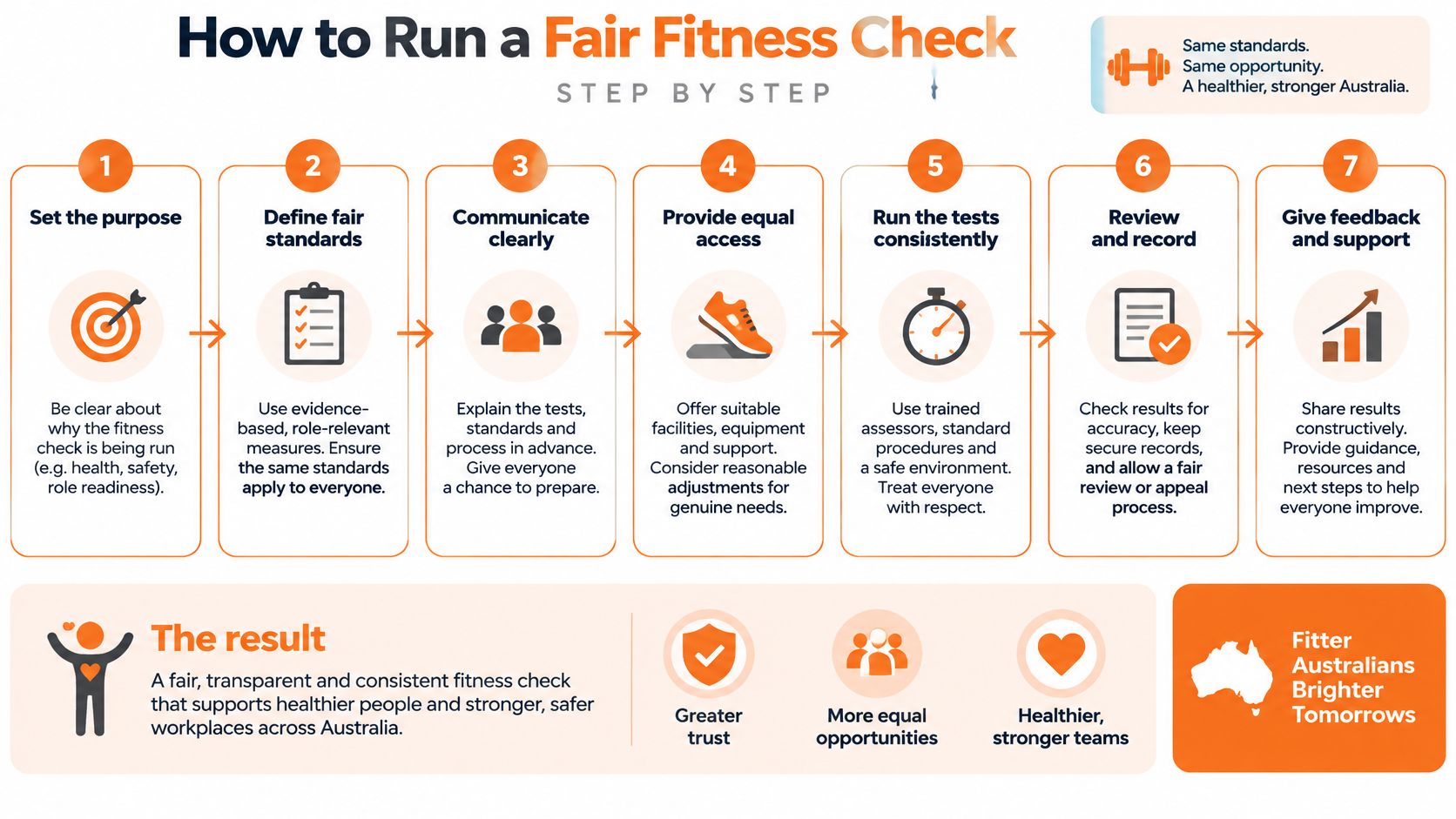
- List the safety-critical tasks for each site. Start with plant operation, work at height, driving, confined spaces and manual handling. Fitness means nothing against a task you can't name.
- Write observable criteria for each one. Safe reach, balance on a ladder, sustained focus for the duration of the task. Criteria written as diagnoses, or as a blanket "medically fit", give a supervisor nothing to test.
- Check before work starts. Combine a pre-start declaration, a supervisor's observation and the worker's own report. A stack of signed declarations nobody reads, with no follow-up question, only proves paper changed hands.
- Escalate in private to a nominated person. The concern goes to a named manager or H&S officer, away from the crew. Raise it in a toolbox talk and the worker defends rather than discloses.
- Choose the least restrictive control that keeps the task safe. Alternative duties, reduced hours, a two-person lift, with removal from high-risk work held as the last resort. Stepping someone off all work when a task change would have done is the overcorrection to avoid.
- Record decisions as functional restrictions, not medical detail. One audit trail per worker and site, so the next supervisor inherits the reasoning. Where records sit in software, Safety Space is one option to assess against this list; it tracks PCBU obligations, manages worker consultation processes, and its risk assessment workflows follow WHS Act methodologies with document management that keeps an audit trail.
- Reassess after any change in health, medication, roster or task demands. A judgement made in March is stale by June. The trigger list matters more than any fixed interval: a new prescription, a switch to nights or a heavier lift plan each reopen the question.
The PCBU may set its own drugs and alcohol policy, but it must consult workers who are, or are likely to be, directly affected. On projects with labour hire, subcontractors and a principal contractor, consultation, cooperation and coordination with other duty holders counts as part of the duty rather than a courtesy, and the split of employer and worker health and safety responsibilities needs settling before the first shift. There is no single national testing threshold and no one mandatory fit-for-work form, so the policy has to fit your jurisdiction, your workforce and your risk profile.
Return to Work and Reviewing Fitness After Absence
A return-to-work plan for a mental-health absence needs closer review than one for a sprained ankle, because the capacity changes are harder to see and the absence tends to run longer.
Having a plan at all changes the odds. In the 2025 National Return to Work Survey, 94.0% of injured workers with a return-to-work plan had returned at some point, compared with 81.7% without a plan, a 12.3 percentage point difference, according to Safe Work Australia's national return to work data.
Absences are long enough to need structure. The ABS work-related injuries release reported that 497,300 people, 3.5% of the 14.1 million people who worked in 2021-22, experienced a work-related injury or illness, that 66% took time off, and that 34% of those absent were away for more than 10 days. It also found lifting, pushing, pulling or bending was the leading cause at 24% of cases, which is why the plan and the manual-task assessment belong together.
What goes in the plan
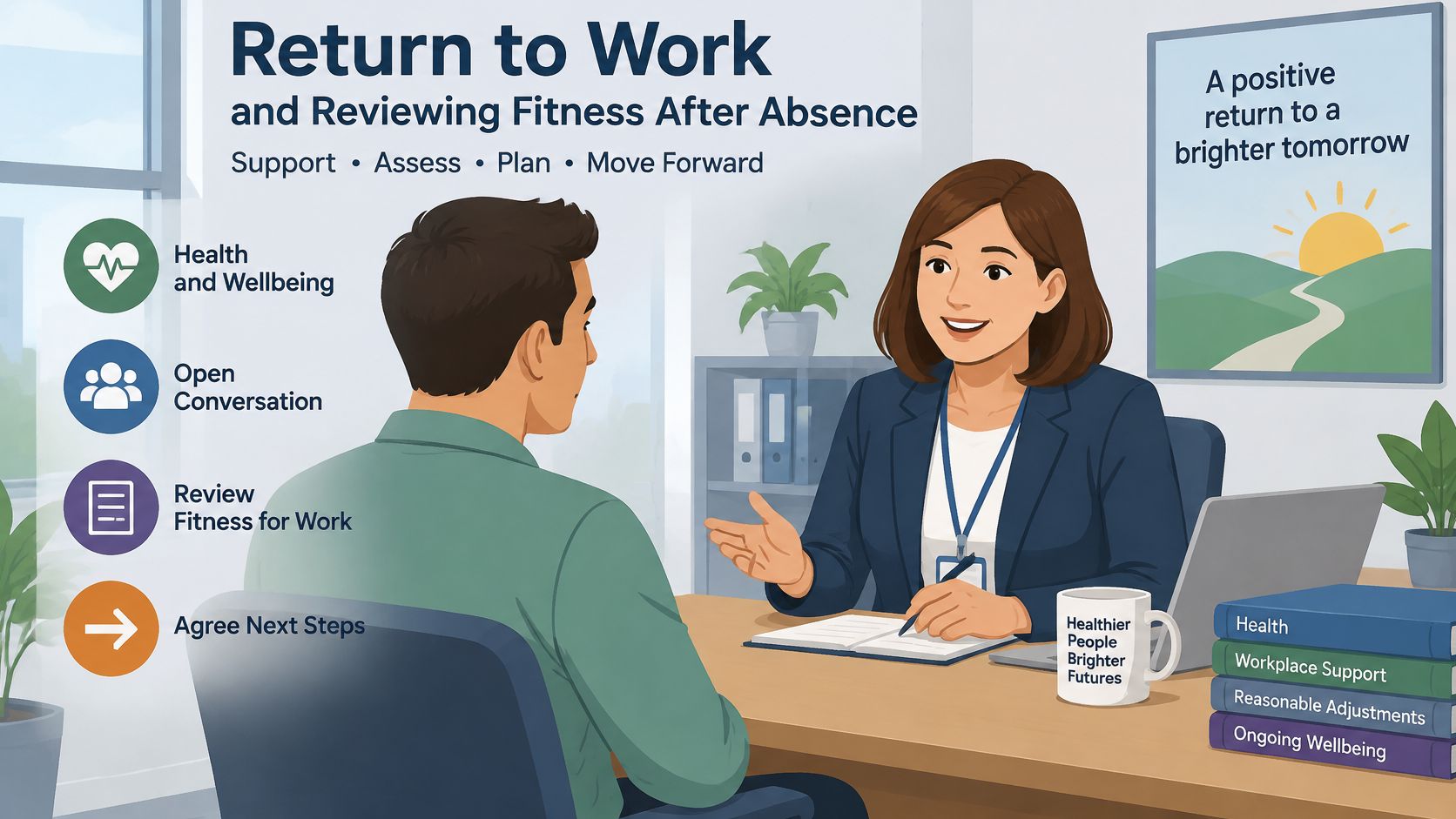
- Graduated hours, with the start point and the step-up dates written down.
- Suitable duties, named specifically rather than "light duties".
- Functional limits such as lifting limits, permissible exposure, hours or supervision needs.
- Consultation with the worker on each limit, and a named reviewer.
- Review dates, set before the first shift back rather than after a problem.
Trigger a review when a worker reports a functional limitation, has repeated musculoskeletal symptoms, returns after a significant absence, or is assigned materially different physical or safety-critical duties. Capacity gets expressed in functional terms so a supervisor can apply the control without the medical file.
Take a crew member returning after a back injury. They start on reduced hours with an agreed lifting limit and no work above shoulder height. The plan is reviewed at two weeks, the limit is adjusted at each review point, and the final step back to the full task set is agreed with the worker before it happens. Where trauma is part of the picture, services such as PTSD therapy for Vernon residents show what specialist support looks like, and the workplace's job is to adjust the task while that support does its work.
Confirm Your Fit for Work Process This Week
A fit-for-work process is proven by what a supervisor can produce on demand: the task, the observable limit and the record of agreement.
Run this as a records test. For each item, ask for the entry a supervisor could pull up during a pre-start.
- Task-to-criteria map: pick three safety-critical tasks and confirm each names observable limits such as lift height, exposure time, sole control or fatigue cues, with functional wording doing the work.
- Currency check: confirm the task list was reviewed after the last roster, plant, contractor or scope change, and that the date sits on the record.
- Consultation evidence: confirm the criteria and any limits show worker input, with a name and date attached.
- Record location: list any fitness evidence still held in paper, inboxes or personal drives, and name the module that will hold it.
- Access boundary: confirm supervisors can see functional limits and current restrictions while medical detail stays with the person authorised to hold it.
- Action trail: pick one recent concern and confirm it produced a corrective action or task adjustment with an owner and close-out date.
- Owner and date: stop only when every gap above has both.
If the sticking point is the record side rather than the policy side, Safety Space offers a free H&S consultation that can be booked for exactly that conversation.
Safety Space is cloud-based workplace health and safety software used by residential construction, property development, manufacturing, commercial cleaning and waste businesses across Australia, New Zealand and the United States. Records are kept by site or project through the modules each business switches on, covering incident and hazard records, inspections, corrective actions, contractor documents and inductions, toolbox talks and training registers with expiry reminders. That gives a supervisor one audit trail for the evidence behind a fitness decision, with documents and sign-ons attached to the job they apply to. Visit Safety Space to see which modules match how your sites already run.
Ready to Transform Your Safety Management?
Discover how Safety Space can help you implement the strategies discussed in this article.
Explore Safety Space FeaturesRelated Topics
Safety Space Features
Explore all the AI-powered features that make Safety Space the complete workplace safety solution.
Articles & Resources
Explore our complete collection of workplace safety articles, tools, and resources.