
Construction accounted for 20% of all traumatic work-related deaths nationally in 2024, so effective health and safety management in construction must do more than satisfy an audit. A sound system keeps people alive, controls changing work, and gives the business evidence that it met its WHS duties.
That gap between written procedures and actual site behaviour is where most safety systems fail. A principal contractor may have a complete WHS management plan, approved SWMS and induction records, yet still miss a changing exclusion zone, an uncoordinated subcontractor activity or a control that exists only on paper.
The practical answer is to connect legal duties with daily decisions. That means planning the work before mobilisation, controlling interfaces between businesses, checking whether controls are working, and changing the system when the risk changes. It also means treating silica exposure and psychosocial hazards as operational risks, not separate HR or compliance projects.
Table of Contents
- What the 2024 Fatality Data Says About Site Risk
- Legal Duties and the PCBU Model
- Making SWMS Work on Site
- Managing Subcontractors and Site Fragmentation
- Adapting to Recent Regulatory Changes
- Regional Nuances for Western and Southern Australia
What the 2024 Fatality Data Says About Site Risk
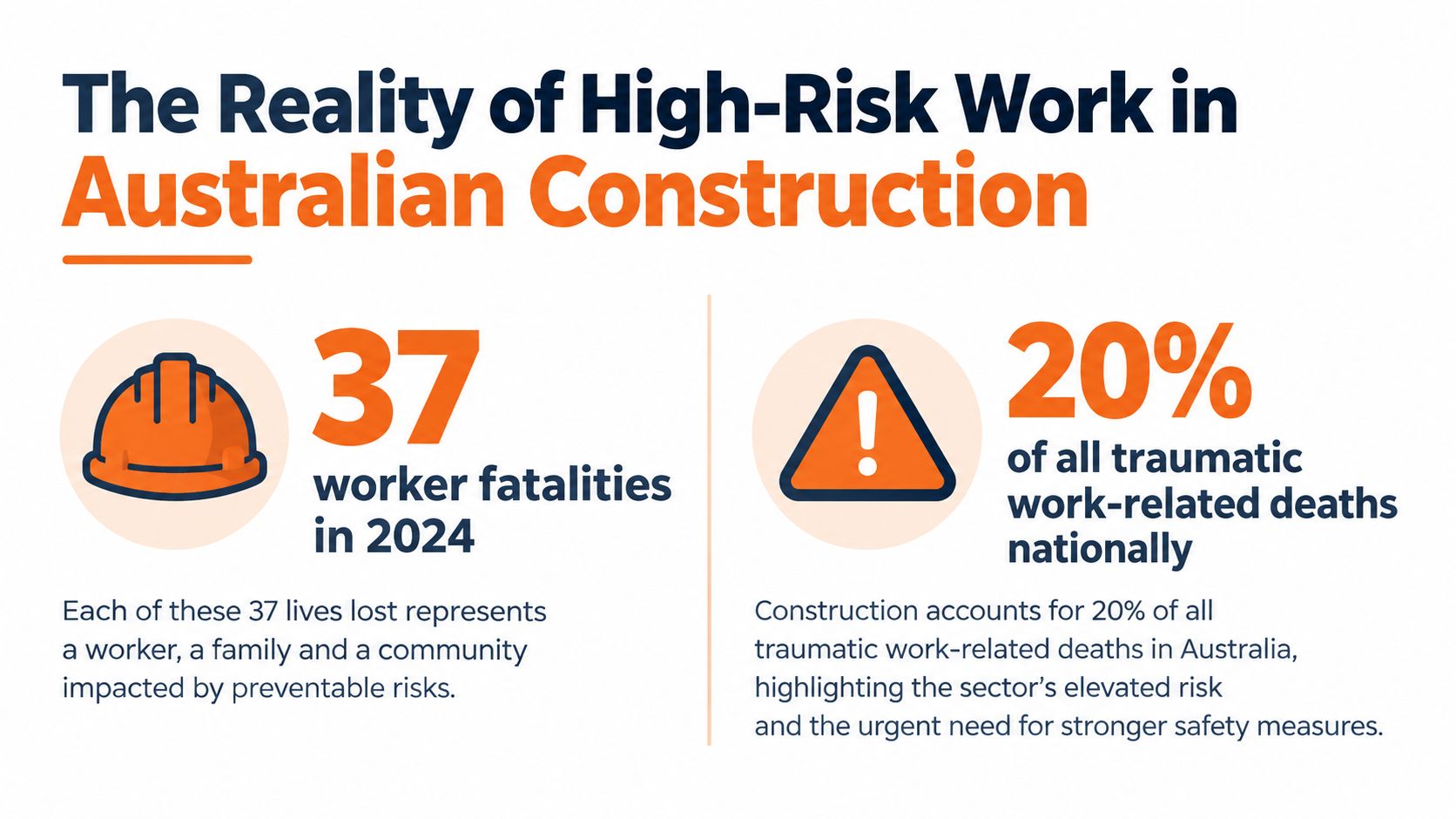
Safe Work Australia recorded 37 construction worker fatalities in 2024, representing 20% of all traumatic work-related deaths nationally. Across all industries, there were 188 work-related deaths, with a fatality rate of 1.3 deaths per 100,000 workers in the same year, according to Safe Work Australia's latest national WHS statistics.
These figures require a practical response from site managers. Fatal events usually develop through several ordinary decisions rather than one dramatic failure. A crew starts before the access system is complete. A delivery vehicle enters a work zone during another trade's lift. A subcontractor changes the method without updating the SWMS. A supervisor notices the problem but assumes another company controls it.
Those gaps appear on projects across Western and Southern Australia, where work fronts shift, subcontractors overlap and local conditions can change quickly. Principal contractors must keep control of these interfaces while ensuring subcontractors understand who owns each control. That includes risks that have gained more attention during the 2024-2025 regulatory changes, such as silica exposure and psychosocial hazards.
Fatal incidents are only part of the burden
Construction also records a substantial volume of serious injuries. Safe Work Australia's industry snapshot identifies around 12,700 serious workers' compensation claims each year, with leading mechanisms including falls from height, being hit by falling objects, and muscular stress from lifting and handling materials, as reported in the same national WHS statistics release.
A fatality receives immediate attention. Repeated handling injuries, non-fatal falls and struck-by events can remain spread across claims, modified duties, absenteeism and subcontractor disputes. They still reduce labour availability, disrupt programme reliability and create compliance work for the businesses involved.
Operational rule: If your system only measures serious incidents, it is looking backwards. Check each day whether controls for common injury mechanisms were planned, verified and corrected.
Construction safety management needs two operating speeds. Strong controls must prevent catastrophic events involving falls, plant, vehicles and falling objects. Daily checks must also reduce the repeated exposures that drive serious claims and weaken delivery performance.
Legal Duties and the PCBU Model
The PCBU, or Person Conducting a Business or Undertaking, holds the primary WHS duty. That duty sits with the business conducting the work. It doesn't transfer to a site supervisor because that supervisor is physically present.
Safe Work Australia states that a PCBU must manage risks so far as is reasonably practicable, ensure the health and safety of workers and other people at the workplace, consult with workers affected by WHS matters, and consult, cooperate and coordinate with other duty holders. The duty includes labour hire workers and isn't limited to direct employees, as set out in Safe Work Australia's guidance on construction WHS duties.
Put legal control into site decisions
The PCBU model becomes useful when managers translate it into work controls.
- Plan the activity: Identify foreseeable hazards before the crew starts. Include access, plant movement, services, lifting, interfaces and emergency arrangements.
- Provide resources: Make sure the business provides suitable plant, PPE, first aid access, emergency plans and traffic management where the work requires it.
- Consult affected workers: Ask the people doing the job whether the proposed method matches the actual sequence, access and constraints.
- Coordinate duty holders: Establish who controls shared areas, exclusion zones, permits, isolation points, deliveries and emergency response.
- Review changed conditions: Escalate when design, weather, access, sequencing, plant or personnel changes the risk profile.
The hierarchy of control should guide those decisions. Start by asking whether the business can eliminate the exposure. If it can't, consider substitution and engineering controls before relying on administrative controls such as procedures, training and SWMS. PPE remains necessary in many tasks, but it shouldn't carry the whole burden where a physical or engineered control is reasonably practicable.
Principal contractor control isn't subcontractor outsourcing
A principal contractor can allocate work to a subcontractor. It can't outsource its responsibility to coordinate the project. The practical test is whether the principal contractor knows what work is happening, understands how activities interact, and acts when a subcontractor's controls don't protect the wider site.
That requires more than collecting certificates during prequalification. Managers need clear approval points, visible site rules, competent supervision and an escalation path that stops work when critical controls fail. A contractor's paperwork may support due diligence, but it doesn't replace active management.
Making SWMS Work on Site
Safe Work Australia requires SWMS for the 18 categories of high risk construction work defined in the WHS Regulations, and the statement must be prepared before the work starts. It must identify the high-risk activities, the hazards and risks, the control measures, and how those controls will be implemented, monitored and reviewed, according to the Safe Work Australia SWMS information sheet.
A SWMS fails when it describes an ideal job rather than the job the crew will perform. Generic wording such as “use appropriate PPE” or “follow site requirements” doesn't tell a worker how the team will isolate plant, control access, manage falling objects or respond when the planned method becomes impossible.
Write for the point of work
A useful SWMS answers four practical questions:
- What high-risk work is happening? Describe the activity and its sequence.
- What can hurt people? Identify the hazards created by the task and its surroundings.
- Which controls must exist before work starts? State the physical, engineered and administrative controls.
- How will someone verify the controls? Name the person or role responsible for checking, monitoring and reviewing them.
The statement should also reflect worker involvement. A supervisor who reads a document prepared elsewhere may miss a conflict with the actual access route, plant set-up or work sequence. The workers carrying out the task can identify those gaps before production pressure turns them into an incident.

Treat the SWMS as a live control
The Safe Work Method Statement guide for construction work is useful when checking whether a document explains the work rather than merely naming it. The next step is operational. Put the SWMS where the crew can access it, discuss the controls at the pre-start, and verify the critical controls at the workface.
Review the document when the work method, site conditions, plant, materials, design or surrounding activities change. A review is also necessary when a worker identifies a gap, an incident occurs, or the control can't be implemented as written.
A practical supervisor doesn't ask only whether the SWMS has been signed. They ask:
- Is the stated plant on site?
- Is the exclusion zone in place?
- Can workers reach the task without bypassing a control?
- Has another trade introduced a new interface?
- Does the crew understand what happens if the method changes?
A signature proves attendance. It doesn't prove control. Field verification closes that gap.
Managing Subcontractors and Site Fragmentation
The common assumption is that a subcontractor's safety system protects the project. It doesn't. It protects the subcontractor's planned scope, and only if the subcontractor applies it properly.
A principal contractor manages a combined workplace. One business may control the crane, another may control the lift, and a third may control the area below. The risk sits at the interface. If each business manages only its own paperwork, nobody may manage the interaction.
Control the interfaces, not just the companies
Start before mobilisation. Review the contractor's capability, licences, supervision arrangements, relevant SWMS and capacity to perform the work safely. Then set project requirements that apply to every business, including reporting, induction, consultation, permits, access, traffic movement, emergency response and stop-work escalation.
A site induction shouldn't be a long presentation followed by a signature. It should explain the controls that affect how the project operates. Workers need to know who controls shared zones, how to report a hazard, who can stop work, and how a change reaches the people exposed to it.
The subcontractor management best practices resource can help structure those controls across procurement, onboarding, site activity and close-out.
Make accountability visible
Use one project risk picture, even when several companies perform the work. That doesn't mean every subcontractor needs an identical procedure. It means their procedures must fit the site plan and each other.
- At tender: Test whether the contractor can meet the project's WHS requirements.
- At mobilisation: Verify competency, licences, plant, SWMS and emergency arrangements.
- During work: Inspect the controls, not just the documents.
- At change points: Reassess interfaces when work phases, access or sequencing change.
- After a failure: Escalate through a defined process, with clear authority to pause the activity.
For managers comparing Australian arrangements with overseas contractor frameworks, OSHA requirements for construction contractors provides useful context. Australian businesses still need to apply the WHS Act, local regulations and regulator guidance that govern their own work.
A subcontractor may be technically competent and still create an uncontrolled risk through poor coordination. The principal contractor's job is to detect that gap early, resolve ownership and confirm that the control works for everyone sharing the site.
Adapting to Recent Regulatory Changes
Silica and psychosocial risks expose gaps in established safety systems. Companies often place silica with occupational hygiene and psychosocial risk with HR. Workers experience both through the same work design, supervision, schedule and production pressure. Principal contractors need one operating process that connects these risks to planning, subcontractor coordination and field verification.
Australia strengthened silica controls from 1 September 2024. The changes cover materials containing at least 1% crystalline silica, controlled processing, risk assessment and silica risk control plans for high-risk engineered stone work. Regulators have signalled that air and health monitoring requirements will tighten through 2025. Check current Safe Work Australia silica guidance before mobilising high-risk engineered stone work. Safe Work Australia's 2024–25 annual report discussion of WHS policy provides the wider policy context.
Build one exposure control process
For silica, identify the material, define the processing method, choose controls, verify them and retain the evidence. Wet methods, on-tool extraction, isolation, restricted access, cleaning procedures, respiratory protection and monitoring must match the task. A SWMS that requires equipment or facilities the site cannot provide has failed before work starts.
Apply the same management discipline to psychosocial hazards. Examine work demands, role clarity, fatigue, bullying, poor support, conflict, isolation, exposure to traumatic events and unreasonable pressure. Assign actions to people who can change the work, including project managers, supervisors and subcontractor leaders. The H&S team can coordinate the process, but it cannot fix production planning or poor supervision alone.
Use a single workflow across the project:
- Project planning: Identify silica materials, high-risk tasks and psychosocial pressures before mobilisation.
- Task controls: Put exposure controls, consultation requirements and ownership into the relevant SWMS and work plan.
- Field checks: Verify dust controls, access, supervision, breaks, reporting channels and worker concerns.
- Escalation: Give supervisors a clear route for stopping unsafe work and referring unresolved psychosocial issues.
- Evidence: Keep monitoring, training, consultation, corrective action and review records together.
Use digital records where complexity demands them
Paper can show that a check was completed. It rarely shows what remains open across several sites, contractors and work fronts. A digital workflow can connect a hazard, SWMS review, inspection, corrective action, worker notification and close-out evidence.
Technology does not replace governance. Configure forms around actual risks, make critical fields mandatory, support offline capture where connectivity is poor and give supervisors ownership of overdue actions. Dashboards help only when someone reviews the information and acts.
The objective is a shorter delay between a changed condition and a management response.
Regional Nuances for Western and Southern Australia
Western Australia recorded a construction lost-time claims frequency rate of 9.2 claims per million hours worked, against a scheme average of 6.9 in 2022/23. WorkCover WA identifies falls, trips and manual handling as the construction industry's leading lost-time hazard groups in its WorkCover WA construction industry report.
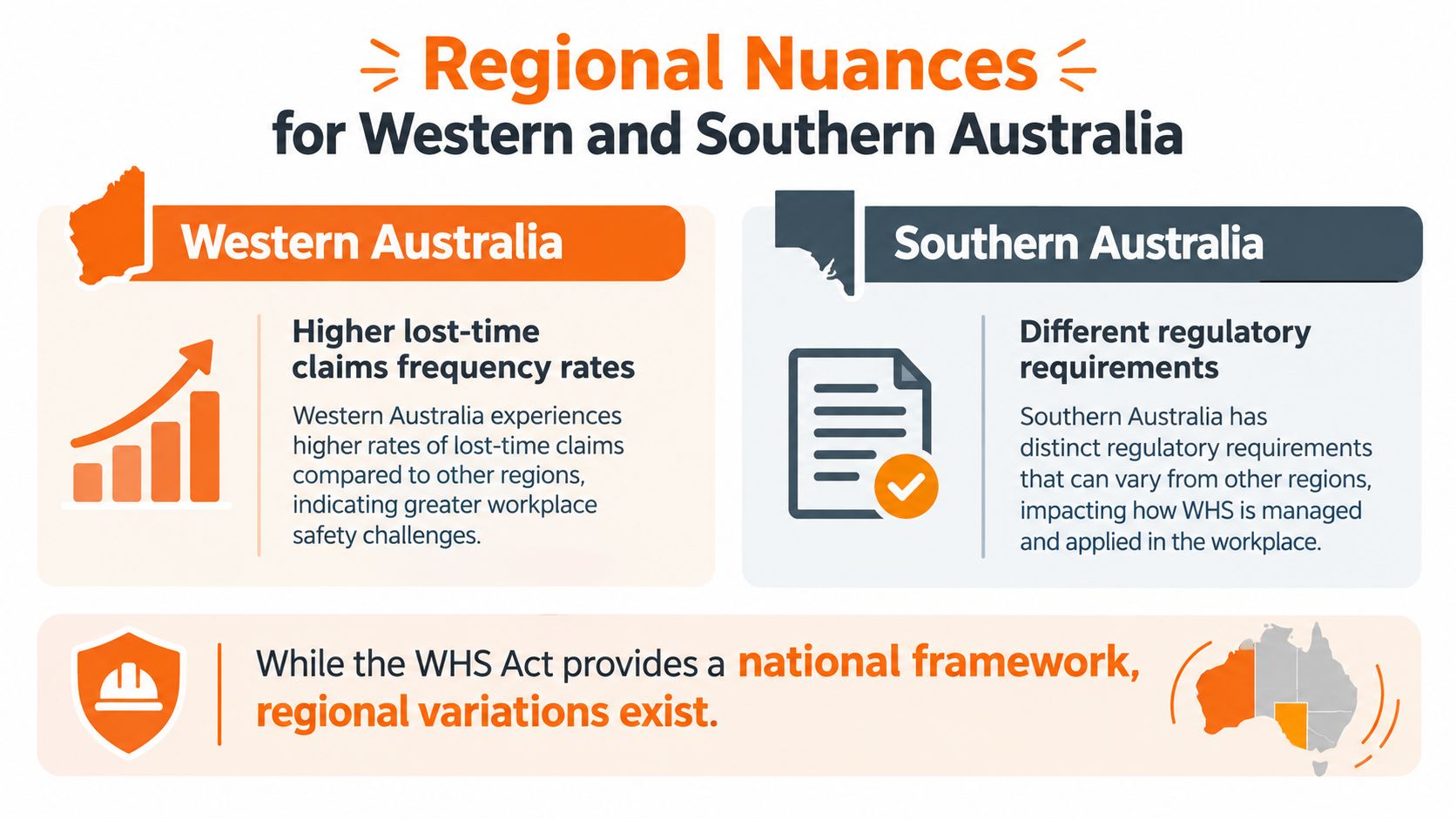
Those figures support a practical WA focus on work at height, housekeeping, access, manual handling and supervision at busy interfaces. A low corporate injury rate does not prove that a new WA project has low exposure. Check the local work, workforce, subcontractor mix, sequencing and site conditions before accepting the corporate risk profile.
Build these checks into mobilisation and project reviews:
- Confirm which WA regulator requirements and reporting processes apply.
- Map falls, trips and handling risks to work packages, SWMS and inspections.
- Check that subcontractor controls match the actual site sequence.
- Review lost-time trends with hazard observations and overdue corrective actions.
- Escalate recurring failures to operations leadership, not only the site supervisor.
Southern jurisdictions require local validation
Southern Australia includes several separate regulatory systems. Victoria, South Australia, Tasmania and the Australian Capital Territory may apply different legislation, codes, regulator guidance and reporting arrangements. A corporate WHS template gives the project a starting point. It does not replace checking the law and regulator expectations that apply at the workface.
The regulatory position is changing. Victoria flagged a 2025/26 construction strategic approach, and the ACT approved a new Construction Work Code of Practice in 2025, as recorded in Safe Work Australia's 2024–25 annual report. Treat these developments as document-control triggers, not reasons to wait for an annual folder review.
Use two connected layers. Corporate standards should set expectations for consultation, incident management, subcontractor control, audits and evidence. A project jurisdiction register should then identify the applicable regulator, legislation, codes, notification process and local approval requirements. Assign an owner to the register and review it when the project changes, a regulator issues guidance or a new work method creates a different duty.
This matters most where the principal contractor manages several subcontractors across changing work fronts. A generic template can leave supervisors unsure which notification route, code or approval applies. The register turns that uncertainty into a visible task with an owner and review date.
Management test: A system is ready for cross-border work when a supervisor can identify the applicable local requirement without asking the H&S team to interpret a generic template at the workface.
The operating principle stays consistent across regions. The controls must still match local law, regulator expectations, project sequencing and site conditions.
Safety Space provides digital tools for construction teams, including permit systems, mobile toolbox talks, real-time hazard tracking and oversight of multiple sites and subcontractors. Visit Safety Space to review how it supports a live WHS system, then use a demonstration or consultation to map the platform to SWMS, subcontractor controls and regional compliance processes.
Ready to Transform Your Safety Management?
Discover how Safety Space can help you implement the strategies discussed in this article.
Explore Safety Space FeaturesRelated Topics
Safety Space Features
Explore all the AI-powered features that make Safety Space the complete workplace safety solution.
Articles & Resources
Explore our complete collection of workplace safety articles, tools, and resources.