
A supervisor walks the floor during a concrete pour and sees a contractor setting up lifting equipment differently from the SWMS. The work looks routine, the crew is under pressure, and the supervisor has a choice: record “unsafe lifting” on a checklist, or find out why the documented method isn't being followed and assign an action that prevents the same gap tomorrow.
That choice defines the value of a job safety observation form. A useful form captures the difference between the written procedure and the work being performed, then turns that difference into a controlled action. It isn't a tick-box exercise for an audit file.
Table of Contents
- What a Job Safety Observation Form Actually Is
- Job Safety Observation Form Template and Field Guide
- Completed JSO Examples for Construction and Manufacturing
- Two Approaches to Conducting Safety Observations
- Paper, PDF, or Digital Choosing Your JSO Format
- Why Digital JSOs Are Essential for Multi-site Operations
- Integrating JSOs Into Your Existing WHS System
- Using Safety Space for Digital Job Safety Observations
- Quick Reference JSO Implementation Checklist
- Common Misconceptions About Job Safety Observations
What a Job Safety Observation Form Actually Is
A supervisor walking through a manufacturing plant may notice an operator bypassing part of a lockout procedure to clear a jam. The observation matters, but the note “lockout not followed” doesn't tell you enough. You need to know which procedure applied, what the operator did, what made the documented method difficult to follow, and what will change before the task happens again.
A job safety observation form is a structured record of that conversation. It should capture:
- The reference procedure, such as a SWMS, SOP, permit, or isolation instruction.
- The task steps and work conditions observed.
- Positive practices and unsafe conditions or behaviours.
- What the worker said about the task.
- Immediate controls and longer-term corrective actions.
- The person responsible and the follow-up status.
Safe Work Australia's workplace inspection guidance recommends regularly walking around the workplace and observing how work is done, including plant and equipment use, chemicals, housekeeping, and safe or unsafe practices. It also supports a workplace-specific checklist for finding and recording hazards.
That makes the JSO a risk-control tool, not a passive record. A practical explanation of how task analysis connects with safety procedures is available in this guide to what a JSA is. The key distinction is simple: the form should help you understand the work, not just judge the worker.
Practical rule: If the form can't show the gap between the documented method and the observed method, it isn't doing enough.
Job Safety Observation Form Template and Field Guide
Use the following fields as the base for a construction or manufacturing JSO. Keep the language specific enough that another manager can understand the finding without speaking to the original observer.
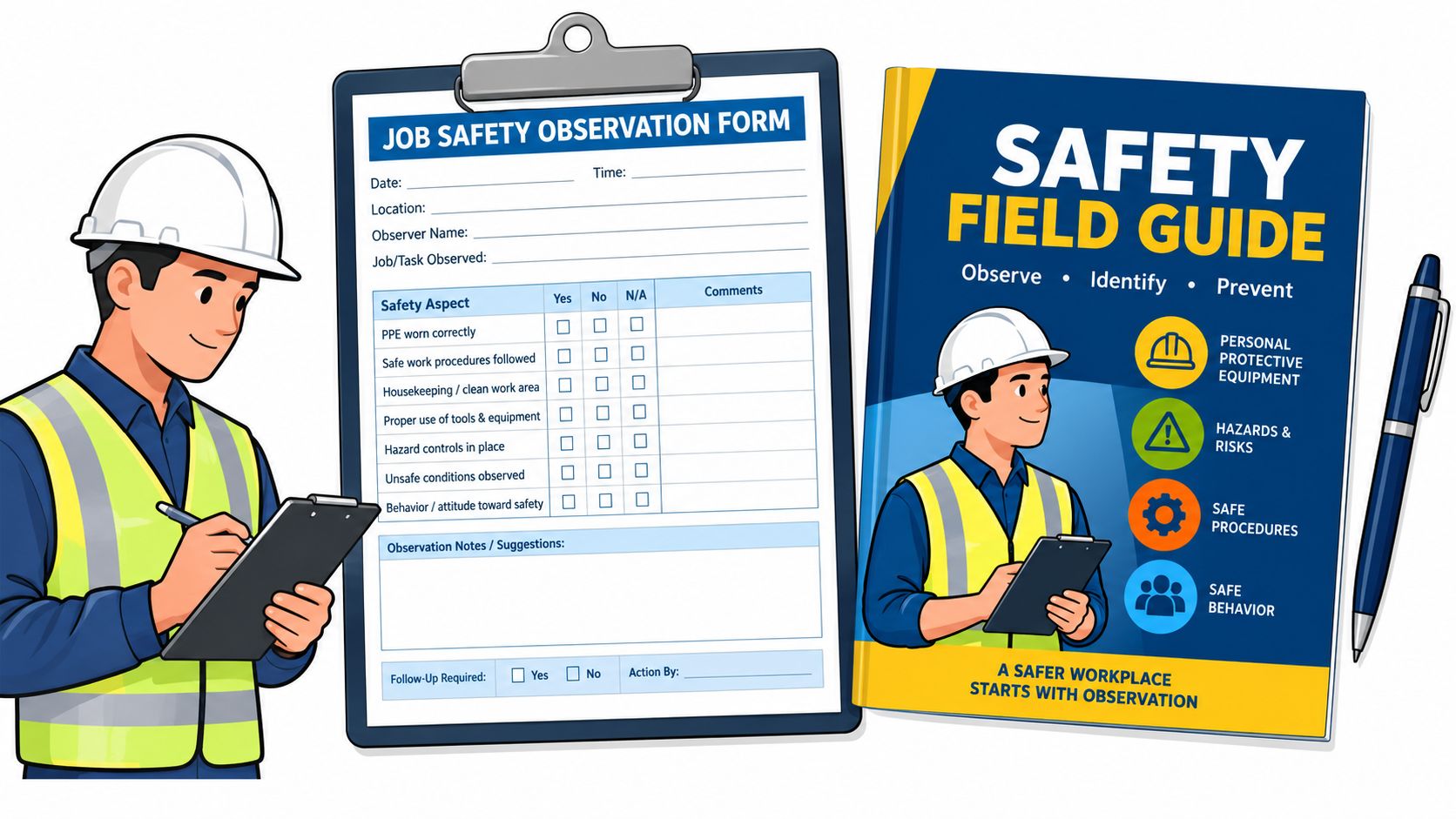
Site and date
Record the project, plant, location, date, and time. “Site 4” isn't enough if the organisation operates across several projects. Use an entry such as “Riverside residential project, slab area, morning concrete pour”.
Observer and PCBU representative
Name the supervisor, H&S manager, or other PCBU representative conducting the observation. Record the relevant employer or duty holder where subcontractors are involved. This establishes who conducted the review and who can coordinate the response.
Task or work area
Describe the activity precisely. “Crane lift of concrete kibble to slab edge” is useful. “Construction work” isn't. In a plant, record the line, machine, or work cell.
Reference document
Identify the SWMS, SOP, lift plan, permit, or isolation instruction being checked. Include its title or document identifier. For example, “Concrete placement SWMS, lifting and exclusion-zone section”.
Observation method
State how you verified the work. “Direct observation with worker consultation” is stronger than “spot check”. Other valid methods include group discussion and recall-and-check, where workers validate a task breakdown after the supervisor drafts it.
Observed practice and hazard
Write what happened, not a judgement about the person. For example: “The crane was positioned outside the setup described in the lift plan, and the exclusion zone did not cover the delivery path.” Include the potential exposure and the people affected.
Worker consultation notes
Record what workers explained. A useful note might say, “Dogger reported that the planned setup conflicted with vehicle access and the crew had adopted the alternate position during previous pours.” That information points to a control design issue, not merely a behaviour issue.
Immediate action
Record what happened at the time. Examples include pausing the lift, isolating the machine, removing a damaged sling, or separating pedestrians from mobile plant. Serious hazards need immediate attention, not a deferred action.
Corrective action, owner, and due date
State the change required, name the responsible person, and set a due date. “Review lifting setup with the project engineer and update the SWMS before the next pour” is actionable. “Improve compliance” isn't.
Follow-up status
Use a controlled status such as open, in progress, verified, or closed. Closure should confirm that the action was completed and the revised control works in the field.
Completed JSO Examples for Construction and Manufacturing
The following examples are illustrative entries. They show the level of detail needed to identify a procedure gap without turning the form into a long incident report.
Construction example
Site and date: Residential construction site in Western Australia, concrete pour area, observation during the morning shift.
Observer: Site supervisor, acting for the PCBU.
Task: Crane-assisted placement of a concrete kibble.
Reference document: Concrete pour SWMS and lift plan.
Method: Direct observation with worker consultation.
Finding: The lift plan positioned the crane and exclusion zone to keep workers clear of the delivery path. The actual crane setup was shifted to accommodate vehicle access, leaving part of the path outside the planned exclusion zone.
Worker discussion: The dogger and concreter understood the written method but said the planned position created access problems. They also reported fatigue after repeated early starts and difficulty hearing radio instructions while the pump was operating.
Immediate action: The lift paused. The exclusion zone was repositioned, and the supervisor confirmed communication arrangements before work resumed.
Corrective action: Review the lift setup with the crew, update the SWMS if required, and conduct a toolbox talk before the next shift. The site supervisor owns the action and must verify completion.
The form should also identify relevant construction site alarm systems where site access, warning arrangements, and emergency communication form part of the broader control environment.
Manufacturing example
Site and date: Victoria manufacturing plant, production line machine guarding verification.
Observer: Plant H&S manager.
Task: Operator changeover and jam-clearing process.
Reference document: Machine SOP and isolation instruction.
Method: Direct observation followed by group discussion.
Finding: The documented process required isolation before access to the guarded area. The operator stopped the machine but used the control panel reset rather than applying the documented isolation process for a minor jam.
Worker discussion: The operator said the reset normally cleared the issue and the isolation point was several metres away. The maintenance technician confirmed that similar jams had occurred during changeovers.
Immediate action: The task stopped, the machine was isolated, and the supervisor reviewed the instruction with the operator.
Corrective action: Check the jam-clearing control, review the SOP with maintenance and operators, and confirm the revised method at the next changeover. Assign the production manager as owner and record verification after the review.
SafeWork NSW inspection guidance supports consistent checklists, recording tasks that weren't directly observed, and immediate correction of serious hazards. The point of both examples is to record the documented control and the actual work, not just label an unsafe act.
Two Approaches to Conducting Safety Observations
Choose the observation method according to the risk and the question you need answered. A quick inspection can confirm whether a known control is present. It may not explain why workers use a different method.
Observation with workers
Walk through the task with the people performing it. Ask them to explain the critical steps, constraints, equipment choices, and workarounds. Compare those answers with the SWMS, SOP, or permit while the work is visible.
This approach suits high-risk tasks, new processes, changed equipment, and recurring findings. It also works when an incident or near miss indicates that a control exists on paper but fails in practice.
Victorian construction guidance recognises direct observation, group discussion, and recall-and-check as ways to analyse work. In each case, the supervisor needs a task breakdown and worker validation, not just a free-text hazard description.
Independent inspection
An independent inspection reviews the documented controls against the work area without making worker consultation the centre of the activity. It suits routine verification of established controls, such as checking guarding, housekeeping, chemical storage, access routes, or emergency equipment.
The trade-off is speed versus context. An independent check may identify that a guard is missing. A conversation may reveal that the guard is removed because a production fault cannot be cleared without access, which requires a different corrective action.
An automated risk assessment guide can help teams think about how digital workflows support risk review, but automation shouldn't replace field discussion where the reason for a control failure isn't obvious.
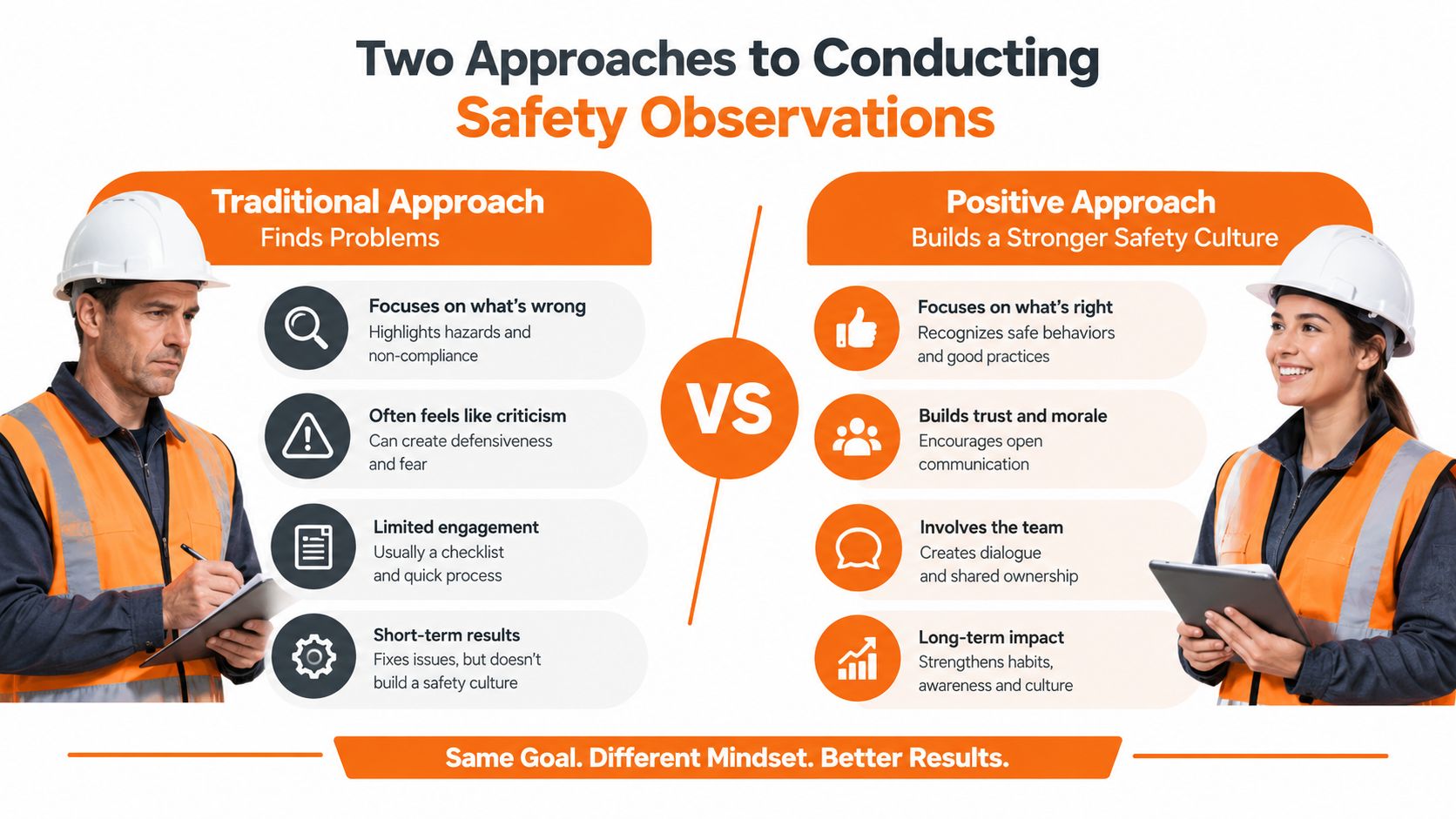
Worker consultation also broadens the observation beyond physical conditions. SafeWork NSW guidance on psychosocial hazards identifies signs such as workers being rushed, delayed, confused, or making frequent mistakes. Those observations need careful discussion. They should identify workload, design, communication, or supervision issues, not become a subjective performance review.
Paper, PDF, or Digital Choosing Your JSO Format
The right format depends on the number of sites, the number of people submitting observations, and how reliably managers close actions. Paper can work for a single crew with a supervisor who reviews every form promptly. It becomes weak when forms travel between sites, offices, and subcontractors.
A PDF improves storage and distribution, but it still relies on someone to email it, extract the findings, assign actions, and check overdue items. A digital workflow creates a stronger record because the observation, action, owner, and status remain connected.
An Australian government guide recognises paper, PDF, and app-based safety observation tools, while also supporting the need to analyse information across locations and subcontractors. Mobile safety inspections are one way to capture the record at the point of work rather than transcribing it later.
| Format | Data Centralisation | Real-time Alerts | Multi-site Capability | Follow-up Tracking | Best For |
|---|---|---|---|---|---|
| Paper | Low | No | Limited | Manual | One crew and one site |
| Moderate | Usually no | Limited | Manual or spreadsheet-based | Small operations with simple reporting | |
| Digital platform | High | Available through configured workflows | Strong | Built into the record | Multi-site operators and subcontractor networks |
Paper isn't automatically poor practice. A paper form is preferable to no observation process, particularly where connectivity or device access is limited. The weakness appears when the organisation has no reliable method for transferring findings into a central register.
Decision test: If managers can't identify open actions across every active site without chasing individual supervisors, the current format is no longer sufficient.
Why Digital JSOs Are Essential for Multi-site Operations
A paper process assumes someone can collect every form, read every entry, copy actions into a register, and report patterns back to operations. That assumption fails when crews work across states, subcontractors submit information on different schedules, or supervisors hold forms in vehicles and site offices.
A digital JSO gives the organisation one working record. Supervisors can submit the finding from the field, managers can see the action, and the responsible person can receive the required follow-up without waiting for a weekly document pack.
The value isn't limited to speed. Digital records help managers compare recurring issues by site, task, contractor, or hazard type. They can also connect a JSO finding with the hazard register, incident investigation, SWMS review, or management report instead of storing it as an isolated inspection.
Safe Work Australia describes the PCBU process as identifying hazards, assessing risks, controlling risks, and reviewing controls so far as is reasonably practicable. That risk management process gives the JSO its place in the wider WHS system. An observation becomes useful when it feeds one of those activities.
The common objection is that digital systems add complexity. In most multi-site operations, the complexity already exists. Manual processes hide it in separate spreadsheets, inboxes, folders, and informal conversations. A central workflow exposes the workload and gives managers a way to assign, escalate, and verify it.
Digital tools still need sound governance. A badly designed form creates poor data faster. Keep mandatory fields limited to information that supports a decision, and give observers a clear path for urgent hazards.
Integrating JSOs Into Your Existing WHS System
A JSO should connect with the controls you already use. Treating it as a separate monthly activity creates duplicate records and leaves findings outside the normal risk review process.
Schedule observations around risk
Set the cadence around high-risk tasks, operational changes, contractor activity, and recurring findings. Schedule observations during the work that creates exposure, not only during quiet periods when the procedure is easier to follow.
Make the task and observer clear. A supervisor should know whether the purpose is to verify a SWMS, test a machine control, investigate a recurring deviation, or look at how work changes under production pressure.
Conduct the observation consistently
Use the form to record the reference document, task steps, actual practice, worker discussion, and immediate controls. Train observers to describe what they saw and heard without using labels that obscure the cause.
Include positive practices where they matter. A worker who uses the correct isolation sequence or maintains an exclusion zone demonstrates a control worth reinforcing. The form should identify both reliable controls and control failures.
Close the action
Every material finding needs an owner, a due date, and a verification step. The observer may fix a minor issue immediately, but the record should still show what was corrected. A larger issue may require engineering review, a SWMS amendment, consultation, or a change to the plant.
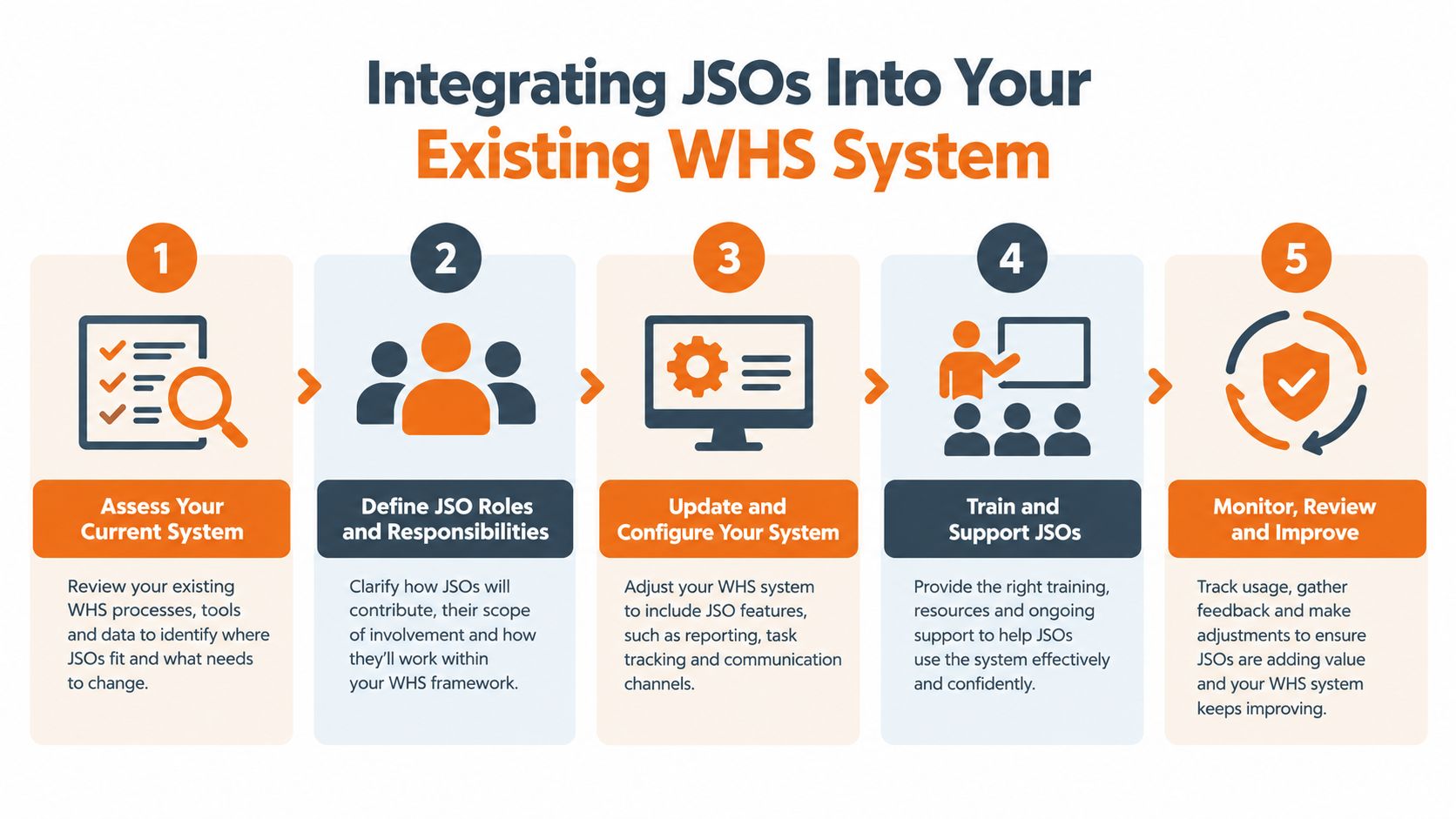
Safe Work Australia's guidance on measuring and reporting WHS includes conducting a workplace safety observation and then meeting with managers and workers to identify risks, challenges, and improvement opportunities. The guidance on measuring and reporting WHS supports a closed-loop approach. Schedule the observation, record the reality, assign the control, and confirm the change works.
Using Safety Space for Digital Job Safety Observations
Set up the digital form around the work your teams perform. Create fields for the site, task, reference SWMS or SOP, observation method, actual practice, worker comments, immediate action, corrective action, owner, due date, and closure evidence. Keep the structure consistent across sites, but allow task-specific questions for lifting, isolation, chemicals, plant, or traffic management.
Safety Space provides a customisable health and safety management platform for digital forms, real-time monitoring, AI-powered form completion, and oversight across sites and subcontractors. Its practical role in a JSO process is to keep the field record and the management response connected.
Start with the form configuration. Align the questions with the hazard register and the controls in the relevant SWMS. Use the form-building guidance to configure the fields, required responses, and action workflow rather than copying a generic checklist that doesn't match the task.
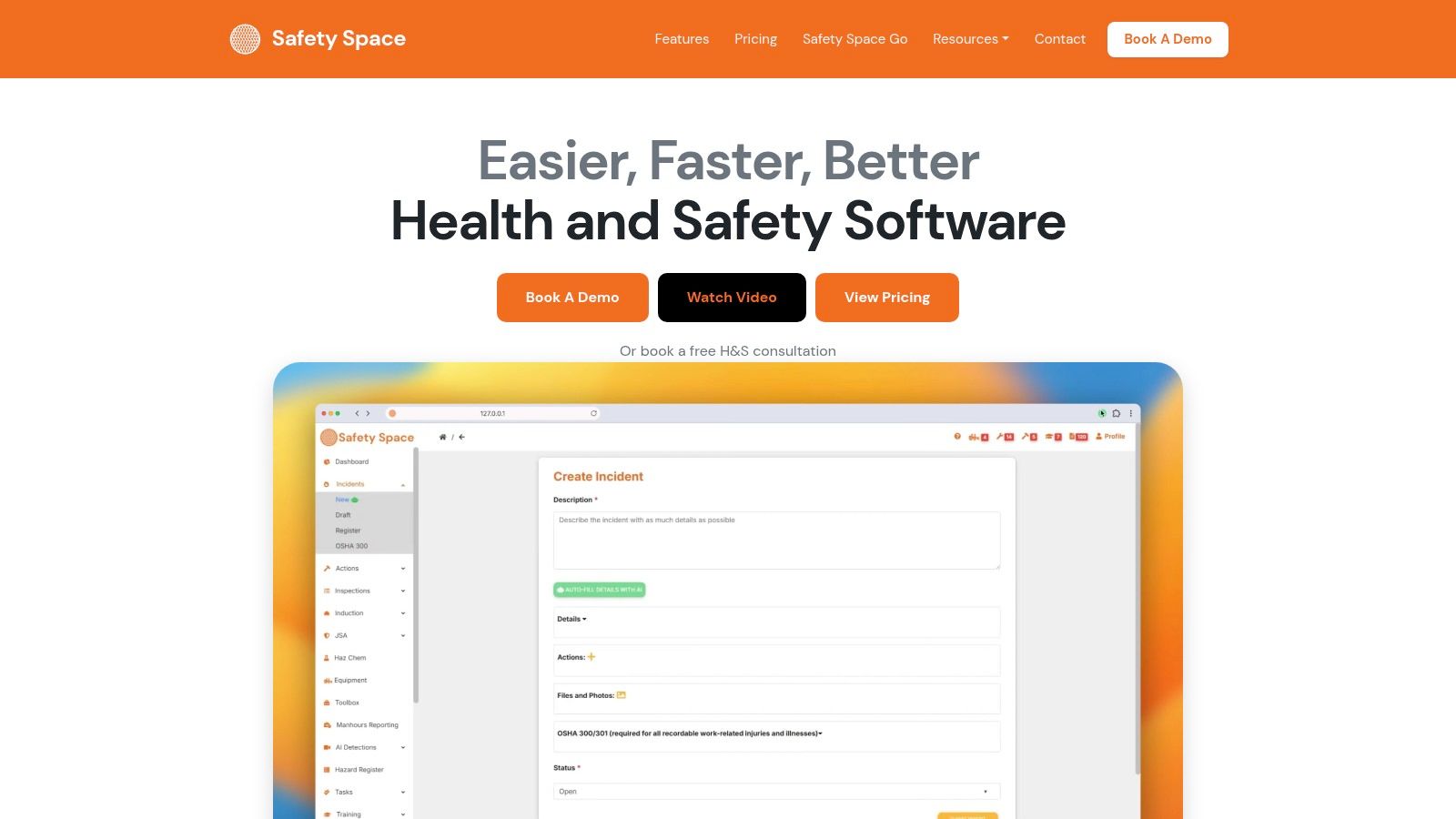
Then configure the response path. A critical hazard should notify the person who can intervene. An overdue corrective action should escalate according to your internal responsibility structure. A routine observation should remain visible for trend analysis without creating unnecessary alerts.
Managers can use the dashboard to review observations by site, location, hazard type, or status. That makes it easier to identify repeated deviations, compare contractor performance, and prepare management reports from the same record used in the field.
The platform shouldn't remove judgement from the observer. It should reduce transcription, make ownership visible, and help the organisation respond before an isolated finding becomes a repeated control failure.
Quick Reference JSO Implementation Checklist
Use this checklist to test whether the process works in practice.
| Check | Yes or No |
|---|---|
| Does the form record the reference procedure and actual observed practice? | Yes / No |
| Does it capture worker consultation? | Yes / No |
| Does every corrective action have an owner and due date? | Yes / No |
| Is follow-up tracked until closure is verified? | Yes / No |
| Are observations scheduled according to risk and operational activity? | Yes / No |
| Is data centralised when the business operates across sites or subcontractors? | Yes / No |
| Do findings feed the hazard register and incident reporting process? | Yes / No |
| Does management receive regular trend information? | Yes / No |
A “No” doesn't always mean the entire system has failed. It identifies the part of the process most likely to lose information between observation and control.
Common Misconceptions About Job Safety Observations
“JSOs take workers away from productive work.” A poorly designed form can waste time. A focused observation that examines a high-risk task, asks why the work differs from the SWMS, and assigns a clear action is different. It addresses the condition that can disrupt work later through an incident, investigation, regulator response, or shutdown.
“They exist for auditors.” An auditor may review the record, but the earlier value is operational. A recurring deviation can show that a control is impractical, equipment is poorly designed, or workers haven't received usable instruction. That warning arrives before the event, not after it.
“A familiar paper form is enough.” Familiarity doesn't prove that managers can find trends or close actions. Paper may suit a single crew with direct supervision. It creates blind spots when observations come from multiple sites and subcontractors.
“The observer only needs to record unsafe acts.” Victorian construction guidance supports direct observation, group discussion, and recall-and-check, with an explicit task breakdown and worker validation. A strong form records safe practices, work conditions, worker explanations, and the control that needs attention.
The best JSO process treats the form as a predictive risk-control record. It asks what the procedure requires, what the work entails, and what must change before the next person faces the same exposure.
Safety Space offers customisable digital safety forms, action tracking, real-time monitoring, and multi-site and subcontractor oversight for teams that need their JSO process connected to the wider WHS system. Visit Safety Space to review how it can support job safety observations from field submission through to verified close-out.
Ready to Transform Your Safety Management?
Discover how Safety Space can help you implement the strategies discussed in this article.
Explore Safety Space FeaturesRelated Topics
Safety Space Features
Explore all the AI-powered features that make Safety Space the complete workplace safety solution.
Articles & Resources
Explore our complete collection of workplace safety articles, tools, and resources.