A pre start meeting is a two-way WHS consultation held before a shift or task, where today's hazards and controls are agreed before anyone is exposed to them. It is not a repeat of induction, and it is not a sign-on sheet.
The most repeated advice about pre starts is to keep them short, run them from a script and collect every signature before the crew walks out. That advice produces a tidy file. It doesn't produce a safer job, because a script can't hear the thing that changed overnight, and a signature can't tell you whether anyone in the room was given a reason to speak.
Table of Contents
- What a Pre Start Meeting Is For
- Topics to Cover Before the Crew Starts
- How to Run the Meeting With the Crew
- Records That Prove Consultation Changed the Work
- Pre Start Practice in Different Industries
- Australian Duties and the New Zealand Note
- Hold or Start Decision
What a Pre Start Meeting Is For
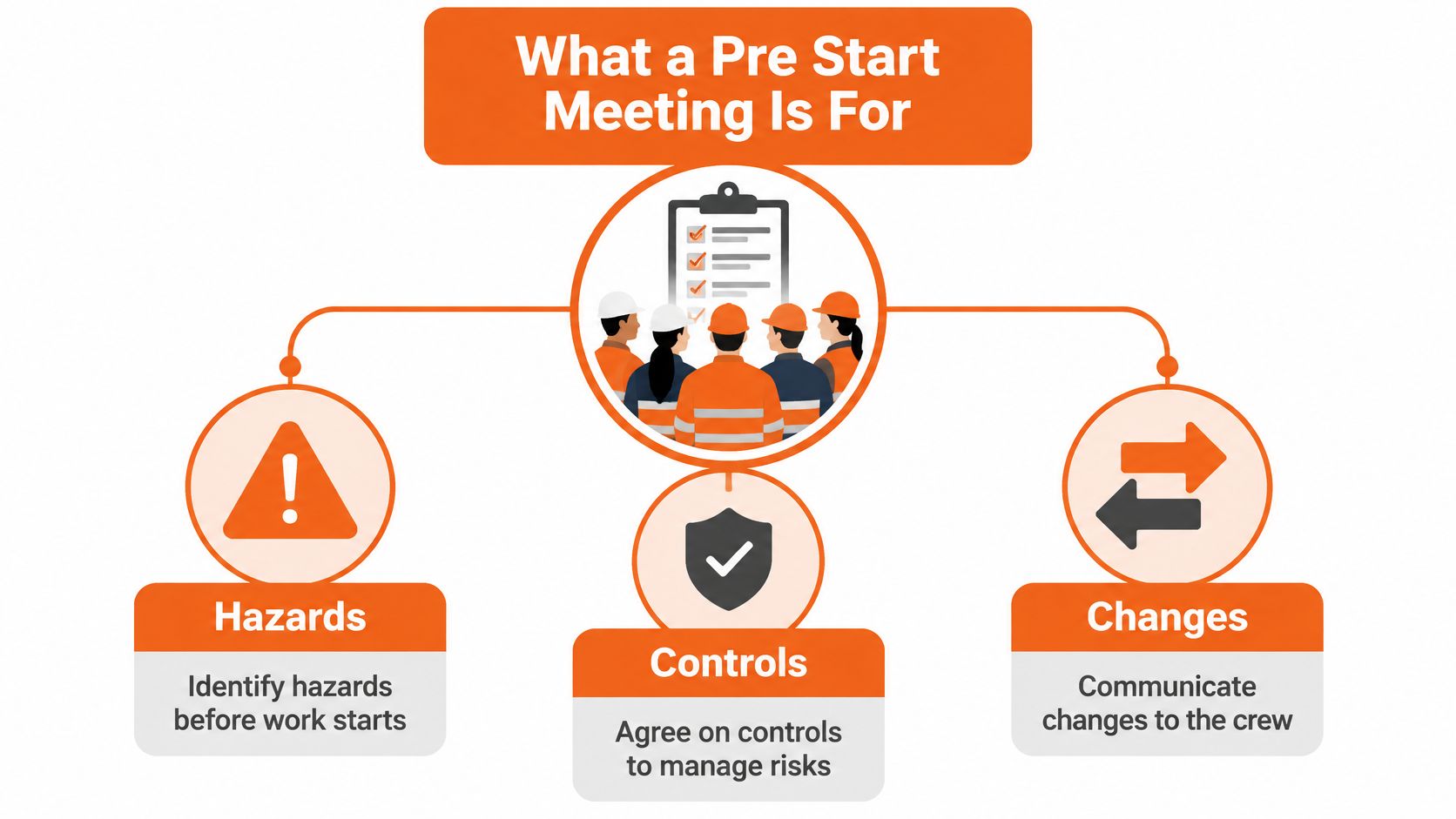
The meeting exists to close the gap between the plan and the day. Drawings, SWMS and programmes describe work as it was designed. The site on any given morning is weather, deliveries, another trade in the same bay, a labour hire crew nobody has met and a pump that hasn't arrived. The pre start is where the supervisor and the crew reconcile the two before anyone picks up a tool.
Safe Work Australia lists pre-start briefings and toolbox talks as accepted consultation methods alongside regular team meetings, and its consultation model code is explicit that a PCBU must consult, so far as is reasonably practicable, with workers who carry out work for the business or undertaking and who are, or are likely to be, directly affected by a health and safety matter (Safe Work Australia, WHS consultation, cooperation and coordination model code). The same code puts consultation during work planning, not after the work has started, and keeps it running on long projects as the environment, the activity or the people involved change.
Three meetings that get confused
- Induction: once per site. Covers the layout, the rules, the emergency arrangements and who does what. It doesn't cover today.
- Toolbox talk: a set topic on a schedule, such as silica, manual handling or isolation. Useful, but it runs on a calendar, not on conditions.
- Pre start: today's task, today's crew, today's changes. It expires at the end of the shift.
The test that separates consultation from a briefing
Ask one question of any pre start. Can a worker stop or change the job because of something raised in the room? If the answer is no, the crew received an announcement, and the record won't show otherwise.
The test: if nothing a worker says can change the sequence, the exclusion zone or the plant movement, the meeting was a briefing.
A two-way meeting adjusts sequencing, exclusion zones, permits, supervision or PPE before the first task starts, and writes down which of those changed. That written change is the only durable evidence that consultation did anything.
Topics to Cover Before the Crew Starts
Use a fixed agenda so the meeting can't drift into a general chat. The ten rows below cover the ground on most construction, manufacturing and facilities sites. The third column does the work, because it's the condition that holds the crew rather than the condition that merely gets discussed.
| Topic | Confirm before start | Pause if |
|---|---|---|
| Work scope and location | Task, area and person in charge | Crew is on a different task or area than planned |
| SWMS or JSA | Correct version for the method in use | Method, plant or crew no longer matches the document |
| High-risk construction work | New high-risk activity named and controls in place | High-risk work starts without the agreed controls |
| Access and security | Entry, exclusion zones and site security match the plan | Access route or fence line has changed |
| Public interface | Separation from neighbours, traffic and pedestrians | Public can enter the work area |
| Plant, traffic and deliveries | Routes, spotters, reversing and exclusion zones | Vehicle path, timing or plant interaction has changed |
| Simultaneous work | Other trades and PCBUs and how they interact | Another crew is in the same area without an agreed sequence |
| Weather and site conditions | Wind, rain, heat, mud or visibility and the matching control | Conditions make the selected control unsuitable |
| PPE and emergency | PPE for the task, muster, first aid and who calls emergency services | Crew cannot state the emergency arrangement |
| Open actions | Corrective actions that still affect this crew | A control from an earlier action is missing |
Work the rows in the same order every shift. Most take one line. The supervisor states a fact, not a slogan: isolation points identified and locked off, lifting gear inspected and tagged, the pedestrian route segregated with barriers, the concrete truck still booked for 10.30, the SWMS still describing the method the crew will use.
Safe Work Australia's construction model code names new high-risk construction activities, changes to site access or security, and changes that may affect members of the public as items for these meetings, and frames them as a way for builders and subcontractors both to provide information and to receive worker feedback (Safe Work Australia, construction work model code). The same code expects the topic, attendees and feedback to be recorded, a programme that gives workers enough opportunity to contribute to risk controls, and effectiveness monitored through implemented controls and near misses.
Where the agenda earns its keep
The plant, traffic and deliveries row changes more often than any SWMS review cycle, and it's the row a document-based pre start skips. If vehicles and reversing are part of the day, a read on spotting hazards on overnight box-truck routes is worth ten minutes before the week's traffic row is set, because it frames the same questions about route changes, timing, fatigue and pedestrians that a yard or loading dock throws up.
Keep the list identical on every shift and every site. Running it from a pre start meeting checklist means a supervisor covering for someone else doesn't invent a shorter version at 6am.
Shared areas and multiple PCBUs
Where several PCBUs share the area, the principal contractor and each subcontractor exchange what is different today rather than relying on a generic induction. Weather gets the same treatment as plant. Heat, wind and mud don't just make work unpleasant, they invalidate controls chosen in a different season, and the crew knows before the supervisor does.
If a topic hasn't changed, say so in one line and move on. Empty rows are what turn a good agenda into a meeting people stop listening to.
How to Run the Meeting With the Crew
Run it at the work area, where people can see the fence line, the access route and the plant they will be working around. Pointing at the actual gate settles an argument faster than describing it from a smoko room.
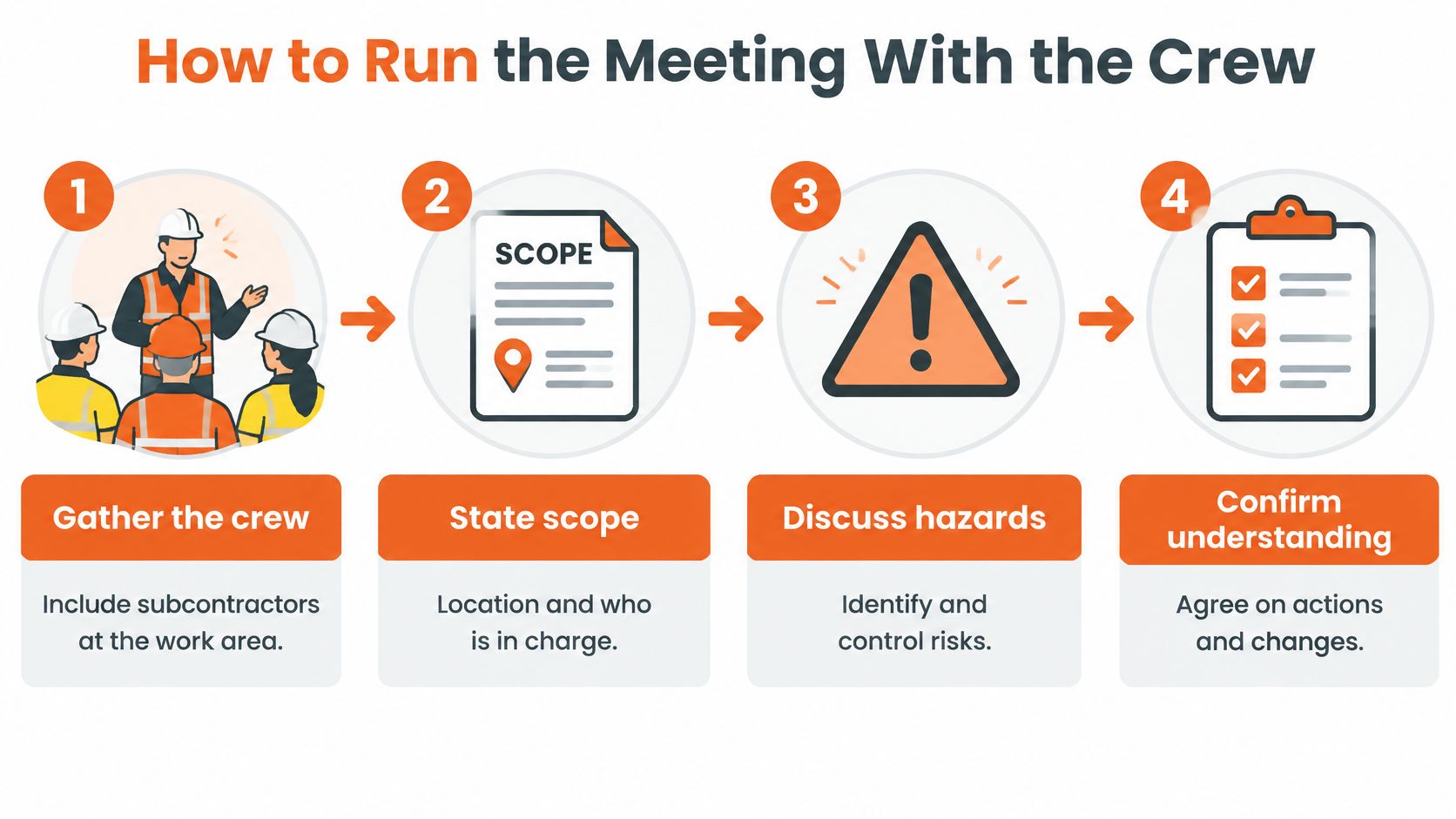
- Gather the whole task crew, including subcontractors. If a crane crew, a traffic controller or a subcontractor's leading hand works in the same space, they're in the meeting. The construction model code puts consultation at each stage of the risk-management process, so a pre start that leaves out the subbies working next to your crew falls short of the standard it is meant to meet (Safe Work Australia, construction work model code).
- State scope, location and who is supervising. One sentence each. A crew that can't name the person in charge will ask a different person for permission.
- Name the SWMS or JSA and the controls that must exist before the first action. Three or four of them, the ones that fail first if nobody checks.
- Walk the changes since the last shift. High-risk work, access, public interface, plant movements and the other crews sharing the area.
- Ask a direct question, then wait. Silence usually means the question was too broad. Narrow it: where will people and plant cross today, what is different from the SWMS, what would make you stop.
- If a worker reports a new hazard, pause that task and change something. The change is a sequence, an exclusion zone, a permit, supervision or PPE, and the risk assessment or SWMS is updated where the method has altered.
- Assign each action to a name and say who may start and who waits. An action without an owner and a time is a conversation.
- Release the crew only after step 7. Then let them go.
Step 6 is the whole point
Conditions move faster than paperwork. The controls selected at tender or at the last review may already be wrong by the time the crew arrives, and worker feedback is how that gap gets found before exposure rather than after a near miss.
A reported hazard closes when a control changes, the change is written down, and the affected crew is told. Reassurance on its own leaves the hazard where it was, and workers learn quickly whether raising something costs them five minutes of standing around or changes the job.
The other seven steps exist to make step 6 possible: enough people in the area, a clear scope to compare against, and a supervisor with the authority to hold the work. A supervisor who has to phone a project manager before pausing a task will stop asking the question that triggers the pause. That authority needs to sit in the role itself, and the wider set of supervisor safety responsibilities is where it is normally defined.
Language and late arrivals
If part of the crew won't follow spoken English, use the same short structure in a language they use, or a bilingual leading hand, and check understanding with a question rather than a nod. A translated document nobody explains doesn't meet the consultation duty either.
Late arrivals and anyone returning from leave get the same brief individually before they enter the task, recorded against their name. They stay out of the work area until the same checks the crew confirmed have been confirmed for them.
Records That Prove Consultation Changed the Work
A signature shows the crew attended. Evidence shows the work moved because of what they said: a reversing route changed, a fatigued driver taken off an early start, a plant interaction caught before the first lift.
That gap matters most where the hazards move. Vehicles and mobile plant account for more workplace deaths in Australia than falls from height, and the gap between the two is wide. A pre start that only asks whether the crew understood the SWMS keeps missing the changed traffic route, the delivery pressure and the interaction with plant, which is where those deaths cluster. A meeting that asks what moved on site this week catches them.
So the record has to carry more than attendance. These are the fields that turn a pre start into evidence.
| Field | What to write | Shows |
|---|---|---|
| Site, date, shift | Project or site, date and which crew or shift | Which work the record belongs to |
| Topic and activities | Tasks covered and the SWMS or JSA version | The discussion matched the method in use |
| Hazards and controls checked | Hazards named and the field check of each control | Controls were available, not only discussed |
| Worker feedback | Question or concern in the worker's words | Consultation was two-way |
| Agreed change | What changed in sequence, zone, permit, supervision or PPE | Feedback altered the work |
| Action, owner, due date | The task, the person and when it closes | Someone is accountable |
| Close-out and acknowledgement | Evidence the action is done and affected workers were told | The loop was finished |
Four questions that test any record
- What worker input was written down, in the worker's words rather than a summary?
- Which actions closed, and who verified the close-out?
- Which controls were seen in the field, not just described?
- Which near misses were reviewed and fed back into the next meeting?
A record that can't answer those four is an attendance log with extra columns.
Turn repeat themes into a document change
The same concern raised three shifts running is a document problem, not a briefing problem. Move it into the revised SWMS or the site rule, then confirm at the next pre start that the change is in place. That is a plan, do, check, act loop running on a daily cycle instead of an annual audit.
Where one crew works across several sites, file the record against the site or project so the next supervisor sees open actions instead of a clean sheet. Safety Space keeps pre start and toolbox talk records against each site, with attendance, topics and actions in one place. Its action-required setting can also stop a form being submitted until the person raises an action, so a blank feedback field can't pass as consultation.
The consultation duty itself is broader than the meeting, and the WHS consultation process is worth reading alongside the record design, because a well-kept record of a meeting nobody was allowed to influence is still a weak one.
Pre Start Practice in Different Industries
Keep one structure and change the questions. The agenda rows stay, the emphasis moves, and each sector has a hazard that a generic read of the SWMS never surfaces.
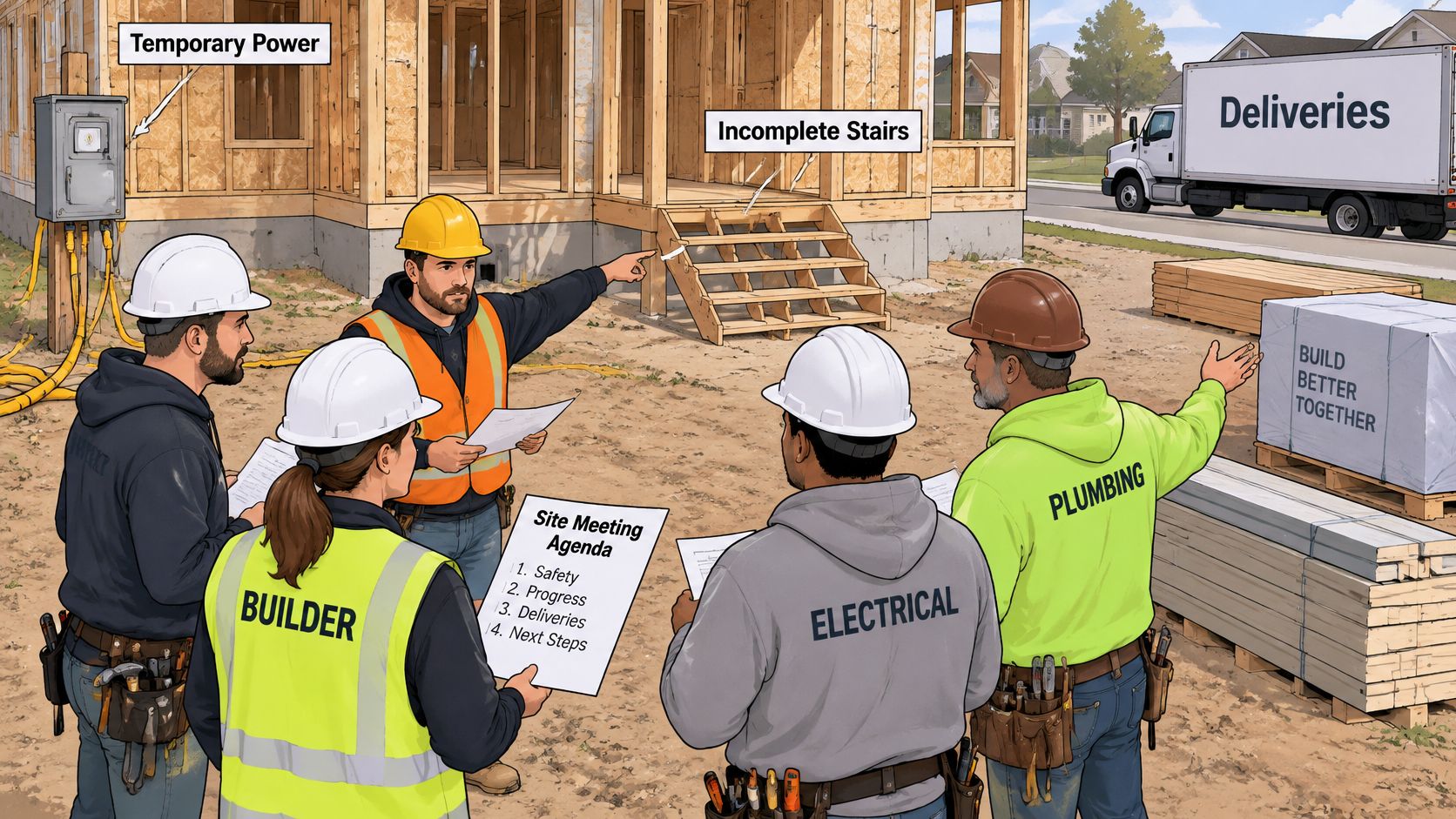
A residential build stacks trades in one house. The flash points are temporary power, incomplete stairs without a guard, a delivery truck on a live suburban street and three trades sharing a single ladder. The generic read covers the SWMS. It doesn't cover the fact that the electrician will be in the roof space while the roof plumber is on it.
Commercial construction adds public interface, crane and mobile plant paths, and the question of which PCBU owns each exclusion zone. Two contractors can both believe the other one has barricaded the lift shaft.
In manufacturing, the pre start is usually a shift handover. Isolation and lockout still in place, line speed, chemical decant, and which guard or interlock was bypassed on the previous shift and hasn't been restored. Cleaning and facilities crews rarely share a shed with the client, so the brief confirms the site contact, after-hours access, wet floor control and what client work is happening in the same area. Waste and transfer stations run on traffic flow, reversing, pedestrian separation and fatigue on early starts.
The transport sector has already done this at scale. The National Heavy Vehicle Regulator describes toolbox talks as a primary safety-communication mechanism for heavy vehicle operations, and a government-supported project developed 13 Heavy Vehicle Toolbox Talk packages, later translated into Arabic, Punjabi and Simplified Chinese (National Heavy Vehicle Regulator report). Short, repeatable, topic-specific messages, built to be understood by the people in the room rather than recorded as delivered.
That's the benchmark worth copying. A transport pre start borrows the topics directly: fatigue, load restraint, reversing, mobile plant and traffic management. When plant has to come in or out across a live street or a tight access route, heavy equipment tips from Home Removals Sydney cover the pre-move checks that belong in the access and deliveries row.
What shouldn't be copied is the construction high-risk list into a cleaning shift where it doesn't apply. What should be copied is the rule that attendance without understanding isn't consultation.
Australian Duties and the New Zealand Note
Australian pre starts run against the model WHS Act, applied locally by each state and territory regulator. Work in New South Wales is checked against the NSW regulator's guidance, work in Queensland against the Queensland regulator's, and the construction and consultation model codes set the reference for what the meeting covers and how worker input is recorded.
New Zealand runs a different Act. The Health and Safety at Work Act 2015 applies, and WorkSafe New Zealand publishes the guidance. The PCBU concept carries across, so the duties to involve workers and to coordinate with other businesses sharing a site stay in place.
The document set is where crews get caught. An Australian SWMS check looks for the risk assessment, the named controls and a sign-on from every worker on the task. A New Zealand site-specific safety plan can cover hazards and emergency arrangements cleanly and still fail that check, because it was never built to carry a worker participation record in the Australian format. A crew briefed on the wrong hierarchy reaches for the wrong plan.
A trans-Tasman business should keep the two document sets separate, with separate templates and separate review cycles.
Run the toolbox talk the same way on both sides of the Tasman. Audit the record against the local Act, because the template the other country's file was built on will not match what the inspector asks to see.
Hold or Start Decision
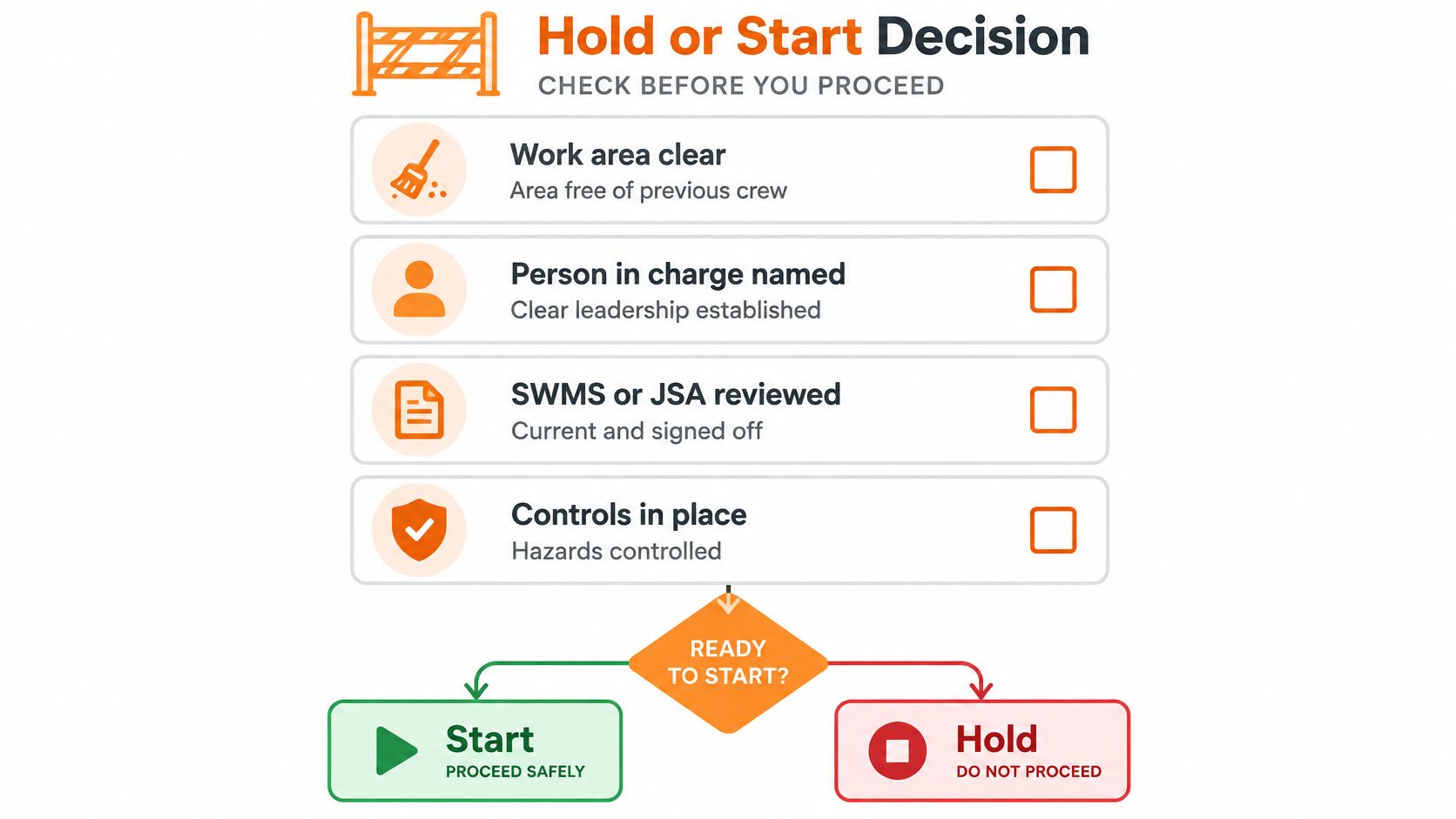
The pre start ends with one binary decision. The crew starts, or the crew waits. Anything else is a conversation that drifts until someone picks up a tool.
Hold the task when any of these is true.
- The work area isn't clear of the previous crew, their plant or their waste.
- The person in charge isn't named, or isn't on site.
- The SWMS or JSA version on site doesn't match the method the crew will use.
- A worker raised a hazard and no control changed yet.
- Nobody in the crew can state the emergency arrangement, including who calls emergency services and where the muster point is.
A hold is a normal outcome and should be recorded like any other decision. Record the reason, the owner of the fix and the time the crew was released. Tell the waiting crew what they're waiting for and when they'll be briefed again, because a crew left standing around without information will find something to do.
A start carries the same weight. Whoever calls it is confirming the area is clear, the person in charge is named, the document version matches and the emergency arrangement is known. Both decisions belong on the record, because either one is evidence that the meeting verified the controls before work began.
If a worker believes the task is unsafe and won't start, the task stays on hold until the supervisor checks the concern and records the outcome. A refusal that was investigated and closed out is consultation evidence. One that was talked down and forgotten leaves nothing to show.
At the end of the shift, review every hold. If the same reason appears twice in a week, move it into the SWMS or the site procedure so the next pre start doesn't carry it again. A recurring hold shows you where the system is weak, and a run of them on the same cause is the clearest signal a supervisor gets that the procedure needs changing.
Book a demo at Safety Space to see how the meeting record, the actions and the consultation trail sit together.
Ready to Transform Your Safety Management?
Discover how Safety Space can help you implement the strategies discussed in this article.
Explore Safety Space FeaturesRelated Topics
Safety Space Features
Explore all the AI-powered features that make Safety Space the complete workplace safety solution.
Articles & Resources
Explore our complete collection of workplace safety articles, tools, and resources.