
The crew is ready, the saw is on site, and the programme is already tight. Then someone asks for the concrete cutting SWMS, and the only copy available is an old template with “control dust” written in a generic risk table. That document won't protect the crew, satisfy an audit, or explain what happens when the cut hits reinforcement, water runs across a live electrical area, or slurry starts moving towards a public access route.
A useful safe work method statement for concrete cutting is a job control document. It tells the crew what they're cutting, what can go wrong, which controls must be in place, who checks them, and when work stops. The strongest SWMS documents now move beyond basic PPE and dust suppression. They deal directly with respirable crystalline silica, equipment selection, exposure management, exclusion zones, embedded services, and evidence that workers understood the method.
Table of Contents
- Why Your Concrete Cutting SWMS Is a Legal Requirement
- Step by Step to Drafting Your SWMS
- Managing Silica Dust and Equipment Hazards
- Real World Scenario and Common Mistakes
- Storing and Managing SWMS in Safety Space
- Key Takeaways for Your Next Job
Why Your Concrete Cutting SWMS Is a Legal Requirement
A SWMS isn't optional when concrete cutting forms part of high risk construction work. In Australia, a SWMS must be prepared before high risk construction work starts, and the document must identify the work, the hazards and risks, and the controls that will be implemented. Safe Work Australia's SWMS information sheet sets out those requirements for the 18 high risk construction work activities defined in the WHS Regulations. Our guide to what a safe work method statement is covers those general requirements in more detail.
Concrete cutting and drilling also sit within the controlled construction activities addressed by the national construction guidance. That guidance directs workers to consult builder's plans, keep bystanders at a safe distance, retain guards on equipment, and avoid unsafe positions such as using hand-held saws above shoulder height. The Model Code of Practice for Construction Work supports those controls.
The legal requirement matters, but the operational test matters more. If the SWMS says “use appropriate PPE” without identifying the cutting method, the dust control system, the exclusion zone, or the inspection responsibility, it isn't controlling the task. It's describing an intention.
What the document must prove
Your SWMS should show that the business has thought through the work before the blade starts. At a minimum, it should identify:
- The exact task: State whether the crew is floor sawing, wall sawing, hand sawing, chasing, drilling, or removing a cut section.
- The physical hazards: Include blade contact, kickback, flying fragments, noise, vibration, water and slurry, manual handling, and falling or unstable sections.
- The site hazards: Check access, public interfaces, nearby workers, plant movement, combustible materials, fumes, and electrically powered equipment.
- The control sequence: Specify what happens before setup, during cutting, when conditions change, and during cleanup.
- Worker responsibilities: Name who checks plans, equipment, water delivery, extraction, exclusion zones, and the pre-start briefing.
The PCBU must also ensure the team has been briefed and can access the current document during the job. The SWMS must be available throughout the work and kept for at least 2 years after a notifiable incident, as stated in the national construction guidance.
Use your organisation's wider construction health and safety regulations process to connect the SWMS with permits, competency records, consultation and incident response. A signed form sitting in an office isn't evidence of effective control if the crew is working from a different method on site.
Step by Step to Drafting Your SWMS
Start with the work package, not a generic template. Write down the location, the concrete element, the intended cut, the equipment, the people involved, the surrounding operations and the expected sequence. A floor cut inside an occupied plant room needs a different method from an isolated external slab, even if both use a saw.
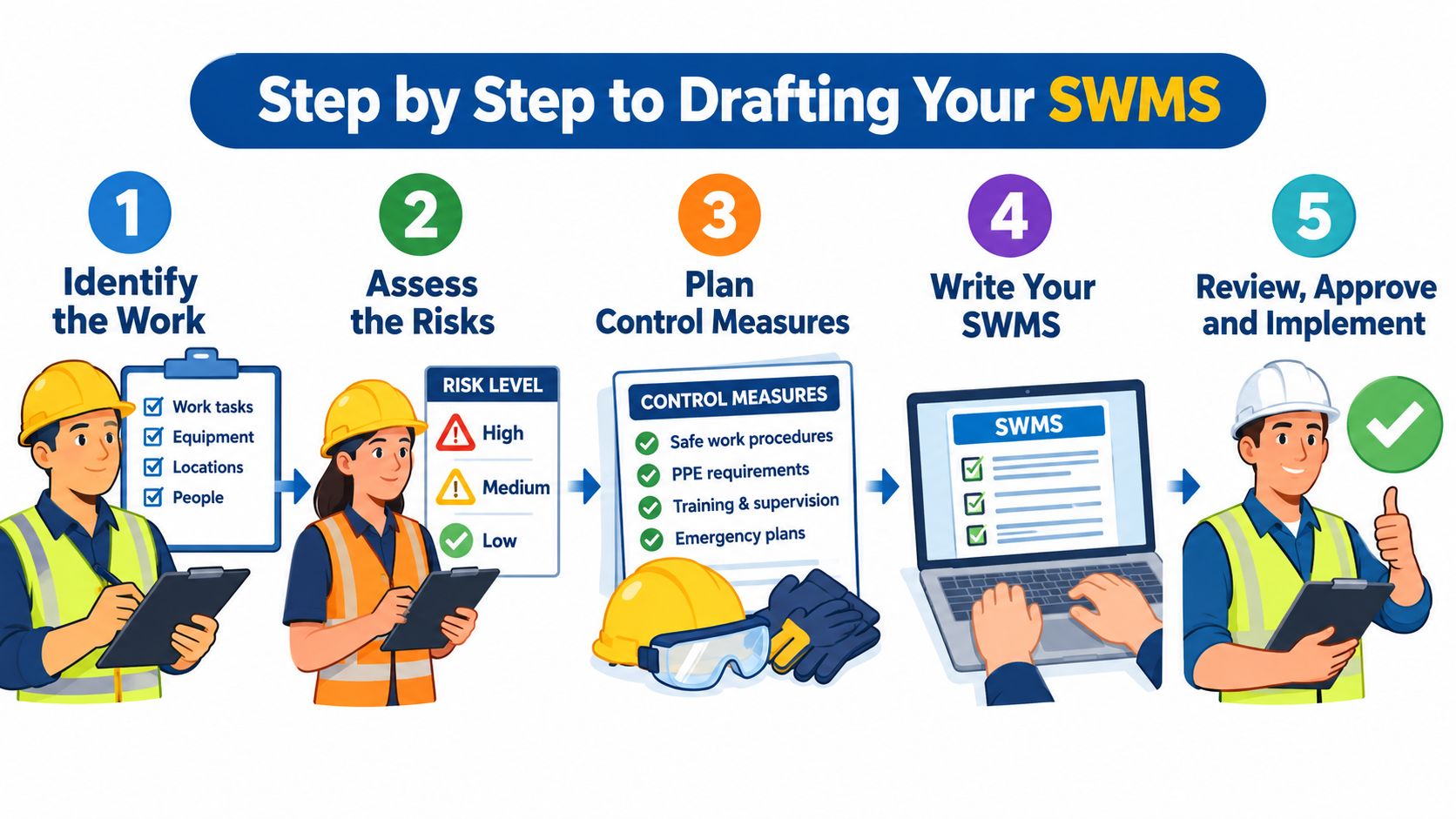
Identify the work before assessing it
First, confirm whether the task includes any high risk construction work activity. Consider work near a fall edge, work involving a hazardous material such as asbestos, structural changes, temporary support, confined access, or interaction with moving plant. Don't assume the concrete itself is the only issue.
Then inspect the work area with the people who'll perform the task. The operator may know that the proposed cut forces an awkward stance. The supervisor may know that the only water connection sits across a pedestrian route. The electrician may know that the drawing set doesn't reflect a later service installation.
Record the hazard, the people exposed, the mechanism of exposure and the credible consequence. “Silica dust” is a starting point. “Operator and nearby trades inhale airborne RCS during dry setup and cleanup” gives the team something they can control.
Select controls in the right order
Apply the hierarchy of controls before reaching for PPE. Ask whether the cut can be avoided, changed, isolated or engineered so people aren't exposed to the hazard. For concrete cutting, that commonly means isolating the area, selecting a suitable cutting system, controlling water or dust at the tool, and preventing access by people who don't need to be there.
Write controls as actions with an owner. “Exclusion zone established by supervisor before energising equipment” is stronger than “use barriers”. “Operator confirms continuous water delivery before the first cut” is stronger than “wet cut where possible”.
The SWMS should then describe the work in order:
- Pre-start: Confirm plans, services, structural information, equipment condition and worker competency.
- Setup: Establish barriers, signage, drainage, slurry controls, water supply, extraction and safe electrical arrangements.
- Cutting: Follow the manufacturer's method, maintain the control system and stop if the blade binds, water fails or conditions change.
- Completion: Isolate equipment, remove slurry safely, inspect the cut area and leave the work zone safe for others.
- Review: Update the method after changes, defects, near misses or feedback from the crew.
A clear construction safety forms process helps keep the SWMS connected to pre-starts, inspections and sign-offs. Review the document whenever the equipment, location, crew, sequence or surrounding work changes. A new hazard doesn't wait for the next scheduled document review.
Managing Silica Dust and Equipment Hazards
Concrete cutting generates respirable crystalline silica, so the SWMS must begin by identifying where RCS is produced and who can inhale it. The exposure standard for respirable crystalline silica in Australia is 0.05 mg/m3, which provides the benchmark for judging whether controls are effective, not a reason to accept visible dust as normal. Safe Work Australia's national silica guide identifies concrete cutting, drilling, grinding and polishing as activities that can generate silica dust.
The control sequence should be deliberate. Isolate the cutting area first. Use wet cutting with continuous water delivery or a water-suppressed system. Add on-tool dust extraction or local exhaust ventilation where practicable. Use administrative controls and a P2 half-face respirator where residual exposure remains.
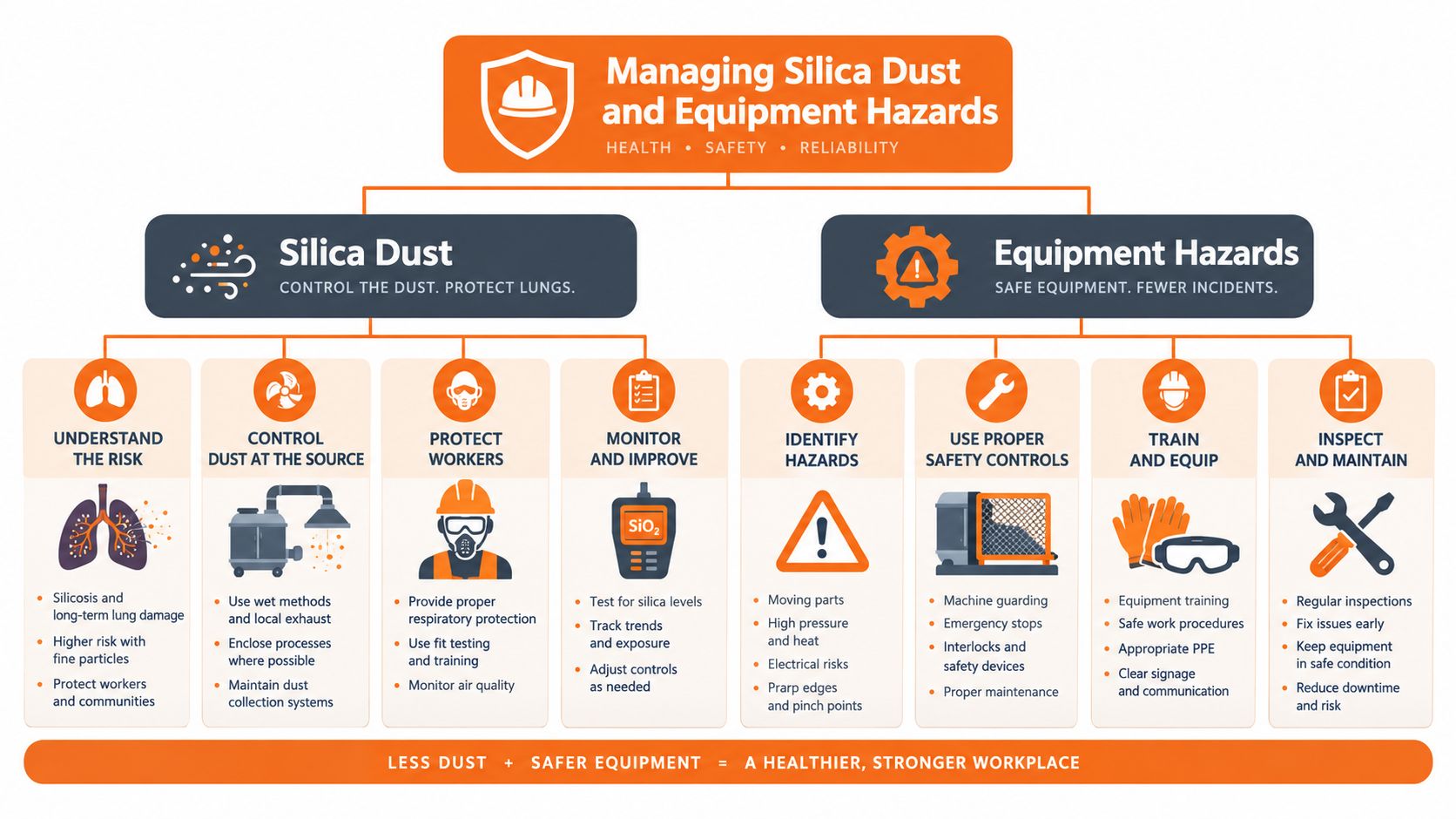
Engineering controls must do the heavy lifting
Wet cutting works because it suppresses dust at the blade. It doesn't mean connecting a hose and hoping water reaches the cutting surface. For brick and concrete cutting, Safe Work Australia specifies that hand-held power tools should use multiple water feeds that deliver water to the blade. Your SWMS should name who checks the feed, what happens if flow stops, and how the team controls the resulting slurry.
Dry cutting requires a properly designed extraction arrangement. Set out the compatible shroud, hose, vacuum and filter requirements, then state the stop-work trigger for a blocked hose, full vacuum or loss of suction. Don't allow workers to remove guards or improvise collection systems that interfere with blade operation.
Housekeeping is part of exposure control. Don't use compressed air to blow dust across the work area. Don't dry sweep contaminated surfaces. Use suitable vacuum cleanup and prevent workers from walking through or disturbing settled material.
Plant managers dealing with recurring dust from cutting, grinding or other production activities may also benefit from guidance on dust collection for plant ops. The same principle applies on a construction site. Capture contamination close to the source, maintain the system and verify that it still performs under working conditions.
Equipment hazards need their own controls
Silica isn't the only risk. The SWMS should address:
- Kickback and blade failure: Use the manufacturer-recommended blade and guard configuration. Keep the cutting line stable and stop if the blade binds or behaves unexpectedly.
- Electrical exposure: Use residual current devices, inspect and tag portable equipment, keep leads away from water, and prevent cutting near unidentified services.
- Noise and vibration: Select equipment and methods that reduce exposure, maintain tools, limit time in the cut zone and provide hearing and vibration controls where required.
- Water and slurry: Plan drainage, collection and cleanup before cutting. Slurry that reaches a walkway creates a separate slip and contamination hazard.
- Respiratory protection: Select, fit and maintain RPE properly. PPE supplements engineering controls. It doesn't replace them.
Where exposure may remain, connect the SWMS to workplace health monitoring. Monitoring should follow the risk assessment and the applicable WHS requirements, rather than being used to justify weak engineering controls.
Real World Scenario and Common Mistakes
A crew is cutting a concrete floor for new ductwork inside an active facility. The foreman wants to recover time, so the team starts without setting up wet cutting. Dust moves through the work area, nearby workers put on disposable masks, and the crew keeps cutting because the line is already marked.
That job has failed before the blade reaches the planned depth. The control relied on a mask instead of source suppression. The SWMS may say “wear respiratory protection”, but it hasn't explained how the cutting area will be isolated, how the dust will be captured, how workers will clean the surface, or who has authority to stop the task.
A better method starts with a pre-start hold point. The supervisor confirms the builder's plans and checks for embedded reinforcement, conduits and other objects. The team establishes a clearly marked exclusion zone, positions the water and slurry controls, checks the saw and guard, and confirms that bystanders have a safe separation. If the planned method can't be set up, the work doesn't start.
Where crews usually lose control
The recurring failures are practical rather than technical:
- The exclusion zone is too small: People pass behind the operator, enter to retrieve tools or work on the other side of a wall. Barriers and signage need to reflect flying debris, noise, dust and the movement of equipment.
- The plans aren't checked: Cutting into an unidentified service or structural element can turn a routine penetration into a serious event.
- The guard is treated as an inconvenience: Removing it may make the cut feel easier, but it removes a designed protection and conflicts with the required safe method.
- The operator works above shoulder height: The WA code specifically prohibits holding a hand-held saw or drill higher than shoulder height and prohibits inverted cutting or drilling with a hand-held saw. WorkSafe WA's concrete and masonry cutting code provides those task-specific controls.
- The blade specification is assumed: The manufacturer-recommended blade size must be used. A damaged, unsuitable or poorly fitted blade increases the chance of binding, kickback and poor control.
The crew also needs a stop-work rule that people can use without negotiating with the programme. A change in dust, water flow, noise, vibration, blade behaviour, access or weather should trigger a pause and reassessment.
For teams responsible for finished floors after cutting and construction work, a practical reference on floor care for San Antonio homes can help explain the difference between routine floor care and the more controlled removal of slurry and construction residue. The compliance point remains the same: cleanup must not re-aerosolise dust or create a new slip hazard.
Storing and Managing SWMS in Safety Space
Paper can work for a small, stable operation. It becomes unreliable when several supervisors hold different copies, subcontractors arrive after the briefing, or the work changes halfway through a shift. The problem isn't paper itself. The problem is weak version control and no reliable evidence that the current method reached the people doing the job.
For a PCBU carrying out high risk construction work, the SWMS must be prepared or arranged, kept, followed, reviewed and provided to the principal contractor. Safe Work Australia's construction risk guidance makes that responsibility clear.
Manual storage versus digital control
A shared drive and printed site folder can be adequate when someone actively manages them. The control fails when the folder contains superseded copies, the printed version is damaged by water, or the person responsible for updates is away from site.
| Manual approach | Digital approach |
|---|---|
| Printed copies are easy to use without a device, but they can be lost, damaged or replaced informally. | A controlled platform can make the current document available to authorised users across sites and devices. |
| Shared folders provide a central location, but they don't automatically prove who read or acknowledged a change. | Digital acknowledgements and audit records can show distribution and worker interaction. |
| Revisions depend on someone replacing old copies and notifying the crew. | A documented review process can link changes to the task, site conditions and responsible person. |
| Audits require someone to locate the right file and supporting records. | Searchable records can bring the SWMS, briefing and review history together. |
The technology won't fix a poor method. A badly written SWMS remains poor when uploaded to an application. Configure the workflow so the supervisor must confirm the site conditions, the crew receives the current version, and changes trigger a fresh briefing.
Build the review into the job
Use a status that distinguishes draft, approved, superseded and closed documents. Give the supervisor a simple way to record what changed, why the change was necessary and who received the revised method. Keep inspection records for the saw, extraction equipment, water system, barriers and electrical controls with the relevant task record.
Safety Space is one digital option for creating, storing and sharing health and safety documents, with real-time monitoring, form completion, accountability records and oversight across sites and subcontractors. It can sit alongside existing systems, provided your organisation defines who approves the SWMS and who verifies that workers have understood it.
A practical digital workflow looks like this:
- Before mobilisation: Prepare the task-specific SWMS and attach relevant plans, permits and equipment checks.
- At the pre-start: Brief the crew, record questions and capture acknowledgement.
- During the cut: Record changes, stop-work events, defects and corrective actions.
- After the work: Close the task, retain the records and feed lessons into the next method.
That approach turns document storage into operational control. It also makes an audit conversation more useful because the organisation can show not only what it intended to do, but how the method was communicated and managed.
Key Takeaways for Your Next Job
Treat the SWMS as the decision record for the work, not as a form that clears procurement or site administration. A credible document describes the actual cut, the actual equipment, the actual exposure pathways and the actual people who must act.
Before the next job, check these points:
- Confirm the legal trigger: Decide whether the task involves high risk construction work and prepare the SWMS before work starts.
- Check the concrete and the plans: Identify embedded objects, services, structural constraints, access problems and nearby operations.
- Control RCS at the source: Isolate the area, use continuous wet cutting or suitable extraction, control cleanup and use RPE for residual exposure.
- Inspect the equipment: Verify guards, blade suitability, water delivery, extraction, electrical protection and manufacturer requirements.
- Brief the people doing the work: Ask the operator to explain the sequence and the stop-work conditions in practical terms.
- Review when the job changes: A different saw, location, crew, material, service or surrounding activity can invalidate the original method.
- Keep evidence accessible: Store the current SWMS with briefings, inspections, revisions and corrective actions where supervisors can retrieve it quickly.
The strongest control is the one that survives contact with the site. If the crew can't set up the water system, isolate the area or verify the plans, the supervisor needs a clear instruction to stop and escalate. A digital record can make that decision visible, but competent planning and active supervision still do the work.
Audit one current concrete cutting SWMS before the next mobilisation. Remove generic statements, assign owners to each control, test the briefing with the operators and verify that the cleanup method doesn't create a second exposure.
Safety Space provides a customisable health and safety management platform for managing SWMS, briefings, inspections and accountability across construction and industrial operations. Use Safety Space to review how a digital workflow could keep your concrete cutting controls current, accessible and connected to the people doing the work.
Ready to Transform Your Safety Management?
Discover how Safety Space can help you implement the strategies discussed in this article.
Explore Safety Space FeaturesRelated Topics
Safety Space Features
Explore all the AI-powered features that make Safety Space the complete workplace safety solution.
Articles & Resources
Explore our complete collection of workplace safety articles, tools, and resources.