
Falls from height accounted for 13% of worker fatalities in Australia between 2015 and 2019, equal to 122 deaths, according to Safe Work Australia's working-at-heights guidance. That figure changes how a business should view a safe work method statement for working at heights. It isn't a form to file before the crew starts. It's the control system that connects planning, equipment, supervision, worker consultation and rescue arrangements to the actual task.
For H&S managers, operations managers and PCBUs, the practical test is simple. Can a supervisor use the SWMS to brief the crew, verify the controls on site and stop the job when conditions change? If not, the document may satisfy a filing process while failing the people exposed to the fall hazard.
Table of Contents
- Legal Triggers and Fatality Data for Height Work
- Required Elements of a Compliant SWMS Document
- Applying the Hierarchy of Controls to Fall Hazards
- Adapting Generic Templates to Specific Site Conditions
- Operational Rollout and Worker Consultation Requirements
- Pre-Start Verification Checklist for H&S Managers
Legal Triggers and Fatality Data for Height Work
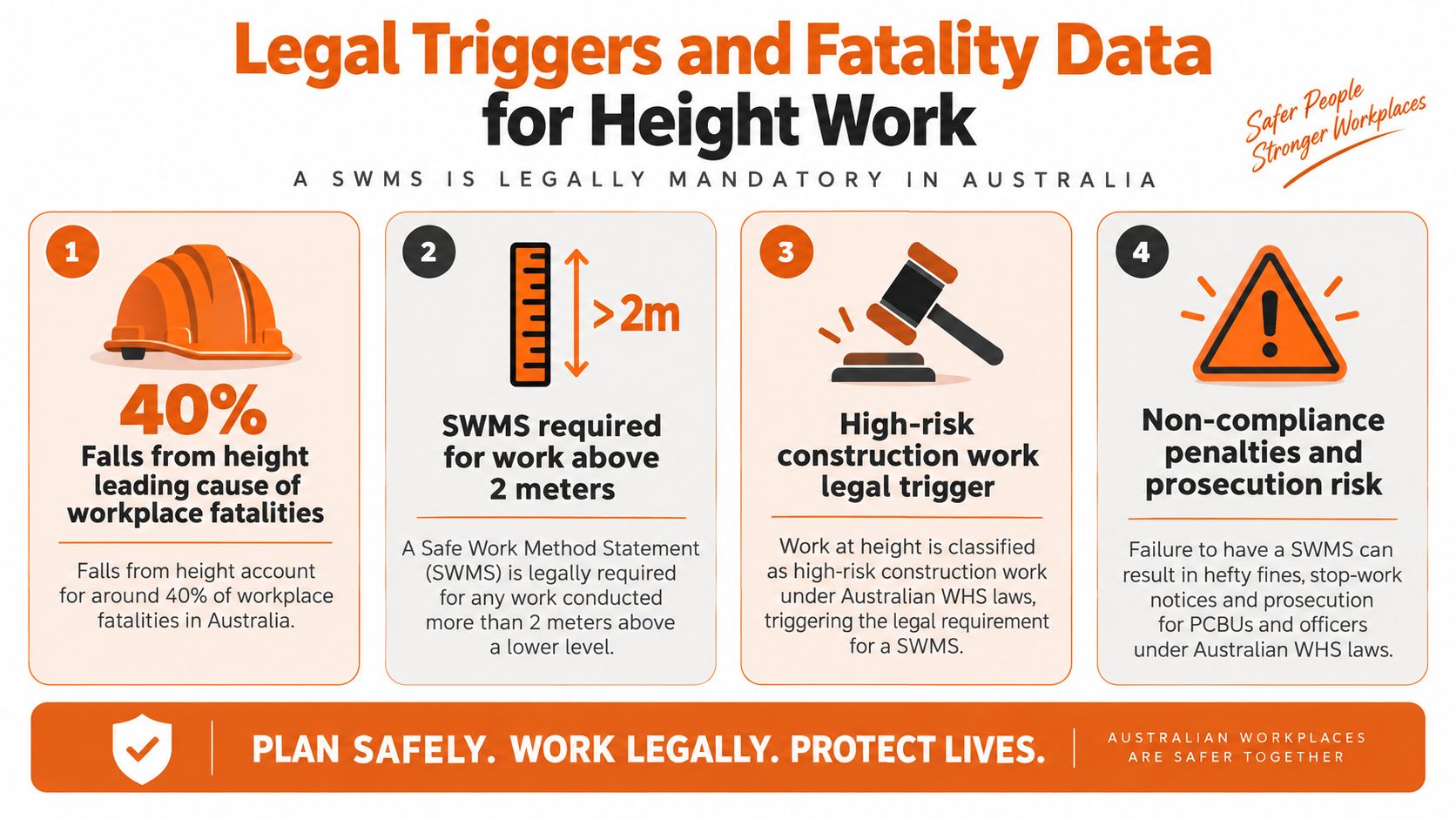
Falls from height have remained a persistent national problem. Safe Work Australia recorded 232 worker deaths from falls from height between 1 July 2003 and 30 June 2011, representing 11% of all worker deaths in that period. The same analysis recorded 29 fatalities in 2010–11, or 0.25 fatalities per 100,000 workers. The later national data recorded 122 deaths between 2015 and 2019, while Australian WHS reporting cited 29 fatalities from falls from height in 2023, equal to 15% of all worker fatalities. These figures appear in Safe Work Australia's historical falls-from-height analysis.
Australian WHS law treats working at heights as high-risk construction work where there's a risk that a person could fall more than two metres. A PCBU must prepare a SWMS before that work starts. The threshold doesn't remove the duty to manage lower-level falls. A person can still suffer serious harm from a fall below that threshold, particularly where the landing area contains machinery, sharp edges, chemicals or other hazards.
Practical rule: Treat the two-metre trigger as the point that mandates a SWMS, not the point at which fall controls first become necessary.
The SWMS should identify the work, explain the fall hazards and state how controls will be implemented, monitored and reviewed. For roof access, edge work, scaffolding, ladders and work platforms, that means the document should reflect the access route, work position, equipment and rescue method. A generic statement that workers will “use appropriate fall protection” won't help a supervisor verify whether the selected system is suitable.
For work involving both restricted access and height exposure, guidance on confined space and working at heights can help managers consider how the hazards interact. The legal obligation still sits with the PCBU and the duty holders managing the work.
Required Elements of a Compliant SWMS Document
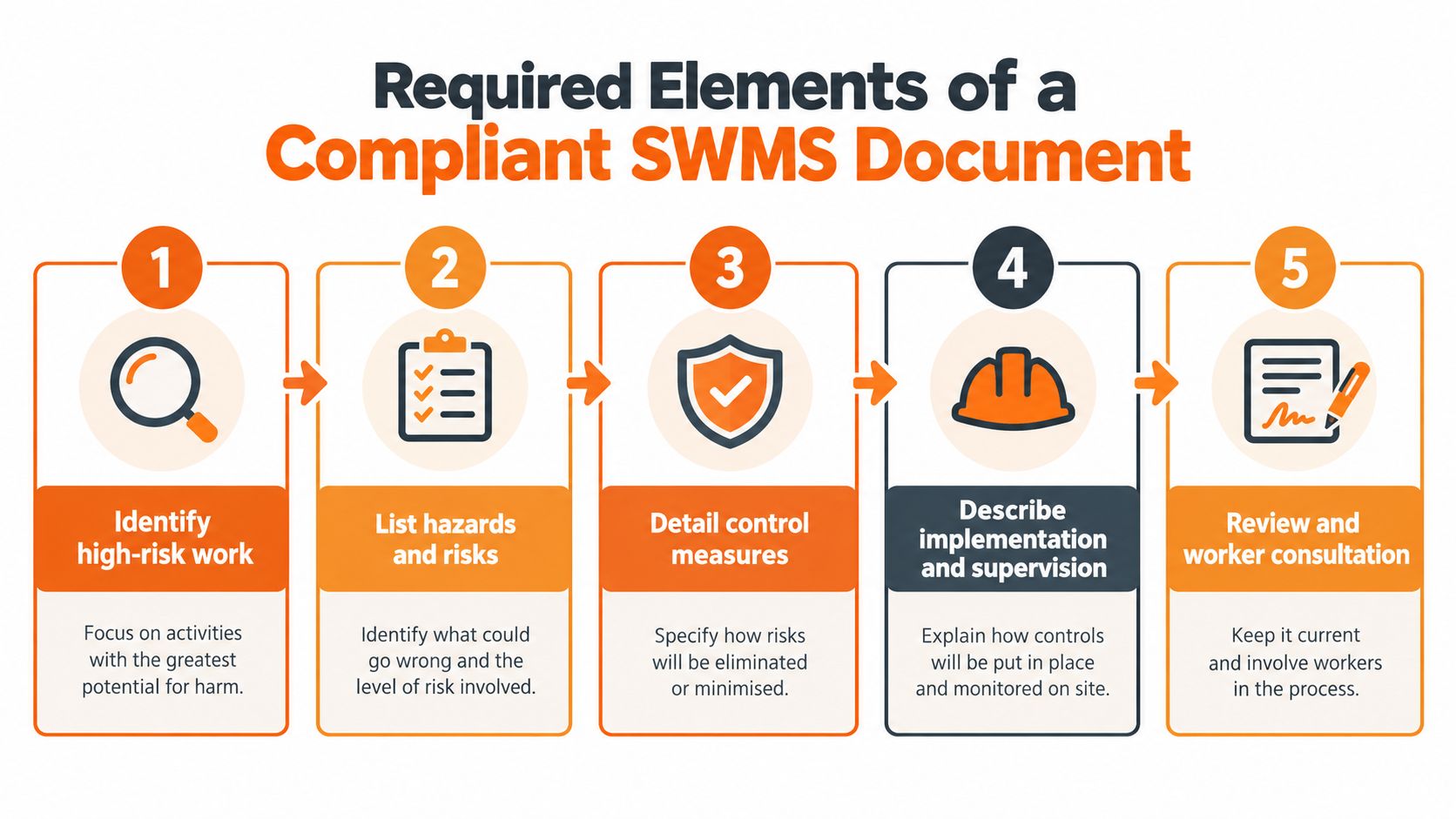
A compliant SWMS has to describe the work clearly enough for someone on site to follow it. Safe Work Australia's information sheet on Safe Work Method Statements and the Queensland government build sequence both support the same practical approach. Start with the high-risk construction activity, divide it into procedure steps, identify hazards for each step, select controls and explain how the controls will operate.
The document should follow the work sequence, not the order in which someone found headings in a template.
Describe the activity before listing controls
State what the crew will do and where they'll do it. “Roof maintenance” is too broad. A useful description identifies the roof area, access point, work location, materials, plant, nearby trades and the sequence from set-up through clean-up.
Then break the task into individual steps. Include preparation, delivery of equipment, access, movement across the work area, the actual repair or installation, removal of controls and clean-up. Each step creates different exposure. Carrying materials up to a roof can create a manual handling and dropped-object risk before the worker reaches the edge.
Match hazards to each procedure step
List the hazard beside the step that creates it. This makes the control visible to the person supervising the work. For example, an access step may involve unstable ladders, an edge step may involve an unprotected perimeter, and clean-up may expose workers to loose materials near an opening.
Avoid broad entries such as “fall risk managed by PPE”. Identify the source of the fall, the person exposed, the location and the control that prevents or limits the event.
Explain implementation, monitoring and review
A control only matters if someone can verify it. State who installs edge protection, who checks the EWP, who confirms the exclusion zone and who leads the pre-start briefing. Include what happens when a control fails or the task changes.
The SWMS guidance from Safety Space is useful when checking whether the document describes the work in a way workers can act on. A signed document that stays in the site office isn't an operational control.
Applying the Hierarchy of Controls to Fall Hazards
Fall protection decisions often fail because the SWMS starts with the equipment already available. A harness appears in the template, so the team writes around it. That reverses the required thinking.
Safe Work Australia and state guidance expect the PCBU to work through the hierarchy of controls, starting with the highest level that's reasonably practicable. The Queensland template directs users to describe the task, identify hazards and select controls from the top of the hierarchy downwards.
Remove the exposure before selecting equipment
Ask whether the work can be completed on the ground. A roof component might be assembled at ground level and lifted into position. An inspection might be completed from a safe location using an alternative method. The safest fall is the one the task never creates.
If work at height remains necessary, prioritise collective and engineered protection. Guardrails, edge barriers, scaffold platforms and properly designed access systems protect more than one person and don't rely on perfect behaviour at every moment.
Only move down the hierarchy when higher-level controls aren't reasonably practicable. The SWMS should record why. “Not available” isn't a sufficient explanation. Describe the site constraint, the work requirement and the alternative controls selected.
A harness limits the consequences of a fall. It doesn't prevent the worker from reaching the edge.
Fall-arrest equipment also creates a second risk profile. The SWMS must cover compatible anchor points, inspection, connection, clearance, swing-fall exposure and a rescue plan. A suspended worker can't be left until emergency services arrive.
The fall protection systems guidance provides useful context for comparing systems, but the selection still needs to match the task and site. For roof work, managers may also consult information on safety roof anchors 2026 compliance when checking anchor-related requirements and design considerations.
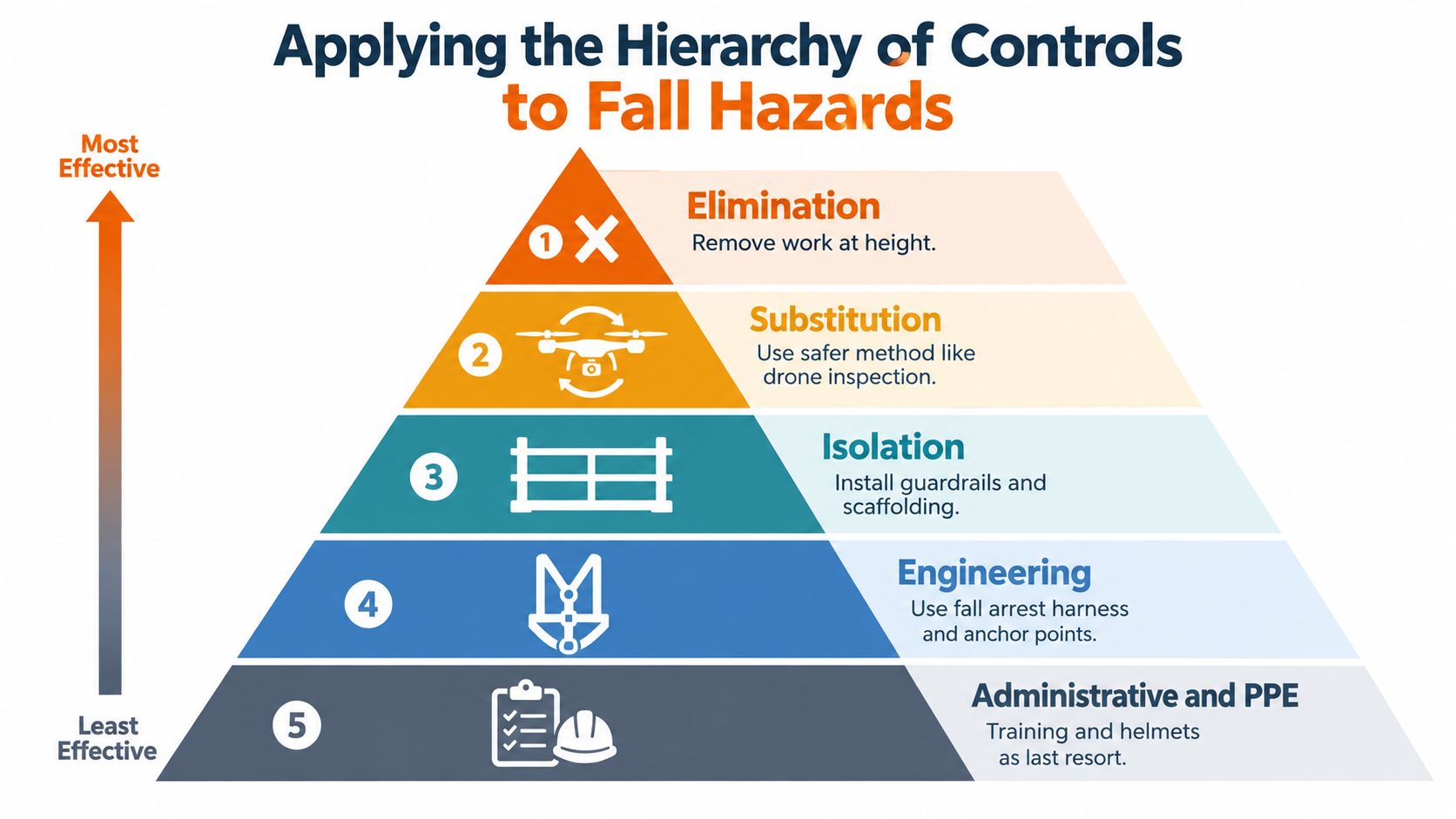
A common sequencing error is treating administrative controls and PPE as the main solution. Training, signs, spotters and helmets support the system, but they don't replace a physical barrier where a barrier can be installed. The SWMS should show that the decision was deliberate.
Adapting Generic Templates to Specific Site Conditions
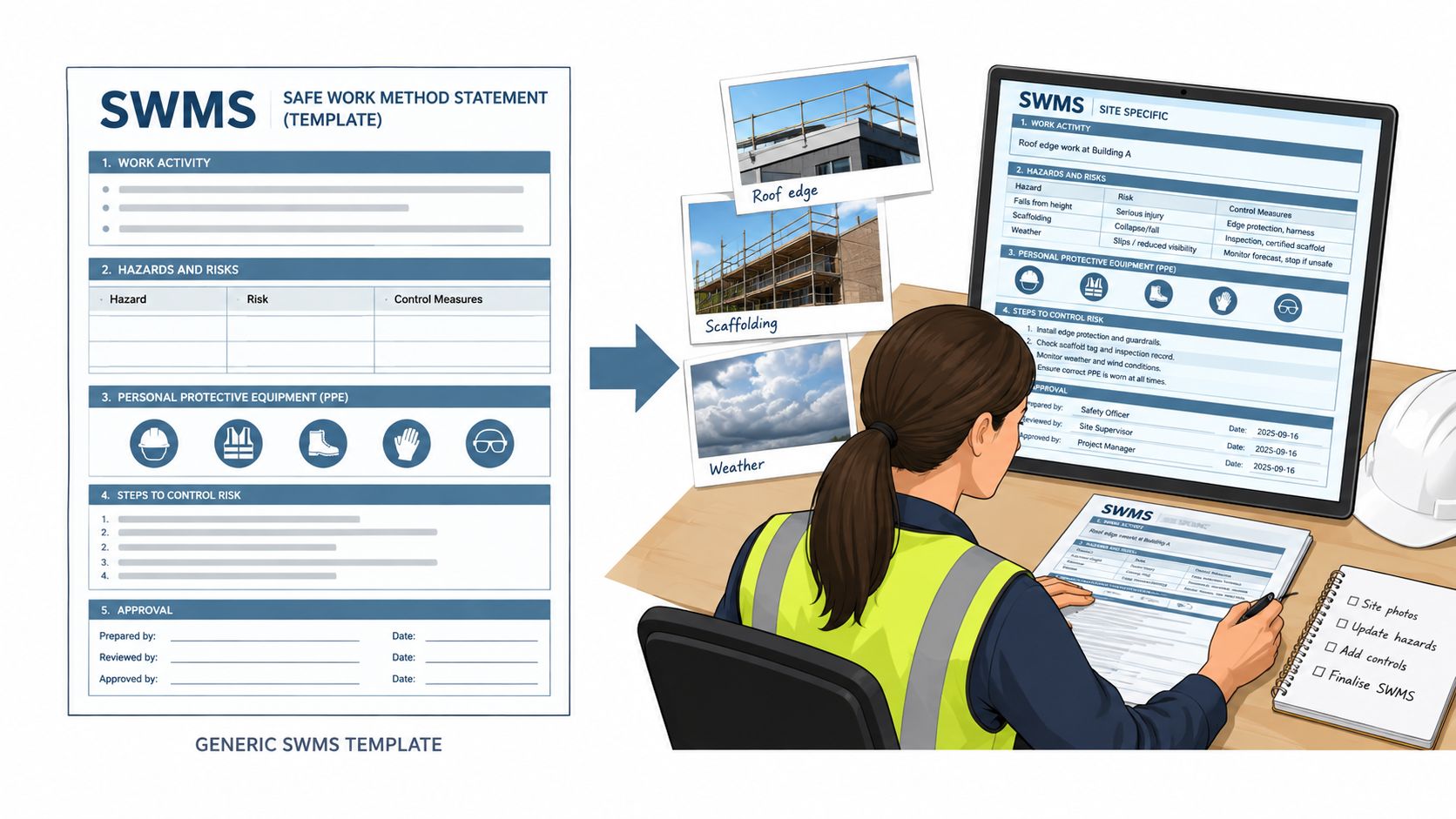
A generic SWMS usually fails at the point where the site departs from the assumptions built into the template. The document might cover roof work, but not a fragile roof hidden beneath a layer of insulation. It might mention scaffolding, but not the wind exposure beside an open facade. It might define a drop zone, but not account for a second subcontractor moving materials through it.
Consider a maintenance crew working on a commercial roof. The base template says workers will access the roof by ladder, stay clear of edges and wear fall-arrest equipment. That wording doesn't answer the questions the supervisor faces at the access point.
Is the roof surface fragile? Does the ladder land beside an opening? Can workers reach the work area without stepping across an unprotected section? Where will tools be placed? What happens if wind makes materials unstable? Who controls the area below while the crew works overhead?
Change the document when the geometry changes
A site-specific SWMS should capture physical conditions that alter the fall pathway. Fragile roof areas need defined travel routes, covers or barriers and a clear prohibition on stepping outside the protected path. Open edges need a control that remains effective while materials move through the area.
Scaffolding requires more than a statement that it will be inspected. The method should address ground stability, loading, access, incomplete sections, adjacent structures and weather exposure. Wind can affect both the scaffold and the materials workers carry. The supervisor needs a clear decision rule for stopping or changing the task when conditions exceed the safe method.
Coordinate the drop zone and rescue route
Multiple subcontractors create interaction risks that a single-trade SWMS can miss. One crew may work above another, mobile plant may cross the exclusion zone, or a delivery path may pass below suspended materials. The principal contractor and PCBUs need to agree on who controls access and how workers will know the zone is active.
Rescue arrangements must match the site. A plan that says “call emergency services” doesn't explain how a person will be reached if the only access is through a locked roof hatch or if an EWP can't approach the facade. Name the equipment, access route, trained responders and communication method. Review the plan when the work location moves.
The practical test is whether a supervisor can walk the site with the SWMS and point to each control. If the document describes a different roof, scaffold, crew or access route, revise it before work starts.
Operational Rollout and Worker Consultation Requirements
A SWMS becomes useful when the workers carrying out the task can challenge it. Consultation isn't a signature collection exercise. The crew knows whether the proposed access route is blocked, whether the anchor is reachable, whether the exclusion zone conflicts with production traffic and whether the rescue equipment can reach the work position.
The PCBU should provide the current SWMS to the workers and other duty holders involved in the activity. The supervisor then needs to brief the work group before commencement, using the actual work area rather than reading every sentence from a desk.
Run the briefing against the physical site
A practical pre-start briefing should cover:
- Work sequence: Confirm the order from preparation through clean-up.
- Fall exposure: Point out edges, openings, fragile surfaces and changes in level.
- Control ownership: Confirm who installs, checks and maintains each control.
- Equipment status: Verify access equipment, edge protection, harnesses and anchors.
- Exclusion zones: Mark the area below and explain who may enter it.
- Rescue response: Confirm the rescue equipment, communication method and responsible people.
Ask workers to identify any difference between the SWMS and the site. Record the issue and resolve it before the task proceeds. A worker who can't explain the method shouldn't be treated as having been consulted because a signature appears beside their name.
Make sign-on and stop-work actions visible
Require every worker and subcontractor involved in the task to sign on to the current version before starting. The sign-on should identify the document version, date, work area and people briefed. Keep the record accessible where the work occurs, whether that's electronically or in a controlled site folder.
Stop work when the weather changes, access equipment is damaged, edge protection moves, another trade enters the drop zone, the work sequence changes or the rescue route becomes unavailable. The supervisor should isolate the area, update the method, consult the affected workers and re-brief the group before restarting.
The strongest stop-work process is specific enough that a worker can use it without asking permission to raise the concern.
The SWMS should also define who can authorise the restart. Without that step, workers may resume work under pressure after a control has failed.
Pre-Start Verification Checklist for H&S Managers
Safe Work Australia reports that around 61% of workers who died from falls from height in 2023 were in construction, according to its Key WHS Statistics 2024 report. The figure reinforces why pre-start checks must test the controls in the work area, not confirm that a SWMS exists. Roofs, platforms, plant access and maintenance work create similar control issues in manufacturing and industrial operations.
Use the pre-start to compare the approved SWMS with the actual work area, equipment and crew. Any mismatch requires a method review before work begins.
Confirm the document and scope
- High-risk activity: Check that the SWMS covers the actual height task, location and work group.
- Procedure sequence: Confirm that preparation, access, work, material movement and clean-up are listed in the order they will occur.
- Task hazards: Ensure each step identifies the fall source and related site hazards.
- Control selection: Verify that the team considered elimination and engineered protection before relying on fall-arrest PPE.
- Responsibilities: Assign named people to installation, inspection, supervision and rescue duties.
- Review status: Confirm the current version reflects today's work and known changes.
A document can be accurate and still fail at the point of work. The supervisor must verify that the stated controls exist, remain suitable and can be used as described.
Verify the controls in the work area
- Access equipment: Inspect the ladder, scaffold or EWP. Confirm it suits the surface, reach and task.
- Edge protection: Check guardrails, barriers, covers and openings against the documented method.
- Fall-arrest system: Confirm compatible harnesses, lanyards, anchors, clearance and user checks.
- Dropped-object controls: Establish exclusion zones, tool controls and communication with people below.
- Weather and surfaces: Assess wind, rain, wet surfaces, visibility and any condition affecting stability.
- Rescue arrangements: Confirm equipment, access, trained responders and a workable route to the casualty.
Confirm people and communication
Brief the crew at the work location. Ask workers to identify differences between the SWMS and site conditions, then record and resolve each issue before exposure begins. A signature does not prove consultation if the worker cannot explain the method or controls.
- Sign-on: Record every worker and subcontractor against the current SWMS version.
- Competence: Confirm people understand the equipment and controls they will use.
- Stop-work trigger: Ensure everyone knows when to stop and who reviews the method.
- Restart authority: Name the person who approves recommencement after a change.
For managers coordinating multiple sites and subcontractors, Safety Space can manage SWMS records, worker consultation, sign-ons and corrective actions. Review the checklist before work starts, record the result and close every gap before anyone is exposed to a fall hazard.
Use Safety Space to manage SWMS records, worker consultation, sign-ons and corrective actions across construction, manufacturing and industrial sites. Book a demonstration or H&S consultation to assess how the platform can support a live, site-specific height-work control process.
Ready to Transform Your Safety Management?
Discover how Safety Space can help you implement the strategies discussed in this article.
Explore Safety Space FeaturesRelated Topics
Safety Space Features
Explore all the AI-powered features that make Safety Space the complete workplace safety solution.
Articles & Resources
Explore our complete collection of workplace safety articles, tools, and resources.