
A compliant safety glasses inspection must verify that the eyewear remains fit for purpose, including lens and frame condition, markings, fit, coatings, cleanliness, compatibility and service records. Australia records about 50,000 eye injuries each year, costing around AUD 60 million, and eye injuries account for around 8% of workplace injuries.
That makes a damaged pair of safety glasses more than a minor housekeeping issue. A scratched lens can obstruct vision. A loose temple can make eyewear fall away from the face. Unmarked or unsuitable eyewear gives a worker and PCBU no reliable assurance that the product meets the required protection level. A cited Australian workplace safety guide also notes that roughly 60% of eye injuries occur in the workplace. The Australian mandatory standard for sunglasses and fashion spectacles provides useful context for the scale of preventable eye harm.
Use this safety glasses inspection checklist at issue, during routine PPE inspections, before a task, and after impact or exposure to chemicals, heat, welding spatter or heavy contamination. A worker's visual check should be quick and practical. A formal inspection should be documented by a supervisor or nominated competent person, with defects, photographs, action taken and replacement details recorded in the H&S system.
The decision is simple. If glasses are damaged, poorly fitted, unmarked, contaminated or incompatible with other PPE, they shouldn't remain in service. The following eight checks turn that decision into a repeatable WHS control.
Table of Contents
- 1. Lens Condition and Optical Clarity
- 2. Frame Integrity and Structural Damage
- 3. Markings, Certification and Compliance Labels
- 4. Temple Arms and Strap Condition
- 5. Lens Coatings
- 6. Fit and Comfort
- 7. Cleanliness and Debris Contamination
- 8. Replacement Date and Service Records
- 8-Point Safety Glasses Inspection Checklist Comparison
- Turn Checks Into a Repeatable WHS Control
1. Lens Condition and Optical Clarity
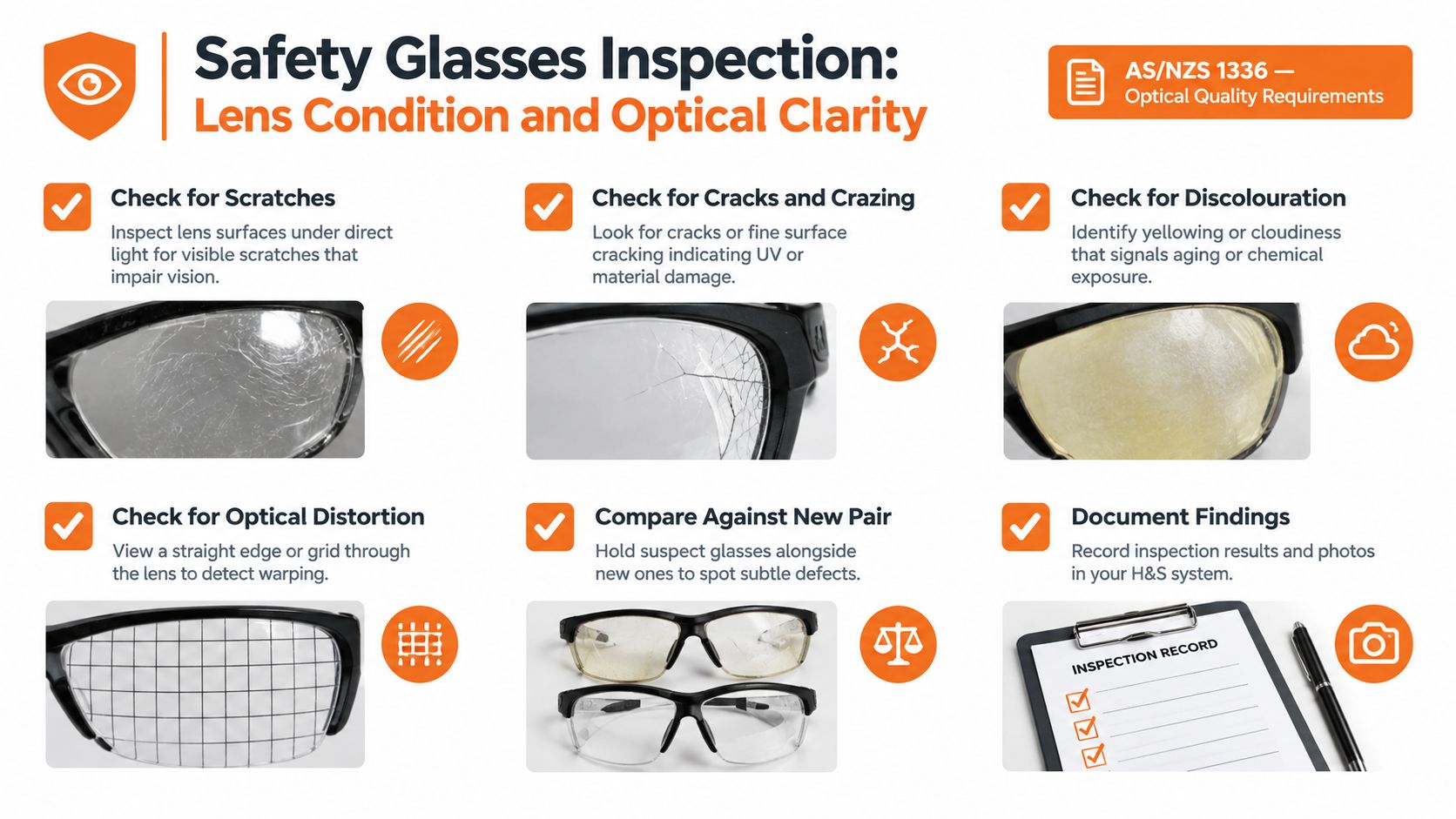
Lens damage creates two hazards at once. It can reduce the protection available to the eye, and it can make it harder for the worker to see the hazard, tool, vehicle or workpiece clearly. Inspect both lenses under good light, then look through the glasses at different angles. A quick glance at the front often misses fine defects.
Look for scratches, cracks, crazing, pitting, discolouration, cloudiness and optical distortion. Crazing appears as fine cracking across the lens surface. It can indicate material fatigue or degradation after prolonged exposure to harsh conditions. A lens that looks acceptable when held at arm's length may still distort the worker's view during close work.
Practical rule: Compare suspect eyewear with a clean, new pair. Differences in clarity and distortion are easier to identify side by side than in isolation.
What failure looks like
A deep scratch across the worker's normal line of sight is a removal trigger. So is a crack that reaches an edge, a pitted area that scatters light, or discolouration that changes how the worker sees the task. Don't ask the worker to tolerate the defect until the next scheduled inspection. Workers should report a change in clarity as soon as they notice it.
For a high-dust or high-heat environment, set a replacement interval based on actual exposure and inspection results rather than relying on an undifferentiated site-wide rule. Australian guidance notes that scratched lenses reduce clarity and that pitted lenses can compromise impact resistance. Australian safety glasses guidance on AS/NZS 1337 explains why lens condition belongs in the formal inspection, not just in a cleaning routine.
Record the defect and photograph it where the damage may recur across a model or work area. A trend in scratched lenses may point to poor storage, abrasive cleaning practices or unsuitable eyewear for the task.
2. Frame Integrity and Structural Damage
A sound lens cannot compensate for a failing frame. The frame holds the lens in position, maintains the coverage around the eye and helps the eyewear stay on the face during movement or impact. Inspect the entire frame, not just the visible front.
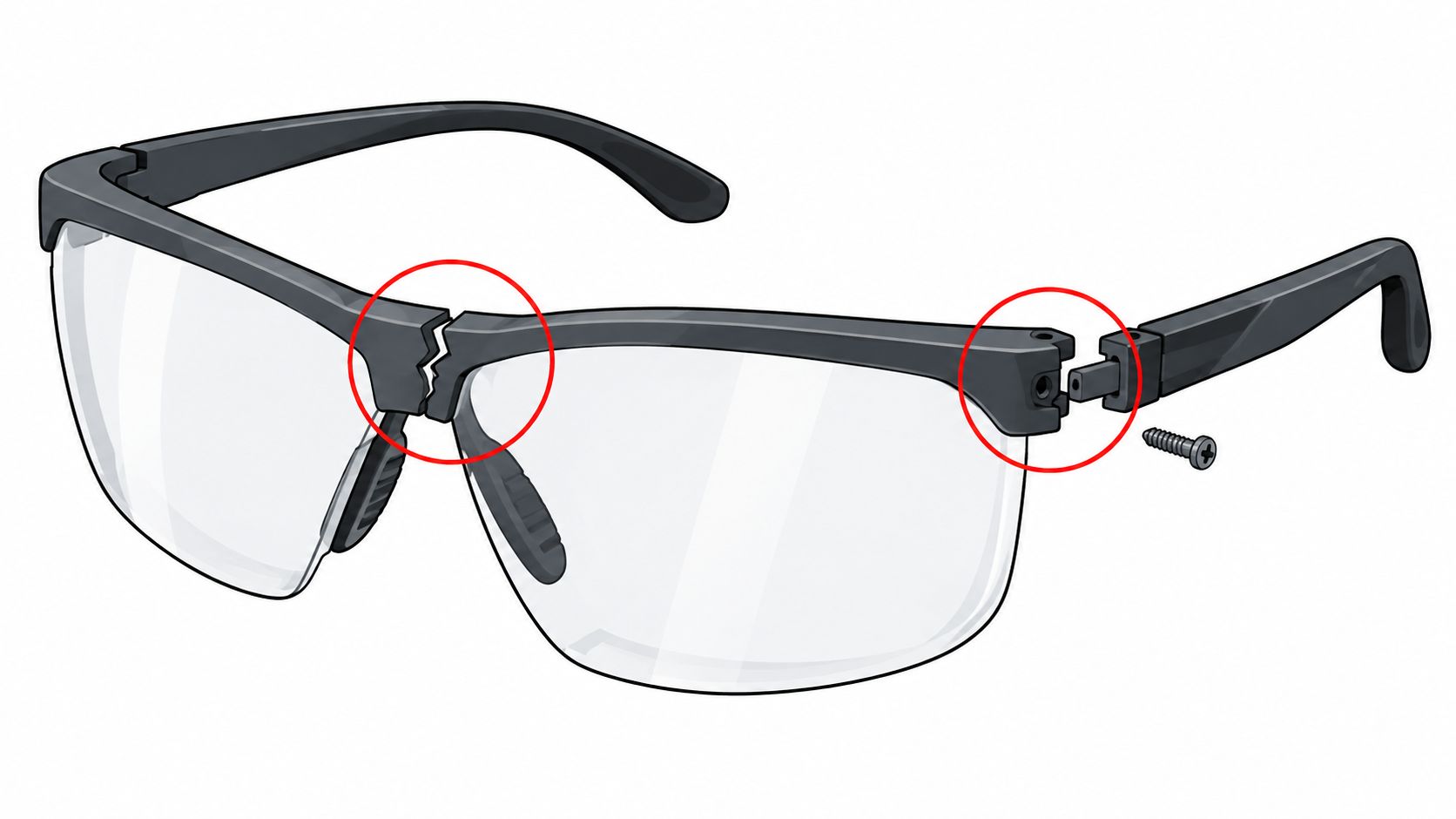
Check the bridge, lens rims, hinges, connection points and any area exposed to repeated flexing. Look for cracks, breaks, warping, brittleness, separation and material delamination. A warped frame may leave a gap at one side of the eye. A broken rim may allow the lens to move or detach. A hinge with visible movement can change the fit each time the worker puts the glasses on.
Open and close each temple gently. Excessive play, loose fasteners or uneven resistance indicate a defect. Flexing the frame lightly can reveal a weak point, but don't force it or bend it beyond its normal range. The inspection should identify weakness without creating new damage.
Remove, don't repair informally
A pair with a cracked bridge, a loose hinge or a detached temple should be removed from service. Tape, glue and makeshift fasteners don't restore certified impact performance and can create sharp edges or further distortion. Tag the item, record the defect and provide suitable replacement PPE.
Heat exposure deserves particular attention in manufacturing and industrial work. Eyewear used around arc welding, furnaces or other heat sources can lose its shape or become brittle. The replacement decision should consider the manufacturer's instructions, the exposure history and the inspection result. Don't apply a generic replacement date to every frame if one area exposes eyewear to much harsher conditions than another.
A recurring frame failure should be logged against the model and supplier. If the same bridge or hinge fails across several workers, procurement should review the product rather than treating each replacement as an isolated event.
3. Markings, Certification and Compliance Labels
A safety glasses inspection can fail before the lens or frame shows visible damage. Missing, faded or illegible markings prevent the inspector from confirming the product's identity, certification and suitability for the hazard.
For Australian industrial eye protection, check the eyewear against AS/NZS 1337.1:2010, which sets minimum requirements for non-prescription eye and face protectors. Its requirements include impact performance. The eyewear must withstand specified testing without cracking, detaching or allowing contact with the eye or head. The AS/NZS 1337 safety glasses reference supports a practical inspection of legible markings, intact frames and lenses without damage that could compromise performance.
Find the marking on the lens, frame or another manufacturer-designated location. Confirm that it remains readable, then compare the manufacturer, model and identification details with procurement records. A familiar design does not prove compliance. Prescription glasses alone do not replace compliant safety eyewear, and tinted lenses must suit the task.
Record the baseline at issue. Photograph the markings and store the image with the model, batch or serial information where available, worker assignment and task rating. A digital record in Safety Space can help supervisors compare later inspection results with the original issue details, flag an unidentified item and assign follow-up action.
Unmarked or illegible eyewear should be isolated until its identity and compliance are confirmed. If confirmation is not possible, replace it. The PPE requirements guidance can support the procurement and issue process, but it does not replace a hazard assessment, manufacturer information or the applicable Australian standard.
The lens marking must also match the current hazard. General impact protection may not cover chemical splash, UV exposure, grinding or welding. Ask whether the worker's task has changed since issue. A compliant product used for the wrong hazard remains an unsuitable control.
4. Temple Arms and Strap Condition
Temple arms and retention straps keep the protection where it belongs. If they fail, the worker may lose coverage during movement or remove the glasses because they no longer stay in place. That makes this a fit and retention check, not just a search for visible breaks.
Inspect each temple arm from the frame connection to the tip. Look for cracks, brittleness, deformation, loose adjustment points and plastic degradation. Wiggle the arms gently from side to side. Movement at the connection suggests a loose hinge, worn joint or damaged frame. Open and close the arms to identify stiffness, looseness or uneven movement.
For goggles and other eyewear with a strap or headband, check the attachment points, stitching, elastic tension and material condition. A strap that has lost its recovery, become brittle or started to separate won't hold the eyewear securely. Chemical exposure, sweat, heat and repeated stretching can all change how the material behaves.
Test retention on the worker
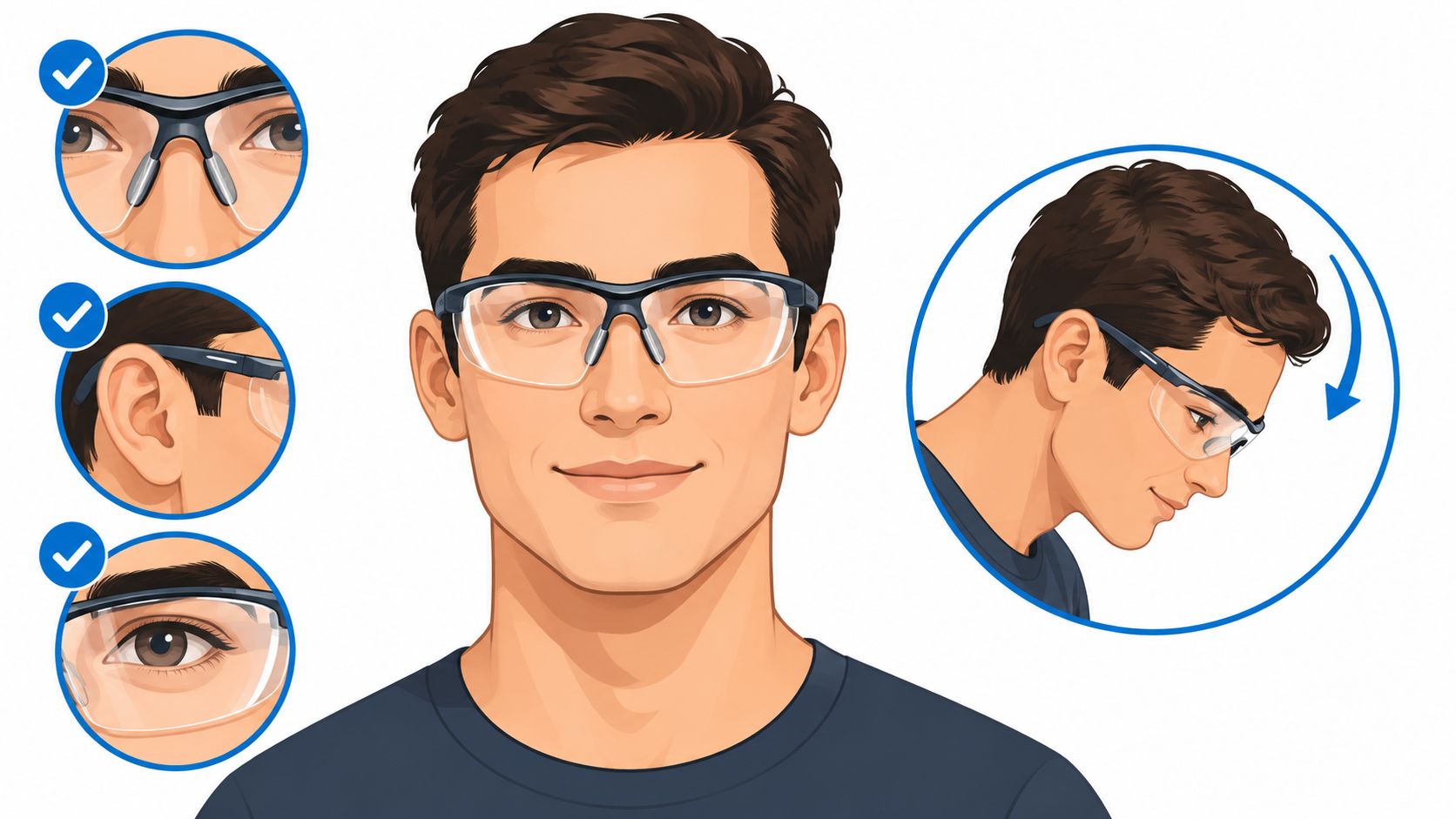
A pair may pass a bench inspection and still fail in use. Ask the worker to tilt the head forward and move it from side to side. The eyewear should stay stable without sliding, lifting away from the face or creating pressure points. Test it with the helmet, hearing protection, respirator or face shield that the worker wears.
Replace damaged arms, loose fasteners and failed straps. Don't rely on a worker to tighten a loose screw in the field unless the manufacturer provides an approved maintenance method and the result can be verified. A recurring strap or temple defect should be recorded against the model so procurement can compare durability and retention performance.
Workers often remove uncomfortable eyewear before they remove a defective glove or damaged boot because the visual impact is immediate. Supervisors should treat repeated reports of slipping or falling glasses as a control failure, not as a worker preference issue.
5. Lens Coatings
Coatings can support visibility and durability, but they can also become a failure point. Inspect the lens under a strong, indirect light source for peeling, flaking, cloudiness, white spots, rainbow effects or areas where the surface finish has separated. A coating that is lifting from the lens can scatter light and create glare.
Anti-scratch coatings can lose their function after abrasive cleaning or repeated contact with rough surfaces. Anti-reflective treatments may degrade after exposure to heat or chemicals. UV protection may not be visible to the eye, so inspectors should verify it through the product specification and approved model records rather than trying to judge it by appearance.
A coating defect is not always an immediate reason to discard the frame, but it is a clear reason to assess visibility, task suitability and remaining service life.
Match maintenance to the coating
Use a soft microfibre cloth and a lens-specific cleaning solution. Harsh solvents can damage coatings and may leave a residue that further reduces clarity. If a worker has cleaned the glasses with an unsuitable product, inspect for cloudiness and surface separation before returning them to service.
Outdoor work, high-UV areas and arc welding environments require particular care. The eyewear must have the protection specified for the task, and coating condition should be considered alongside lens marking and manufacturer guidance. Don't describe a visibly degraded coating as cosmetic if it affects glare, contrast or the worker's ability to see.
Photograph coating deterioration where it appears across multiple pairs. If the same model shows early delamination in a particular environment, review storage, cleaning products, chemical exposure and product selection. Communicate the reason for replacement clearly. Workers are more likely to report and return eyewear when they understand that coating failure affects function, not just appearance.
6. Fit and Comfort
Fit determines whether the protective area stays over the eye during real work. Inspectors should check the bridge, temple length, nose pads, side coverage and the gap between the lens and the face. The glasses should sit securely without sliding, pinching or leaving an avoidable opening around the eye area.
Have the worker try the exact pair before issue. Standard sizing doesn't suit every face, and a model that works well for one crew member may press into another worker's temples or sit too far from the nose. Missing, worn or hard nose pads can cause the glasses to slide down during heat, humidity or physical exertion.
Use a movement test rather than asking only whether the glasses feel comfortable. The worker should tilt the head forward, backward and side to side. The frame should remain stable without pressure points. Check whether the temples interfere with hearing protection and whether the bridge or strap conflicts with a respirator seal.
Fit the complete PPE system
Eye protection needs to work with the rest of the task-specific PPE. Helmets, earmuffs, respirators, face shields and welding equipment can lift the frame, create gaps or push the glasses out of position. Australian guidance notes that eye protection should fit properly, cover the eye area, include appropriate side shielding and remain compatible with other PPE. This construction PPE guidance is useful when reviewing eyewear as part of the wider site PPE arrangement.
Prescription safety glasses need their own verification. Ordinary prescription spectacles alone aren't suitable for industrial eye protection. Where workers use prescription eyewear, confirm that the selected product is designed and approved for that use, then check the fit with the rest of the PPE.
Offer more than one approved style or size where face shapes and tasks differ. Record the worker's successful model and fit preferences in the H&S system. That makes replacement more consistent and reduces the temptation to issue a visually similar but unsuitable alternative.
7. Cleanliness and Debris Contamination
A dirty pair may not be structurally defective, but it can still fail the task. Dust, dried sweat, paint, welding spatter, concrete residue and other debris can obscure vision, create glare or prevent a close inspection of the lens and frame. Clean the eyewear before deciding whether the product has passed.
Inspect the front and rear lens surfaces, frame channels, bridge and nose pads. Debris trapped around the frame can irritate the worker or indicate that the glasses are being stored in an unsuitable location. Welding spatter and cured paint can permanently damage the lens surface. Don't scrape hardened material with a blade or abrasive object.
Set a cleaning and storage standard
Workers should clean eyewear at the start of each shift and whenever contamination affects vision. Provide microfibre cloths, lens-specific cleaner and protective cases at practical points on the site. Tissue and paper towels can create fine scratches. Compressed air can move dust into the eyes or force contamination into frame gaps, so it isn't a substitute for proper lens cleaning.
- Clean before inspection: Remove loose dust and residue so inspectors can identify scratches, pitting and coating damage.
- Clean after exposure: Treat paint, concrete dust, chemicals and welding residue as reasons for an immediate condition check.
- Store between uses: Keep glasses in a case or protected storage area rather than loose in a pocket, vehicle tray or toolbox.
- Escalate chronic contamination: Record work areas where eyewear repeatedly becomes unusable and investigate ventilation, dust suppression, work methods and product suitability.
Some environments may justify eyewear with coatings that resist dust and sweat, but a coating won't compensate for poor storage or inadequate housekeeping. If contamination repeatedly prevents workers from seeing clearly, the PCBU should review the broader control measures rather than just issuing more glasses.
8. Replacement Date and Service Records
An inspection is only useful if the organisation can show what happened to the item afterwards. Record the issue date, worker, model, identification details, inspection result, defect description, photographs, action taken and replacement date. The record should show whether the glasses passed, were cleaned, were repaired through an approved process or were removed from service.
Australian workplace guidance expects PPE to be inspected regularly and before use. Damaged or defective items should be reported immediately, tagged out, repaired or replaced. Tasmania's WorkSafe guidance also links eye protection to task suitability and compliance with AS/NZS 1337 and AS/NZS 1338. The Victorian PPE guidance provides a useful Australian reference point for regular inspection and defect escalation.
Western Power's PPE procedure gives a practical benchmark for prescription safety glasses. It specifies visual checks before each use and an optical dispenser or optician inspection for prescription safety glasses older than two years. Use that kind of documented benchmark where it fits the equipment and exposure, but follow the manufacturer's instructions and your risk assessment where they require a different control.
Define the replacement decision
Retire eyewear when the lens is scratched, pitted, cracked, crazed or distorted, when the frame or hinge is damaged, when markings are illegible, when the coating has degraded, or when the glasses no longer fit securely. Replace immediately after a significant impact or unusual exposure if the condition can't be confirmed through inspection.
- Record the trigger: Identify whether replacement followed damage, contamination, coating failure, poor fit, lost markings or a scheduled review.
- Track repeat defects: Log failures by model, batch, task and work area. Procurement decisions should use this evidence.
- Use reminders carefully: Schedule prompts before planned replacement or review dates, but never allow a reminder system to override a failed pre-use check.
- Review service history: Check outstanding replacements and overdue inspections during routine H&S reviews.
A digital record makes the workflow more reliable than loose forms or an uncontrolled spreadsheet. For example, calibration management in Safety Space illustrates the value of assigning equipment records, recording service activity and prompting action when a review is due. Apply the same discipline to PPE, with the inspection outcome linked to the worker, item and corrective action.
8-Point Safety Glasses Inspection Checklist Comparison
| Checkpoint | Core features ✨ | Safety rating ★ | Value / Action 💰 | Target & USP 👥🏆 |
|---|---|---|---|---|
| Lens Condition and Optical Clarity | Inspect scratches, cracks, crazing, discolouration; check distortion under light | ★★★★★ | 💰 High ROI, replace every 6–24 months in harsh use | 👥 Workers & supervisors 🏆 Prevents dual hazard (vision + protection) |
| Frame Integrity and Structural Damage | Check cracks, warping, hinge failure, bridge stress; flex test joints | ★★★★★ | 💰 Medium cost, immediate replacement on visible damage | 👥 PPE techs & maintenance 🏆 Visible failure avoids catastrophic break |
| Markings, Certification and Compliance Labels | Verify AS/NZS 1336, CE/ANSI, manufacturer & batch info | ★★★★ | 💰 High compliance value, remove unmarked items | 👥 Compliance officers & procurement 🏆 Audit-ready evidence |
| Temple Arms and Strap Condition | Inspect cracks, loose adjustments, strap elasticity and attachments | ★★★★ | 💰 Low–medium cost, replace straps annually in heavy use | 👥 Site supervisors & end users 🏆 Improves fit retention and compliance |
| Lens Coatings (Anti-Scratch/AR/UV) | Look for peeling, delamination, white spots; test against light | ★★★★ | 💰 Medium cost, costly to match on replacement; protect with care | 👥 Outdoor workers & welders 🏆 Coatings boost comfort and clarity |
| Fit and Comfort (Bridge, Temple, Nose Pads) | Assess bridge fit, temple length, nose pad condition; movement test | ★★★★ | 💰 High behavioural ROI, better compliance = fewer removals | 👥 All workers 🏆 Multiple sizes/styles improve uptake |
| Cleanliness and Debris Contamination | Check for dust, paint, welding spatter, dried sweat; cleaning routine | ★★★ | 💰 Low cost, daily cleaning kits reduce lens damage | 👥 Operators in dusty/dirty areas 🏆 Maintains optical clarity between replacements |
| Replacement Date and Service Records | Track issue date, inspections, serials; automate reminders | ★★★★ | 💰 High administrative value, digital records reduce audit risk | 👥 H&S managers & admins 🏆 Enables scheduling & traceability |
Turn Checks Into a Repeatable WHS Control
The checklist should operate at three levels. Workers should check their glasses before use and report any defect immediately. Supervisors or nominated competent people should complete formal inspections at intervals set by the risk assessment, exposure conditions and manufacturer information. The organisation should also inspect eyewear after impact, chemical contact, heat exposure, welding spatter or contamination that may have changed the product's condition.
The first check is a use decision, not a paperwork exercise. If the glasses don't fit, don't have readable markings, don't suit the task or show damage, the worker should stop using them. The supervisor should provide suitable replacement PPE before the work continues. A worker shouldn't have to choose between an uncomfortable pair and no eye protection.
Use a clear failure path
Failed eyewear needs a controlled route out of service. The person who finds the defect should:
- Stop use: Remove the glasses from the task immediately.
- Identify the defect: Record the precise issue, such as a cracked bridge, pitted lens, failed strap or unreadable marking.
- Isolate the item: Tag it or place it in a designated quarantine location so another worker can't pick it up.
- Issue replacement PPE: Provide eyewear that matches the hazard, prescription needs and other PPE.
- Record evidence: Add photographs, model information, worker details and the action taken.
- Investigate recurrence: Review the task, storage, cleaning method, procurement choice and exposure if similar failures continue.
This process supports the PCBU's duty to provide and maintain safe systems of work. It also gives supervisors a defensible record during an incident investigation. A completed form alone doesn't demonstrate control if the defective item remained in the worker's locker or returned to the issue cupboard.
Make the digital record useful
A digital inspection should force the information that matters. Include the worker and work area, eyewear model, identification details, task or hazard, lens result, frame result, markings result, fit and compatibility result, cleanliness result, photographs, pass or fail outcome, corrective action and reviewer. Use mandatory fields for a failed check so the system can't close the form without an action.
Safety Space is one relevant option for holding these records. Its H&S platform can be configured for inspection forms, photographs, reminders, corrective actions and oversight across sites and subcontractor teams. The value comes from the record design and follow-up, not from merely replacing a paper form with a phone screen.
Start at one site. Select the approved eyewear models, define the failure triggers, train workers on the pre-use check, give supervisors the formal inspection form and establish the quarantine process. Review the first records for repeated defects and missing actions. Then adjust the form and roll it out across other locations, including a clear requirement for subcontractors to provide equivalent evidence for their teams.
A practical system should make the safe action easier than the unsafe one. Keep replacement eyewear available, provide cleaning supplies, protect stored glasses and make reporting immediate. For broader Australian compliance context, a painters' safety compliance guide also demonstrates why task-specific PPE records need to sit within a wider site control system rather than operate as an isolated checklist.
Safety Space can hold safety glasses issue details, inspection outcomes, defect photographs, replacement reminders and corrective actions in one configurable H&S record. Visit Safety Space to review how it can support digital PPE inspections across Australian sites and subcontractor teams.
Ready to Transform Your Safety Management?
Discover how Safety Space can help you implement the strategies discussed in this article.
Explore Safety Space FeaturesRelated Topics
Safety Space Features
Explore all the AI-powered features that make Safety Space the complete workplace safety solution.
Articles & Resources
Explore our complete collection of workplace safety articles, tools, and resources.