
A signed attendance sheet doesn't prove toolbox talks worked. It proves people stood in a room. Popular advice focuses on picking topics, keeping talks short and collecting signatures, but that leaves the harder question unanswered: did workers influence the control, and can the record show it? Treat each talk as a documented consultation step with a close-out chain, and the signature becomes the least important line on the form.
Table of Contents
- Core Fields Every Toolbox Talk Record Needs
- How to Plan a Toolbox Talk Around Site Hazards
- How to Run the Talk and Capture Worker Input
- Reach Every Worker on the Crew
- Raising Psychosocial Hazards Without Forcing Disclosure
- Measures and Close-Out Checklist
Core Fields Every Toolbox Talk Record Needs
A record only shows consultation when it shows what changed. Under model WHS laws, toolbox talks can form part of a PCBU's worker consultation system, and Safe Work Australia's consultation guidance identifies toolbox talks and pre-start briefings as recognised consultation methods. The method must suit the workforce, locations, hazards and worker needs, and health and safety representatives must be included where they represent workers.
Required Fields for Every Record
| Field | What to Record | Why It Matters |
|---|---|---|
| Topic and hazard or change | The specific task, hazard or site change discussed | Links the talk to a real risk |
| Date, location and work group | Site, crew, shift and task area | Shows where and for whom the talk applied |
| Attendees | Names and employer, including subcontractors | Shows coverage across employers |
| Worker questions and feedback | Concerns raised, recorded as close to the worker's words as practical | Evidence of two-way consultation |
| Agreed controls | Control decisions and the reason for each | Shows the talk changed the work |
| Responsible person and due date | A named owner for each action | Makes follow-up traceable |
| Close-out evidence | Date the control was verified and by whom | Closes the loop |
Topic and hazard should never read "general safety". Name the scaffold change, delivery route, new compound layout or other site change. Where the talk covers temporary amenities or compound layout, supervisors comparing site setup options can check guides on modular site infrastructure for context on how layout affects access and services, then record the actual hazard on this site.
Attendees need employer recorded beside each name. On a multi-employer site, a list of first names can't show which subcontractor crews were covered and which weren't.
Worker feedback is the field most records leave blank, and it's the one that matters most. Write the concern plainly, even if the answer was no change. A blank feedback box reads as a one-way briefing, not consultation.
Practical rule: If the record doesn't show a question, a decision and an owner, it doesn't show consultation.
Agreed controls, owner and close-out form one chain. "Crew reminded to take care" isn't a control. "Extend exclusion zone to loading bay door, owned by leading hand, due before first delivery" is. Close-out needs a date and a verifier, not a tick added weeks later.
Complete the record on site before work starts, while the crew's still present to correct names, wording and ownership. Filling it in from memory later produces neat forms and unreliable evidence.
For New Zealand operations, equivalent worker participation duties sit in the Health and Safety at Work Act 2015, and WorkSafe NZ publishes the guidance. Check current wording before quoting it in procedures or training material.
How to Plan a Toolbox Talk Around Site Hazards
Planning starts with today's work, not a topic library. A Safe Work Australia research brief found 64% of construction employers reported running toolbox sessions, compared with 19% across the other priority industries examined. That prevalence means workers know the format well. They also recognise a generic talk delivered because it was next on a list.
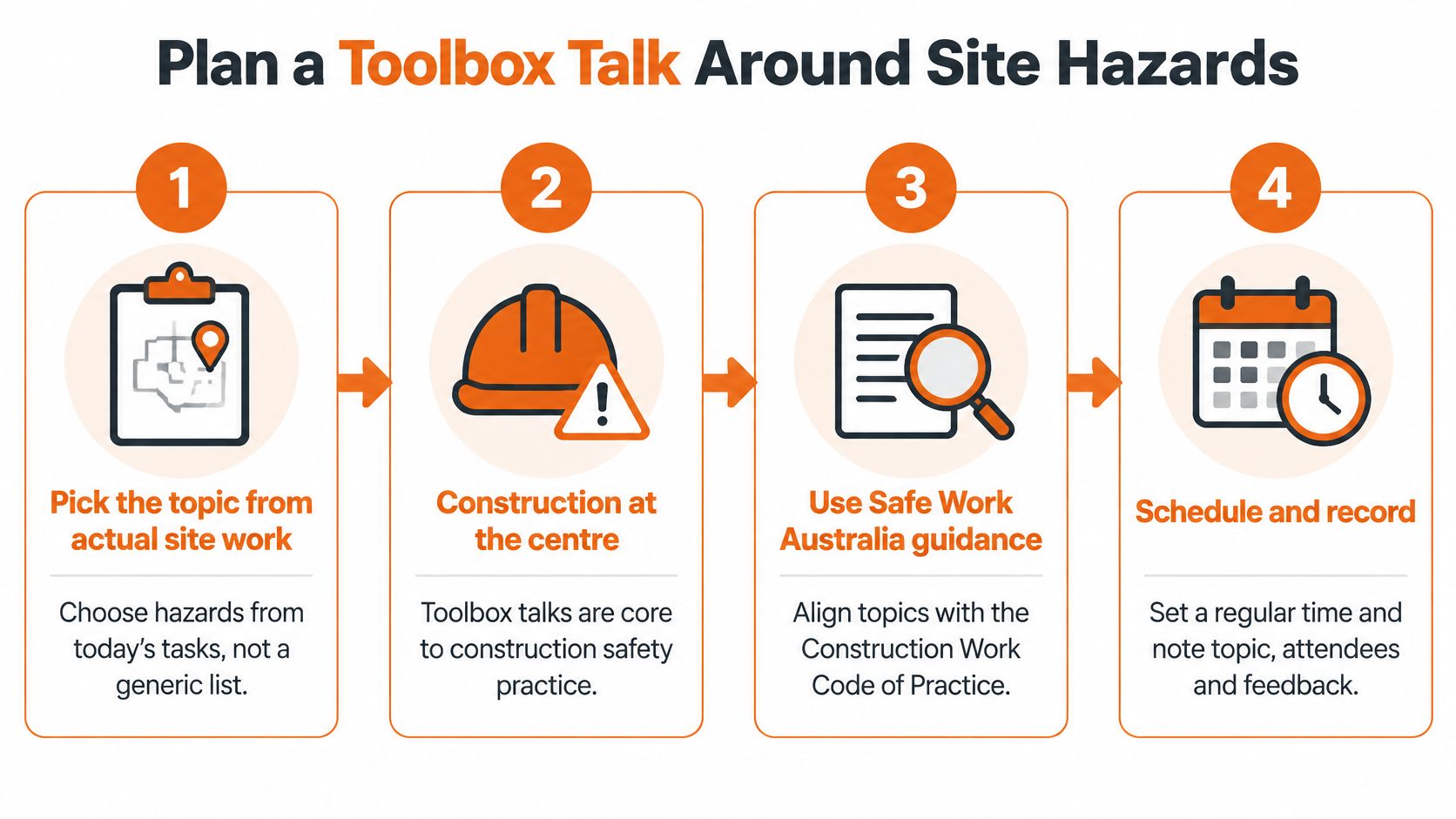
Six Planning Steps Before Each Talk
- Review today's tasks: Check plant movements, deliveries, access changes and overlapping trades for the crew. The hazard usually sits at an interface, such as a mobile plant route crossing a pedestrian path.
- Pick one hazard or change: Choose what matters today, a new exclusion zone, a housekeeping build-up or noisy work starting near other crews. For noise, a quick check with a workplace noise checker can help a supervisor frame whether hearing protection zones or timing changes need discussion, before formal assessment.
- Check the last record: Open actions from the previous talk come first. Starting a new topic while old controls sit unverified teaches workers that follow-up is optional.
- Confirm the work group: List every crew affected, including subcontractors starting later and shift workers on handover. A control agreed without the crew who'll work beside it often fails by midday.
- Decide language and format: Arrange translated or visual material where workers need it, before the talk, not during it. Scrambling for an interpreter while the crew waits shortens the discussion that matters.
- Set timing before work starts: Hold the talk while controls can still change. A talk after the pour has started can only describe decisions already locked in.
What a Good Opening Sounds Like
One hazard, one task, one question. For example: "The delivery route moves past the amenities today. Deliveries start at nine. What do people crossing to the crib room need changed?" That opening gives workers something concrete to answer.
Topic libraries still have a place for seasonal risks and recurring reminders, and safety share ideas can prompt discussion when site conditions are stable. The library should support planning, not replace it. If the topic could be delivered unchanged on any site in the country, it's probably not the right topic today.
How to Run the Talk and Capture Worker Input

Run the talk as a conversation at the work area, not a presentation beside it. Point to the access route, plant, stored materials or changed edge protection while describing it. Workers respond to what they can see, and a hazard they can touch produces better input than one described from a meeting room.
A Sequence That Produces Input
- State the hazard or change: Name the task it affects in one or two sentences. Skip background that doesn't change today's work.
- Show the control: Walk to it, demonstrate it or mark it on the ground. Explain why it applies here, not just what the rule says.
- Ask direct questions: Put one question to workers about their task, then wait. Silence after a question feels awkward, but filling it with the supervisor's own answer ends the consultation.
- Record every concern: Write minor points down too. Small housekeeping and access complaints are often early warnings for larger interface problems.
- State decisions and reasons: Tell workers which controls were agreed and why any suggestion wasn't adopted. Unexplained rejections stop future suggestions.
- Confirm owner and due date: Read both back to the crew before they leave. The owner hears the commitment publicly, which improves follow-through.
Each step feeds the record. A concern raised during the talk becomes a line item carrying a decision, a reason, an owner and a due date. That close-out chain is what separates a consultation step from a signature sheet, because an auditor can trace a worker's view through to the action it produced.
Safe Work Australia's guidance on WHS consultation duties says PCBUs must give workers a reasonable opportunity to express views, consider those views before decisions are made, and advise workers of the outcome. That duty covers employees, contractors and other people carrying out work. A talk run on the sequence above satisfies more than an attendance requirement, and a documented WHS consultation process gives supervisors a consistent structure to follow.
Two Failures to Watch For
The first is a talk that collects signatures but no questions. Treat repeated silence as a format problem, not crew apathy. Shorten the presentation part, ask about a specific task and check whether timing or language is blocking input.
The second is disagreement with a control. Record the concern in the worker's terms, give the reason for the decision and involve the health and safety representative where one represents the workers. Don't argue the point closed in front of the crew and don't leave it off the record. An unresolved concern with a named follow-up is defensible. A concern erased from the record isn't.
A disagreement recorded accurately is stronger evidence of consultation than a form showing no questions at all.
The running rule stays the same for every group: workers speak, decisions get explained, actions get owners.
Reach Every Worker on the Crew
Start with the crew list, not the talk content. Name every group that must hear it: employees, labour hire workers, subcontractors and anyone else carrying out the work. Then choose a time and format each group can use.
Match Format to Group
- Shift workers: Hold the talk at a start or handover time they attend, or run a short second session on night shift. Sending day shift notes to a night crew isn't equivalent, because they can't question a control already in place.
- Subcontractors: Run the talk with the principal contractor and each subcontractor supervisor present. Interface hazards, shared access, plant movements and exclusion zones sit between employers, so no single employer briefing covers them.
- Culturally and linguistically diverse workers: Arrange an interpreter or translated material, then check understanding by asking the worker to explain the agreed control back. A nod during an English-only talk isn't evidence of understanding.
- Workers with literacy or disability needs: Use pictures, marked-up site plans, demonstration or a verbal walk-through of the area. Record the format used so coverage can be shown later.
The duty behind this is plain. A PCBU must give every worker covered by the talk a reasonable opportunity to influence the controls, and consultation must be accessible and understandable. Accessibility isn't an optional extra added when time allows. It's a requirement for the consultation method itself.
An English-only talk held at 6 am for a night crew that speaks three languages produces a signature, not consultation.
That trap is common because it's administratively tidy. One time, one form, one presenter suits the office. It doesn't suit the workers carrying the risk, and it leaves gaps an auditor will find by comparing the attendance list against the site sign-on register.
Close each record by noting the format and timing used for each group. If a second session ran for night shift with an interpreter, write that down. Coverage that isn't recorded can't be demonstrated, and gaps stay invisible until an incident exposes them.
Raising Psychosocial Hazards Without Forcing Disclosure
Most toolbox talk libraries cover slips, PPE, manual handling and plant, then stop. Bullying, threats from the public, fatigue and excessive work pressure don't appear on a plant checklist, but they affect decisions, concentration and reporting on every task. Leaving them out doesn't make a talk programme neutral. It signals those hazards aren't legitimate safety topics.
Safe Work Australia's 2026 construction case study on psychosocial hazards describes toolbox talks that include psychosocial risks and recommends private consultation with workers and subcontractors, because people may not raise sensitive concerns in a group meeting. Its workplace violence guidance recommends discussing psychosocial hazards in toolbox talks so workers can identify inappropriate behaviour, feel able to speak up and understand reporting channels.
Use a Two-Part Format
Part one is a brief group prompt. Name the issue without asking anyone to disclose. For example, a supervisor might say that aggression from members of the public at the gate is a hazard, restate the expected response and name the reporting channel. Nobody is asked whether it has happened to them.
Part two is a private route. Offer a one-to-one conversation with a supervisor or another named contact, or a confidential digital report. State who receives it, what happens next and how escalation works. A private option without a named contact and follow-up path won't be used.
This structure works because it separates awareness from disclosure. The group session normalises the topic and explains controls. The private channel lets a worker raise bullying, threats, fatigue or work pressure without an audience that may include the person involved.
Record Carefully
Keep attendance records separate from confidential concerns. Record only the detail needed to act, and link each concern to the control, referral and review date, not to a general meeting note circulated to the crew. A psychosocial risk assessment gives those individual concerns a structured place to feed into, so patterns across crews become visible without exposing individuals.
Supervisors should also watch what the group format can't show. A quiet crew after a prompt on work pressure may mean no issue, or it may mean the supervisor setting the programme is the source of pressure. That is exactly why the private route needs an alternative contact outside the direct line.
Rule for the group prompt: A brief prompt that leads to a private option is more useful than a group discussion that forces disclosure.
Measures and Close-Out Checklist
Attendance is the weakest measure of a toolbox talk, yet it's often the only one tracked. Safe Work Australia's model Construction Work Code of Practice specifies three measurable practices: record the topic, attendees and feedback, schedule talks so workers have sufficient opportunities to influence risk controls, and monitor effectiveness using safety outcomes such as controls implemented and near misses.
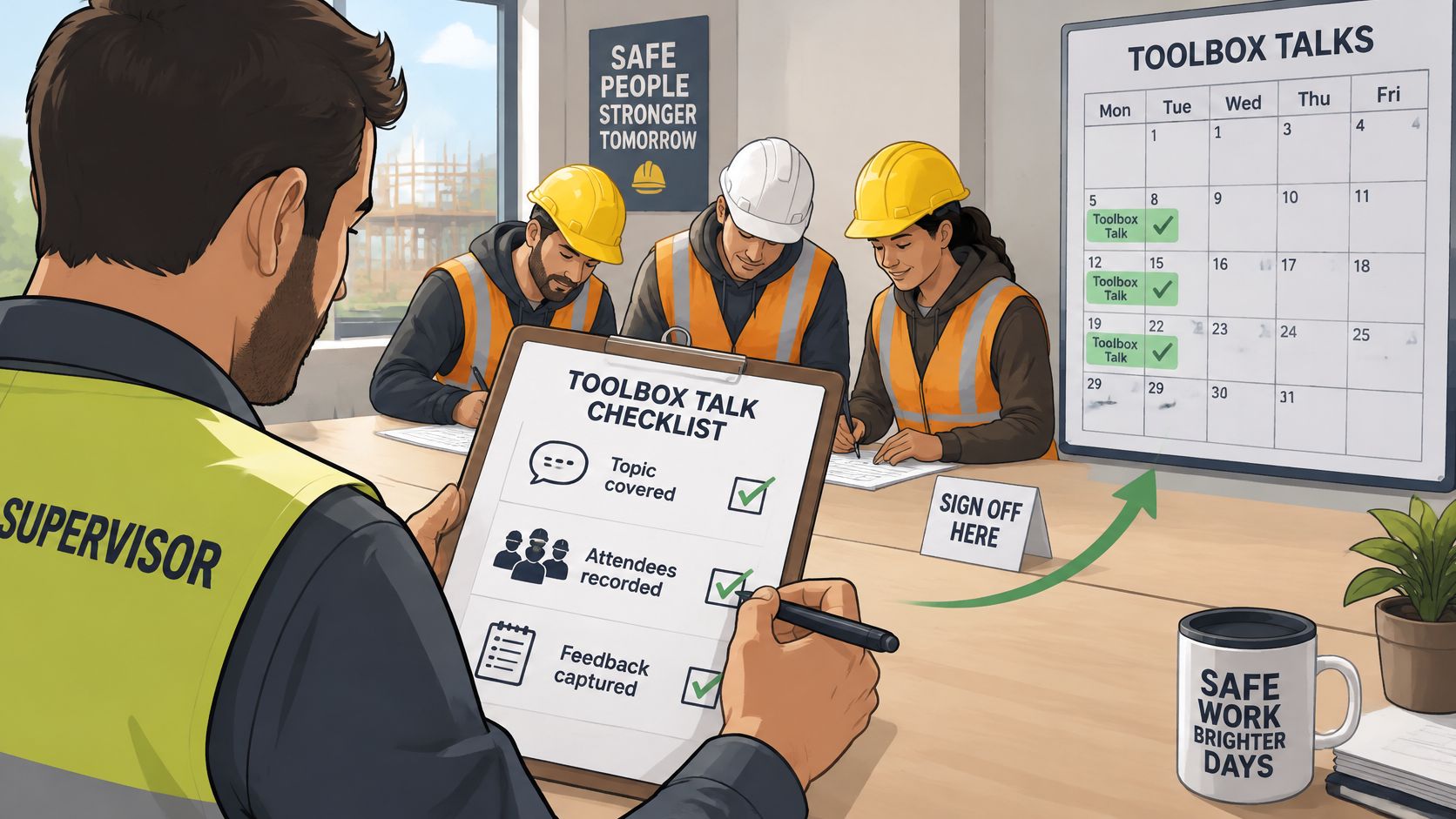
The Close-Out Chain
Use one chain for each agreed control: hazard or change, worker feedback, control action, verification. Assign an owner and due date at the talk, check completion on that date, then review near-miss reports on the task over the following weeks. Talks can also exchange risk information between builders and subcontractors on upcoming high-risk work, access changes and effects on the public, so verification should include the crews affected, not just the crew that raised the point.
| Measure | What It Shows | Limit |
|---|---|---|
| Controls implemented on time | Whether agreed actions were completed | Relies on owners and due dates being set |
| Near-miss reports on the task | Whether reporting changed after the talk | Needs a baseline from before the talk |
| Overdue actions | Where follow-up is slipping | Only as reliable as the close-out records |
| Attendance | Who was present | Shows exposure to information, not understanding |
Controls implemented on time ranks first because it tests whether the talk changed the work. Near-miss reporting ranks second, with a caution: a rise after a talk may show better reporting, not worse conditions, which is why a baseline from before the talk matters. Overdue actions expose weak supervision follow-up. Attendance sits last because presence proves exposure only.
Where owners, due dates and verification are recorded in software, Safety Space keeps toolbox talk records and corrective actions together. The software tracks PCBU obligations and manages worker consultation processes, and it tracks incidents, manages corrective actions and sends instant alerts when safety issues arise.
An action with no close-out date is a finding in itself. If a control wasn't implemented, or near-miss reporting on the task didn't change, reopen it, assign a new owner or control, and tell workers at the next talk what happened.
Checklist Before the Next Talk
- Topic tied to a named hazard or change: Not a library title.
- Subcontractors and shift workers included: Checked against the sign-on register.
- Worker questions recorded: Including concerns not adopted, with reasons.
- Owner and due date on every control: Named person, real date.
- Close-out and review dates set: Verification booked, near misses checked.
- Private reporting route stated: Named contact where psychosocial issues arose.
Pull the last month of records now. List every control with no close-out date and assign an owner to each before the next talk.
If toolbox talk records sit in folders while corrective actions live in a separate spreadsheet, Safety Space brings consultation records, owners, due dates and close-out evidence into one system built for WHS duties. Visit the site to see how toolbox talks, corrective actions and PCBU obligation tracking work together for site and office teams.
Ready to Transform Your Safety Management?
Discover how Safety Space can help you implement the strategies discussed in this article.
Explore Safety Space FeaturesRelated Topics
Safety Space Features
Explore all the AI-powered features that make Safety Space the complete workplace safety solution.
Articles & Resources
Explore our complete collection of workplace safety articles, tools, and resources.