
Start with the worker booked onto tomorrow's high-risk task, then check whether the training register can prove that person is ready. The spreadsheet may show a completed induction and a certificate, while the practical assessment sits in an email and the licence renewal hasn't been verified.
A useful training register template connects the worker, the task, the evidence and the next decision. For WHS managers and supervisors, that means being able to explain why someone is authorised to work, not just when they attended training.
Table of Contents
- Training Register Fields for an Australian Template
- Tracking Competence Rather Than Attendance
- Setting Renewal Dates and Expiry Alerts
- Evidence and Retention for Construction and High-Risk Work
- Set Up the Register and Run the Final Check
Training Register Fields for an Australian Template
A training register is evidence of how a business manages its training obligations. It isn't proof of compliance by itself.
Safe Work Australia's training guidance connects the PCBU's duty to provide information, training, instruction and supervision with induction, task-specific training and ongoing training, and recommends records showing who was trained, how they performed and what further training they need. Its construction guidance also calls for participant names, content, trainer and date, with participant acknowledgement, and accepts electronic records.
The template therefore needs enough detail to support a decision about work allocation. A course title and completion date leave too much unanswered.
Training register fields and what each one proves
| Field | What to record | Why it matters |
|---|---|---|
| Worker name | Full legal name and employee or contractor ID | Ties every record to one person |
| Site or project | Site, project or work area | Shows where the competency applies |
| Training topic or task | Induction, task, or licence named as the course | Separates general and task-specific training |
| Provider and trainer | Registered training organisation or assessor name | Shows who delivered or assessed the training |
| Delivery date | Date and time of each session | Proves when training occurred |
| Competency outcome | Competent, not yet competent or restricted | Shows capability, not attendance |
| Evidence reference | Card number, certificate, checklist or assessment file | Lets the business produce proof on request |
| Procedure version | Version of the SWMS, SOP or procedure trained | Shows the training matches current controls |
| Issue and expiry date | Card or licence issue date and renewal date | Drives renewal reminders |
| Supervisor sign-off and acknowledgement | Name, date and signature or e-acknowledgement | Confirms worker and supervisor agree the record |
Competency outcome and evidence reference are the fields that make the register useful during scrutiny. The outcome records the decision. The evidence reference allows an auditor or inspector to examine what supported that decision.
Keep identifiers consistent. A contractor recorded under a nickname in the register and a legal name on the licence creates unnecessary verification work, particularly when crews move between projects.
Define requirements before entering completions
The business needs a task-to-competency map before populating worker records. Spark's resource on mappare le competenze formative obbligatorie provides context for mapping mandatory training competencies, but Australian requirements still need to be established against the work and jurisdiction.
Use controlled task names rather than free-text descriptions. For example, separate a general chemical induction from instruction in a specific dosing process. Those records answer different questions and may need different evidence.
Practical rule: A register entry should identify both the training event and the decision it supports.
Copy these columns into the template, then test the filters. The register owner should be able to retrieve a worker's records by worker, site and task within a minute, as an internal usability target rather than a regulatory deadline.
Tracking Competence Rather Than Attendance
The attendance trap starts when a completed course automatically becomes a competent status. That shortcut removes the assessment decision from the record.
Safe Work Australia's task-specific training guidance says workers should receive supervised, hands-on training and demonstrate that they can follow procedures and perform the task safely without direct supervision. Acknowledging a procedure doesn't establish that capability.
Competency status values and the action each triggers
Use the following as an internal status model. The 60-day Expiring window is a suggested administrative trigger, not a statutory renewal period.
| Status | Meaning | Action |
|---|---|---|
| Not started | No training or assessment recorded | Block allocation to any task that needs a licence or competency |
| In progress | Training delivered, assessment still pending | Schedule the observation or assessment and record a date |
| Competent | Assessed in practice and knowledge, evidence attached | Confirm procedure version is current and set a review date |
| Expiring | Tracked date falls within 60 days | Start renewal and notify the worker and supervisor |
| Expired or not competent | Date has passed, or assessment was not passed | Remove from the task, retrain and re-assess before reallocation |
The final status groups records requiring an immediate allocation decision. Keep a separate reason field, because an expired licence and an unsuccessful practical assessment need different corrective actions.
Similarly, In progress mustn't become informal permission to work independently. Record the supervision arrangements, permitted activities and restrictions while the worker completes training.
Record what the assessor checked
A manufacturing worker may finish an induction without demonstrating safe isolation of the machine being assigned. A construction worker may understand the SWMS but still need supervised practice on the equipment. A cleaning contractor may recognise a chemical label without being able to prepare the specified dilution safely.
The assessment record should identify:
- Procedure version: The SWMS, SOP or task instruction used during assessment.
- Assessor and method: Who checked knowledge and observed performance.
- Observation result: The critical steps completed correctly and any missed controls.
- Restrictions and follow-up: What remains prohibited, who will supervise and what reassessment is required.
Use an onsite training and assessment process that produces a retrievable checklist or assessment record. Attach the evidence supporting the result rather than relying on a signature with no assessment detail.
A longer list of completed modules doesn't compensate for an untested critical control.
Separate legally required records for specified activities from good-practice records retained for other training. Both belong in the system, but the register policy should identify which records carry specific legal requirements and which support the business's broader assurance process.
Setting Renewal Dates and Expiry Alerts
Renewal tracking needs two separate decisions: when the underlying requirement ends, and when the business starts acting. Confusing them can leave supervisors treating an internal reminder date as a legal expiry date.
Record the issue date, expiry or review date, evidence reference and named owner for each tracked requirement. Licences and certifications belong against the worker; insurances, calibrations and permits may belong against a contractor, asset or work activity. Link those related records without labelling them worker competencies.
Set the alert windows in the register policy
A practical internal design is to flag a requirement as Expiring within 60 days, then escalate unresolved renewals to the supervisor 30 days before expiry. These are suggested workflow settings, not regulatory timelines.
The policy should distinguish the actions at each point:
- Early warning: Confirm the renewal route, book training or assessment, and request replacement evidence.
- Supervisor escalation: Resolve booking delays, arrange alternative competent workers and review upcoming allocations.
- Expiry: Stop allocation where the current licence or competency is required.
- Evidence gap: Withhold authorisation for that task until the missing date or supporting record is verified.
A review date isn't necessarily an expiry date. Where no fixed expiry applies, label it review due and record the business's reassessment trigger rather than inventing an expiration.
For a renewal involving an online knowledge assessment, Form Timer's date window setup for timed exams provides a useful example of separating an assessment's opening and closing window. That window controls assessment availability, not the validity of the licence.
Preserve history and give reminders an owner
When a renewed licence arrives on a new form, close the previous record and create a replacement with its own issue date, expiry date and evidence. Don't overwrite the history needed to establish what was current when earlier work occurred.
At the software setup stage, Safety Space provides a centralised Training Register for certifications and supports assigning training documents and videos to employees. Its tracked-date notifications can name a staff member or the person completing the form as the email recipient.
For an online learning management workflow, keep course completion separate from licence verification and task authorisation. Passing a renewal module shouldn't automatically resolve every related requirement.
Each week, the register owner should review upcoming dates, unresolved evidence requests and expired entries against planned work. A reminder isn't closed because an email was sent; it closes when the replacement evidence is verified or the allocation changes.
Evidence and Retention for Construction and High-Risk Work
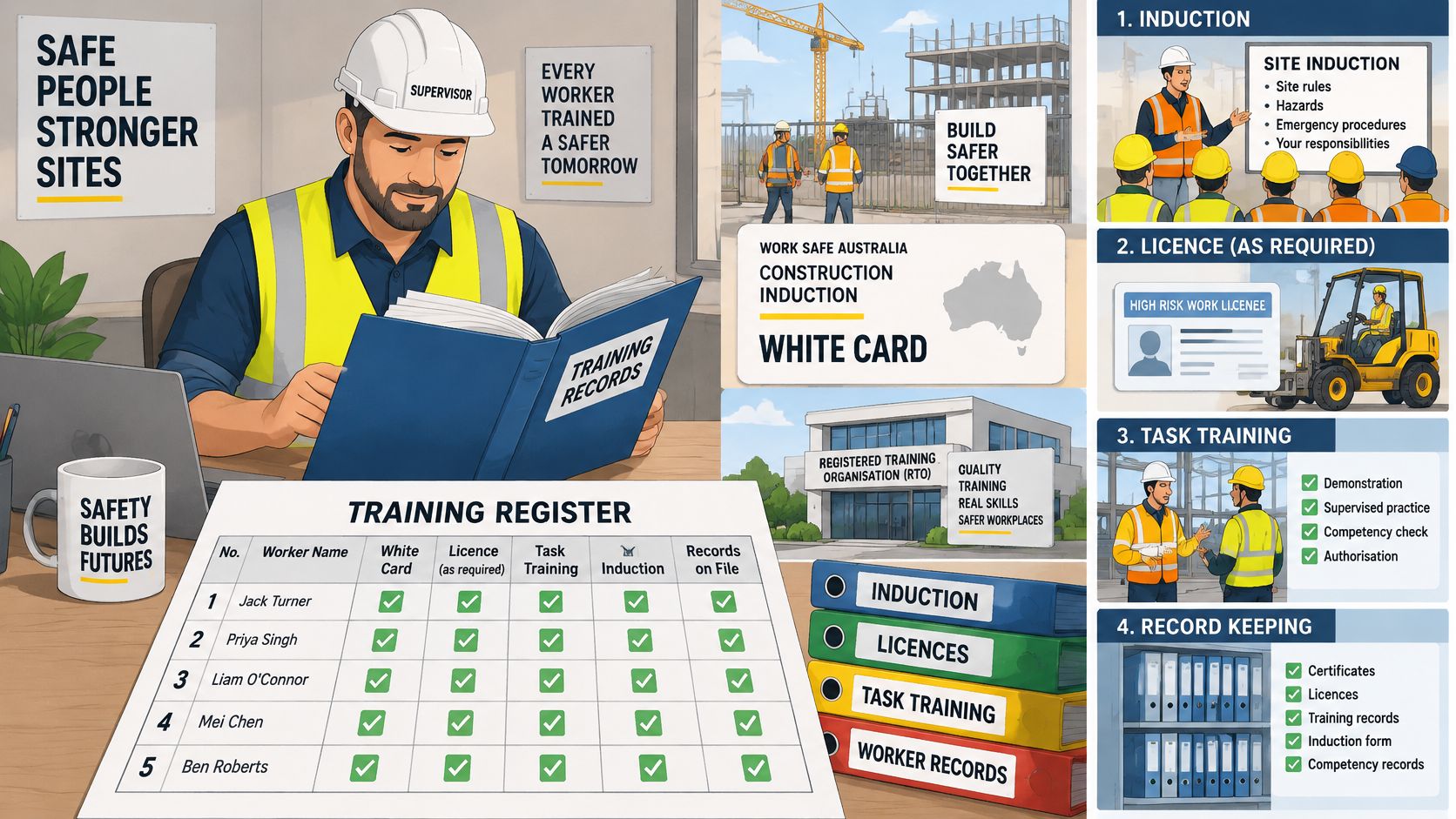
The common construction access check starts with general construction induction. The model Construction Work Code of Practice specifies training delivered in Australia by a Registered Training Organisation and a White Card, or certification issued within the preceding 60 days where the card has been applied for but not yet issued.
Record the card or certification number, issue date, evidence file and verification status before site access. This check applies to people carrying out construction work, including relevant managers, supervisors and contractors, not just employees on the tools.
Match evidence to the activity
For high-risk-work trainees, the national high-risk-work licensing standard specifies recording practical-session details at each session's completion, including the trainee, RTO, date and time, tasks, equipment, outcomes, and supervisor's name and licence number.
Link the session record to assessment forms and relevant photographs. Photographs can support an assessment, but they don't replace a documented outcome or establish competence on their own.
Evidence to hold and retention by case
The historical national construction induction code recommends retaining construction induction records for the employment or project period plus three years; its accompanying guidance also identifies retention while engaged for major-hazard-facility training records. These retention bases appear below, while activity-specific periods need confirmation with the relevant regulator before adoption.
| Case | Evidence to hold | Keep until |
|---|---|---|
| General construction induction | White Card number, issue date, RTO-delivered course, participant acknowledgement | Employment or project period plus three years, under the cited historical guidance |
| Certification applied for, card not yet issued | Certification issued within the preceding 60 days, evidence file, verification status | Construction induction retention period; retain alongside the replacement card evidence |
| High-risk work licence | Licence number and each practical session: date, time, RTO, tasks, equipment, outcomes, supervisor name and licence number | The applicable jurisdiction's confirmed licence and training-record retention period |
| Confined space or hazardous chemical training | Training record, licence where one applies, assessment evidence | The activity-specific retention period confirmed with the regulator |
| Major-hazard facility training | What was covered, who received it, when, and who provided it | While the worker remains engaged at the facility |
Electronic storage is acceptable under the cited guidance. Apply privacy controls and make records retrievable for authorised requests, rather than leaving evidence in individual supervisors' inboxes.
Check current safety training requirements against the activity and local regulator. Confined-space and hazardous-chemical training records shouldn't be treated as evidence that a separate licence is always required.
New Zealand note: The Health and Safety at Work Act 2015 includes the duty to provide information, training, instruction and supervision, but the Australian White Card rows don't transfer to New Zealand. Record site-specific safety plan inductions and task competence in the same structure, and confirm current requirements with WorkSafe NZ.
Set Up the Register and Run the Final Check
Start the final check with the worker-to-task trace. Select a worker scheduled for a high-risk task and follow the assignment back through the task requirement, licence evidence, practical assessment and renewal date. Confirm that the supervisor's allocation decision matches the evidence and that any required supervision is available.
Safe Work Australia's ongoing training and supervision guidance supports assessing workplace performance and knowledge, documenting achievement and addressing further training needs. The final check should show that each requirement has evidence attached to the worker, the task and the authorisation decision.
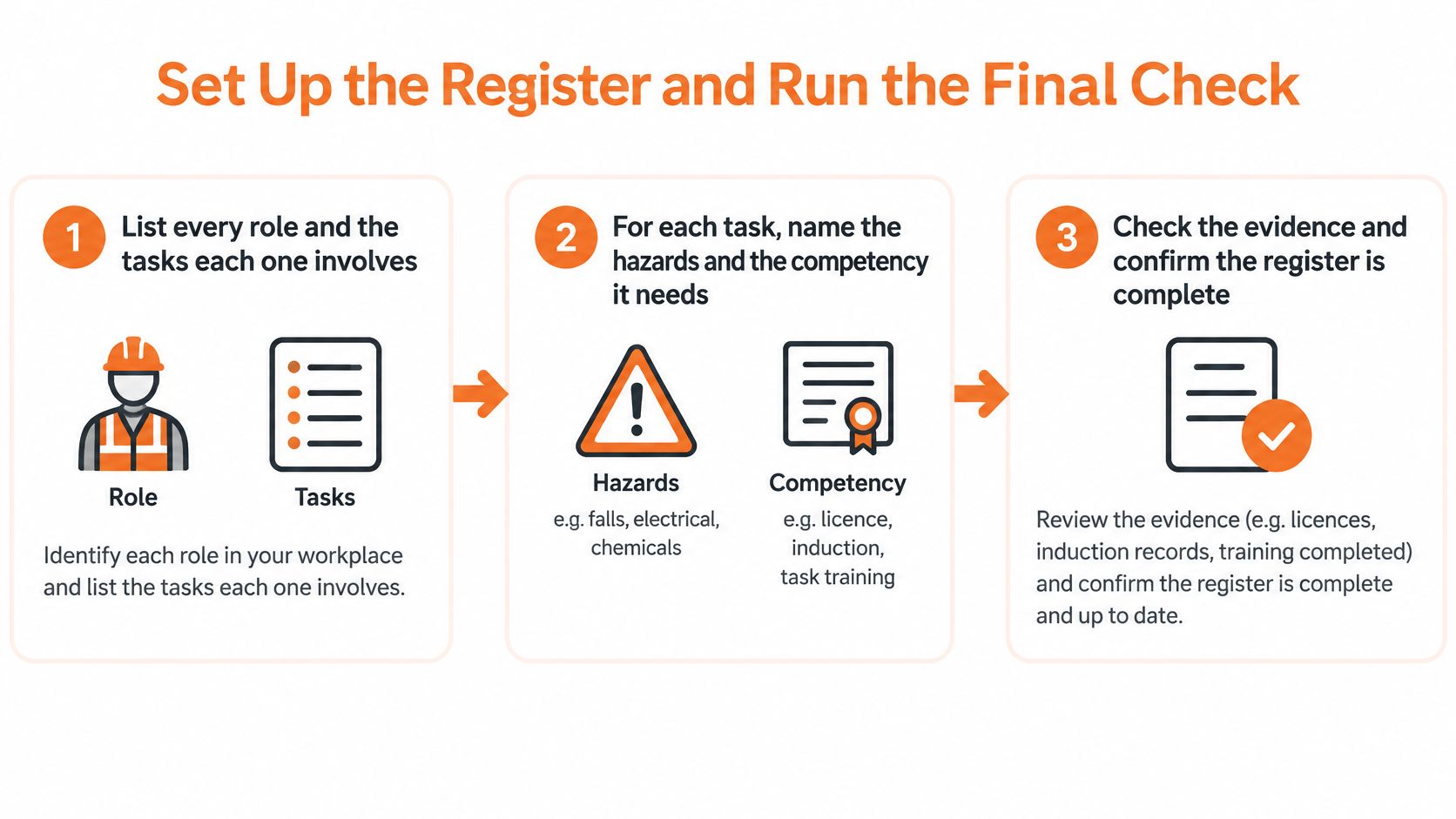
Then test the reverse direction. Select the task and identify every worker currently authorised to perform it. Check the worker-to-task link in both directions because a register can look complete from the worker side while still leaving a task with too few authorised people. Any mismatch, missing attachment or unsupported status is the first gap to fix before that work is allocated.
A reliable final check also asks what the record proves. A course completion, site attendance list and practical assessment answer different questions. A training record shows that content was delivered. An assessment record shows what the worker was asked to know or do. A licence record shows that an external requirement has been met. The authorisation decision brings those records together and states whether the worker can perform the task, with or without restrictions.
I would keep that authorisation decision visible beside the task, not buried in a comment or attachment. A supervisor needs to see the current status, the expiry date and any limit before assigning work. The register owner should be able to explain the basis for the decision without rebuilding it from messages, certificates and supervisor memory.
Build the setup around actual work
Build the training register template around actual work before importing historical course completions. Otherwise, the business can end up with a polished record of training delivered and no reliable way to identify unmet requirements.
Use the role and task structure established earlier as the setup spine. Include occasional duties, relief arrangements, temporary assignments and contractor activities, then attach each requirement to the relevant risk assessment, SWMS or SOP. Keep each licence, induction and equipment-specific assessment as a separate worker entry so it carries its own evidence, verification result and review trigger.
A worker ID can connect the entries, and a summary view can help supervisors. The summary still needs to expose incomplete requirements. An overall green status has little value if one expired licence or missing assessment sits underneath it.
Run the final control checklist
Before an audit, test the register as a working control rather than checking whether every cell contains text. Start with records likely to expose a weakness: a renewed licence, a contractor who changed projects, an unsuccessful assessment and a worker returning to an altered procedure.
The final check should cover:
- Ownership: Every tracked date and open corrective action has a named person responsible for resolving it.
- Task allocation: Supervisors can identify expired requirements and missing evidence before assigning the work.
- Access control: Staff can view what they need, while only authorised people can alter assessment outcomes or authorisations.
- Change history: Amendments preserve who changed the record, when and why, without removing previous evidence.
- Retention: The policy states the applicable retention basis, the responsible owner and how disposal is authorised.
- Export and retrieval: Evidence files open correctly, links remain usable and exports retain identifiers, dates and outcomes in a format acceptable to the requesting regulator or client.
Open the underlying evidence and check that it belongs to the named worker, covers the assigned task and supports the recorded outcome. A dashboard can help with visibility, but the final test sits in the record itself. An inspector or auditor may ask how the business reached its decision. The register owner should be able to show the requirement, the assessment evidence, the authorisation and any restrictions in one trace.
A spreadsheet can support this workflow when someone actively maintains it and supervisors can access a controlled version. The trade-off is manual coordination: evidence links, status changes and allocation decisions need deliberate checking. Software also needs clear ownership because a status field cannot decide who may authorise work. Give the supervisor an explicit authorisation decision, including restrictions where they apply.
Close gaps before work is allocated
For each unresolved gap, assign an action owner and a due date. State whether the worker needs further instruction, supervised practice, another assessment or replacement evidence. Define what closes the action. A course booking is progress; the requirement is met when the evidence and outcome support the task.
The final check earns its place in the process. It turns a register from a filing exercise into a control over work allocation. The question to keep asking is simple: can this worker perform this task now, on this site, under these conditions? The answer should be traceable from the task back to the worker and from the worker forward to every task they are authorised to perform.
Safety Space offers training registers with certification tracking, expiry reminders and documents assigned to employees. A free H&S consultation can be booked to discuss how worker requirements, assessment evidence and renewal responsibilities can be organised for the business's sites.
Ready to Transform Your Safety Management?
Discover how Safety Space can help you implement the strategies discussed in this article.
Explore Safety Space FeaturesRelated Topics
Safety Space Features
Explore all the AI-powered features that make Safety Space the complete workplace safety solution.
Articles & Resources
Explore our complete collection of workplace safety articles, tools, and resources.