
On a busy site, the gap usually isn't between policy and intent. It's between who influenced the task and who thinks they still own the risk. If your yard, workshop or project relies on subcontractors, schedulers, loaders, labour hire or freight carriers, chain of responsibility sits in that gap.
Table of Contents
- Why a Familiar Site Can Still Create a Compliance Gap
- The Core Idea Behind Chain of Responsibility
- Who the Law Treats as a Duty Holder
- How WHS Duties Stack in a Contractual Chain
- Two Worked Examples from Construction and Logistics
- What Good Controls Look Like Across the Chain
- Misconceptions That Get Managers in Trouble
- Putting It Into Practice This Week
Why a Familiar Site Can Still Create a Compliance Gap
It's Wednesday morning in a mid-size precast yard. The principal contractor is coordinating several concrete crews, a crane operator and a freight carrier taking blocks to a depot across state lines. A steel-fixing subcontractor has brought its own crew. The scheduler has set the run times. The loader has restrained the load. The driver has already had a long week.
Nothing about that setup feels unusual.
That's the problem. Familiar work often hides split control. One party plans the task, another supplies the labour, another manages the site, another loads the truck, and another drives the load out the gate. When something goes wrong, regulators won't look for one person to blame if several parties shaped the conditions that led to the event.
Where managers get caught
A shifted load on the freeway might look like a transport incident. A pump rollover might look like an operator error. A worker entering an exclusion zone might look like a supervision failure. But in each case, the issue is often broader.
- The scheduler may have compressed the job.
- The loader may have accepted a poor restraint method.
- The site controller may have allowed conflicting activities.
- The subcontractor may have sent people who weren't properly briefed.
The legal system looks past the person at the sharp end and asks who had influence over the risk.
That's where chain of responsibility matters. It exists because modern construction, manufacturing and industrial services rarely involve one employer, one site controller and one clear line of command. They involve overlapping decisions.
Why the concept matters in practice
If you only investigate incidents by asking what the driver did, what the worker did, or what the subcontractor did, you'll miss the actual compliance exposure. The law is built to catch that mistake.
For Australian managers, the question isn't only what happened. It's who set the conditions for it to happen. That's the starting point for understanding what is chain of responsibility in a way that helps you run a site or fleet.
The Core Idea Behind Chain of Responsibility
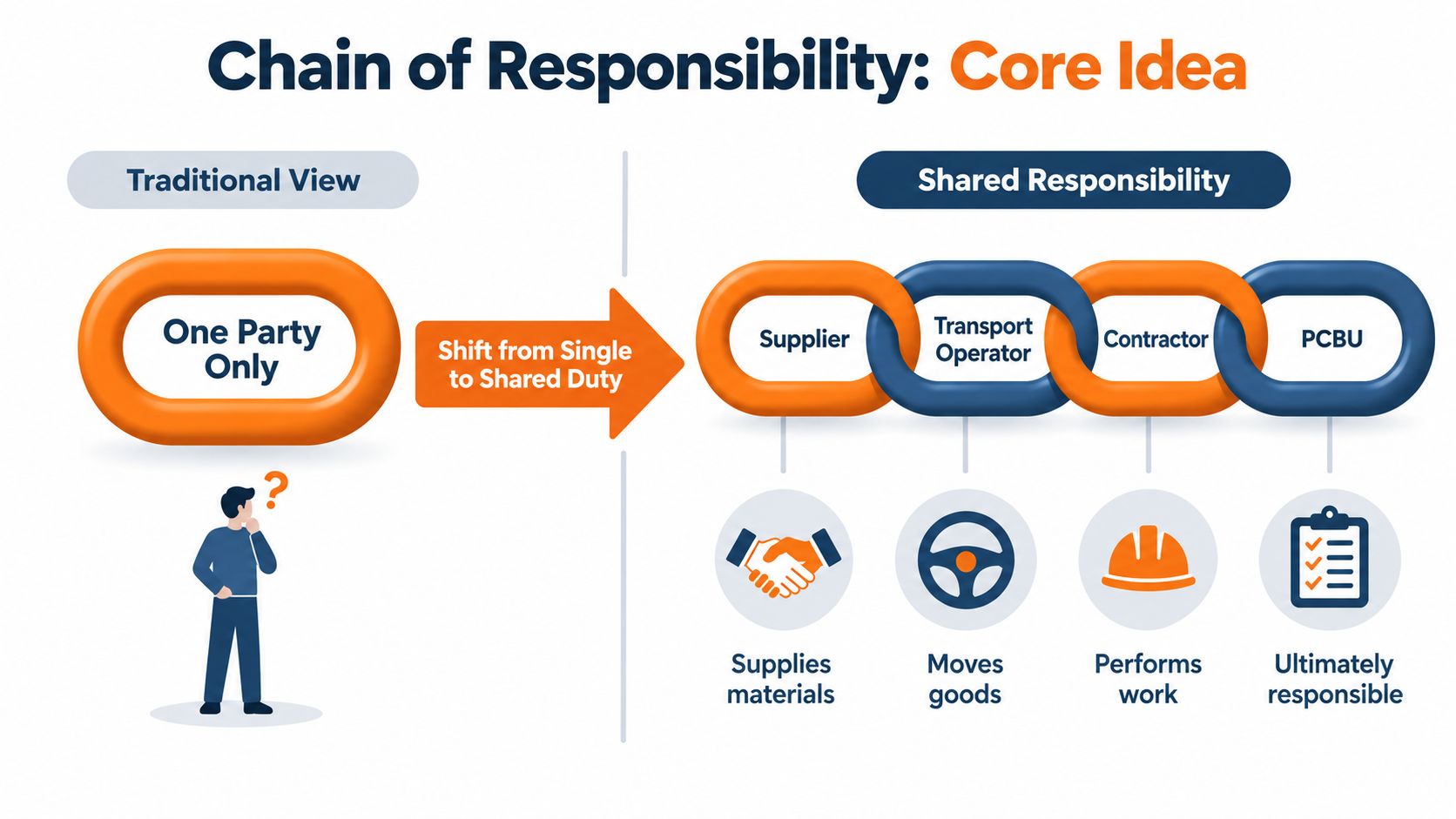
Chain of responsibility means responsibility follows influence. If a person or business can affect how safely a task is planned, authorised, loaded, scheduled, supervised or carried out, that person or business may carry a legal duty.
Older models often treated incidents as the fault of the person doing the work at the end of the chain. In transport, that usually meant the driver. In contracted work, that often meant the subcontractor on site. That view is too narrow for modern operations.
The law moved because safety decisions aren't made only at the wheel or at the workface.
Two legal frameworks that managers need to hold together
In Australian practice, managers usually deal with chain of responsibility through two related frameworks.
The first is WHS law. Safe Work Australia states that the primary duty holder under the model WHS laws is a PCBU, and duties can't be transferred to another person through contract. It also explains that in a contractual chain there may be multiple contractors and subcontractors, and there doesn't need to be a direct contractual relationship for duties to arise for lower-level workers under that chain (Safe Work Australia guidance on duties in a contractual chain).
The second is heavy vehicle law. Under the Heavy Vehicle National Law, the NHVR says liability extends beyond the driver to parties who influence the transport task, including employers, schedulers, consignors, loaders, unloaders, operators and consignees (NHVR chain of responsibility overview).
The shift managers need to make
The practical shift is simple. Stop asking, “Who was there when it happened?” Start asking, “Who shaped the task before it happened?”
That's the difference between a driver-only view and a real chain analysis. If your team needs a transport-specific breakdown, Safety Space has a practical guide to transport chain of responsibility that aligns that question to heavy vehicle operations.
Practical rule: if someone can influence time, load, sequence, method, site conditions or supervision, treat them as part of the chain until proven otherwise.
A lot of confusion comes from thinking influence must be direct. It doesn't. A person can affect risk by setting deadlines, approving a method, choosing a carrier, controlling the workplace or withholding critical information.
Who the Law Treats as a Duty Holder
Once you stop looking only at the person doing the task, the next question is who the law treats as a duty holder. In practice, the answer is often “more people than the site assumes”.
Under WHS law, the central duty holder is the PCBU. Safe Work Australia says a PCBU has the primary duty to ensure the health and safety of workers while they are at work in the business or undertaking, and also of other people who may be affected by the work, so far as is reasonably practicable (PCBU duties under WHS laws).
WHS duty holders
That primary duty catches more than one entity on the same job. Safe Work Australia says duties in a contractual chain may be owed by the PCBU that engages another party, the PCBU that causes a worker to be engaged through subcontracting or directs or influences the work, the PCBU that manages or controls the workplace, and the PCBU doing other work at the same workplace that may affect nearby people. It also says there does not need to be a direct contractual relationship for a duty to exist (WHS duties in a contractual chain fact sheet).
Officers matter too. Directors and senior decision-makers don't disappear behind the company structure. They carry due diligence obligations in relation to compliance.
If you need a sharper refresher on the legal role itself, Safety Space's page on WHS duties of a person conducting a business or undertaking is worth keeping in your internal references.
Heavy vehicle chain parties
Heavy vehicle law names different roles because the task is different. The question isn't who employed the driver. It's who influenced mass, load restraint, fatigue, speed, route or timing.
Here's a practical comparison.
| Duty Holder | Regime | Trigger of Liability |
|---|---|---|
| PCBU | WHS | Conducts the business or undertaking and influences the work or workplace |
| Officer | WHS | Makes or governs decisions affecting whether the PCBU meets its duties |
| Workplace controller | WHS | Manages or controls the workplace where the risk exists |
| Engaging contractor | WHS | Brings another party into the work and still influences how work is done |
| Subcontracting PCBU | WHS | Directs, influences or performs work that affects workers or others |
| Employer | Heavy vehicle law | Influences how the transport task is carried out |
| Operator | Heavy vehicle law | Runs the vehicle operation and related controls |
| Scheduler | Heavy vehicle law | Sets timing that affects fatigue, speed or compliance |
| Loader or unloader | Heavy vehicle law | Influences load placement, restraint or mass outcomes |
| Consignor or consignee | Heavy vehicle law | Initiates or receives the freight task and can influence how it is performed |
One person can wear several hats
A logistics manager can be an officer of a PCBU, a scheduler for a trip and a consignor for a particular load. A head contractor can also control site access, sequence work and approve SWMS. Duties don't cancel each other out because roles overlap. They stack.
That's why job title alone is a poor guide. Follow the decisions, not the org chart.
How WHS Duties Stack in a Contractual Chain
The most common legal mistake in contracted work is assuming the contract map is the same as the duty map. It isn't.
A head contractor can engage a specialist subcontractor. That subcontractor can engage labour hire. A plant owner can provide equipment. A designer can specify part of the work method. All of that may be commercially tidy. None of it removes WHS duties from the parties who still influence the work.
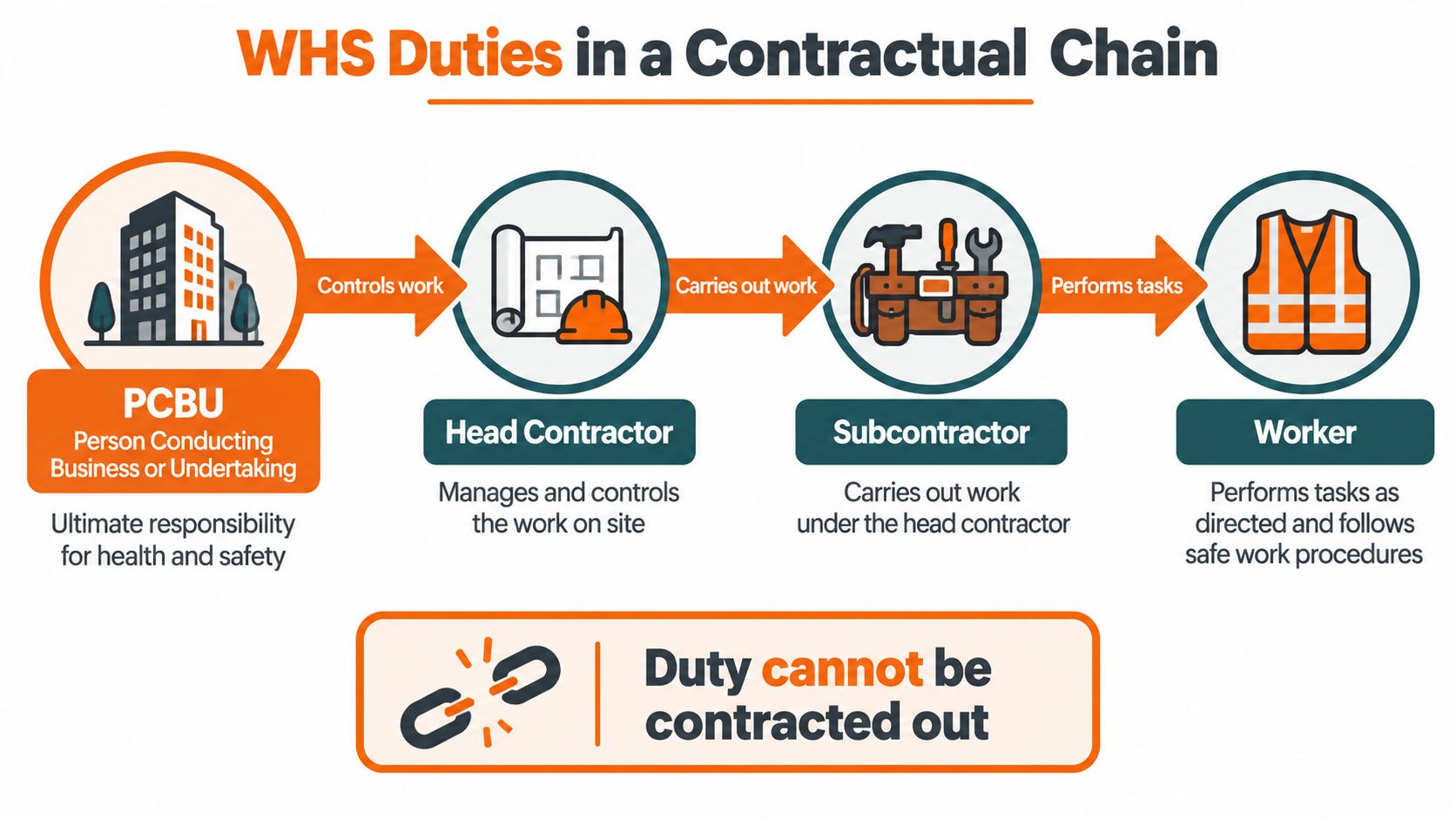
Contracting out doesn't work
Safe Work Australia explains that where multiple contractors and subcontractors work on the same project, each duty holder must consult, cooperate and coordinate with others rather than assuming the duty is transferable (contractual chain WHS fact sheet).
That point matters because many systems still rely on a “subcontractor shield”. The principal says the subcontractor owns the SWMS. The subcontractor says labour hire owns competency. Labour hire says the host controls the site. Everyone points down the line.
The WHS Act doesn't work like that.
What overlapping duties look like on site
On a live construction or industrial site, overlapping duties usually show up in these places:
- Scheduling and sequencing. One business controls when the task happens. Another controls how it happens.
- Plant and workplace control. One party owns the plant. Another controls the work area where it's used.
- Supervision and information flow. One party briefs the crew. Another holds design or site hazard information the crew needs.
If two PCBUs affect the same risk, both need to be in the control conversation.
Safe Work Australia's consultation code says a PCBU must consult, cooperate and coordinate activities with all others who have a WHS duty in relation to the same matter, so far as is reasonably practicable, and must consult workers who are or are likely to be directly affected by a health and safety matter (consultation requirements in the code).
SWMS is part of the chain, not a side document
For construction, Safe Work Australia's model code says a PCBU must prepare, or ensure a SWMS has been prepared, before high risk construction work starts. It also says workers and health and safety representatives must be consulted when preparing and reviewing the SWMS, and officers have a due diligence duty to ensure the PCBU complies with its obligations (construction work model code).
That makes SWMS consultation a live chain issue. If the parties who hold the site knowledge, design intent, crew capability and work method aren't all feeding into the control, the document may exist but the duty hasn't been properly discharged.
Two Worked Examples from Construction and Logistics
Managers usually understand chain of responsibility once they can see the task split across real people. Two examples make the point faster than another definition.
Construction example with four PCBUs on one task
A tier-two builder engages a specialist flooring subcontractor for a concrete pour. That subcontractor brings in a pump operator through labour hire. The engineer has specified the slab and noted a soft edge near one boundary.
On paper, each party has a neat scope. On the ground, four PCBUs influence the same task.
The head contractor controls site access, sequencing and exclusion zones. The engineer holds design intent and critical information about the slab edge. The subcontractor controls the immediate work method and the briefing to the pour crew. The labour hire provider has a role in ensuring the operator supplied is competent for the task being sent to site.
Now change one thing. The pump operator is never told about the soft edge the engineer had already identified. The plant sets up too close, the ground gives way, and the boom movement creates a near miss or worse.
No single party can safely say, “That wasn't ours.” The engineer held information. The subcontractor controlled the briefing. The head contractor controlled site coordination. Labour hire supplied the operator into the system. The exposure sits in the missed handover between them.
The failure isn't only the plant position. It's the broken transfer of risk information across the chain.
Logistics example with off-site decisions still in scope
A manufacturing site books a B-double through a third-party broker to move finished product. The freight leaves from a loading bay run by site staff. Delivery times are tight because the receiving slot is fixed.
Under heavy vehicle chain thinking, the driver is only one part of the task. The consigner, loader, scheduler, packer, consignee and operator may all shape the conditions for compliance or non-compliance.
If the rear axle ends up overloaded because the loader is rushing, the booking window is too tight, and the scheduler has left no room for correction, the legal issue won't stop with the driver. Off-site decisions still count if they affected the job.
For teams trying to digitise those handoffs, these fleet management mobile app examples are useful because they show practical ways businesses capture dispatch, proof of task and field communication across moving operations. The value isn't the app itself. It's making the decision trail visible.
The common thread
Both examples turn on the same point. The chain is built by influence over safe execution, not by who signed the last subcontract or who happened to be present when the event occurred.
That's why what is chain of responsibility can't be answered properly with a transport-only lens or a contractor-only lens. In real operations, those two worlds overlap.
What Good Controls Look Like Across the Chain
Good controls don't start at induction. They start when the work is scoped, bought, scheduled and assigned. By the time a task reaches the site gate or loading bay, many of the risk decisions have already been made.
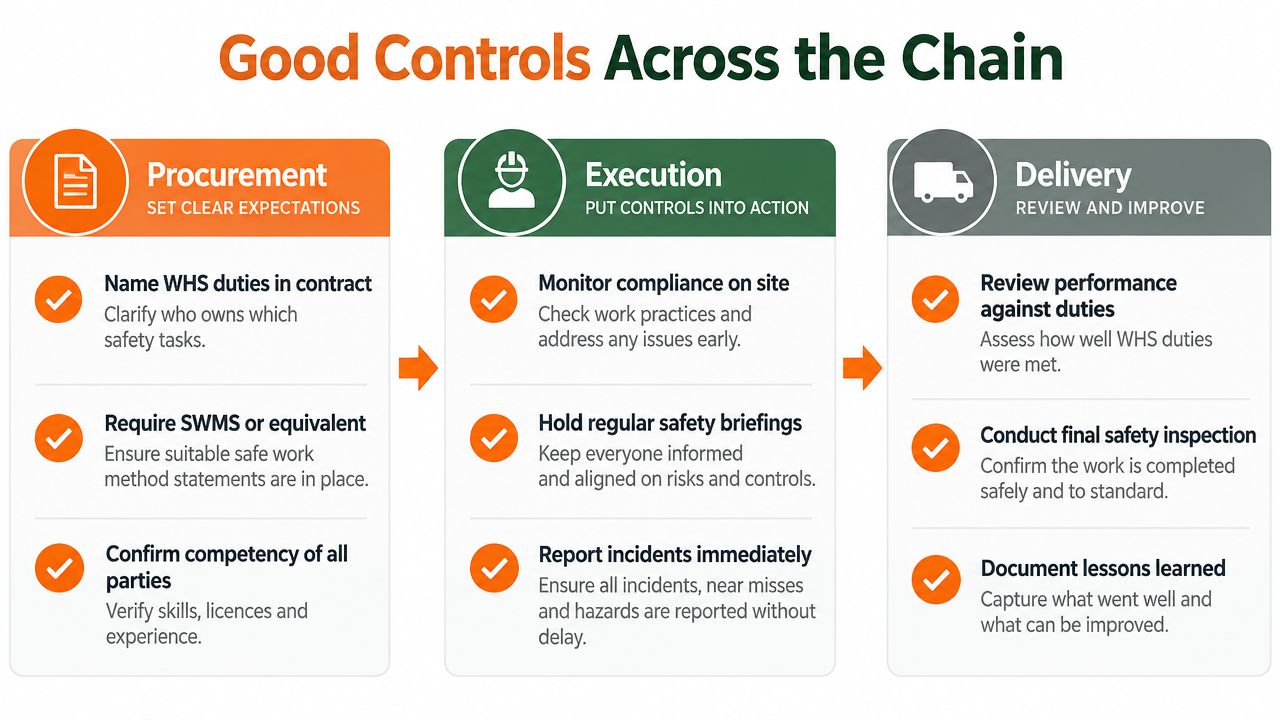
Procurement and mobilisation
Start before the first crew arrives.
- Define duty touchpoints. Contracts should identify who controls the workplace, plant, supervision, sequencing and risk information.
- Require task controls early. For high-risk work, don't wait until the morning of the job to ask for SWMS and supporting evidence.
- Check competency and supervision. Confirm who is sending workers, who is supervising them and who verifies that on site.
Site execution and transport execution
Once the job is live, paperwork alone won't carry the duty.
- Brief the task. Walk crews through the SWMS, interfaces with other trades and stop-work triggers.
- Verify controls in the field. Check that barriers, plant setup, exclusion zones, load restraint and fatigue-related scheduling controls are in place.
- Adjust when conditions change. Variations to sequence, weather, ground conditions, access or delivery timing need the controls reviewed, not just noted.
If you're reviewing whether your selected controls are proportionate to the risk, the Safety Space guide to the hierarchy of controls in WHS is a useful cross-check for managers refining site and transport controls together.
Evidence, accountability and follow-through
After the task, keep a clean record of what was consulted, changed, verified and signed off. That matters in both improvement work and enforcement response.
For leaders trying to turn “someone should own this” into a real management process, this MyCulture.ai accountability measurement guide is a practical read. It helps frame how accountability is measured across teams rather than left as a vague expectation.
One system option is Safety Space. In this context, it can hold SWMS, contractor compliance evidence, training records and incident reports in one place so a head contractor, operations manager or auditor can trace what controls were specified, briefed and verified for a particular task.
Good chain controls answer four questions clearly. Who knew the risk, who communicated it, who checked the control, and where is that evidence kept?
Misconceptions That Get Managers in Trouble
Most enforcement surprises come from assumptions that felt reasonable at the time. Three come up again and again.
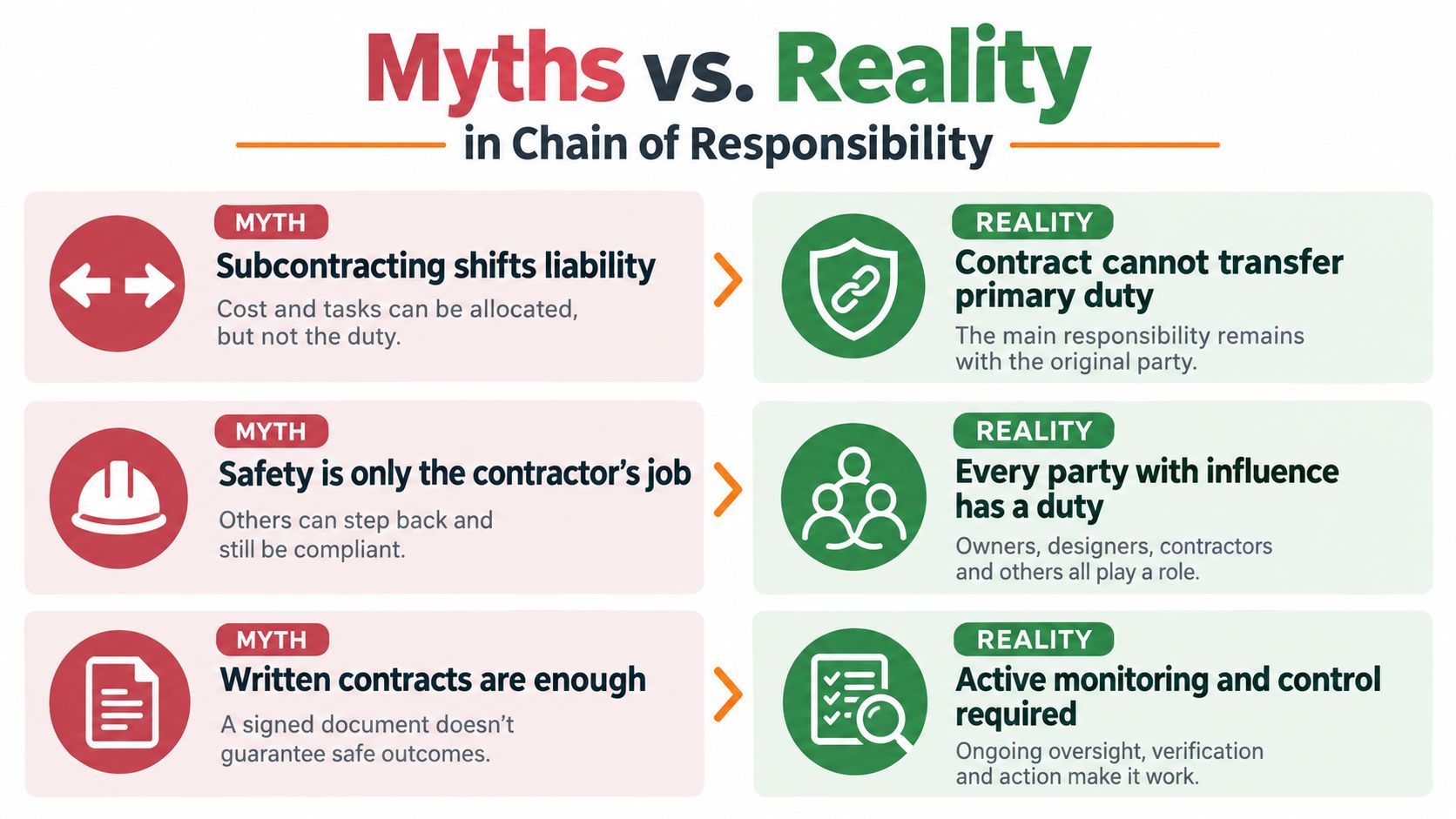
Myth one says subcontracting shifts liability
Managers still say, “We engaged a specialist, so that risk sits with them.”
That's only partly true, and often dangerously so. You can allocate commercial scope. You can require a subcontractor to provide a SWMS, supervision and competent people. But if your business still controls the site, the sequence, the plant interface or the work conditions, your duties remain attached to those decisions.
The risky assumption is thinking a contract replaces active control.
Myth two says the driver takes the fall
This one survives because it matches old habits. Something goes wrong on the road, so attention goes straight to the driver.
Heavy vehicle chain obligations are broader than that. When scheduling, dispatch timing, load placement or consignment instructions created the conditions for the breach, upstream parties stay in view. That's why transport incidents often expose weaknesses in office decisions, not only driving behaviour.
Myth three says signed paperwork is enough
A filed SWMS. A completed induction. A fatigue policy in the system. None of that proves the work was controlled on the day.
Paperwork matters because it shows what the business intended to do. It doesn't prove the supervisor checked the soft ground, stopped the conflicting lift, corrected the load or challenged the timetable.
- Documents show intent. They record the planned control.
- Supervision shows action. It shows whether the control was applied.
- Verification shows credibility. It tells a regulator the system was more than administrative.
A signed form is evidence of process. It isn't proof that the risk was managed.
The useful test is blunt. If an inspector asked what happened at the point of work or dispatch, could your team show the control, not just describe the document?
Putting It Into Practice This Week
Treat this as a short reset, not a major project.
Day one to day three
On day one, list every party who influences safety on your site or fleet. Include subcontractors, labour hire, schedulers, loading supervisors, plant owners and freight providers. Mark which ones are PCBUs, officers or heavy vehicle chain parties.
On day two, pull the current SWMS for your high-risk work. Check whether the consultation record reflects the people doing the task and the parties who hold the relevant site, design or supervision information.
On day three, review recent transport tasks. Look at scheduling, load placement, restraint checks, consignment instructions and any evidence your team keeps around fatigue-related decisions.
Day four and day five
On day four, test your consultation and coordination process where duties overlap. If two businesses affect the same task, can you show how they consulted, who approved the final method and how changes were communicated?
On day five, log the gaps. Assign an owner to each one. Set a date that operations will respect.
A good weekly review usually finds the same weaknesses. Missing handovers. Assumed responsibilities. Controls that exist on paper but not in the field. That's why the fastest improvement often comes from making the chain visible, not from writing another procedure.
If you've been asking “what is chain of responsibility” as a legal definition, that's only half the job. The better question is whether your current work system makes the chain obvious before something goes wrong.
If your chain is hard to see across contractors, SWMS, site controls and transport handoffs, Safety Space gives you one place to manage that evidence. It helps teams keep contractor records, task controls, training and incident documentation connected to the actual work, which makes duty-holder responsibilities easier to track and easier to show when you need them.
Ready to Transform Your Safety Management?
Discover how Safety Space can help you implement the strategies discussed in this article.
Explore Safety Space FeaturesRelated Topics
Safety Space Features
Explore all the AI-powered features that make Safety Space the complete workplace safety solution.
Articles & Resources
Explore our complete collection of workplace safety articles, tools, and resources.