
In Australia, a job safety analysis helps control task-level risks against a background of 188 worker deaths from traumatic injuries in 2024 and 146,700 serious workers' compensation claims in 2023–24. A JSA is a task-oriented risk assessment completed by the work team before starting a specific job, so the crew can identify hazards and apply controls where the work will take place.
The supervisor may have a permit, a site risk register and a procedure on file. The crew still needs to stop at the job, break it into steps and confirm that the planned controls fit the equipment, people, environment and conditions in front of them. A generic form signed at the crib room won't do that.
Table of Contents
- Defining Job Safety Analysis Under Australian WHS Law
- Aligning Task Assessments With National Injury Data
- Executing the Four Step Risk Management Process
- Distinguishing JSA From Safe Work Method Statements
- Applying JSA to High Risk Manufacturing Tasks
- Digitising Task Assessments for Multi Site Oversight
Defining Job Safety Analysis Under Australian WHS Law
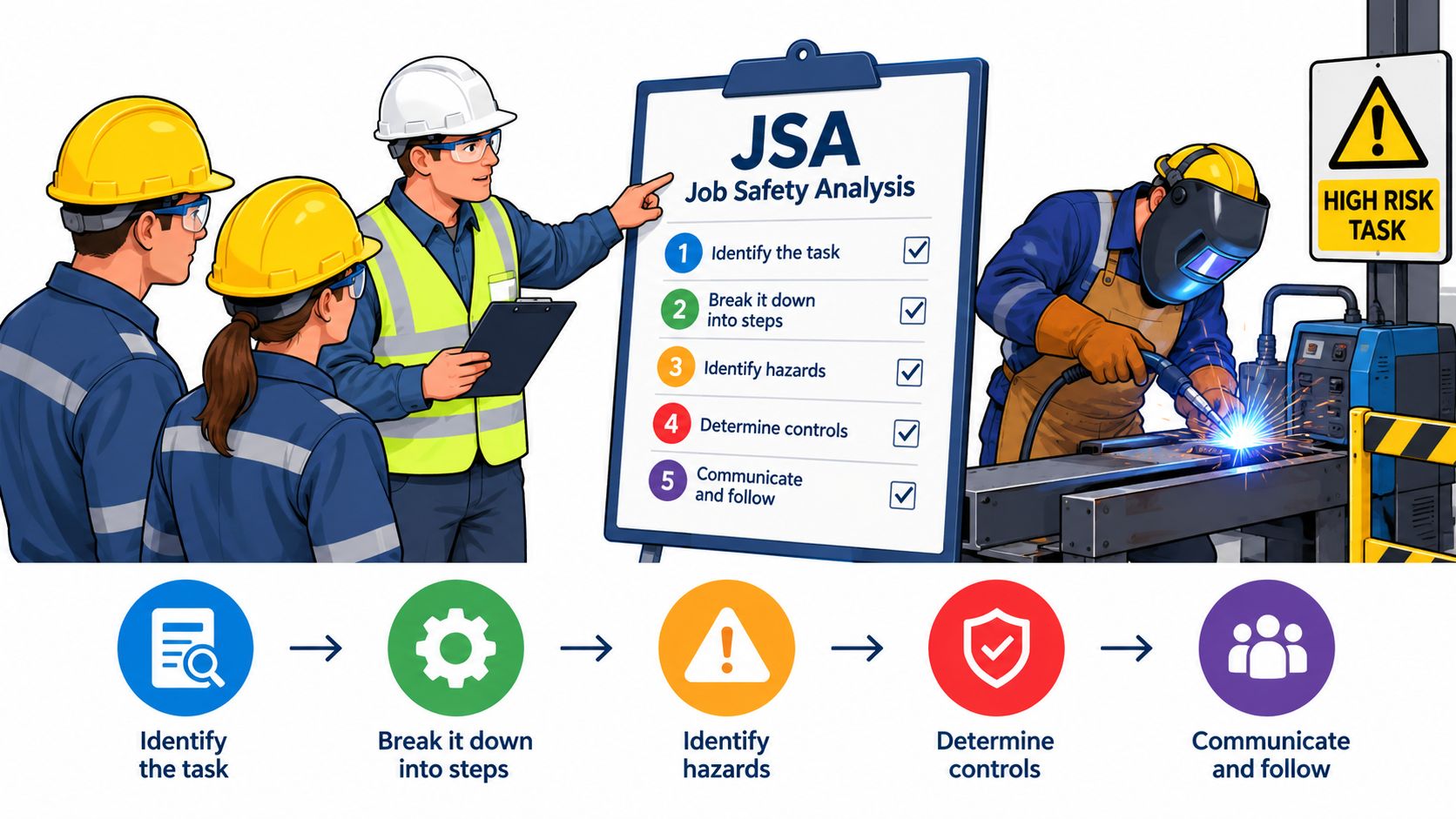
A job safety analysis, or JSA, is a work-team assessment of a specific task. The team works through the job in sequence, identifies what could cause harm at each stage, decides how to control the risk and confirms who will do what before work starts.
The distinction matters. A site-wide risk assessment might address traffic management, hazardous chemicals, plant or emergency arrangements across an operation. A JSA narrows the focus to the job being performed now. It asks practical questions:
- What is the next step?
- What energy, movement, material or condition could hurt someone?
- Which control will prevent exposure or reduce it?
- How will the crew know the control remains effective?
Queensland mining guidance describes a JSA as a work-team method applied on site for routine activities, used as a precursor to a safe working procedure. It also requires workers to consider both consequence and likelihood when assessing hazards, as set out in the Queensland mining guidance note.
The PCBU's role
The PCBU carries the duty to ensure work is planned and performed without exposing workers and others to health and safety risks, so a JSA can't be treated as a worker-owned form. The PCBU, officers and supervisors need a system that identifies which tasks require analysis, involves competent workers and checks that agreed controls are implemented.
That doesn't mean every low-risk, familiar activity needs a new document. It does mean the organisation must recognise when conditions, equipment, workers, interfaces or the task itself have changed. A JSA should be revised when the work changes, not merely filed when the work finishes.
A useful external reference for managers who need to compare methods is this practical risk assessment guide. For the Australian application, the job hazard analysis explanation also helps distinguish the task assessment from wider safety planning.
What a useful JSA contains
A working JSA normally records the job, location, people involved, equipment, task steps, hazards, controls, residual risk where required and worker acknowledgement. Its value comes from the discussion and the control decisions, not the form design.
Practical rule: If the person doing the job can't explain the control without reading the form, the JSA hasn't achieved its purpose.
Aligning Task Assessments With National Injury Data
A JSA should reflect how people can be hurt during the work. That sounds obvious, but many templates give equal space to minor housekeeping issues and mechanisms that can kill or permanently injure a worker.
Safe Work Australia reports that vehicle incidents caused 42% of work-related fatalities in 2024, while falls from a height caused 13%. The same source records 146,700 serious claims involving at least one week of lost time in 2023–24. These figures don't tell a supervisor exactly how to control a particular job, but they show why vehicle interaction and work at height deserve deliberate treatment rather than a generic tick box. See Safe Work Australia's analysis of the causes of workplace harm.
Test the template against the job
For vehicle-related work, the JSA should identify interaction points, reversing, loading and unloading, pedestrian separation, line of sight and changes in traffic conditions. “Follow traffic management plan” is not enough if the crew can't identify where a person could enter the vehicle path or how the control will be maintained.
For work at height, the assessment should identify the point where a fall could occur, access and egress, dropped objects, fragile surfaces, rescue arrangements and the effect of tools and materials on worker positioning. PPE may be necessary, but it shouldn't be the first or only answer where the work can be redesigned, completed at ground level or protected by suitable equipment.
The same logic applies to other mechanisms such as body stressing, falls, slips and trips, and being hit by moving objects, which Queensland guidance identifies within the broader Australian injury context. A JSA that spends most of its time on low-consequence hazards while treating stored energy, mobile plant or a fall edge in one line is poorly prioritised.
Use the data as an audit prompt
Review completed JSAs and ask:
- Exposure: Does the form identify the actual source of energy, movement or height?
- Specificity: Could another crew use the control description and know exactly what to do?
- Verification: Does someone check that the control is present before work proceeds?
- Change: Is there a trigger to stop and reassess when conditions change?
Practical workplace injury prevention tips can support broader prevention work, but the JSA must remain specific to the task. National data should shape what supervisors look for. It shouldn't replace observation and worker involvement at the job.
Executing the Four Step Risk Management Process
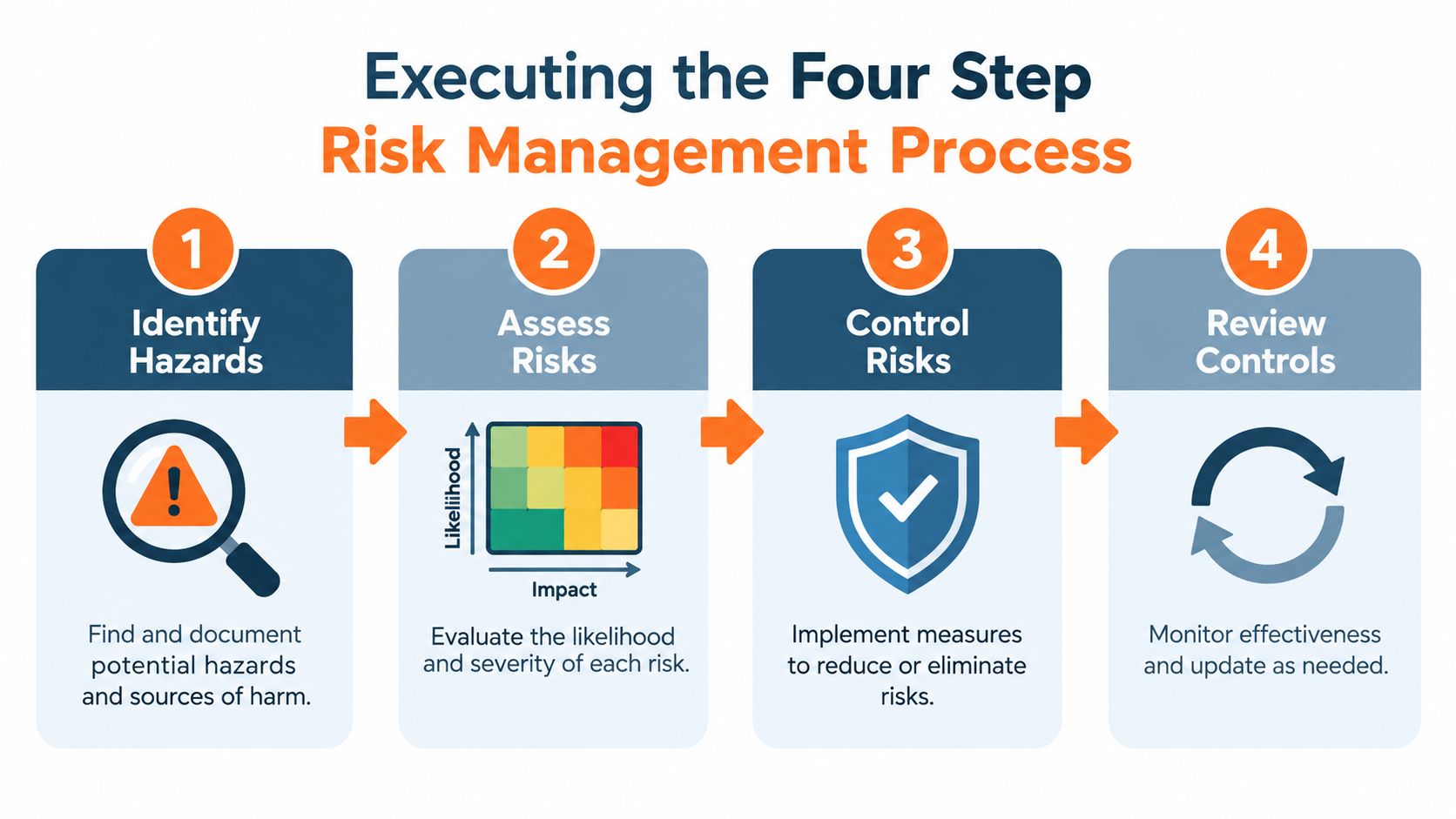
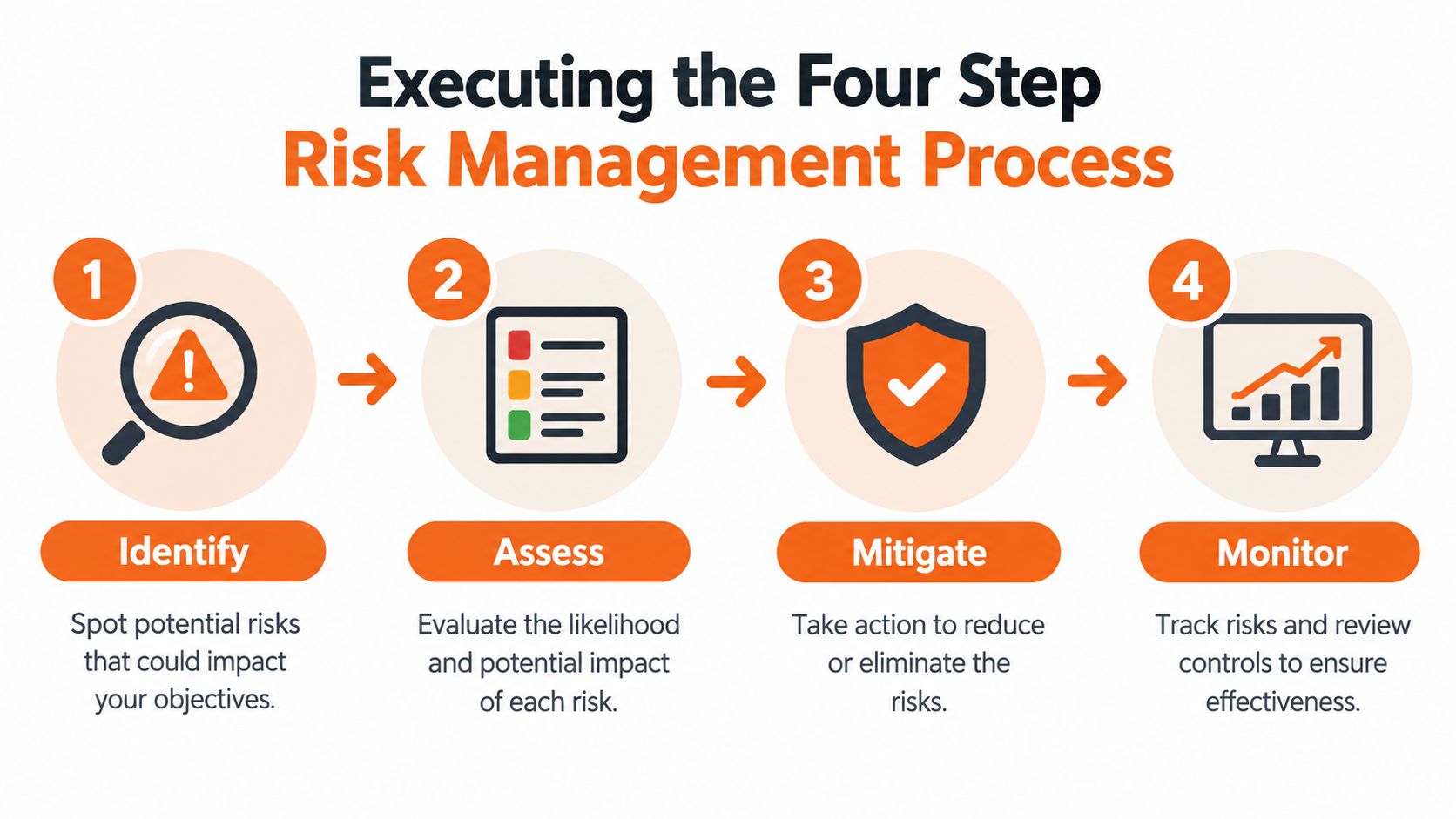
The WHS risk management process gives a JSA its operating structure. Safe Work Australia describes four actions: identify hazards, assess risks if necessary, control risks using the most effective reasonably practicable measure, and review controls to confirm they work as planned. The PCBU risk management guidance sets out that framework.
Identify hazards at each step
Start with the job sequence, not a hazard catalogue. “Remove guard”, “isolate motor”, “disconnect coupling” and “lift component” create different exposures, even though they belong to one maintenance job.
Ask the crew to consider:
- Energy: electrical, hydraulic, pneumatic, mechanical, thermal and gravitational energy.
- Movement: plant movement, suspended loads, rotating parts and vehicle paths.
- People: workers, contractors, visitors and anyone affected by the task.
- Environment: access, lighting, weather, noise, dust, congestion and nearby operations.
- Materials: chemicals, sharp edges, unstable loads and contaminants.
Workers who perform the task often identify interactions that a remote reviewer misses. The supervisor's job is to draw those observations out and turn them into controls that can be checked.
Assess only where it adds value
The law doesn't require a separate formal risk assessment for every known risk with known controls. Safe Work Australia states that risk assessment may not be necessary where the risk and controls are already known. That doesn't remove the duty to identify the hazard or implement the control.
Use consequence and likelihood when the risk needs further examination. A serious consequence with credible exposure deserves attention even if the event seems infrequent. Don't let a low likelihood score hide a control failure that could produce a fatal outcome.
Control, then review
Apply the hierarchy of controls. Eliminate the exposure where possible, substitute a safer method or material, use engineering controls, then apply administrative controls and PPE. Procedures, exclusion zones, permits, supervision and training support the system, but they rely more heavily on worker behaviour than physical separation or guarding.
Review the controls before the job starts and during the work. Stop when the plant, sequence, people, weather or work area changes. A JSA is current only when it reflects the conditions under which the crew is working.
Distinguishing JSA From Safe Work Method Statements
A JSA and a SWMS can use similar task analysis, but they don't have the same legal status. A JSA is a broad task-level tool that organisations use to identify hazards and controls. A Safe Work Method Statement is a prescribed document for high risk construction work.
Under Australian WHS requirements, a PCBU carrying out high risk construction work must prepare, keep, comply with and review a SWMS. The PCBU must also give a copy to the principal contractor where one is involved. The SWMS must describe the high risk construction activities, hazards and risks, control measures, and how those controls will be implemented, monitored and reviewed. Safe Work Australia requires it to be prepared before the work starts, as explained in its SWMS information sheet.
Compare the application
| Assessment Type | Legal Trigger | Preparation Timing | Primary Focus |
|---|---|---|---|
| JSA | A task requires focused hazard identification and control, under the organisation's WHS system | Before the specific job begins and whenever conditions change | The practical sequence, hazards and controls for the task |
| SWMS | High risk construction work is being carried out | Before high risk construction work starts, then reviewed as required | The high risk construction activity, risks, controls and control implementation |
Safe Work Australia lists 18 categories of high risk construction work that trigger SWMS requirements. They include work involving falls of more than 2 metres, demolition of load-bearing elements, asbestos disturbance, confined spaces, trenches deeper than 1.5 metres, explosives, pressurised gas mains, energised electrical installations and work on or near traffic corridors. The complete high risk construction work list should be checked against the actual scope.
A JSA can support the development of a SWMS, but it doesn't automatically replace one. Treating a JSA as a substitute creates a documentation gap. Treating a SWMS as a detailed pre-start conversation can create a different gap, because workers may sign a document without applying it to the immediate work area.
Make the two documents work together
Use the SWMS to establish the required method and controls for the high risk construction activity. Use the JSA or pre-start discussion to confirm the crew understands the method, site interfaces, current conditions and any task-specific changes.
The difference between a JSA and SWMS is useful when setting internal rules. Your procedure should state when a JSA is required, when a SWMS is mandatory and how the two records connect.
Applying JSA to High Risk Manufacturing Tasks
A maintenance crew replacing a heavy motor on a production line should not begin with a blank signature box. The supervisor should bring the people doing the isolation, rigging, removal and installation into the pre-start discussion, then build the assessment around the actual sequence.
Start with the sequence
The team breaks the job into workable stages:
- Prepare the area: confirm access, tools, lifting equipment, replacement motor and isolation points.
- Isolate the line: shut down the equipment, isolate energy sources, apply lockout-tagout and verify zero energy.
- Disconnect the motor: remove guards and connections while controlling stored kinetic, electrical and mechanical energy.
- Rig and remove: position the mechanical hoist, attach the load and maintain exclusion from pinch points and suspended loads.
- Install and reconnect: align the replacement, secure it, reconnect services and restore guarding.
- Test and hand back: clear people and tools, remove locks under the agreed process, test the line and return it to operations.
The crew then identifies hazards against each step. Stored energy can remain after shutdown. A coupling can move unexpectedly. The motor can shift during rigging. Fingers can enter pinch points during alignment. Manual handling can strain workers when the load isn't supported correctly.
Choose controls the crew can verify
The agreed controls should describe actions and conditions, not aspirations. Lockout-tagout needs isolation points, personal locks, verification and a defined release process. A mechanical hoist should be selected, inspected and positioned so workers aren't taking the weight manually. Barriers or an exclusion zone should prevent people entering the line of fire.
The strongest JSA conversations happen at the point where the work can go wrong, not at the point where the form gets signed.
The supervisor asks the workers to explain the critical controls back in their own words. If the hoist can't reach the motor, the replacement part arrives damaged or another contractor enters the area, the team stops and revises the assessment.
Close the loop after the job
The final sign-off should confirm that the work was completed under the agreed controls, not merely that workers attended a briefing. The supervisor should capture changes, control failures and useful improvements while the details remain clear.
Those observations can improve the procedure and future assessments. The job safety analysis examples provide a useful reference for structuring task steps, hazards and controls, but the crew still needs to adapt every assessment to the plant and conditions in front of them.
Digitising Task Assessments for Multi Site Oversight
Paper JSAs work only when someone can find the current version, confirm who reviewed it and verify that the controls were implemented. Across multiple sites, paper folders and spreadsheets make that difficult. Head office may learn about a missed review or recurring control failure only after an incident, audit or complaint.
A digital process creates a clearer operational trail. Supervisors can complete the assessment at the work location, workers can acknowledge the relevant controls, and managers can review outstanding actions without waiting for a folder to arrive. The system should preserve the task detail, not reduce the JSA to a checkbox.
Select controls that improve supervision
A useful digital JSA system should support:
- Reusable templates: Start with an established task structure, then edit it for the equipment, location and crew.
- Task-level risk controls: Record hazards and controls against individual job steps rather than in one undifferentiated text field.
- Worker acknowledgement: Capture who participated and who received the briefing.
- Change management: Make it easy to revise the assessment when conditions or methods change.
- Management visibility: Show incomplete reviews, recurring hazards and actions requiring attention.
- Contractor oversight: Connect inductions, documents and task assessments across subcontractor activities.
Automation can remind supervisors about reviews, but it can't decide whether a control is suitable. A dashboard can show that a JSA was completed, but only field verification shows whether a barrier is installed, an isolation is effective or a crew understands the method. Digital tools should strengthen the conversation and accountability, not replace competent supervision.
Safety Space is one platform option for this workflow. Its JSA feature supports building assessments from scratch or with AI assistance, defining job steps, PPE, hazards and controls in a risk matrix, and collecting worker signatures. It also provides centralised health and safety management for multi-site and subcontractor oversight.
The right test is operational: can the system help your supervisors identify the highest-consequence exposures, assign controls clearly and show managers what needs attention before the work proceeds? If it can't, changing from paper to software hasn't solved the underlying problem.
Safety Space helps Australian organisations manage JSAs, worker acknowledgements, risk controls and multi-site safety records in one system. Visit Safety Space to arrange a demo and assess whether its digital workflow fits your construction, manufacturing or industrial service operations.
Ready to Transform Your Safety Management?
Discover how Safety Space can help you implement the strategies discussed in this article.
Explore Safety Space FeaturesRelated Topics
Safety Space Features
Explore all the AI-powered features that make Safety Space the complete workplace safety solution.
Articles & Resources
Explore our complete collection of workplace safety articles, tools, and resources.