
A signed hot work permit can authorise the wrong decision. A permit is an administrative control, not evidence that fuel sources have been removed, connected services isolated or surrounding work made compatible with sparks. A useful hot work permit template makes those conditions explicit and prevents approval when another control or authority is needed.
Table of Contents
- Hot Work Permit Template Fields to Record
- When Hot Work Needs a Permit and What Else Applies
- Hazard Controls to Confirm Before Ignition Sources Start
- Confined Space Tests and Stop-Work Triggers
- Approvals, Fire Danger Checks and Revalidation
- Close Out the Permit Before Leaving the Site
Hot Work Permit Template Fields to Record
Safe Work Australia's hazardous chemicals code defines hot work as grinding, welding, brazing, oxycutting, heat treatment or another process that generates heat or continuous streams of sparks. It identifies significant fire and explosion risks where flammable or combustible chemicals or materials are present, and describes permit systems as an administrative means of controlling when and how work occurs.
The working form therefore needs more than a task description and signatures. It should identify the specific method, exact location, authorised period, fuel sources and verified controls.
Hot work permit template fields and what each records
| Field | What to record | Why it matters |
|---|---|---|
| Permit number and validity | Unique reference, issue date, valid-from and valid-to times | Allows the permit to be traced, formally extended or voided |
| Task and hot work method | Welding, grinding, brazing, oxycutting, heat treatment or comparable process | Defines the ignition source being controlled |
| Location and boundaries | Building, level, area, exact work point and adjacent areas | Stops controls being applied to the wrong spot |
| Equipment | Tool type, asset ID, power or gas supply | Identifies ignition and fuel sources in use |
| Combustibles and chemicals | Flammable or combustible materials, liquids, residues, dust and SDS reference | Establishes the fire and explosion exposure |
| Connected services | Pipework, drains, ducts, voids and vessels checked | Shows whether fuel can reach the work point through another path |
| Confined space status | Yes or no, with confined-space entry permit reference | Triggers additional entry controls and testing |
| Hazardous area status | Yes or no, with classification reference | Flags responsible officer and fire watch requirements |
| Fire danger status | State or territory, Fire Danger Period or Total Fire Ban status, authority approval reference | Identifies restrictions that site approval cannot override |
| Controls confirmed | Each control verified, with the confirming person's name | Records who checked that controls were in place |
| Fire watch | Named person, start time and end time | Assigns monitoring during and after work |
| Approvals | Issuer, receiving worker and responsible officer signatures, where applicable | Assigns accountability for the decision to start |
| Stop-work triggers | Changes in wind, gas readings, crew or adjacent work that suspend approval | Defines when the crew must stop |
| Close-out | Work completion time, final check, fire watch end and retention location | Records completion and the site handback |
Complete the fields in decision order
Start with identity and scope. Welding a bracket on a conveyor frame is a useful task description. Maintenance welding is not. Record where sparks, slag and heat could travel, not just where the operator stands.
Next, identify the equipment and fuel inventory. A chemical name without an SDS reference leaves the assessor searching for information. A tick beside connected services checked is weak evidence unless the record identifies the affected line, drain or vessel and the control applied.
Then complete the screening fields. Unknown isn't the same as no. If the area classification or confined-space status hasn't been established, the issuer should resolve that uncertainty before approval.
Form design rule: Every field should answer an ignition-control question. A blank field leaves no evidence that anyone answered it.
Finish with control verification and accountability. Separate planned controls from confirmed controls, and provide a reasoned not-applicable option rather than encouraging meaningless ticks. The approval should apply to the defined job, not become standing permission for any spark-producing work nearby.
When Hot Work Needs a Permit and What Else Applies
A single signature sheet creates false confidence when the job also needs entry approval, atmospheric testing or isolation. The permit should act as a screening gateway, with answers that change the approval pathway.
The University of Adelaide's hot work guidance distinguishes hazardous-area work requiring a responsible officer, fire watcher and permit from ordinary workshop work that may be authorised through hazard management. Its guidance also requires a separate confined-space entry permit for confined-space hot work, alongside the applicable confined-space regulations and Australian standards for entry and hot work.
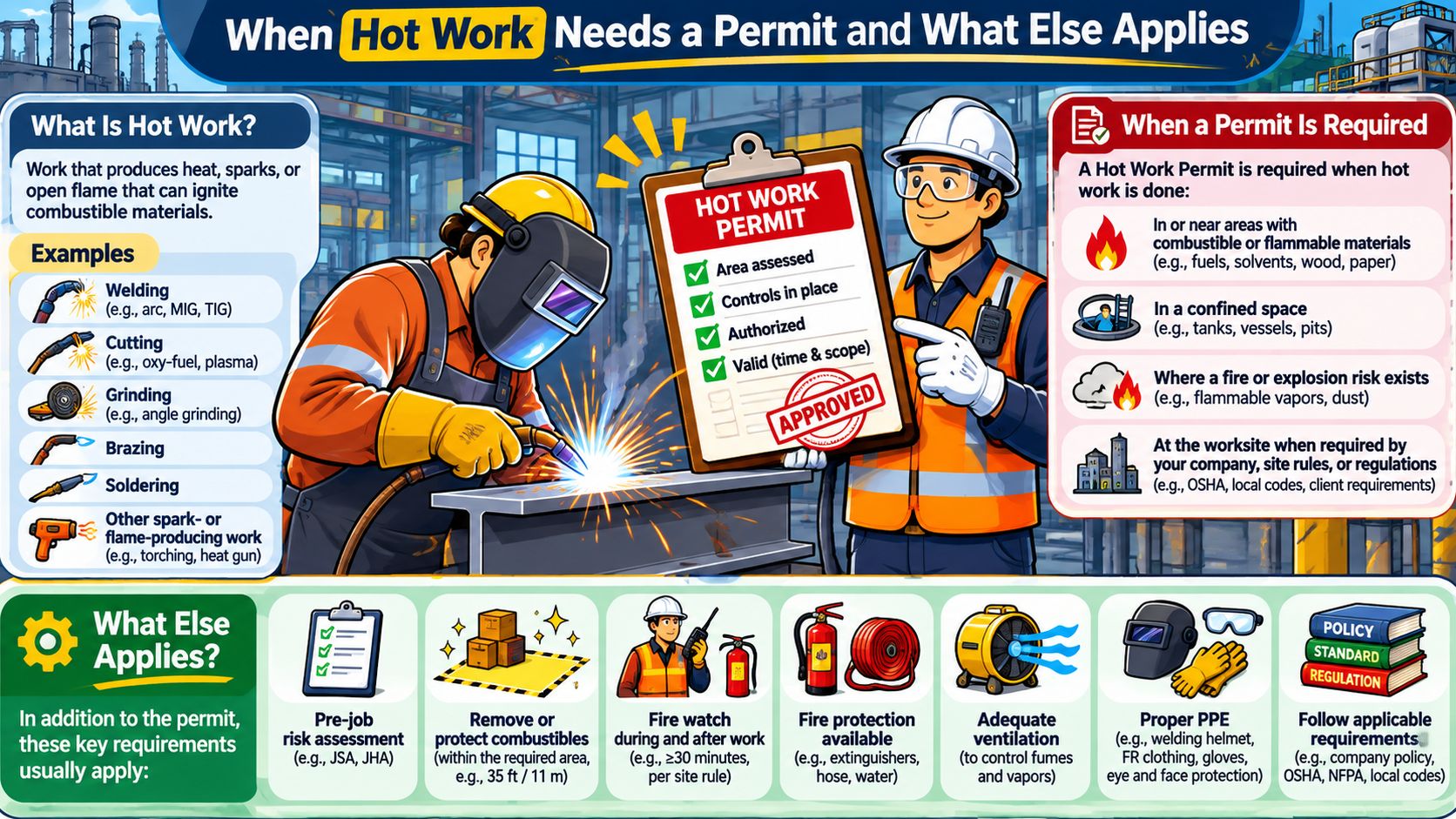
Gateway screen for hot work
| Screen question | If yes | Also required |
|---|---|---|
| Hazardous area? | Responsible officer, fire watch and hot work permit | Hazardous-area classification reference |
| Confined space? | Separate confined-space entry permit under the applicable entry and hot work standards | Recurring atmospheric tests and rescue readiness |
| Dusty or flammable atmosphere? | Escalate before any permit is issued | Appropriate atmospheric testing and isolation or lockout |
| Concealed combustibles nearby? | Remove or protect combustibles before starting | Pipework, drain and void check |
| SWMS or JSA covers the task? | Confirm approval names the actual hot work method | Link the permit reference to the job record |
| No flagged answers in an ordinary workshop? | May be authorised under a hazard-management process | Keep the authorisation record and fire precautions |
Escalate the job, not the paperwork
Say a maintenance welder proposes cutting a bracket on a wall beside a solvent store. The work point looks clear, but the screen identifies potential flammable vapour exposure. The issuer shouldn't sign and leave the welder to resolve it.
The job needs assessment of the solvent operation, possible vapour pathways, isolation and testing arrangements. If safe conditions cannot be established and maintained, relocate the task or use a method that doesn't introduce an ignition source.
A permit-to-work process should connect these approvals without implying that one replaces another. A SWMS or JSA describes the work and controls; it doesn't automatically provide confined-space entry authorisation or hazardous-area approval.
For New Zealand operations, the Health and Safety at Work Act 2015 and WorkSafe NZ guidance apply. The screening logic remains useful, but local duties, terminology and entry arrangements need checking rather than importing an Australian approval pathway unchanged.
Hazard Controls to Confirm Before Ignition Sources Start
A clean welding point doesn't establish a safe work area. Connected pipework, drains, concealed voids and residues can expose the job to fuel that isn't visible from the operator's position.
Safe Work Australia's welding processes code supports removing or isolating combustible and flammable materials, purging vessels before welding and, where appropriate, filling them with nitrogen or water. It identifies AS 1940, AS 2865 and AS 1674.1 as relevant references for flammable liquids, confined spaces and welding fire precautions.
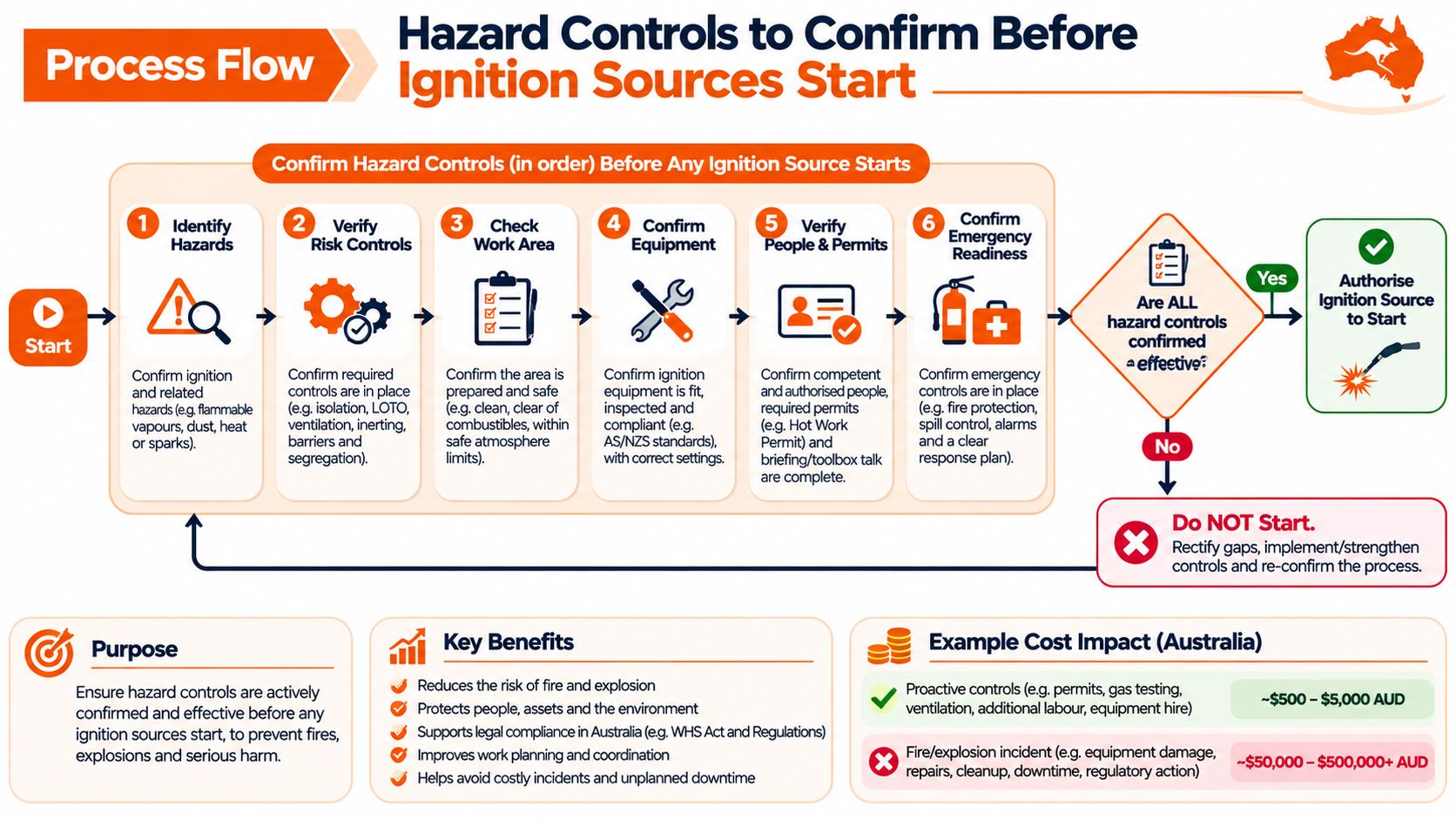
Verify controls in the order that removes exposure
Eliminate or isolate fuel sources. Consider moving the component to a prepared work area or using a suitable cold method. Where fuel-bearing equipment remains, identify the isolation points and verify their effectiveness. Closing an operating valve without checking the isolation arrangement isn't enough.
Remove combustibles and residues from the work area and surrounding structure. Check accumulated dust, oily deposits, packaging and insulation, including the opposite side of the work surface. The common slip is clearing the floor while leaving combustible material above or behind the job.
Purge drums, tanks and vessels before welding. Record the preparation method and verification, not that it is empty. A drained vessel can still contain flammable residue or vapour. If its previous contents cannot be established, stop the approval process.
Where appropriate, use nitrogen or water filling under a competent, task-specific procedure. These methods aren't interchangeable blanket solutions. Nitrogen can introduce an oxygen-deficiency hazard, so the permit must account for displaced gases and any associated entry exposure.
Prevent adjacent operations from reintroducing fuel. Coordinate solvent transfer, cleaning, spraying and dust-generating work before ignition starts. Record who controls those activities and how the restriction will be communicated. An initial area inspection won't prevent another crew changing the atmosphere later.
Check connected pipework, drains, ducts and concealed voids. For example, a drain connected to a solvent-handling area can provide a vapour pathway to the job. Identify where that pathway goes and how it has been isolated, cleaned or otherwise made safe.
Keep supporting checks specific
Where propane is involved, safety advice from Heartland Propane can support the crew's cylinder and fuel-handling briefing. It doesn't replace the site's equipment inspection, SDS review or permit assessment.
Firefighting equipment is a supporting control, not permission to leave removable fuel in place. Confirm the appropriate equipment is accessible and serviceable, with fire extinguisher inspection records available to support that check.
The issuer should record who verified each control and any evidence reference. If the conditions change, the crew must recheck the affected controls rather than relying on the original ticks.
Confined Space Tests and Stop-Work Triggers
Confined-space conditions can deteriorate after approval. Vapour can enter through connected services, ventilation can fail, and oxygen levels or heat exposure can change while work continues.
The confined-space guidance reproduced by Safe Work Australia states that hot work in, or on the exterior of, an occupied confined space shouldn't begin until a hot work permit has been issued, with precautions certified and testing frequency identified. It also recommends considering a fire watch during the activity and for at least 30 minutes after completion.
Record conditions over time
The hot work permit and separate confined-space entry permit should reference each other. Their conditions must agree, particularly on isolation, ventilation, testing, communications and emergency arrangements.
The template needs fields for:
- Atmospheric results: Pre-start and recurring readings, sampling locations, test times and acceptance criteria set by the controlling procedure.
- Tester and instrument: Tester identity, instrument identification, calibration status and relevant operational checks.
- Ventilation or purging: The arrangement used, its operating status and the response to interruption.
- Connected services: Isolation references and the person responsible for verification.
- Rescue readiness: Confirmation that the planned arrangements remain available throughout entry.
- Stop-work response: Conditions that require stopping ignition, suspending entry or initiating the emergency procedure.
The record should also identify combustible materials removed or protected with non-combustible blankets or flame-resistant tarpaulins. These controls need to remain effective while the work generates heat, not merely during the pre-start inspection.
Make a changed reading lead to a decision
Suppose a recurring test detects a rising flammable-gas reading during welding. The welder stops the ignition source, and the crew follows the confined-space procedure, including withdrawal where required. The responsible person investigates the source and restores the controls before retesting.
The record should show the changed reading, stop time, corrective action, retest result and renewed approval. Ventilating until the instrument appears acceptable, without identifying the cause, can leave the same failure ready to recur.
A safe initial reading is evidence of conditions at the sampling time. It isn't approval to ignore subsequent changes.
Testing frequency belongs in the permit and controlling confined-space procedure. The welder shouldn't improvise it around production demands. A gas instrument alarm, failed ventilation, lost communication or unavailable rescue arrangement must have a defined response.
Keep these records with the confined-space work controls, so the entry team and hot work issuer operate from the same current authorisation.
Approvals, Fire Danger Checks and Revalidation
A fully completed site permit can still be insufficient on a Total Fire Ban day. The issuer's signature cannot override restrictions imposed by the relevant fire authority.
Fire Rescue Victoria's outdoor work guidance states that during the Fire Danger Period, outdoor welding, grinding, gas cutting and similar work require a fire-resistant shield, a cleared or wetted 1.5-metre area, available water or an extinguisher, and fireproof containers for hot offcuts; on Total Fire Ban days, these activities are generally prohibited unless an authorised permit is issued. These are Victorian conditions, not a national clearance rule.
Assign each approval a purpose
The approval chain should distinguish the people making different decisions:
- Issuer: A person competent and authorised for the task confirms that the stated controls are in place.
- Receiving worker: The worker accepts the scope, limits and stop-work conditions in writing.
- Responsible officer: Where required for hazardous-area work, this person provides the additional approval.
- Fire watch: The named person accepts the monitoring period, communication arrangements and authority to stop work.
For digital administration, Safety Space provides permits to work with approvals and records organised by site or project. Its Australian coverage addresses the harmonised Work Health and Safety Act 2011 framework as implemented across most states and territories, including jurisdiction-specific variations in Victoria and Western Australia.
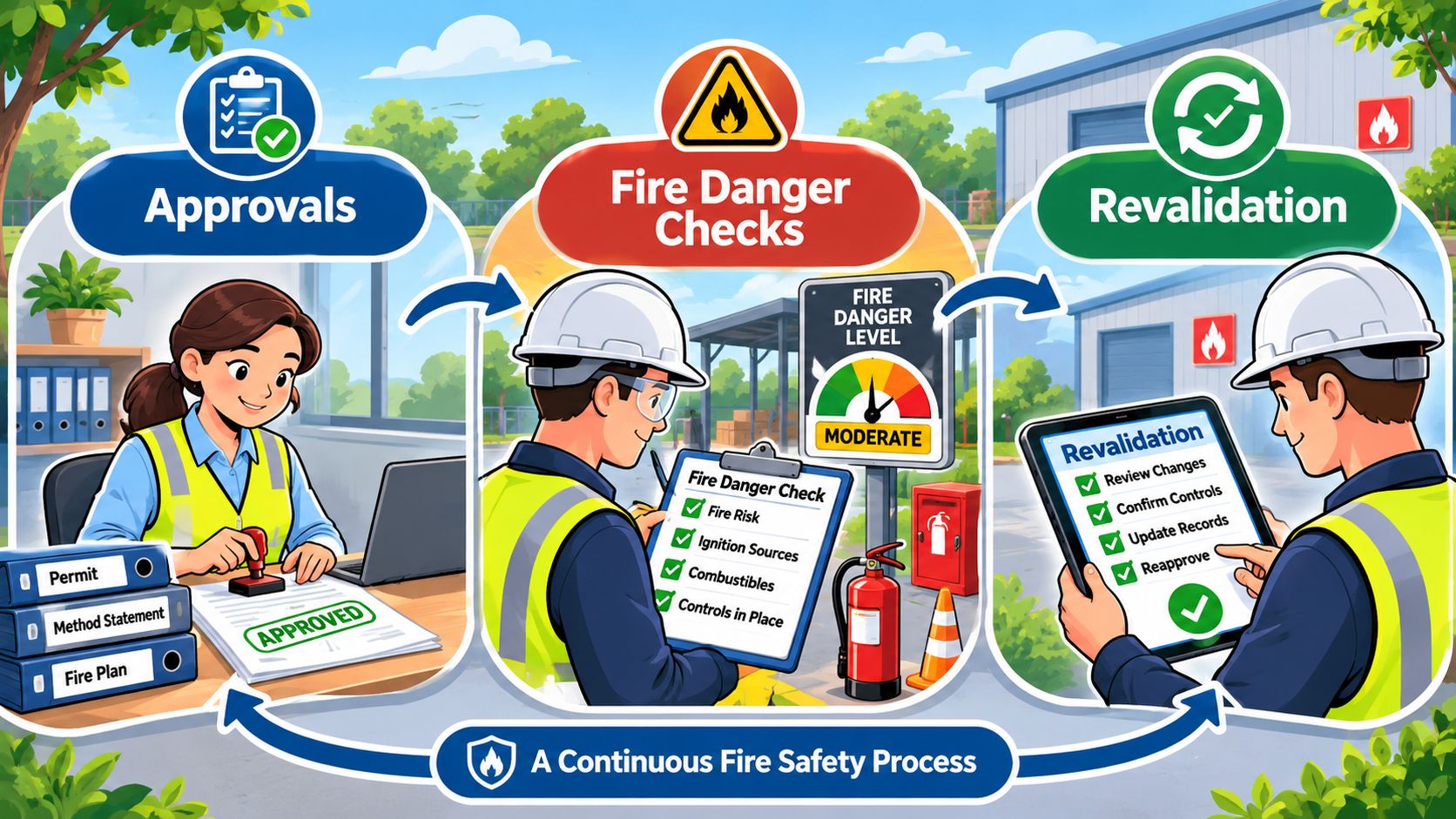
Revalidate against the actual day and location
Separate indoor and outdoor work on the form. For outdoor work, record the state or territory, location, date, current restrictions, applicable authority and any approval reference. Include weather, wind, nearby vegetation and combustible storage.
Revalidation is needed after postponement, relocation or a change in fire-danger status. The authorised person should record the fresh check and decision before the crew resumes.
Approval boundary: A site permit controls the job within the site's authority. It doesn't replace permission required from a fire authority.
Crews crossing jurisdictions must check the rules for each location they enter. A restriction check copied from yesterday's permit, or from another project, doesn't establish that today's work is permitted.
Close Out the Permit Before Leaving the Site
The fire watch shouldn't leave just because the welder has packed up. Close-out remains open until the specified monitoring period and final inspection are complete.
Hand the area back deliberately
Inspect the work area and connected spaces. Look for smouldering material, hot residue and locations where sparks could have travelled. Include accessible areas below, behind and opposite the work.
Check combustible materials and protective coverings. Don't return removed combustibles while residual heat remains hazardous. Leave necessary blankets or flame-resistant tarpaulins in position until the area can be safely handed back.
Complete the specified fire watch. Keep the named person in place for the full period recorded on the permit. Any handover needs a named replacement and an explicit transfer of responsibility.
Restore isolations only through the authorised isolation and handback process. Coordinate with the entry team and affected operators before returning connected services to their normal state.
Record separate completion times. Enter when ignition-producing work ended and when the fire watch stood down. A single finish time obscures whether post-work monitoring occurred.
Sign off the permit, return it to the issuer and close the record. Unresolved heat, damaged protection or incomplete checks mean the area isn't ready for unconditional handback.
Retain the permit against the job or site. Keep related test results, isolation references and revalidation records together so the decision trail can be retrieved.
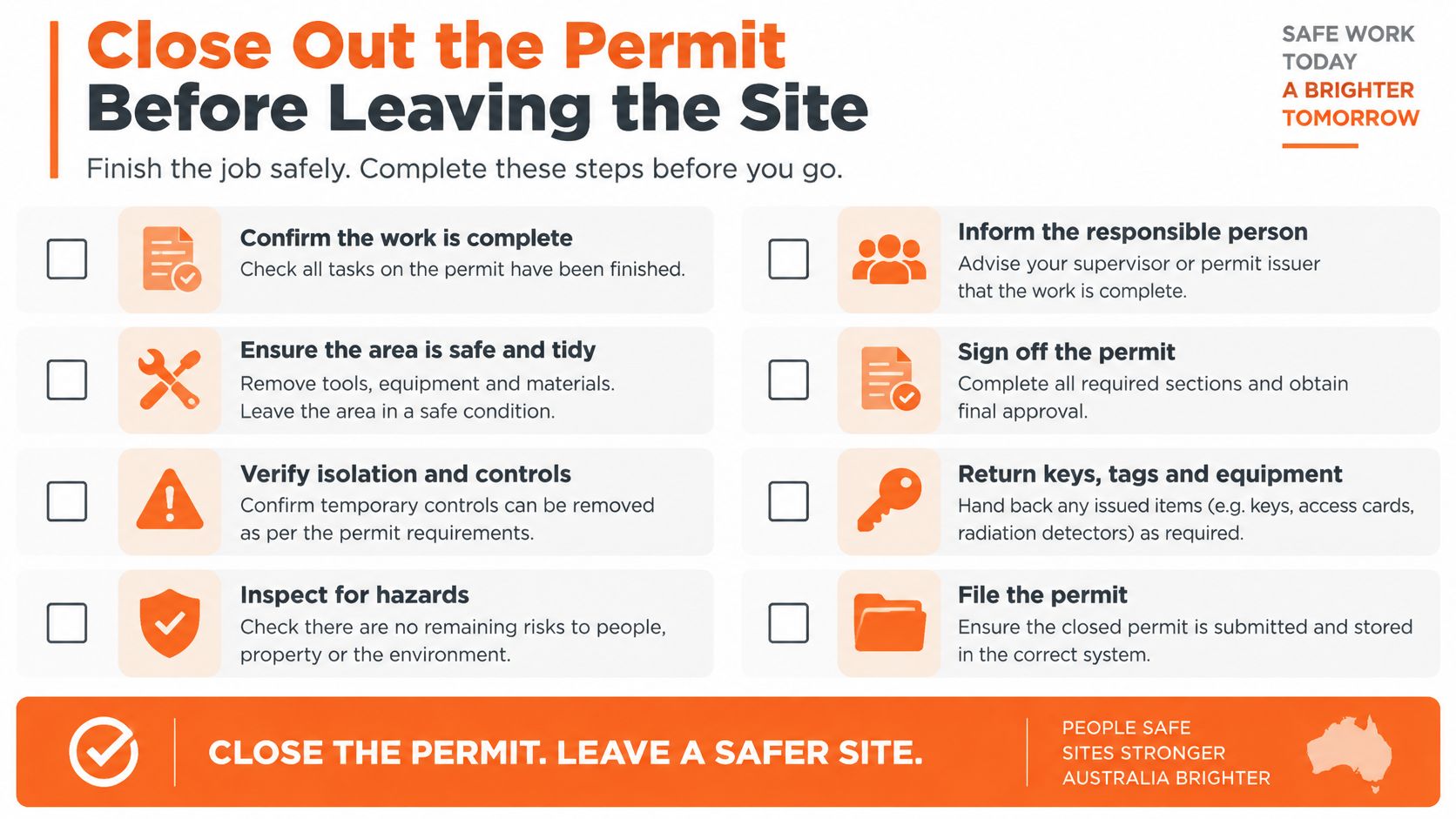
Review closed permits for repeated stop-work triggers, unclear boundaries and controls that needed correction after approval. Assign changes to the template or work-planning process, rather than accepting the same gap on the next job.
Safety Space offers permits to work with approvals, SWMS and JSAs with worker sign-on, and site-based safety records. Visit Safety Space to discuss a hot work workflow that keeps screening decisions, supporting controls and close-out records connected to the job.
Ready to Transform Your Safety Management?
Discover how Safety Space can help you implement the strategies discussed in this article.
Explore Safety Space FeaturesRelated Topics
Safety Space Features
Explore all the AI-powered features that make Safety Space the complete workplace safety solution.
Articles & Resources
Explore our complete collection of workplace safety articles, tools, and resources.