
A bent stile found after pre-start needs a ladder ID and an immediate isolation decision, not another tick on the toolbox sheet. Say the paper form has no ID and the ladder cage is already open. The supervisor can't establish which ladder failed, whether it was removed, or whether another crew has taken it.
A usable ladder inspection checklist connects the worker's pre-use check, the competent person's detailed inspection, set-up controls and the quarantine record. For WHS teams already managing SWMS and equipment registers, the task is to make those records support the same issue-or-stop decision.
Table of Contents
- Ladder Inspection Checklist Fields to Capture
- How to Complete the Pre-Use Check
- Defects That Remove a Ladder from Service
- Set-Up and Use Checks on the Same Form
- How to Record Findings and Close Actions
- Confirm the Ladder Before It Is Issued
Ladder Inspection Checklist Fields to Capture
The missing ID is the first problem to fix. A description such as silver extension ladder won't distinguish equipment moving between a housing site, a workshop and a subcontractor's ute. Give each ladder a durable, readable identification mark that matches the equipment register without drilling, damaging or obscuring manufacturer information.
Safe Work Australia's model code on managing the risk of falls calls for a planned inspection and maintenance program covering equipment identification, inspection frequency and type, defect actions, completed records, user training and monitoring. It also says a competent person should regularly inspect ladders in accordance with the manufacturer's recommendations.
Make the inspection identifiable
The core record needs ladder ID, date, inspector, inspection type, condition, defects, corrective action and removal-from-service status. Defects need a written description, not just a failed checkbox. Add close-out fields so the inspection can connect to the repair or replacement decision.
Fields every ladder inspection record needs
| Field | What to write | If it is blank |
|---|---|---|
| Ladder ID | Unique mark matching the equipment register | Cannot show which ladder was checked |
| Date | Day of the check | Cannot tie the record to a shift or hire period |
| Inspector | Name of the worker or competent person | Nobody is accountable for the result |
| Inspection type | Pre-use or detailed | A glance is treated as a full inspection |
| Condition | Pass, or fail with the defect named | A tick with no words hides a fault |
| Corrective action | Repair, replace, or leave in service | The finding has nowhere to go |
| Removed from service | Yes or no, and where it is stored | A failed ladder can be picked up again |
| Close-out | Owner and the evidence that closed it | The defect stays open on paper |
Keep equipment condition separate from permission to use. An undamaged ladder can still be unsuitable for the proposed task or location. A repair entry also shouldn't automatically change the equipment status to available.
Separate the inspection types
The pre-use check belongs to the worker before that setup. It addresses the ladder's immediate condition and the intended use.
The detailed inspection belongs to a competent person with enough knowledge to recognise damage, assess the components and apply the manufacturer's criteria. Its schedule should reflect the manufacturer's recommendations, with an earlier assessment where condition or exposure warrants it.
Outdoor storage, repeated transport, vehicle contact and chemical exposure deserve attention when setting that schedule. A calendar reminder alone doesn't account for a ladder dropped from a rack or struck during loading.
Record rule: An inspection without an identifiable ladder and a clear disposition is an incomplete equipment-control record.
The PCBU should also nominate who reviews inspection completion. Filing forms proves that forms exist. Comparing completed records against the active equipment register helps establish whether the inspection program covers the fleet.
How to Complete the Pre-Use Check
Run the check before every setup, including hired equipment and ladders with a current detailed inspection. Transport, handling and worksite conditions can change between uses. A recent inspection sticker doesn't establish that the ladder is suitable for the position where the worker intends to climb.
Safe Work Australia's housing construction code directs workers to check for visible damage, including broken rungs, stiles and footings, before setting up, and to remove faulty or damaged ladders from service. It also recommends regular competent-person inspections in accordance with manufacturer recommendations.
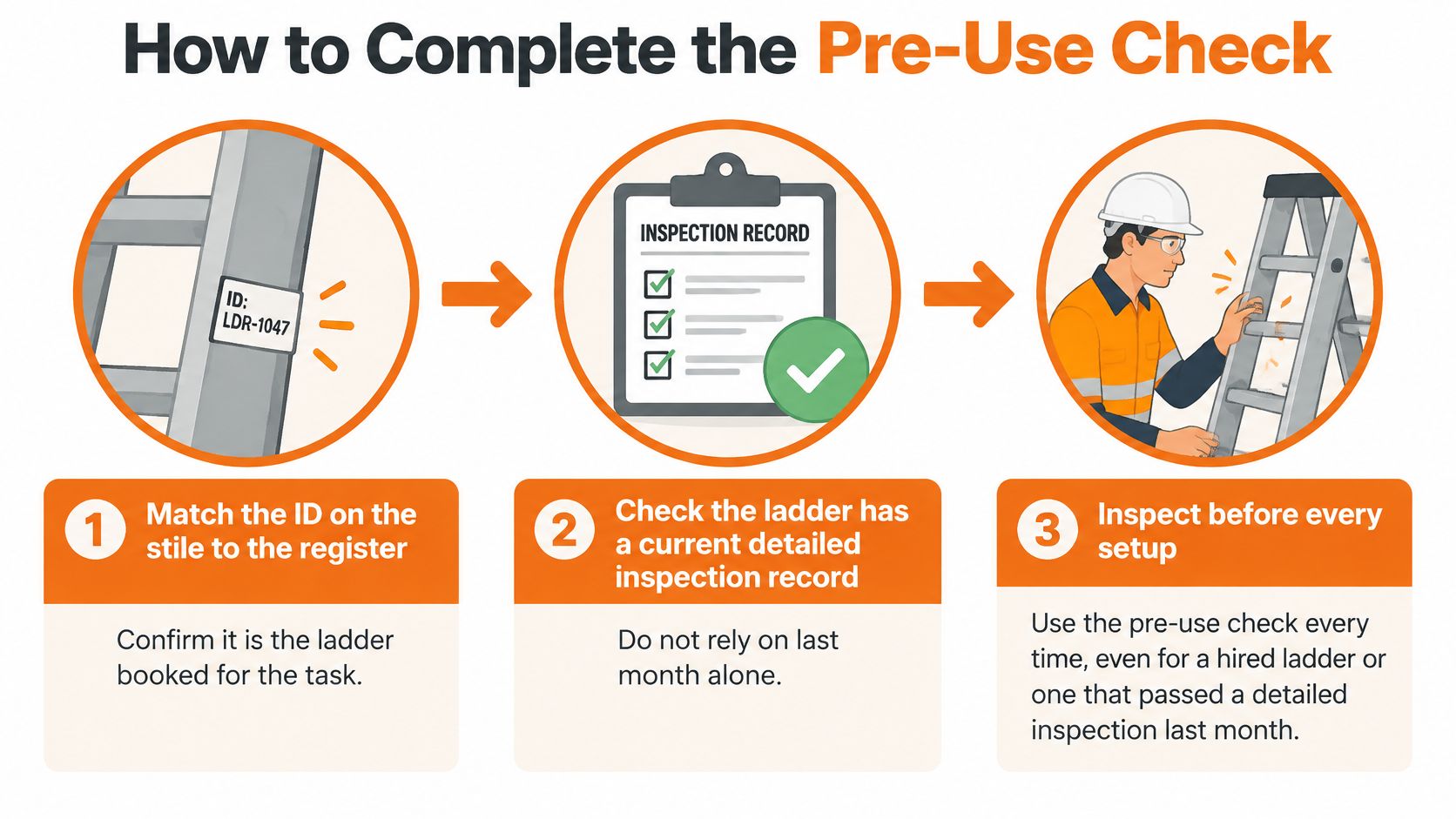
Follow the check in working order
Match the ID to the register. Confirm that the ladder on the ground is the equipment selected for the task, not a shorter substitute taken from the vehicle. Check its detailed inspection status. An unreadable ID or unresolved status needs supervisor review before issue.
Confirm suitability and capacity. Read the manufacturer's marking and account for the worker, tools and materials. Select the appropriate ladder type for the work, including non-conductive equipment where electrical hazards require it. Ladder material doesn't replace electrical isolation or the task's electrical controls.
Inspect the accessible components. Look along the stiles and across the rungs, steps, fittings and feet. Remove loose dirt that prevents inspection without concealing damage or altering the ladder. Stop when damage is apparent or when the worker can't confidently assess a suspect component.
Check the supporting surface. Confirm firm, level support at the intended location. Where a levelling device is proposed, verify that it's designed for the ladder and installed correctly. Loose boards, packaging and improvised packing aren't an acceptable way to correct the setup.
Position and secure the ladder. Check the head support, feet and restraint arrangements before climbing. Consider doors, vehicle movements and other work that could disturb it. If the proposed restraint can't prevent slipping or displacement, stop and change the arrangement.
Test the working position from the ground. Identify the actual work area and whether the worker can reach it without leaning outside the stiles or stepping sideways. A ladder placed beside the job isn't necessarily positioned to do the job safely. Move it or select different access equipment.
Record the result before work starts. Enter the outcome against the ladder ID and identify the task or work area. A failed answer needs a disposition, not an unchecked comment box left for the end of the shift.
Connect the result to the work
On a housing site, the supervisor should assess the result against the task's SWMS. If the planned work can't be performed within the nominated ladder controls, the answer is to change the access method, not amend a failed answer to keep the program moving.
A worker should also know where to report uncertainty. Pre-use checking isn't an invitation to diagnose a cracked weld or decide whether damaged fibreglass retains its strength. Uncertain condition is a reason to withhold the ladder for competent assessment.
Defects That Remove a Ladder from Service
Withdraw a ladder immediately when a defect affects strength or stability. A note saying repair next service doesn't control access to damaged equipment. The competent person's detailed inspection determines whether repair is appropriate or replacement is necessary.
Safe Work Australia's code on preventing falls in housing construction supports examining the ladder's structural parts, fittings and feet, with immediate withdrawal where defects affect integrity or stability. It also supports inspection intervals based on manufacturer recommendations, equipment condition and the work environment.
Apply component-specific fail criteria
Lay the ladder down in a well-lit inspection area. Open or extend it only as needed to examine the mechanisms safely. Dirt, paint build-up and stored materials shouldn't prevent inspection of connections or hide the condition of the stiles.
Defects that take a ladder out of service
| Part | Fail signs | Action |
|---|---|---|
| Timber stiles | Warped, splintered, cracked or bruised | Remove from service and repair or replace |
| Metal stiles | Twisted, bent, kinked, crushed, or cracked weld | Remove from service; do not straighten on site |
| Fibreglass stiles | Cracks, chips, severe fading or exposed fibres | Remove from service; do not use for electrical work |
| Rungs, steps, treads, top plate | Missing, worn, damaged or loose | Remove from service until the part is replaced |
| Feet | Damaged, missing or worn non-slip feet | Remove from service; do not tape or mix foot types |
| Ropes, braces, brackets, fasteners, tie rods | Damaged, frayed, loose or missing | Remove from service until replaced to the manufacturer's specification |
Severity needs competent assessment, but obvious structural damage doesn't need a debate beside the cage. A bent metal stile shouldn't be straightened with workshop equipment and returned to circulation. Re-forming it doesn't establish that it retains the required strength.
Likewise, a replacement foot needs the correct design and attachment. A foot that fits over the stile isn't necessarily an approved replacement. Improvised repairs can conceal the original defect while introducing a different stability problem.
Distinguish inspection from repair approval
The inspector should identify the defect precisely enough for someone else to locate it. Record the affected stile, rung, connection or mechanism and describe the damage. A close photograph helps, but it shouldn't replace the written finding.
A ladder awaiting a repair decision remains unavailable. Uncertainty isn't a pass.
A repair decision should follow the manufacturer's instructions and use appropriate parts. Where the manufacturer doesn't permit the proposed repair, replace the ladder rather than developing a site-made repair method.
Keep ladder assessments distinct from other equipment inspections. A fall protection equipment inspection checklist can support the wider inspection program, but a harness inspection record won't establish a ladder's condition.
After the detailed inspection, the reviewer should check that the register reflects the result. An independent completion check can identify overdue equipment, missing reports and records that show a pass despite an unresolved defect. The reviewer doesn't need to repeat every physical inspection, but should investigate contradictions.
Set-Up and Use Checks on the Same Form
An intact ladder can still be the wrong access equipment. Put task suitability, ground conditions, positioning and safe use on the same form as structural condition. Separate pass-or-fail answers prevent a clean equipment inspection from being mistaken for approval of the whole job.
For leaning ladders, Safe Work Australia's falls-from-height guidance gives a 4:1 setup ratio, approximately one metre of base distance for every four metres of working height. The worker must still assess the actual supports and secure the ladder against slipping.
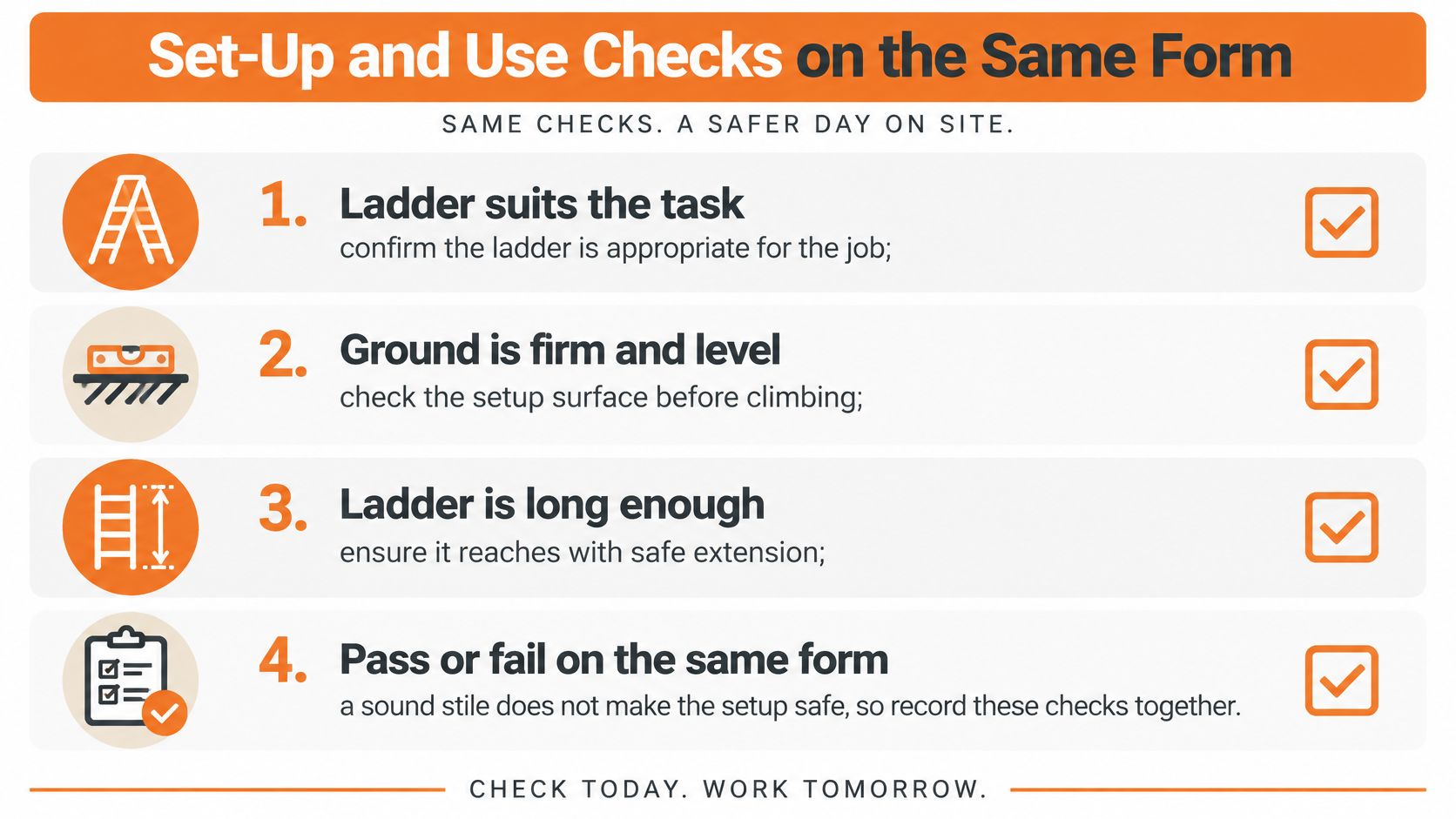
Make use controls observable
The Safe Work Australia slips, trips and falls guide dated September 2026 specifies three points of contact, one person at a time, a working position at least 900 millimetres below the top, and a load rating of at least 120 kilograms, with reference to AS 1892.1-2018 for portable ladders. These are guidance criteria to check alongside the ladder manufacturer's instructions, not substitutes for assessing the task.
Translate the use controls into answers a supervisor can verify:
- Climbing contact: The worker can maintain two feet and a hand, or two hands and a foot, while climbing.
- Tool handling: Tools travel in a belt or side pouch rather than occupying a climbing hand.
- Working balance: The worker can keep the belt buckle between the stiles without leaning sideways.
- Work method: The task is light-duty work that allows tools to be operated safely with a hand remaining available for support.
- Equipment marking: The rating and relevant product information are legible, with no uncertainty about capacity or permitted use.
The same assessment belongs on a facilities stepladder used above a doorway or a cleaning ladder taken from a van. Familiar equipment still needs a suitable work position.
Reject tasks that exceed the controls
A job requiring sustained force, heavy materials, extended work at height or both hands should trigger selection of a platform or another suitable access method. The decision should be reflected in the SWMS or task risk assessment before work begins.
For broader access planning, the working at heights safety guidance provides context beyond the ladder itself. Access equipment selection must address the work position, not just the route to it.
For teams discussing roof-maintenance scope with property owners, 7 Summits Roofing's resource on DIY roof repair risks in Colorado offers an additional discussion prompt. It isn't Australian WHS authority and shouldn't determine local compliance decisions.
Access decision: When the task can't fit the ladder's safe-use conditions, change the access equipment rather than weakening the checklist.
How to Record Findings and Close Actions
A failed answer starts a controlled sequence. The person identifying the defect should tag the ladder out of service, prevent further access and notify the responsible supervisor. The record should follow the equipment through quarantine, repair or disposal.
Tagging alone is weak where workers can still take the ladder from a shared rack. Move it to a designated quarantine area or secure it against issue. Record the tag reference and exact location so another supervisor can find it without searching vehicles and storage cages.
Give the action an owner
Assign a named person who can arrange the repair, replacement or disposal. Set a due date that reflects the operational need without treating that date as permission to keep using the ladder.
The action record should contain:
- Finding: The defect description and the affected ladder ID.
- Immediate control: The tag reference, quarantine location and person notified.
- Responsibility: The action owner and required completion date.
- Resolution: The repair record, replacement details or disposal evidence.
- Release decision: The competent person's reassessment and authorised register update.
For phone-based inspections, Safety Space's inspection builder supports checklist creation and revision, photo capture and mandatory corrective actions triggered by responses, with records organised by site or project. The form should require the ladder ID before completion and make a failed condition answer lead to an action.
A corrective action register template can help structure ownership and close-out requirements. Whichever recording method the business uses, the equipment status and action status must agree.
Close the physical problem, not just the task
A photograph of a replacement component doesn't establish that the ladder is ready for service. After repair, a competent person should inspect the equipment before an authorised person changes the register to available. Disposal evidence should identify the ladder and prevent a discarded item from returning through another crew.
For a repainting contractor, action ownership also needs to survive movement between occupied properties. Painters North Shore's resource on safety compliance for rental repaint jobs provides task context for that conversation, rather than a substitute for the contractor's equipment records.
For New Zealand operations, align the process with the Health and Safety at Work Act 2015 and WorkSafe NZ guidance. The practical record can retain the same equipment, inspection, isolation and close-out fields. United States operations can retain those physical controls while the employer checks applicable local requirements rather than relying on Australian guidance.
Review open ladder actions during the regular H&S meeting. An overdue repair should prompt replacement planning, not an informal return to service.
Confirm the Ladder Before It Is Issued
The supervisor's issue check should answer whether this particular ladder can leave storage for the intended work. It isn't another full inspection. It's a check that the equipment identity, inspection status and outstanding actions support release.
Apply the issue gate
- Is the ladder registered and available? Match the physical ID to the register. Stop if the record shows quarantine, disposal pending or an unresolved status.
- Has the intended user completed the pre-use record? Confirm that it relates to the planned task and setup. A signature copied from another worker's form doesn't establish that assessment.
- Is the detailed inspection current? Check the interval assigned to that ladder and whether intervening damage or exposure requires reassessment.
- Are previous defects closed with evidence? An action marked complete without the required repair or release record isn't enough to authorise issue.
Stop at the first no. A hire company's tag can provide useful information, but it doesn't replace the receiving business's task-specific pre-use assessment.
Check the job as well as the equipment
For residential construction, compare the proposed use with the SWMS before releasing the ladder. If the work requires an unsupported working position or a prohibited standing area, select different access equipment. Don't issue the ladder on the assumption that the worker will find a way.
For cleaning, facilities and waste crews, apply the same gate to vehicle-carried stepladders. Allocate responsibility for checking equipment transferred between vehicles so the register doesn't retain an obsolete location.
At shift end, the receiving supervisor or equipment custodian should ask whether any damage, impact or instability was reported. A ladder shouldn't return to the available rack merely because it left storage with a pass.
Before the next issue: Confirm identity, inspection status, task suitability and defect closure against the ladder actually leaving the cage.
The useful evidence is the release decision tied to identifiable equipment. A fresh stack of blank forms won't establish which ladders were fit for use.
Safety Space offers configurable inspection forms, equipment registers and corrective actions for managing ladder checks and defect follow-up. Visit Safety Space to discuss a checklist that connects failed answers with accountable actions and site records.
Ready to Transform Your Safety Management?
Discover how Safety Space can help you implement the strategies discussed in this article.
Explore Safety Space FeaturesRelated Topics
Safety Space Features
Explore all the AI-powered features that make Safety Space the complete workplace safety solution.
Articles & Resources
Explore our complete collection of workplace safety articles, tools, and resources.