
A permit can be signed, dated and neatly filed while the work front remains uncontrolled. That's why a permit to work audit checklist must test what happened before, during and after the job, not just whether someone completed a form.
The audit should follow the control sequence: competent authorisation, job-specific hazards, verified controls, worker competence, isolation, field confirmation, change management and close-out. A form is evidence only when it matches the conditions people faced on site.
Table of Contents
- Why Most Permit Audits Miss the Operational Risk
- The Core Checks That Apply to Every Permit
- Confined Space Permit Checks
- Hot Work Permit Checks
- Isolation and Lockout Evidence
- Vehicle, Mobile Plant and Changing Site Conditions
- Permit Reissue, Suspension and Shift Handover
- Leading and Lagging Indicators for Permit Audits
- Site-Ready Audit Checklist and Where Safety Space Fits
Why Most Permit Audits Miss the Operational Risk
Signature, expiry and closure checks are the easy part. A permit can look complete while the work front remains exposed because the exclusion zone was never established, isolation was not verified, or conditions changed after approval.
The audit should test whether the permit controls the job in the field. Australian guidance requires employers to establish a safe system of work, identify hazards, implement controls and have an authorised person reconfirm that work can proceed safely before issuing a permit. The permit should identify the task, people, equipment, hazards and controls, consistent with WorkSafe Victoria's guidance on working with energised plant.
Use one rule throughout the audit:
Audit rule: If the permit says a control exists, inspect that control at the work front.
Check the exposure points that paperwork commonly hides: vehicle movement, plant isolation, work at height, dropped objects, contractor interfaces and changing site conditions. Safe Work Australia reported 200 workers fatally injured at work in 2023, compared with 195 in 2022. Vehicle incidents accounted for 42% of workplace fatalities in 2023, equal to 84 deaths, while falls, slips and trips caused 29 fatalities and approximately 30,300 serious workers' compensation claims, according to Safe Work Australia's annual report.
The leading indicators are practical: barriers remain in place, isolations have current verification, workers can explain the permit limits, and supervisors respond when conditions change. A permit audit passes only when it shows that authorisation, competence and field controls stayed effective while the work was underway.
The Core Checks That Apply to Every Permit
Start with the permit register and select current work, recently closed work and permits involving contractors or non-routine tasks. Trace each permit from request to hand-back. The auditor should compare the record with the work area, people, equipment and control evidence.
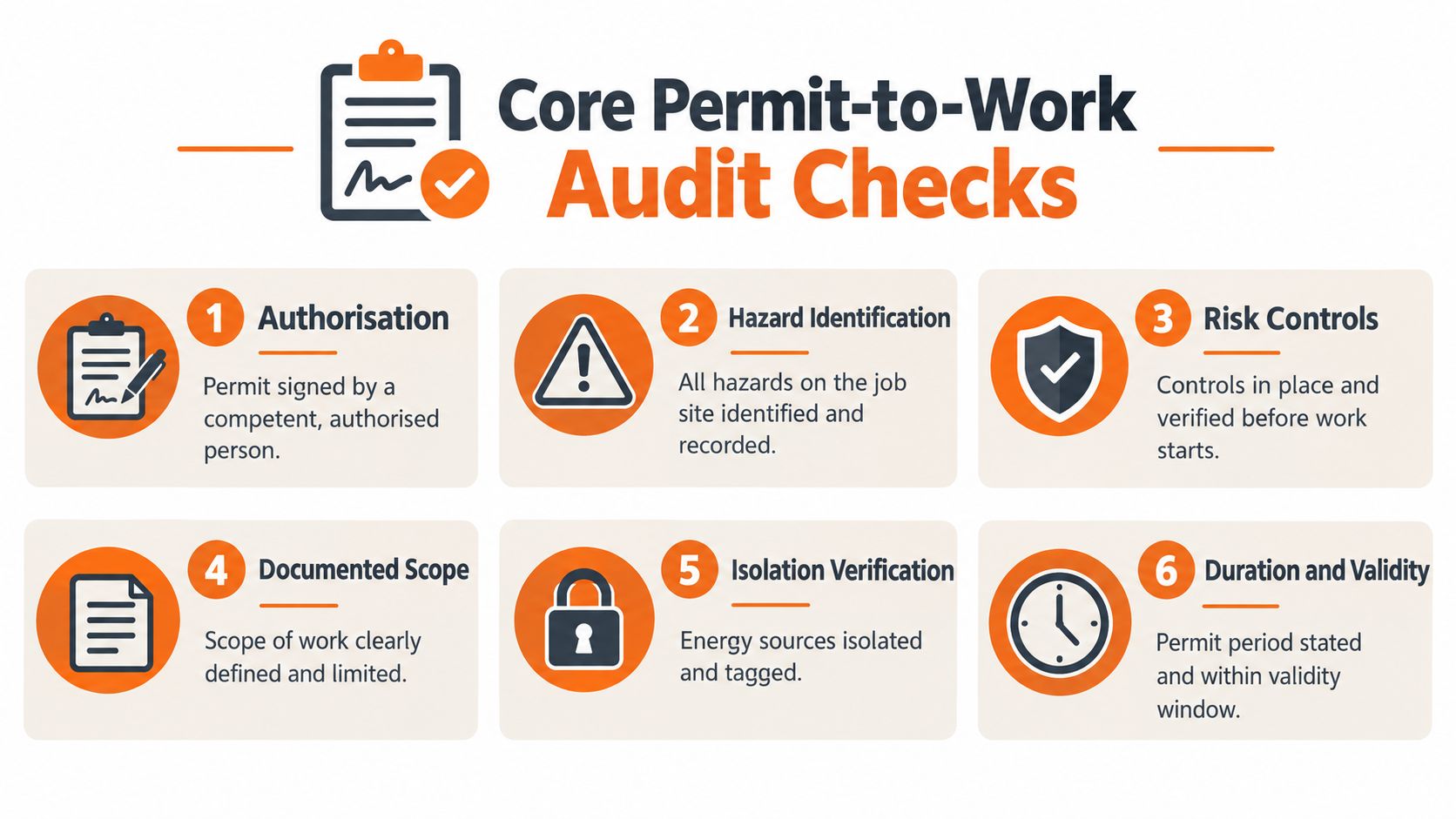
Authorisation and scope
Ask who approved the permit and whether that person was authorised and competent for the task. The approval must occur after hazards and controls have been addressed, not as an administrative step that allows the crew to work out the controls later.
Check that the permit identifies:
- The exact task: The description should be specific enough to distinguish the work from other activities in the same area.
- The people involved: Named employees, contractors, supervisors and other workers affected by the job should be identifiable.
- The equipment and location: The permit should identify the plant, asset, work front or confined space covered.
- The validity period: Start, expiry, suspension and closure arrangements should be clear.
- The work limits: The crew should know what the permit does not authorise.
The risk assessment and SWMS should match the actual job. Generic wording, missing interfaces or controls that nobody owns are warning signs.
Controls and competence
Ask whether each critical control was in place before work started and who verified it. Check worker competency, supervision, induction and any specialist authorisation required for the task.
For energised plant or other hazardous energy, the record should show identified energy sources, isolation arrangements and verification. The advice from Networking2000 also provides useful context on why access and visitor controls need to align with operational risk, rather than sit in a separate administrative process.
Before leaving the record, confirm that supervisors inspected the work before release and that the area was handed back safely after completion. The underlying WHS duty is to control the work, not to produce a complete-looking form.
Confined Space Permit Checks
A confined-space audit should begin with the permit itself. It must be written, dated and issued by a competent authorised person before entry. The permit should apply to one specific confined space and one entry activity, with the permitted work period clearly stated.
Safe Work Australia's model code requires a separate permit for each entry into a confined space. The record may authorise one or more workers, but it must identify every authorised entrant and show that entry controls were established before anyone went inside. The confined-space and working-at-heights guidance can support a broader review of related controls.
Evidence to trace
The auditor should verify:
- Location and scope: The space, entry point, task and date match the work observed or reconstructed from records.
- Atmospheric testing: Readings were taken before authorisation, with the tester identified and the result recorded.
- Isolation: Hazardous plant and services were isolated before entry.
- Rescue arrangements: Communication, rescue equipment, standby arrangements and emergency actions were established.
- Worker control: Every entrant signed on, and the record shows exit at completion.
- Permit closure: The permit was closed when the work ended and wasn't left open as a standing authorisation.
| Required item | Evidence to verify | Common gap |
|---|---|---|
| Written permit | Space, task, date, time and issuer recorded | Generic permit reused for different spaces |
| Named entrants | Worker names and sign-on record | Crew changes not reflected |
| Atmospheric testing | Pre-entry results and tester details | No gas readings or unclear timing |
| Isolation | Isolation points and verification record | Signature without identifiable isolation |
| Rescue arrangements | Rescue method, equipment and communication | Rescue plan attached but not briefed |
| Closure | Exit record and formal close-out | Permit remains open after work ends |
A permit reused for multiple entries, covering more than one space, lacking an authorised issuer or remaining open after completion is a control failure, not a filing problem. The model requirements prohibit a PCBU from directing or allowing confined-space entry without a compliant permit, as explained in Safe Work Australia's model code for confined spaces.
Hot Work Permit Checks
Hot-work auditing fails when it stops at permit issue. The auditor must inspect the area before ignition, confirm controls during the job and verify the fire watch after the operator stops.
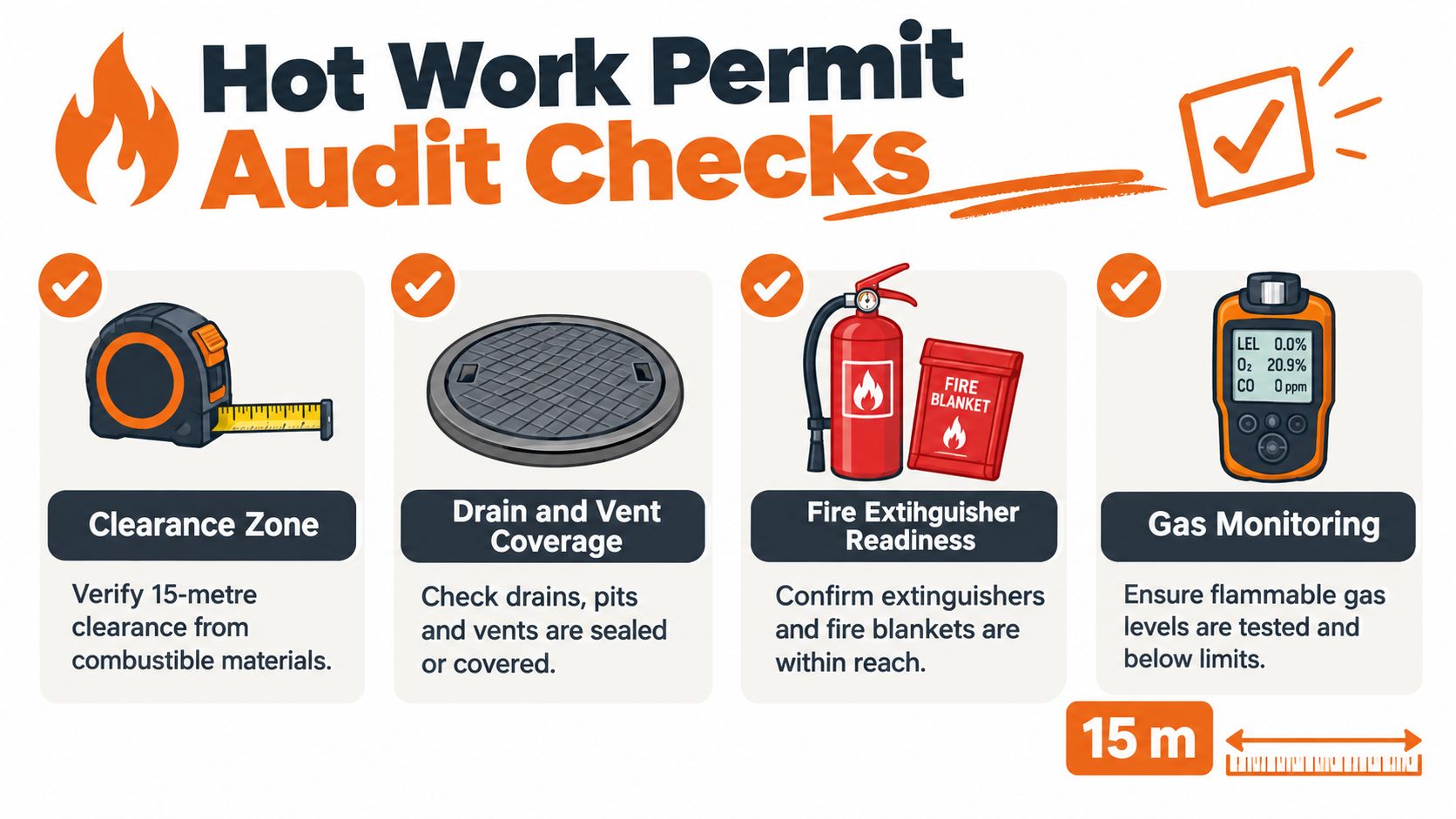
The checklist should confirm that the work area is clean and free of readily combustible materials within 15 metres. Drains within 15 metres should be covered with a wet fireproof blanket. Suitable fire extinguishers must be near the ignition source, and a tested water hose should be available where required.
Where sparks could fall from more than 2 metres, they must be completely contained by a suitable enclosure inspected before work begins. The auditor should inspect above, below and on the other side of walls, decks or platforms. A clean floor beside the welder doesn't prove that sparks can't reach concealed combustible material.
Before, during and after the task
- Before ignition: Confirm the clearance zone, drain coverage, extinguishers, hose and spark containment.
- During work: Check that the permit remains available, the fire watch is present and conditions haven't changed.
- After the tool stops: Verify the fire watch, inspect likely ignition paths and record the end time.
- At closure: Confirm formal close-out and hand-back, rather than treating the end of welding as the end of the control period.
Hot work includes grinding, welding, brazing, oxycutting, heat treatment and similar activities that generate heat or continuous sparks. Australian guidance states that hot work should not begin in or on the exterior of an occupied confined space until a hot-work permit has been issued. The relevant Safe Work Australia material on hot work and confined spaces supports checking the full ignition-control trail.
Isolation and Lockout Evidence
Isolation must be a permit-release condition. It isn't a box workers complete after approval, and a signature doesn't prove that the equipment was made safe.
The auditor should walk from the permit to the isolation register, then to the physical isolation points. The evidence should identify every relevant energy source, the isolation point used, the lock and tag number, the person who verified the condition and the person authorised to remove the isolation.
What the record must show
Check the following:
- Energy identification: Electrical, mechanical, hydraulic, pneumatic, thermal, chemical, gravity and stored energy sources were considered where relevant.
- Isolation points: The record identifies what was locked, tagged, blanked, closed or otherwise physically isolated.
- Zero-energy verification: A competent person checked that hazardous energy was absent or controlled at each required point.
- Personal control: The system identifies who applied the lock or tag and who may remove it.
- Removal authority: De-isolation cannot occur until the work is complete, the area is clear and every worker is accounted for.
- Close-out link: The permit closure confirms that isolation status was reviewed before hand-back.
Safe Work Australia identifies locking, tagging, closing and blanking as examples of isolation measures, and says isolation should be supervised or checked at each isolation point. For confined spaces, the system must prevent isolation from being removed until the work is complete and all workers have left, as described in the model code of practice for confined spaces.
A lock number without a matching register entry is a gap. So is a register entry with no physical lock. The audit standard is point-by-point evidence, not administrative confidence. Teams reviewing their broader control arrangements can also use lock-out tag-out training resources when competency gaps appear.
Vehicle, Mobile Plant and Changing Site Conditions
A permit audit must test the space where people and machines interact, not just the wording on the form. The vehicle fatality share noted earlier is why auditors must verify exclusion zones physically, alongside the broader injury pattern reported in Safe Work Australia's 2024–25 annual report.
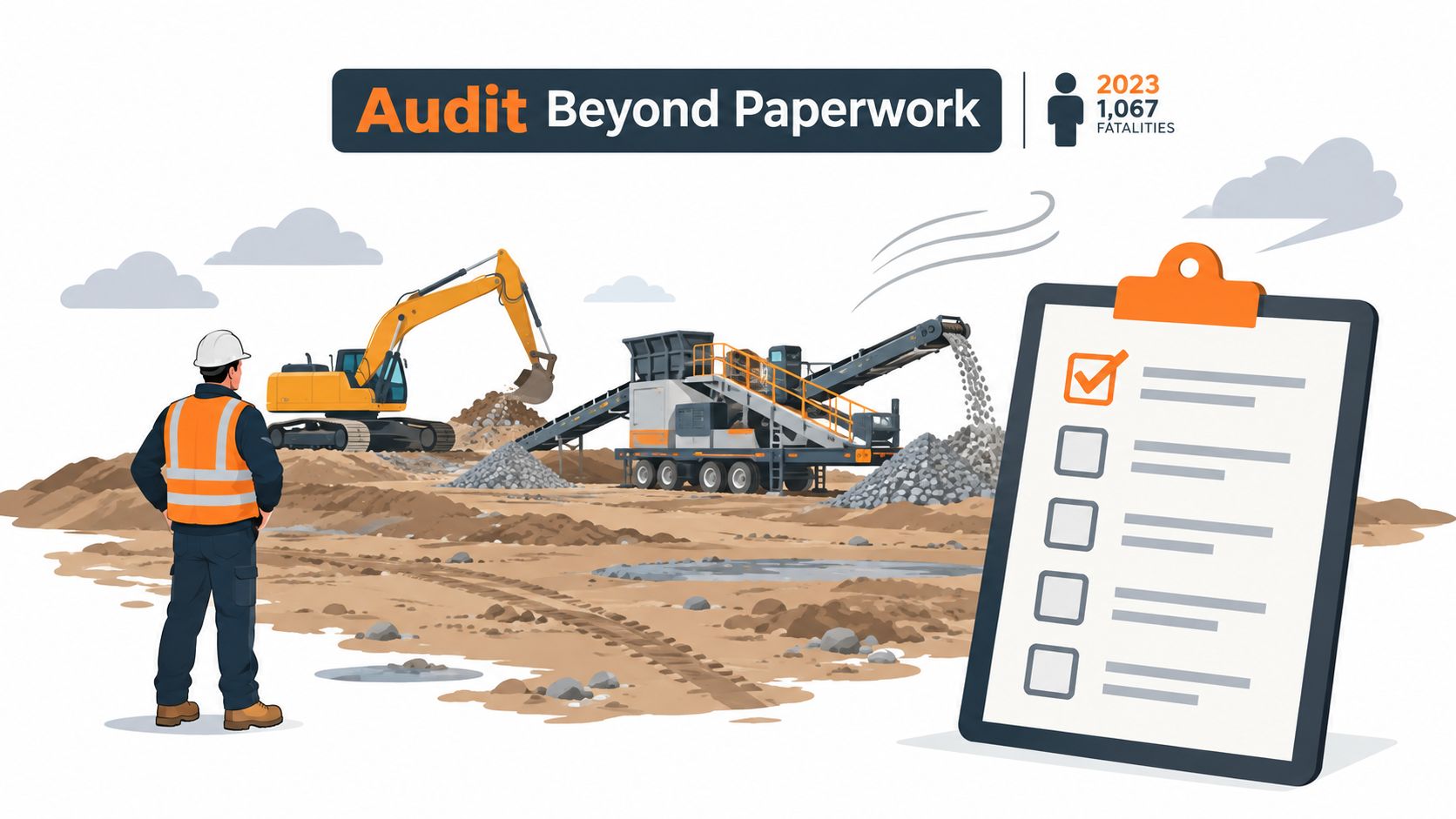
A traffic control listed on a permit can fail at the work front. Barriers may be missing, the spotter may be elsewhere, or a delivery may force a route change after approval. These are field failures, and the permit audit should expose them before someone enters a plant path.
Field questions that expose weak controls
The auditor should ask:
- Was the exclusion zone physically verified? Check barriers, separation, access control and signs against the permit.
- Did the route change? Look for deliveries, excavation, temporary storage or layout changes that altered pedestrian or vehicle movement.
- Were reversing risks identified? Confirm controls for reversing, visibility, spotters and interaction with public roads where relevant.
- Were operators included? Plant operators and subcontractors should understand permit limits, communication methods and handover arrangements.
- Did simultaneous work create a conflict? Compare nearby permits, work orders and active plant.
- Was the control still valid? Weather, production and access changes can remove a control that existed at approval.
Compare the written permit with the physical work front while the activity is underway. A person entering the plant path, or a vehicle entering the exclusion zone, is direct evidence that the control system has failed.
Permit Reissue, Suspension and Shift Handover
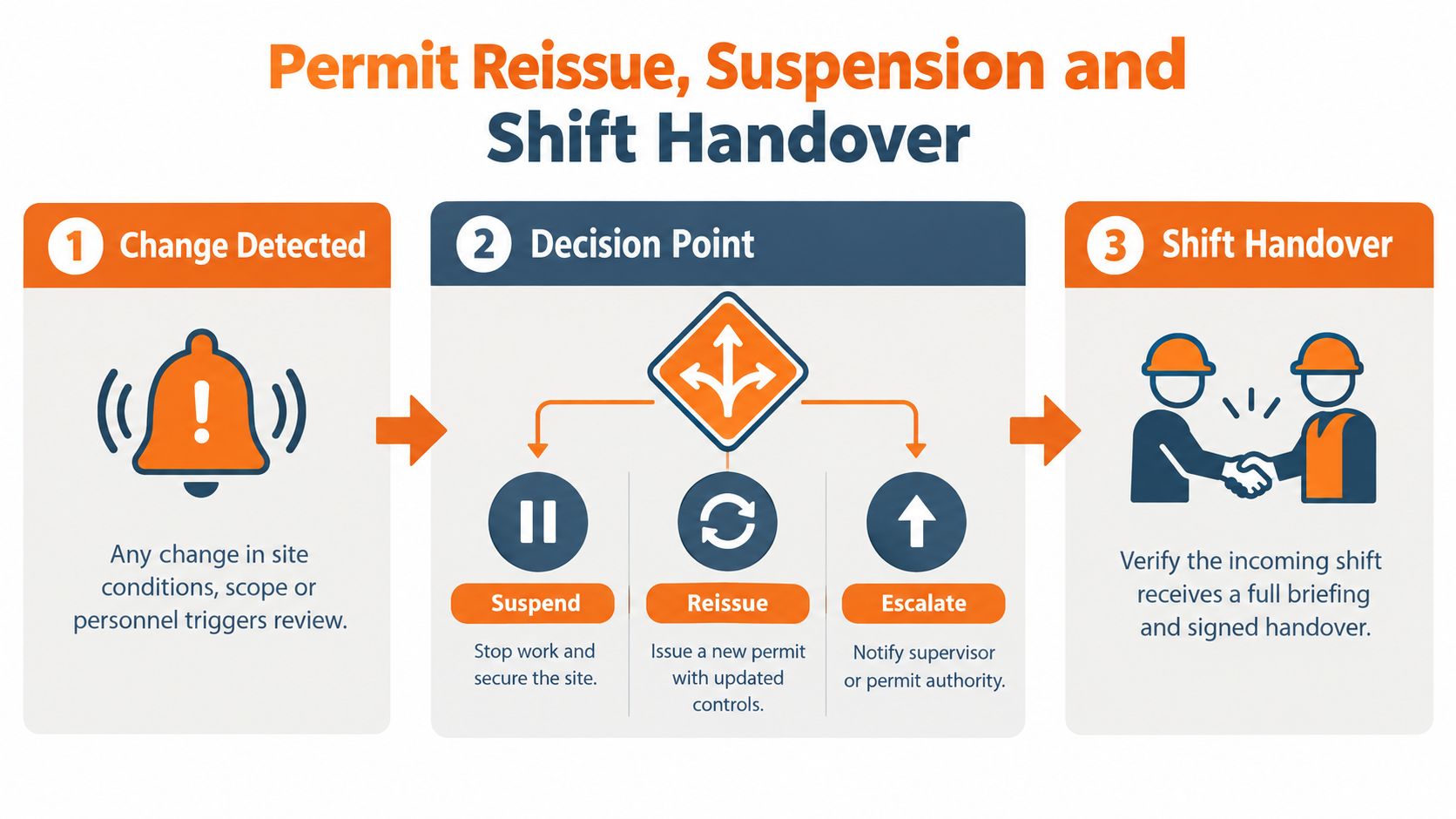
A permit shouldn't survive a material change by default. When the scope, personnel, plant, isolation status or surrounding work changes, the permit authority should decide whether to suspend, reissue or escalate the work.
Check permits that crossed shifts, received extensions or operated alongside other tasks. Look for a documented handover, incoming worker sign-on, supervisor field verification and isolation revalidation. A repeated extension without a fresh hazard review is a warning that the team is preserving an old authorisation instead of reassessing the job.
Triggers for a new decision
- Changed site conditions: Stop and review when access, weather, traffic routes, ventilation, plant or surrounding activities change.
- Changed scope: Suspend the permit if the crew needs to perform work outside the approved task.
- Changed personnel: Confirm that new workers understand the controls and sign on before starting.
- Simultaneous operations: Reassess shared plant, energy sources, access routes and conflicting permits.
- Shift transition: Require a direct briefing and signed handover, not a note left on a desk.
- Isolation change: Revalidate the isolation before work resumes after suspension or handover.
Safe Work Australia guidance supports clearly defined permit types and requires preparation and isolation to be confirmed before issuing a permit. The audit should also examine suspended, extended, cancelled and closed permits, as set out in its major-hazard-facility safety management guidance.
A permit left open across shifts isn't evidence of continuity. It may be evidence that nobody made a new safety decision.
Leading and Lagging Indicators for Permit Audits
Permit volume and signature counts are weak safety measures. More approvals can mean more work, and more signatures can mean more bureaucracy. Neither proves that controls stayed effective.
A useful dashboard separates signals that predict control weakness from outcomes that show the weakness has already caused harm. The measures should be reviewed by site, contractor, task and failure type, not blended into one organisation-wide figure.
Leading indicators
Track:
- Late approvals: Permits authorised after work started or immediately before the task.
- Repeated extensions: Permits repeatedly extended without a new hazard review.
- Missing isolation checks: Records that identify isolation but don't show point-by-point verification.
- Closure without field verification: Permits closed without evidence that the work area was inspected and handed back.
- Unplanned changes: Work that continued after scope, personnel or site conditions changed.
- Corrective-action delay: Actions that remain overdue beyond the organisation's defined due date.
Lagging indicators
Review incidents, near misses, repeat control failures and recurring findings. A recurring isolation gap at one site or contractor matters even when no injury has occurred. The pattern is a warning that the permit system isn't controlling the work reliably.
The annual report from Safe Work Australia records an average fatality rate of 1.4 deaths per 100,000 workers across 2019–2023, with an average of 191 worker deaths each year, providing a wider baseline for why critical-control assurance matters. It shouldn't be used to claim that a particular permit system caused or prevented an outcome.
For practical performance design, leading and lagging indicators guidance can help separate activity measures from evidence that controls worked. Teams building a continuous review process may also find Doczen's transformation playbook useful for thinking about recurring monitoring and action follow-through.
Site-Ready Audit Checklist and Where Safety Space Fits
The auditor should take a short field checklist, then demand evidence for every answer. A tick without verification is just another paperwork result.
- Authorisation: Was the permit issued by a competent, authorised person before work started?
- Scope: Does the permit identify the precise task, location, equipment and work limits?
- Hazards: Are the actual hazards and interfaces recorded, rather than copied wording?
- Controls: Were controls installed and verified before release?
- Competency: Were workers, contractors, supervisors and specialist personnel competent and briefed?
- Isolation: Are energy sources, isolation points, lock and tag numbers and zero-energy checks recorded?
- Atmosphere: For confined-space work, were tests completed before authorisation and linked to the permit?
- Fire control: For hot work, were the clearance zone, drains, extinguishers, hose and spark containment checked?
- Field inspection: Did a supervisor verify the work front before and during the task?
- Change management: Was the permit suspended, reissued or escalated when conditions changed?
- Handover: Did the incoming shift receive a direct briefing and confirm the controls?
- Close-out: Were workers accounted for, the area handed back and isolations removed by authorised personnel?
- Trend review: Are late approvals, extensions, missing checks, weak closures and repeat failures being analysed?
For teams moving from paper and spreadsheets to a system, Safety Space provides permits to work with approvals, inspections with a drag-and-drop form builder, hazard registers, corrective actions and offline mobile use for poor-connectivity worksites. Those features matter only when the organisation still compares completed records with actual site conditions.
The practical test remains simple: walk to the work front, identify the control that should be there, and ask who verified it.
Safety Space can help organisations record permit approvals, inspections, hazards and corrective actions in one system, including offline mobile use for worksites with poor connectivity. Visit Safety Space to assess whether it fits the organisation's permit audit and field-control process.
Ready to Transform Your Safety Management?
Discover how Safety Space can help you implement the strategies discussed in this article.
Explore Safety Space FeaturesRelated Topics
Safety Space Features
Explore all the AI-powered features that make Safety Space the complete workplace safety solution.
Articles & Resources
Explore our complete collection of workplace safety articles, tools, and resources.