
A crew has stopped beside an excavation, the supervisor is asking whether the job can continue, and the programme is already tight. The immediate decision is whether anyone faces serious harm before the concern can be resolved. Stop work authority gives that decision a legal basis, but the employer's response determines whether the stop protects people.
Table of Contents
- What Stop Work Authority Means Under the WHS Act
- When a Stop Is Justified and When It Is Not
- Who Can Stop Work and How Their Powers Differ
- How to Stop Work Safely, Step by Step
- How Employers Can Support Workers Who Raise Concerns
- Stop Work Records, Review and Readiness Check
What Stop Work Authority Means Under the WHS Act
Stop work authority is the legal right for a worker to stop unsafe work, or for a health and safety representative to direct it to stop, when there's a reasonable concern about a serious risk from an immediate or imminent hazard. Within the model WHS framework, the federal Work Health and Safety Act 2011 separates the individual worker's right under section 84 from the representative's direction power under section 85, as outlined in the ACTU's account of Australian workplace safety law.
It's a circuit breaker, not a complaint process. Its purpose is to interrupt exposure to a specific danger, not settle every disagreement about a work method or supervisor's instruction.
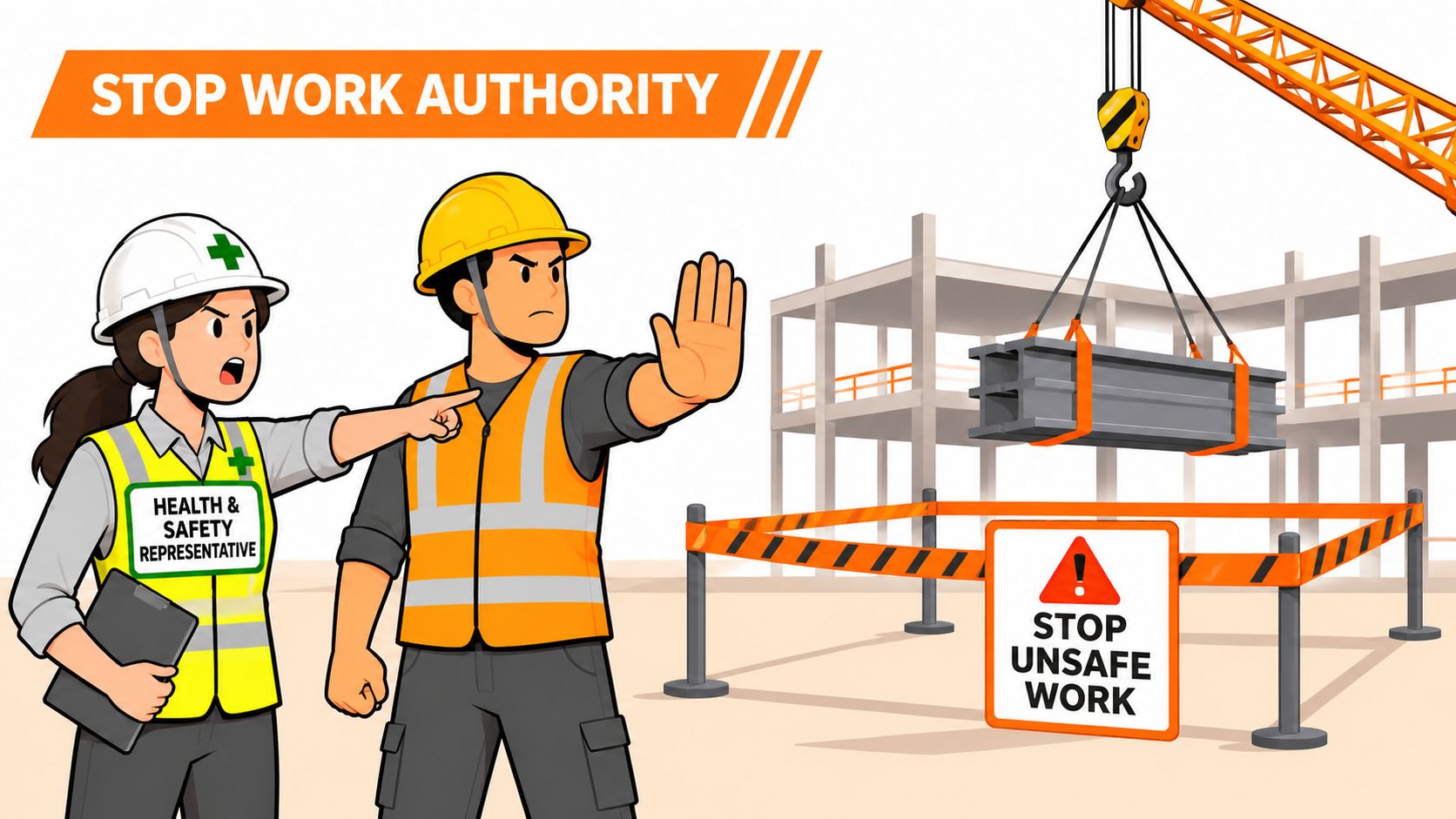
The conditions that matter
The statutory threshold brings together:
- A reasonable concern: There's an explainable basis for believing the work is unsafe.
- A serious health and safety risk: The possible harm is substantial, not inconvenience.
- Immediate or imminent exposure: Someone faces the hazard now or is about to face it.
Consider a crew member who notices a trench wall cracking while workers remain inside and excavation work continues nearby. The concern isn't an abstract objection to the excavation plan. People are already exposed to a potential collapse.
The immediate response should focus on stopping the affected task and getting people clear without creating another danger. Debating the adequacy of the original SWMS while workers remain exposed defeats the purpose of the right.
Operational distinction: Stopping exposure comes before investigating why the planned controls failed.
The stop doesn't establish the final engineering solution. A competent assessment may identify problems with ground conditions, support arrangements, loading near the edge or the excavation method. Those findings determine the corrective work and restart conditions.
For an H&S manager, effective implementation involves distinct skills: recognising when the statutory test is met, choosing the appropriate escalation route, and managing the event through to a controlled restart. A policy that addresses only permission to stop leaves the hardest operational decisions unresolved.
When a Stop Is Justified and When It Is Not
A bad feeling alone isn't enough to establish the statutory right. A justified stop connects an identifiable hazard with serious harm that could occur now or shortly.
Safe Work Australia's guide to the WHS Act sets out the linked requirements of a reasonable concern, serious risk and immediate or imminent exposure, and distinguishes cessation from the normal issue-resolution route. The worker doesn't need to finish an investigation before acting, but should be able to explain the concern in practical terms.
A useful description names the source of harm and the exposure: an accessible moving part during a blockage clearance, for example. Saying that the job feels rushed gives the supervisor less information to act on.
Stop or resolve site situations and the right route
| Situation | Example on site | Stop now? | Route |
|---|---|---|---|
| Immediate hazard, people exposed | Trench wall visibly cracking with workers in the trench | Yes, exposure is immediate | Stop, make safe, notify PCBU |
| Serious hazard, no one exposed yet | Scaffold bay without guardrails, nobody on it and access controlled | No, no exposure now | Fix before next use through issue resolution |
| Production pressure to skip a control | Crew asked to skip isolation for a quick clear | Yes, if energy exposure is imminent | Stop, then escalate to supervisor and PCBU |
| Procedure gap, low exposure | New starter has not signed the SWMS, without an associated imminent serious risk | No, procedure gap without imminent serious risk | Sign on before work and record through the issue process |
| Long-running housekeeping problem | Cluttered walkway left for weeks, without immediate serious exposure | No, on these stated facts | Hazard register and corrective action |
These calls rely on the stated circumstances. An unoccupied scaffold isn't safe merely because nobody is standing on it. Access must remain controlled until the missing protection is fixed.
Likewise, a housekeeping problem's age doesn't determine urgency. Clutter obstructing an emergency exit or exposing someone to moving plant warrants a different assessment from ordinary walkway clutter.
Use issue resolution without accepting the defect
A weak control, missed procedure or deadline pressure doesn't meet the cessation threshold by itself. It can still demand prompt corrective action.
The appropriate route can include PCBU consultation, an agreed issue-resolution procedure or the default WHS Regulations procedure, a provisional improvement notice where applicable, or regulator assistance. A structured risk assessment helps identify the necessary controls without treating every disagreement as a statutory stop.
Practical rule: A concern that can safely await a planned control check belongs in issue resolution. If serious harm could occur before the conversation ends, exposure needs to stop.
That rule isn't permission to postpone repairs. Managers should set urgency according to exposure, not administrative convenience.
Who Can Stop Work and How Their Powers Differ
Workers and HSRs both have stop-work powers, but they exercise them differently. An inspector's prohibition notice is a separate regulatory intervention.
Stop work powers by role
| Who | Legal basis | Key condition | What follows |
|---|---|---|---|
| Individual worker | WHS Act section 84 | Reasonable concern of serious risk from an immediate or imminent hazard | Notify PCBU as soon as practicable and stay available for suitable alternative work |
| Health and safety representative | WHS Act section 85 | Same risk threshold, with power to direct workers in the represented work group to cease | Consult PCBU first unless risk is too serious and immediate, then consult as soon as practicable |
| WHS inspector | Prohibition notice | Serious risk from immediate or imminent exposure to a hazard | Direction to stop or modify the activity, an external regulatory action |
The HSR consultation rule
The HSR's power isn't just the individual right applied to more people. It carries a representative consultation requirement.
The SafeWork SA consultation and representation factsheet explains that the HSR normally consults the PCBU and attempts to resolve the issue before directing cessation, unless the risk is so serious and immediate that prior consultation isn't possible. In that situation, consultation follows as soon as practicable.
Managers shouldn't convert that requirement into a blanket rule that every stop needs prior supervisor approval. Equally, an HSR shouldn't use an urgent direction to bypass consultation over a non-imminent concern.
Internal action and external intervention
A worker's stop is an internal escalation. A prohibition notice is an inspector's direction to stop or modify an activity because of serious risk from immediate or imminent exposure, as described in Safe Work Australia's best-practice review.
Affected parties, including the worker, HSR or PCBU, can request an inspector's assistance to resolve a cessation issue under Safe Work Australia's worker representation and participation guide. That guide also states that workers cannot be discriminated against for exercising the right, including through a pay deduction.
New Zealand note: Equivalent rules sit within the Health and Safety at Work Act 2015, with guidance from WorkSafe NZ. The section numbers above are Australian only; managers should check the New Zealand legislation and regulator guidance before applying a procedure there. Australian provisions shouldn't be transplanted into United States procedures either.
How to Stop Work Safely, Step by Step
A stop is a sequence of actions, not a single decision. The procedure needs to protect the people already exposed, prevent others entering the danger area and establish who can authorise the next move.
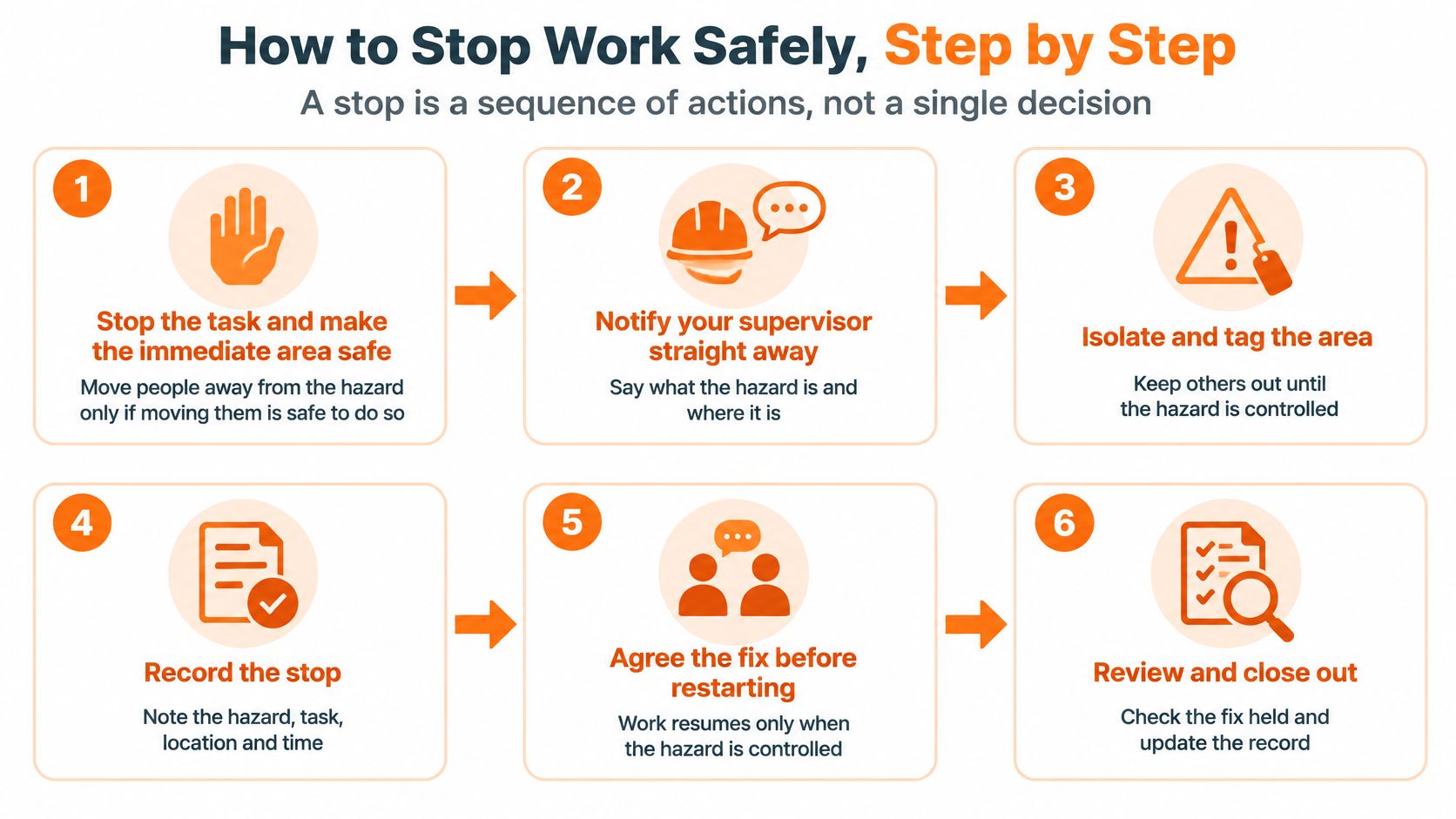
From cessation to resolution
Stop the task and make the immediate area safe. Move people away only if doing so won't increase the risk. Nobody should enter an unstable excavation, reach into machinery or approach an uncontrolled chemical release to make the scene look orderly.
Notify the supervisor and PCBU as soon as practicable. State the hazard, location, task and affected people. Clear notification lets the responsible manager isolate equipment, restrict access and arrange the right technical assessment.
Remain available for suitable alternative work. That may be at the same workplace or another site while the issue is resolved. The manager should identify duties that don't reproduce the disputed exposure.
Request a WHS inspector's assistance if the cessation can't be resolved. The escalation should describe the unresolved hazard and what the parties have already attempted. Continuing an argument beside the work area isn't a substitute for obtaining assistance.
Restart only after the hazard is controlled and the worker and PCBU agree that returning is safe. Make this the site's documented restart rule, rather than treating it as a supervisor's verbal assurance. Check the physical control, changed work method and any permit conditions before releasing the task.
Close the event with a recorded restart decision and corrective action. Separate the immediate fix from any longer-term work, such as replacing equipment or revising the SWMS. An outstanding permanent improvement needs an owner even when temporary controls allow safe work to resume.
Avoid the permission trap
A common procedural failure is telling workers to contact the supervisor before doing anything else. Where exposure is already imminent, that instruction can leave people in danger while a call goes unanswered.
A worker shouldn't have to remain exposed while waiting for permission to exercise the cessation right.
The notification route should still be explicit. If the usual supervisor is unavailable, the procedure needs an alternative contact and a way to keep others out of the affected area.
Before handover, the supervisor should brief the next crew on the changed conditions. A finished stop has a named hazard, a changed control and a clear explanation of what must be different when the work resumes.
How Employers Can Support Workers Who Raise Concerns
The right exists in law, but workers need to believe they can use it without being treated as the problem. An unused stop right is a control failure when people remain exposed because stopping feels costly.
That doesn't mean a low stop count proves poor performance. It means managers should investigate silence where workers describe known hazards, unresolved concerns or pressure to continue.
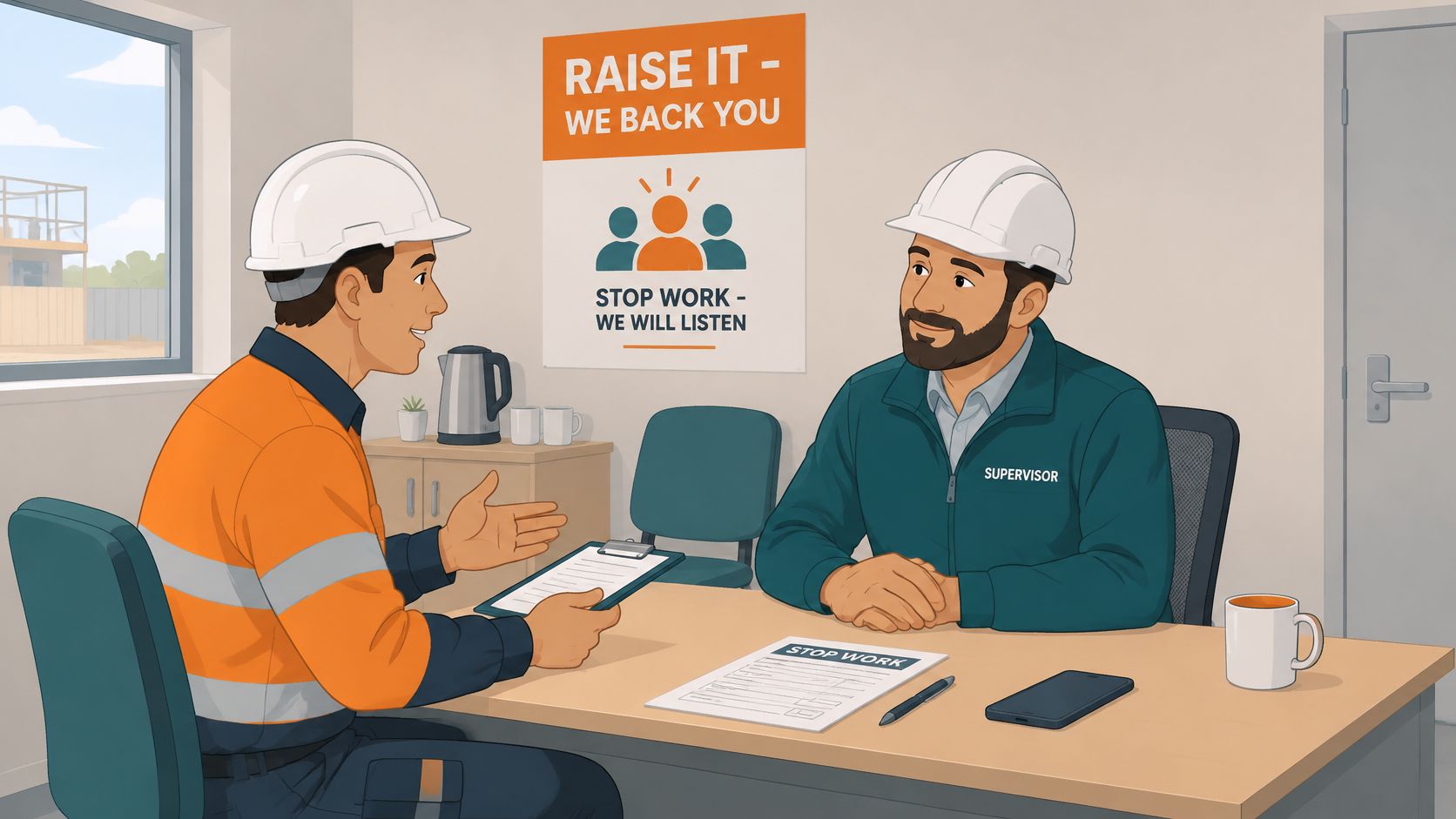
Make the supervisor's response predictable
The employer's arrangements should cover the order in which a concern reaches the supervisor:
- Write the procedure before the incident. Name who can act, distinguish the statutory threshold from any broader company pause-work policy, and specify the restart authority.
- Practise describing the hazard. Use realistic scenarios such as an unisolated conveyor, incompatible cleaning chemicals or an unstable waste load. Workers and HSRs should be able to explain the exposure without having to write a technical report.
- Put non-retaliation expectations in writing. Supervisors need to understand that exercising the right isn't grounds for discrimination or adverse treatment.
- Provide a usable escalation channel. A phone contact or app-based report must work where the task happens. Test reception, access and the after-hours contact rather than assuming an office procedure reaches field crews.
- Assign the response and follow-through. The supervisor confirms the hazard, avoids pressure for a quick restart and gives corrective actions an owner and due date.
The WHS consultation process should let workers challenge a proposed fix and hear why a control is considered adequate. A signature gathered after the decision isn't meaningful participation.
Treat hesitation as a finding
Suppose a cleaner notices damaged electrical equipment but carries on because replacement equipment is difficult to obtain. Repeating the stop-work policy won't fix the underlying barrier if supervisors still expect the job completed with what's available.
Managers should examine access to replacements, escalation delays and the messages supervisors send about production. Correct the conditions that make silence seem easier than reporting.
Where harm has already occurred, the stop record doesn't replace injury reporting or a compensation process. AskLegally's guide to reporting a workplace injury step by step offers United States workers context on workers' compensation; Australian employers must use their applicable local reporting arrangements.
The employer also needs evidence that the concern produced a lasting fix. That evidence belongs in the event record, not only in a toolbox conversation.
Stop Work Records, Review and Readiness Check
The immediate management decision is whether each stop record contains enough detail to reveal a pattern. A report stating only that work was unsafe won't distinguish repeated isolation failures from unrelated equipment defects.
Safe Work Australia's unsafe-work guidance explains the worker's cessation, notification and alternative-work obligations. A practical recording workflow should preserve the information managers need to act on those obligations.
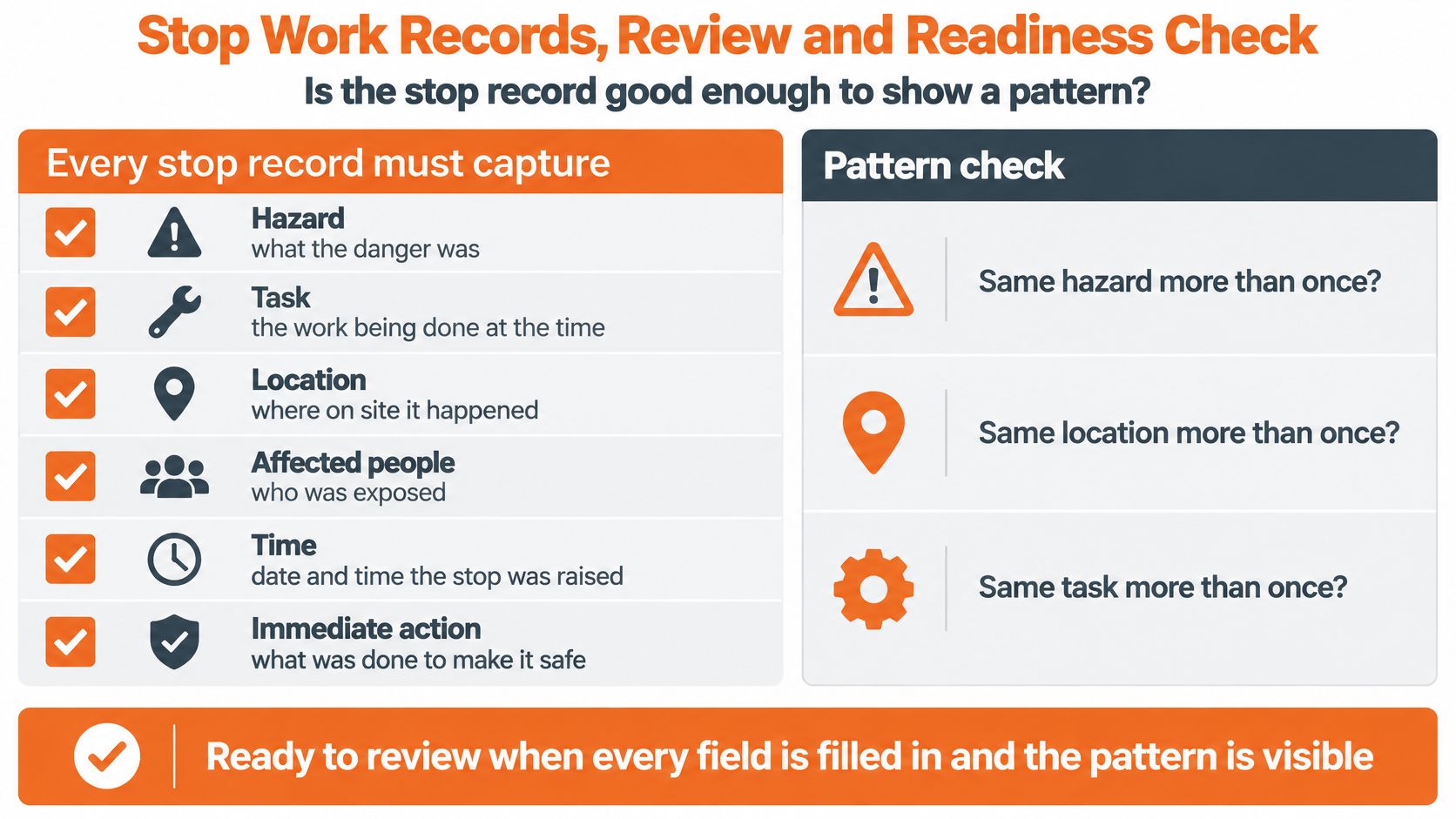
Capture the decision, not just the report
Make hazard, task, location, affected people, time, immediate controls, supervisor notification and restart approval mandatory fields. Blank locations and vague task descriptions prevent managers from identifying recurring exposure.
Link the record to the relevant SWMS or JSA, permit, hazard register entry and corrective action. Consistent incident and hazard report forms help keep those details comparable across sites.
Safety Space's granular roles and permissions can restrict who closes incidents, approves contractors or edits master templates. Its Action required setting means the person must raise an action before submitting. Separately, the employer's procedure should reserve restart approval for designated competent roles.
Readiness check
Review stops monthly by site or project, looking for repeat hazards, locations and tasks. Track stop-work confidence and close-out time alongside incident information, and check whether closed actions prevented recurrence.
Before relying on the process, confirm:
- Required fields are mandatory on every record.
- Control documents and corrective actions are linked to each event.
- Designated roles approve restarts.
- A named owner conducts the monthly review.
- Employer support arrangements are operating, not merely documented.
The test for tomorrow is practical: if a crew stopped today, could the manager find the hazard, the fix and the restart decision without asking anyone?
Safety Space offers hazard registers, incident reporting and corrective actions to keep stop-work concerns and follow-up work in one system. Managers can visit Safety Space to discuss recording stops by site or project and setting permissions for incident close-out.
Ready to Transform Your Safety Management?
Discover how Safety Space can help you implement the strategies discussed in this article.
Explore Safety Space FeaturesRelated Topics
Safety Space Features
Explore all the AI-powered features that make Safety Space the complete workplace safety solution.
Articles & Resources
Explore our complete collection of workplace safety articles, tools, and resources.