
Ask a site manager which codes of practice govern a residential refurbishment and the answer will often stop at construction. The same site is running excavation, work at height, asbestos in the bathroom being stripped out, consultation on every control change and, depending on the crew, psychosocial risk. Each of those has a code behind it.
That gap between the code list and the documents on site is where compliance failures start. A business can hold current policies, a folder of SWMS, an induction deck built years ago and a training register nobody has cross-checked, and still have nothing that connects a revised code to the method a crew is using on Monday.
The businesses that get this right treat each code as a controlled document with an owner, a version and a review date. They can show the trail from code to SWMS to worker sign-on. The ones that don't find out at the worst possible moment.
Table of Contents
- Which WorkSafe WA Codes Apply to Your Work
- How Codes Connect to the WHS Act and Regulations
- Legal Weight of a Code and When You Can Depart From It
- What the Codes Require
- How to Prepare a SWMS for High-Risk Construction Work
- Keeping SWMS Versions and Records for Inspection
- How to Respond When WorkSafe WA Revises a Code
- Check Your Sites Against the Codes Before Work Starts
Which WorkSafe WA Codes Apply to Your Work
Start with the activity, not the document. The table below maps the codes most likely to matter in construction, residential building, property development, manufacturing, cleaning, facilities services and waste to the hazard each covers and the work that should trigger a check.
WorkSafe WA codes by hazard and activity
| Code subject | Hazard or activity | Check it when |
|---|---|---|
| Risk management | General process for managing health and safety risks | Any business or undertaking, as the starting point for every activity |
| Work Health and Safety consultation | Consultation with workers on decisions that affect them | Introducing or changing controls, procedures or plant |
| Construction work | Construction activity in a workplace covered by the WHS Act | Any building, civil or fit-out job, including residential |
| Falls in housing construction | Falls from 2 metres or more on housing sites | Roof work, upper-level work, formwork or working at height |
| Excavation work | Excavation and trench risks | Digging, trenching or footings |
| Confined spaces | Entry to enclosed or restricted spaces | Tanks, pits, vessels or service voids |
| Tower cranes | Crane operation and lifting risks | Projects using tower cranes |
| Asbestos | Identification and handling of asbestos | Refurbishment, maintenance or demolition of older buildings |
| Demolition | Structural demolition risks | Any demolition or partial removal of structures |
| Hazardous chemicals | Storage, use and handling of chemicals | Cleaning, manufacturing, maintenance or waste services |
| Plant | Machinery and vehicle risks | Equipment, vehicles or mobile plant on site |
| Electrical risks | Electrical work and equipment | Site power, electrical trades or equipment testing |
| Hazardous manual tasks | Manual handling and repetitive tasks | Cleaning, waste collection, warehousing or assembly |
| Noise | Noise exposure | Manufacturing, plant areas or noisy site work |
| Psychosocial hazards | Psychosocial risks to workers | All workplaces, including FIFO and project-based work |
The catalogue behind that table is broader than often assumed. WorkSafe WA's current WHS and transitional code collection lists at least 29 subject areas, spanning abrasive blasting, stevedoring, welding, safe design of structures, mine safety-management systems and workplace behaviour alongside the familiar construction and plant titles. No single generic safety policy covers that spread.
The risk management code sits at the top of the list for a reason. Published on 14 July 2022, it sets out the process for managing health and safety risks and then hands off to specialist codes for particular hazards. Read it as the method, and the hazard codes as the specifics.
One site, several codes
A residential refurbishment shows how quickly the rows stack up. Roof work and upper-level formwork trigger the falls in housing construction code. Footings and service trenches pull in excavation work. Opening up a bathroom in an older home can turn the job into an asbestos exercise with its own identification and handling requirements.
Add a tower crane on a multi-unit site and the lifting code joins in. The consultation code applies to every one of those decisions, because each change to a control affects the workers doing the task.
Where the project includes utility or communications infrastructure, fiber deployment for carriers and ISPs often runs alongside the civil works. Trenching, access and traffic controls then need to be agreed with the utility contractor before excavation starts rather than after the first service strike.
Codes that apply everywhere
Psychosocial hazards and workplace behaviour aren't heavy-industry extras. They apply across all workplaces, including office-based property teams and FIFO crews, and they need consultation, behavioural controls and organisational follow-up rather than a PPE check.
Practical rule: match every line on the risk register to at least one code row. A line with no code and no recorded reason is the first thing an inspector will pick up.
How Codes Connect to the WHS Act and Regulations
Western Australia's current framework started on 31 March 2022, when the Work Health and Safety Act 2020 and the Work Health and Safety (General) Regulations 2022 came into effect and replaced the former occupational safety and health framework, as WorkSafe WA's overview of the laws sets out. Anything in a policy library dated before that point deserves a hard look.
Three layers do different jobs, and mixing them up is what produces documents nobody can defend.
- The Act sets the primary duty. It states the outcome a business must achieve, not the method for achieving it.
- The Regulations add specific rules for particular risks, such as licensing and permit requirements.
- An approved code explains how a duty holder can meet the duty for a hazard or activity. WorkSafe WA describes codes as practical guidance supporting the Act and Regulations without replacing them, and states that businesses operating in WA must comply with an approved code under the WHS Act 2020.
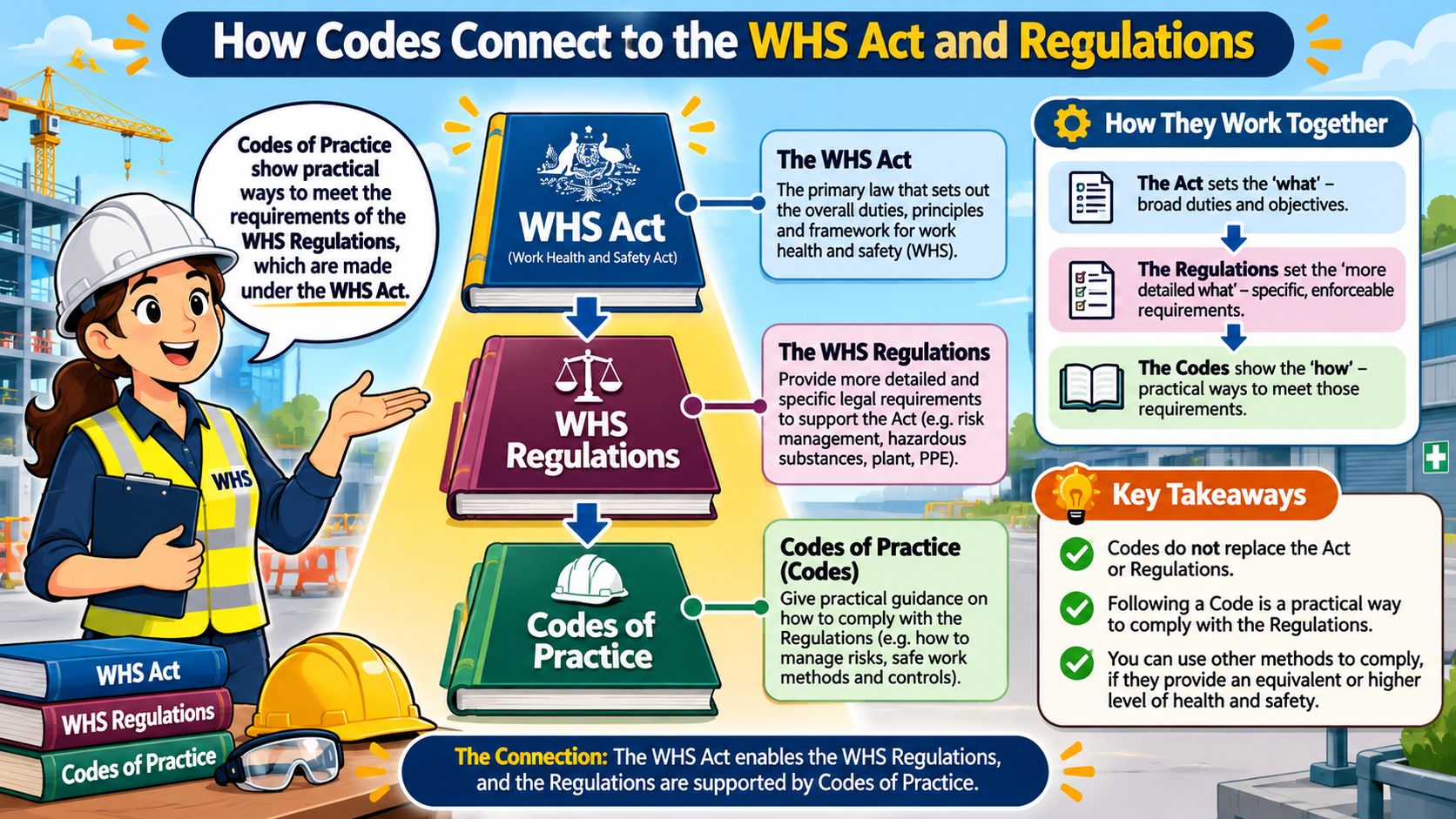
The fourth layer is the one teams skip: the site risk assessment that decides which controls fit the workplace. A code tells you what good practice looks like for a hazard. It can't tell you which guard, which exclusion zone or which access route suits the plant standing in your yard.
Approved codes and transitional codes
Older transitional codes remain relevant in some areas, and they sit alongside codes issued under the post-2022 system. A document that cites a code without saying which list it came from creates ambiguity that costs time during an inspection. Name the code, its status and the date on the document itself.
A worked example
Say a manufacturer is reviewing machine guarding. The sequence runs: identify the duty under the Act, check the plant code for the expected control approach, then run the site risk assessment that accounts for the specific machine, its guarding history and the tasks operators perform.
If the assessment lands somewhere different from the code, that's fine as long as the reasoning is recorded. What doesn't work is a guarding standard copied from a template with no connection to the equipment in the building.
The test for every document: which duty does it serve, and which code does it reference? That single question clears out a surprising amount of dead paperwork. For the WA legislative structure in more detail, see this guide to WHS legislation in Western Australia.
Legal Weight of a Code and When You Can Depart From It
An approved code is often described as guidance, which leads teams to treat it as optional. That reading is wrong in a way that matters in court. Approved codes are admissible in proceedings under the WHS Act and Regulations, and following one assists a duty holder to achieve compliance without removing the need to identify and control risks in the actual workplace, as the Construction code of practice states.
So the code isn't the law, but it sets the benchmark against which your method will be judged. A business that departs from it needs a defensible alternative that achieves an equivalent or better level of control, supported by risk assessment, consultation and documented implementation.
Where generic procedures fail
Three failures show up again and again.
- A template SWMS that doesn't follow the work sequence. The controls are correct in isolation but appear in an order the crew never works in, so nobody uses the document on the tools.
- Plant that doesn't match the code's assumptions. A machine with a different guarding arrangement or a different feed method needs a control set designed for it, not the example printed in the guidance.
- Contractors running different methods. Two subcontractors on the same site using different exclusion zones is a consultation failure before it's a technical one.
The departure record
When the site method differs from the code, record it. Five parts make the record defensible.
- The clause. Name the specific provision of the code the business is not following.
- The alternative method. Describe what the crew will do instead, in enough detail that a new supervisor could run it.
- The risk assessment. Show the reasoning that the alternative achieves equivalent or better control.
- The consultation record. Names, dates and what workers said about the change.
- The review date. A departure is a decision with an expiry, not a permanent exemption.
A departure record missing the assessment and the consultation is weak evidence even when the alternative is safer. The inspector sees a decision with no reasoning behind it.
Could the business explain to an inspector, using records it can produce on the day, why its method is at least as safe as the code's method?
If the answer needs a phone call to someone who has left the company, the record isn't finished.
What the Codes Require
The construction code applies wherever construction work happens in a workplace covered by the WHS Act, including where construction products and equipment are used or stored. It's written for PCBUs, contractors and anyone with management or control of a workplace, principal contractors included, per the Construction code of practice. Three duties in it carry most of the operational weight.
Excavation risks. The code directs PCBUs to manage excavation risks under the WHS Regulations, comply with the requirements for trench excavation, and address general construction induction training. In practice that means a documented excavation assessment, a spoil and edge-protection standard, and a competent person confirming the controls before anyone enters the trench.
Induction training. General construction induction training has to be addressed for everyone on site, including labour hire and short-duration contractors. A register with expired cards in it is the same as no register at all.
Falls. Work at a fall of 2 metres or more is high-risk construction work under WA's construction guidance, which brings roof work, upper-level construction and formwork inside the high-risk net. Those are exactly the activities residential crews tend to treat as routine. The guidance on managing falls in housing construction is blunt that the SWMS must address the fall hazards, the controls chosen and how those controls will be monitored and reviewed.
Design decides a lot of the risk
The code recognises that design decisions involve clients, architects, project managers and technical specialists. A roof access arrangement chosen at design stage determines whether the site needs guardrails, harness systems or both. A plant room layout decides whether a crane lift is straightforward or a daily argument.
Capturing controls at design and procurement is cheaper and more effective than retrofitting them after the first site meeting. Where an Australian technical standard gives an engineering specification or a higher-level control, cross-reference it in the design documentation so the site team knows what the control is measured against.
A project review sequence
Before work starts on a new project, run the duties in this order.
- Scope the activities against the code rows: what work happens, with what plant, in what sequence.
- Confirm the high-risk triggers, starting with any fall of 2 metres or more.
- Check the design and procurement record for the controls already locked in.
- Verify contractor documents and induction evidence for every person who will set foot on site.
- Book the consultation so workers see the controls before the first task, not after the first near miss.
Each of those steps becomes a single line in the pre-start check used before high-risk work begins.
How to Prepare a SWMS for High-Risk Construction Work
The rule first. For high-risk construction work in WA, the PCBU must prepare a safe work method statement, or ensure one has been prepared, before the work starts. Work of a minor nature doesn't need one. The requirement sits in the Work Health and Safety (General) Regulations 2022 and, on mine sites, in the WHS Mines Regulations 2022, as WorkSafe WA's guidance on safe work method statements sets out.
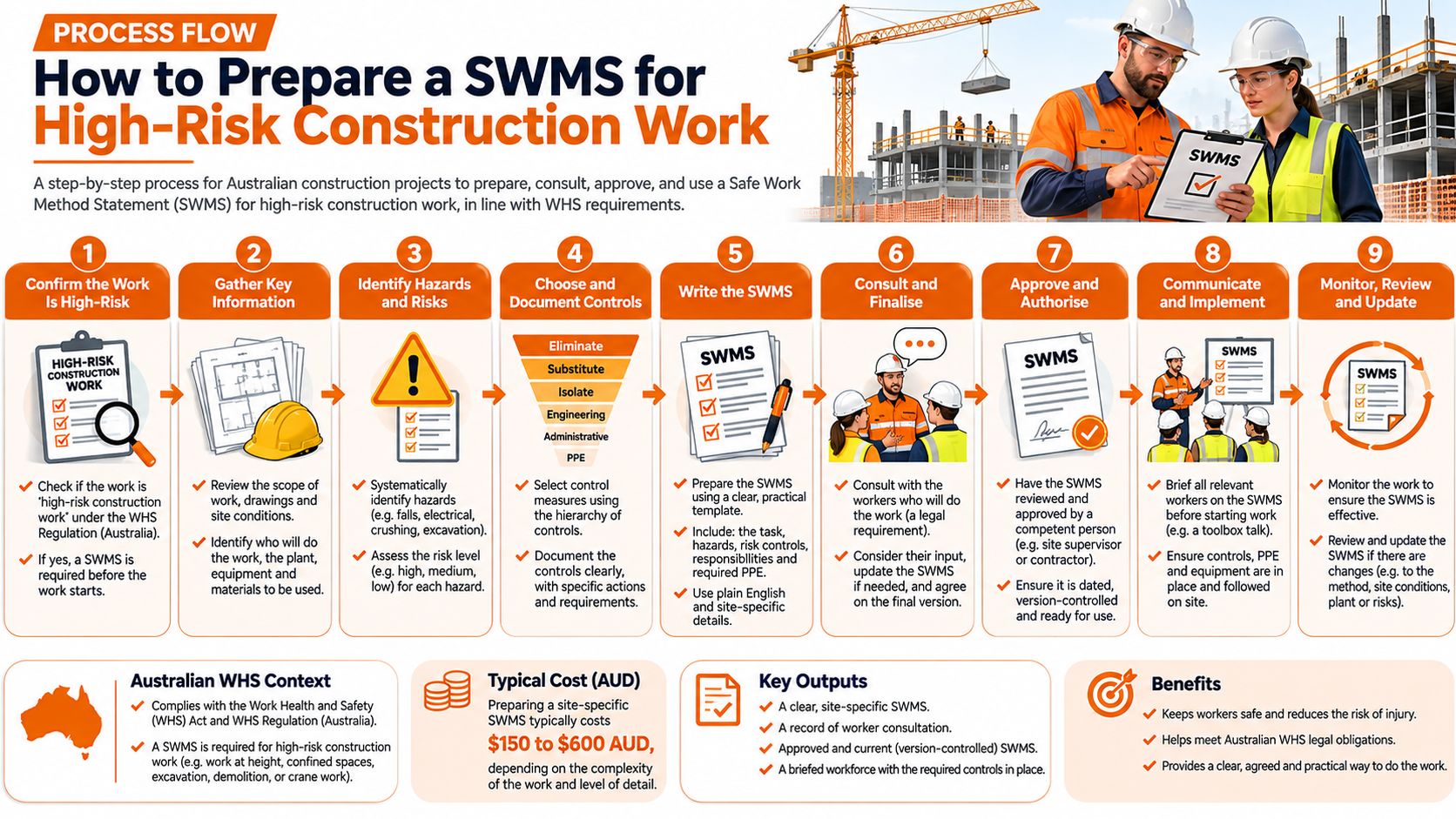
Then the sequence.
- Confirm the work is high-risk construction work. Start with the obvious trigger, any work at a fall of 2 metres or more, then check the other categories. If the task is minor, record why, because "minor" is a judgement someone will question later.
- Agree who prepares it. The principal contractor, PCBU and subcontractors should consult to decide. The person responsible for carrying out the work is best placed to write it, because they know the sequence, the plant and the access.
- Consult the workers directly engaged in the activity. Record who was consulted and when. This is the step most often faked with a signature sheet collected after the document was finalised.
- Describe the work in the order it will happen. Step numbering that matches the crew's sequence is the difference between a SWMS used on the tools and one filed in a folder.
- Identify the hazards at each step. Include the fall hazards explicitly where the work is at height, along with the hazards created by the method itself, such as formwork strike or a crane lift over an access route.
- Specify the controls and who owns each one. A control with no named owner is a suggestion. Name the person or role responsible for installing, checking and maintaining it.
- Describe how the controls will be monitored and reviewed. Say who checks, how often, and what triggers a stop-and-review.
- Make it accessible to each relevant worker before work starts. Accessible means the worker can reach it at the point of work, not that a copy exists on a server somewhere.
- Update it when conditions, plant, access arrangements or controls change. A SWMS that hasn't moved while the job has is a red flag.
What a good one looks like on paper
Take a two-storey residential build with roof work. A workable SWMS names the roof sections in sequence, identifies the fall hazard at each, states the edge protection and harness arrangement chosen, names the supervisor who checks the anchor points, and describes the daily pre-task check.
A weak one says "use harnesses, comply with regulations" and lists eight hazards that apply to any site in the state. The second version passes a glance and fails a serious question.
Common failure points
- Copy-forward documents. Last project's SWMS with a new date and a new address is not a new SWMS.
- Consultation after the fact. Workers asked to sign a finished document aren't being consulted, they're being notified.
- No link to the principal contractor's document. Subcontractor SWMS that don't align with the principal's controls leave gaps at the interface between trades.
Could a new worker on day one find their task, the hazards at each step and the control for each hazard, without asking anyone?
If not, the document is describing the project rather than controlling the work. For the structure behind those steps, see this guide to SWMS requirements in Western Australia.
Keeping SWMS Versions and Records for Inspection
The retention rule that is often misunderstood is the incident trigger. A SWMS must stay accessible to each relevant worker and available for inspection until the high-risk construction work is completed. If a notifiable incident occurs in connection with that work, the SWMS must be kept for at least two years from the date of that incident, per WorkSafe WA's SWMS form.
The second rule is versioning. When a SWMS is revised, keep every version rather than only the current copy. Superseded versions show which controls were authorised and communicated at the time of the work, which is exactly what an investigation needs.
Why superseded versions matter
An incident investigation asks what the crew was told to do on the day. If the SWMS was revised three weeks earlier and the earlier version has been deleted, the business can't show what changed, who knew about it or whether the change reached the workers.
Keeping the current version only looks tidy. It removes the evidence that proves the control was communicated.
The control steps
- Assign a document owner. One named person per SWMS, not a shared folder with no owner.
- Record the approval date on every version. The date the document was approved, distinct from the date the work started.
- Communicate changes before work resumes. A revision issued after the crew has already restarted is a record of an uncontrolled period.
- Link each SWMS to the project, activity and incident record. One identifier across all four saves hours later.
Paper files and shared drives can meet these requirements, but only where version control and worker sign-off are disciplined. The sign-on sheet should sit with the SWMS it covers, not in a separate induction folder.
Where the record-keeping runs through software, Safety Space holds SWMS and JSAs with worker sign-on and a version history, so the current version, the earlier versions and the sign-on record sit against the same project. That's the practical version of the requirement, and it's why document control and version management is the part of a safety system worth getting right first.
A five-minute retention check
For each live SWMS, answer three questions.
- Can you find the current version in under a minute, without asking anyone?
- Can you find every earlier version, including any that was superseded on site rather than in the office?
- Can you find the sign-on record for each worker who worked to it?
If any answer is no, the system has a gap that will surface at the worst possible time.
How to Respond When WorkSafe WA Revises a Code
The code library moves. WorkSafe WA's closed-consultation register records 2025-26 activity on sexual and gender-based harassment, FIFO psychosocial risks, emergency management in mines, excavation work, workers' accommodation and mine traffic management. Its recent code development also covers tower cranes, electrical risks and falls in housing construction.
That list says something about the workload. Half of those topics aren't physical hazards at all. Psychosocial risks, harassment, accommodation standards and traffic management need consultation, behavioural controls and organisational follow-up. A PPE order doesn't touch them.
The gap in most businesses isn't awareness of new titles. It's change management. A revised code affects the SWMS, the SOPs, the induction deck, the toolbox talks, the training register, the contractor pack and the inspection forms, and each of those has to move.
A six-step workflow with an owner for each step
- Monitor WorkSafe WA notices and consultation registers for codes relevant to your activities. Owner: the WHS manager, on a set monthly review.
- Identify the affected hazards and roles by running the change against the lookup table. Owner: the WHS manager with the operations lead for each affected area.
- Revise the controlled documents, starting with the SWMS and SOPs covering live work rather than the ones that are easiest to edit. Owner: the document owner for each affected procedure.
- Consult workers on the changed controls and record what they said. Owner: the site supervisor or area manager.
- Retrain the affected people before the changed controls apply, not after the next audit. Owner: the training coordinator.
- Retain versioned evidence of each step, following the same retention rules that apply to SWMS. Owner: the document controller or WHS manager.
Naming an owner for each step is what stops the workflow stalling between the person who reads the WorkSafe WA notice and the crew who has to work differently on Monday.
What usually goes wrong
The monitoring step happens. The revision step doesn't. A WHS manager reads the notice, notes it, and the change sits in an inbox while the site keeps running the old method.
The second failure is scope. Teams revise the SWMS and forget the toolbox talk, the induction slide and the inspection checklist that still reference the old control. Workers get a new document and an old briefing.
Treat a code revision the way you'd treat an engineering change. Something has to be updated, checked and signed off before work continues under the new method.
Check Your Sites Against the Codes Before Work Starts
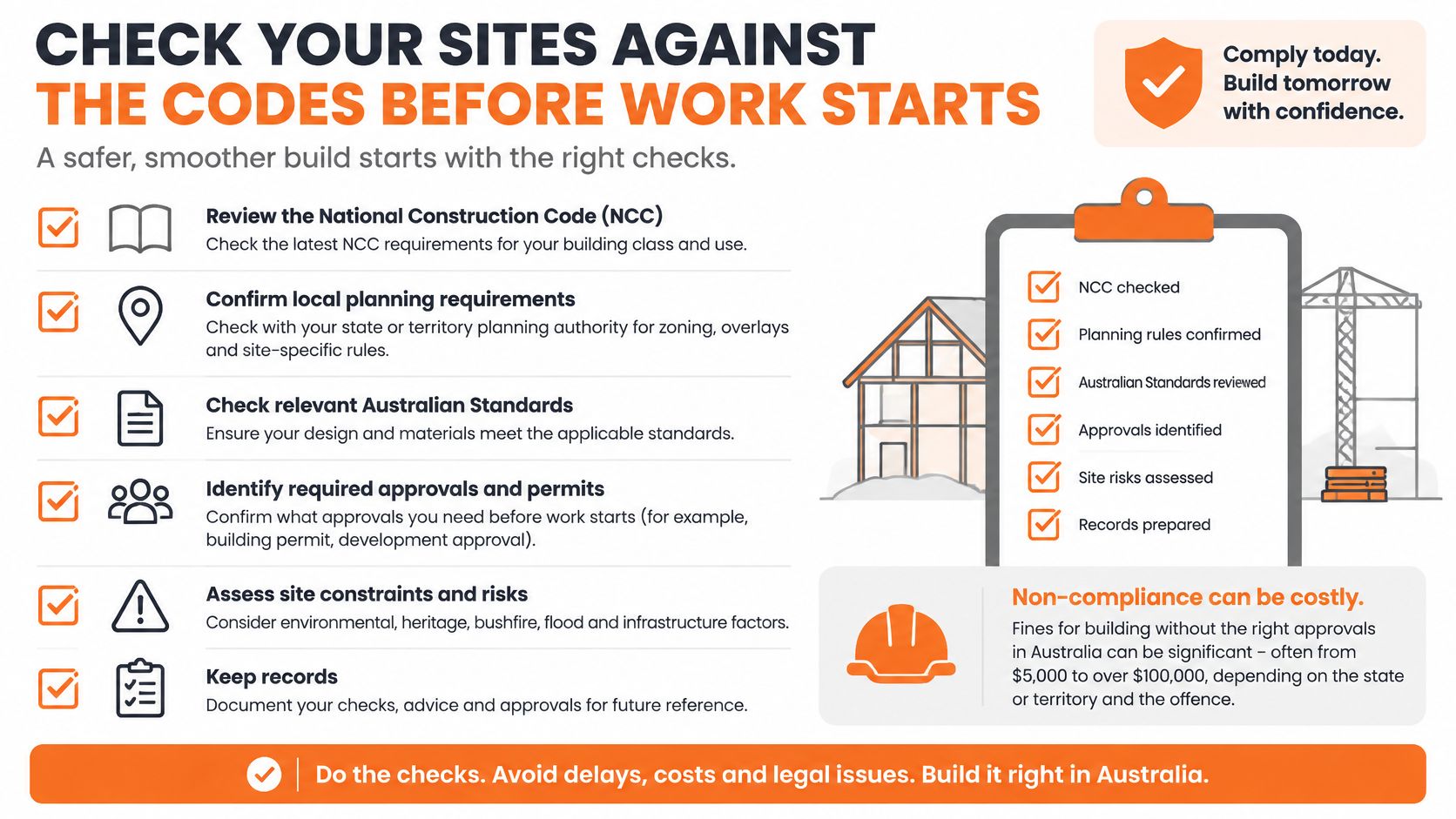
Run these checks before high-risk work begins. Each one is a yes or no, and a no needs a date for when it will be fixed.
- Match each activity on the job to the code rows in the first table, and note any activity that maps to more than one.
- Confirm whether any work is at a fall of 2 metres or more, including roof work and formwork, and that a SWMS exists before that work begins.
- Check the SWMS names the current code version, lists each hazard and its control, and records consultation with the workers doing the task.
- Confirm the SWMS is accessible to each relevant worker and retained for inspection.
- Verify excavation and trench controls against the construction code requirements wherever trenching occurs.
- Confirm general construction induction training is recorded for every worker and contractor on site.
- Check asbestos, demolition and hazardous chemical controls are current for the building and the materials involved.
- Confirm contractor insurances and documents are current and that subcontractor SWMS align with the principal contractor's controls.
- Confirm any departure from a code has a documented alternative method, risk assessment and review date.
- Confirm a process exists to monitor WorkSafe WA notices, and that the last code change was assessed against your controlled documents.
Two of those checks deserve more attention than they usually get. The asbestos check matters most on refurbishment and maintenance work in older buildings, where the material turns up mid-job rather than at planning stage. The contractor check matters most on sites with several trades, where the interface between subcontractor SWMS is where controls disappear.
Where LPG forklifts are in use, choosing a rack for forklift cylinders is a plant and chemical storage decision that belongs in the same pre-start review as the hazardous chemicals check, not in a separate facilities conversation.
Repeat the check whenever the site, the plant or the work sequence changes. A pre-start completed once at project kick-off describes a site that no longer exists three weeks later.
Safety Space holds SWMS with worker sign-on, document control with version history, contractor documents and inspection records against each project, so a code revision can be traced from the updated procedure to the worker who signed on to it. The compliance team monitors WHS legislation changes across jurisdictions and updates templates, with users notified of new requirements. Book a free consultation to see how the modules map to the codes that apply to your work at Safety Space.
Ready to Transform Your Safety Management?
Discover how Safety Space can help you implement the strategies discussed in this article.
Explore Safety Space FeaturesRelated Topics
Safety Space Features
Explore all the AI-powered features that make Safety Space the complete workplace safety solution.
Articles & Resources
Explore our complete collection of workplace safety articles, tools, and resources.